To był dość interesujący szkicownik, prowadzony prawdodpodobnie przez polskiego żółnnierza, być może legionistę w czasie I wojny światowej. Szkicownik obejmował lata 1917-18, były w nim rysunki postaci w mundurach austriackich, niemieckich, nawet rosyjskich. Podpisy pod rysunkami w językach rosyjskim, polskim i niemieckim. Znajdowały się również rysunki polskich oddziałów z których warto zauważyć legionistów z 2-go oddziału strzelców brygady żelaznej, dowodzonej przez Józefa Hallera (wbrew temu co się powszechnie sądzi, Józef Piłsudzki był dowódcą jedynie jednej z brygad a nie całości polskich legionów). Ten rysunek, pokazany wyżej, żołnierzy legionów polskich był datowany 10 lutego 1918 roku a zatem na kilka dni przed ich rozwiązaniem. W sumie ciekawa pamiątka i polonik znaleziony na rynku. Sprzedano go tanio bo wiedza o tym okresie wśród handlarzy jest mikra i pewnie jedynie kolekcjonerzy licytowali.
Lot 888. Skizzenbuch eines polnischen Soldaten im 1.Weltkrieg, angefertigt um 1917, enthält Porträts von Offizieren, Stellungs- und Geländeskizzen, Zeichnungen der Grabenanlage, Karikaturen, usw., ges.ca.45 Zeichnungen. Auktionshaus Bieberle. 08/20/22. Sold 140 euro
Michał Wywiórski był znakomitym obserwatorem-pejażystą i te jego jego późniejsze prace, po zamknięciu tematyki monachijskiej, bardzo sobie cenię. Artysta malował również marynistyczne prace ale te, zwłaszcza z terenów holenderskich czy portów niemieckich, mają dla mnie inny, może ‘obcy’ spelendor – były jednak niektóre bardzo dobre prace. Olej z aukcji niemieckiej jest dla mnie przeładowany ilością kutrów i zamiast się nimi delektowac to zaczynam je niepotrzebnie przeliczać. Jest to olej na kartonie, wyjściowa cena to 550 euro i na tym bym się zatrzymał. Bez fajerwerków.
Lot 381. Michal Gorstkin Wywiórski, Segelboote im Hafen, Ölgemälde um 1900, gerahmt. Michał Gorstkin Wywiórski, 1861 Warschau – 1926 Berlin, polnischer Landschaftsmaler, von 1883 bis 1887 studierte er an der Königlichen Akademie der Künste München bei Karl Raupp und Nikolaus Gysis. Ab 1886 war er in München als freischaffender Landschaftsmaler tätig. In der Suche nach Landschaftsmotiven unternahm er zahlreiche Studienreisen. Er besuchte u. a. die Insel Sylt (um 1898), Italien (vor 1899), Spanien (1899-1900), Ägypten (1900-1901), Norwegen und Schweden (um 1903-1904), die Ostsee- und Nordseeküste, Karpaten (um 1906), sowie die Niederlande, die Krim und den Kaukasus, hier: Segelboote in einem Hafen, Öl/Bristolkarton, 22 x 32 cm, r. u. sign., gerahmt. Estimate 2,200 – 2,500 euro. Kunst & Kuriosa. 09/02/22. Sold 2,200 euro
Nie spotkałem wczesniej tej litografii Henryka Beliewiego. Może to do pewnego stopnia unikat?
Lot 1398 of 409: Henryk Berlewi, Polish/French 1894-1967- Naissance de l’Objet, 1953; lithograph, artist’s proof, signed, dated, titled, and inscribed in pencil, bears label for the Drian Galleries to the reverse, 25 x 30 cm (ARR) (unframed/mounted). Estimate £150 – £250. Roseberys. 08/18/22. Sold £1,200
Fryderyk Chopin. AutografFryderyk Chopin. Autograf
Czynię wyjątek i na głównej stronie zamieszczam dwustronnicowy autograf Fryderyka Chopina, muzyki napisanej przez niego w 1838 roku do wiersza ‘Wiosna’, autorstwa swojego przyjaciela Stefana Witwickiego (1802 – 1847). Autograf może okazać się drogi ale to jest unikat. W sieci można odszukać tę pieśń wykonaną przez wielu artystów. Zainteresowanym podaję link do aukcji: https://www.rrauction.com/auctions/lot-detail/346395106430533-frederic-chopin-autograph-musical-quotation-signed/?cat=0
Błyszczą krople rosy, Mruczy zdrój po błoni; Ukryta we wrzosy Gdzieś jałówka dzwoni.
Piękną, miłą błonią Leci wzrok wesoło; W koło kwiaty wonią, Kwitną gaje w koło.
Paś się, błąkaj trzodko, Ja pod skałą siędę, Piosnkę lubą, słodką Śpiéwać sobie będę.
Ustroń miła, cicha!. Jakiś żal w pamięci, Czegoś serce wzdycha, W oku łza się kręci.
Łza wybiegła z oka!. Ze mną strumyk śpiéwa, Do mnie się z wysoka Skowrónek odzywa.
Lot rozwija chyży.. Ledwo widny oku.. Coraz wyżéj, wyżéj, Już zginął w obłoku.
Nad pola, nad niwy Jeszcze piosnkę głosi.. I ziemi śpiew tkliwy Do niebios zanosi!
Lot 533. Frederic Chopin Autograph Musical Quotation Signed. AMQS on an off-white 8.25 x 5.5 sheet featuring an ornate purple border, signed and inscribed at the conclusion in ink, “Madame Kiéné, hommage respectueux de son devoué, Chopin.” Chopin pens the complete piano score of the Polish song “Wiosna, paroles de Witwicki,” op. posth. 74 nr. 2 in g minor, indicated “All[egre]tto.” This composition, originally written as ‘Andantino’ for one singing voice with piano accompaniment, probably in the spring of 1838, set to a text by Stefan Witwicki, is a typical Dumka, the melancholic counterpart of Polish idyllic song. The oscillation between g minor and b flat major creates a nostalgic ‘senza-fine’ mood. It is probably dedicated to the pianist Marie Catherine Kiéné, née Leyer, the mother of the pianist and composer Anne Marie Bigot de Morogues, who died at a young age, and taught the piano to Fanny Hensel and Felix Mendelssohn Bartholdy. In fine condition. Stefan Witwicki, who wrote most of the texts of the surviving Chopin songs, pressured him to compose a Polish opera. Chopin however, who only enjoyed improvising on Polish songs in a private circle, neither included them in his concert programs, nor had them published. Some songs only existed as drafts and were to be burned, according to Chopin’s last will. Up to date, a total of merely 19 songs are known. The first edition of this song was published as late as 1856 by Aleksander Gins in Warsaw, set to the text of a poem by Stanislaw Jachowicz.
Lot 167. Karol Dominik Witkowski (New Jersey, Polish, 1860 – 1910). Boy Feeding Squirrel, oil on canvas. Two patches. Some paint losses (see pictures carefully). Some craquelure. Few small scattered inpaintings. 24 x 20 inches / 60 x 50 cm, unframed (In-House framing available), lower right. Estimate: $4,000 – 5,250. Broward Auctions Gallery. 10/09/22
Ten obraz Karola Witkowskiego jest zniszczony a w dodatku dość wysoko wyceniony. Na dokładkę, nie jest to najlepszy obraz tego malarza, chyba przesłodzony. Na plus należy natomiast zaliczyć dość dokładną biografię artysty z której czegoś nowego się dowiedziałem i ją cytuję za domem aukcyjnym w całości. Aukcja jest dopiero w październiku a do tego czasu wiele może się wydarzyć.
Karol (Karl) D. Witkowski (16 August 1860, Yazlovets, now Chortkiv Raion – 17 May 1910) was a Polish-American portraitist and genre painter, better known in the US as Karl Witkowski. He painted scenes of contemporary daily life in America.Karol Dominik Witkowski was born to a Polish family in Jazlowiec (Jaslowiec), near Buchach, Czortkow (Podole, Poland, now Ukraine).As young boy he showed unusual talent in making drawings and his parents sent him to school in Chortkiv (12 miles from Yazlovets). In 1879 he enlisted in the Austrian Army (in 19th imate $4,000century southern Poland was occupied by Austria and named Galicia), where he gained popularity by making portraits of his fellow soldiers and commanding officers, including a portrait of General Duke William of Wurttemberg and portrait of Lieutenant Field Marshal Emanuel Salomon Friedberg-Mirohorsky (this army officer also was a genre painter, it is possible, why later in USA Karl Witkowski became genre painter). In 1880 Witkowski left the army and moved to Krakow, where from 1881 to 1883 he studied arts at the Academy of Fine Arts under the directorship of Jan Matejko. Witkowski also studied arts in Munich under Karl von Piloty. Around 1884 Witkowski emigrated from Poland, like many others, and went to America, where he stayed for three years. During that time he created his first famous paintings of young people. In 1887 he left America and arrived in France. In Paris Witkowski studied at the Julian Academy (1887-1888) and continued to work on paintings and portraits. Most of his paintings done there he signed with the added initial of author’s second name (K.D. Witkowski). Some of Witkowski’s painting done in France: Portrait de Tomas Milatycki, Mother with Children.In 1889 Witkowski returned to America and stayed for over 20 years until his death. During those years, besides portraits of the elite in New York City and Newark areas, he made over 200 paintings of young people (mostly newsboys and shoeshine boys), their daily life, at work and at play, often with their pets. The style of these paintings recalls the style of John George Brown to some extent. Most of these paintings were signed “K. Witkowski”. From 1891 until his death his paintings were available for sale at various auctions and picture galleries of New York City area. For some time he had his own studio in Brooklyn, New York (1903).Upon his arrival in the United States in 1884, Witkowski lived in New York City (from 1884 to 1887 and again from 1889 to 1891), later moving to Newark in 1891, and then to Irvington, South Orange, and Vailsburg, Newark.Witkowski died on May 17, 1910, in Newark, from blood poisoning, survived by his wife. Witkowski died at the height of his artistic powers. In 1909 he registered 8 paintings through the United States Copyright Office and in just a few months of 1910 he created and registered 14 pieces more, also in the last months of his life, he exhibited his work at the State Fair of Texas and galleries of New York City.Karl Witkowski painted the elite in Newark and his skills as a portraitist to the wealthy were always in demand. But ironically it was his paintings of newsboys and street urchins in the same city that brought him lasting recognition. His paintings of children are remarkable for their odd combination of sentimentalism and realism. Karl Witkowski as an eminent European artist gave an entirely new study in American newsboy life, his paintings have a characteristic humor and brightness, they are serious or humorous.Karol Witkowski has exhibited his paintings in New York several times each year between 1891 and 1910. His paintings have been exhibited at auctions and galleries of New York, such as: Theodore Stewart’s Sallon, Henry C. Merry Auction, Schenck Art Gallery, P. H. McMahon Auction, WM. B. Norman Auction, James P. Silo Auction, Rohlf’s Gallery, Mathews’s Art Galleries, John Fell O’Brien Art Galleries, Woehr Brothers Auction, Woehr Bros Gallery, John J. Pigot Galleries & Loeser Art Galleries.
Portret tej urodziwej i młodej Góralki był wielokrotnie replikowany przez Stanisława Górskiego. Na usprawiedliwienie, ta wersja jest wyjątkowo udana, na miarę swojego nauczyciela.
Lot 111. Stanislaw Gorski (1887 Koscian – 1955 Krakau). Bauernmädchen in Tracht, Pastellkreide auf Papier, 46,5 cm x 32 cm Passepartoutinnenmaß, signiert. Starting 250 €. WETTMANN | Kunstauktionen. 08/31/22. Sold 550 euro
Jan Konarski. Verschneite Winterlandschaft mit Menschen, Pferden und Hunden
To jest przykład na to, że ceny polskiego rynku napędzają ceny u sąsiada zza Odry. W innym przypadku, cena wyjściowa (440 €) byłaby ceną sprzedaży. Jeden patrzy zazdrośnie przez płot na drugiego i ciągnie ceny w górę. Przyznam, że ten obrazek Konarskiego ma prawo zainteresować osoby nie mogące sobie pozwolić na Wierusza, jest sympatyczny, statyczny, spokojny i może stanowić namiastkę (ersatz) monachijczyka. Towar ten jednak czeka na handlarza, bo w Polsce domy aukcyjne za ‘sofa size’ obrazy Konarskiego liczą już bezwstydnie do 70,000 złotych a to już doprawdę dużo. W tym przypadku obrazek jest mniejszy ale są specjaliści nad Wisłą, którzy jak kamień ścisną to z niego wycisną.
Lot 342. Jan Konarski, Verschneite Winterlandschaft mit Menschen, Pferden und Hunden, Ölgemälde um 1890, in Originalrahmung. Jan Konarski, 1849 – 1918, polnischer Maler, Stimmungsvolle Winterlandschaft bei untergehender Sonne, im Vordergrund ein den Betrachter anschauender Hund, in der Mitte zwei Pferde mit einem Bauern, im Hintergrund ein weiterer Hund sowie eine Bäuerin mit einem Transportschlitten. Nuanciertes Kabinettbild des polnischen Künstlers, der von Alfred v. Wierusz-Kowalski beeinflusst war und dem seine Gemälde oft als Pseudonym (“Alfred von Wierusz-Kowalski”) zugeschrieben wurden. Neuerdings wird jedoch davon ausgegangen, dass „J. Konarski“ ein Pseudonym des Malers Franciszek Bujakiewicz (1856-1918) ist. “Konarski schuf mit virtuos flottem Duktus temperamentvoll gemalte, inhaltlich fesselnde, oft winterlich gestimmte Darstellungen aus dem russisch-polnischen Volksleben mit Schlitten und Kutschen”, Öl/Karton, 32 x 25 cm, r. u. sign., im originalen, schwarzen Gründerzeitrahmen. Opening 440 euro. Estimate 1,600 – 1,800 €. Kunst & Kuriosa. 09/02/22. Sold 2,600 euro
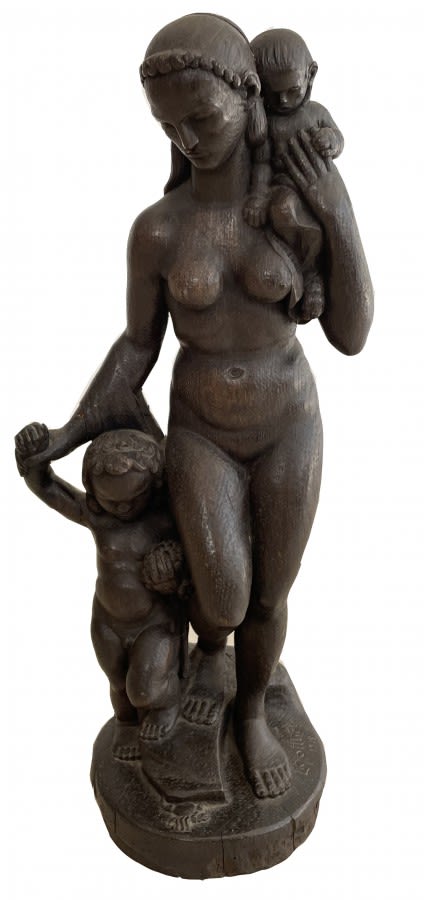
Spora niespodzianka dla mnie: rzeźba w wykonaniu Leopolda Gottlieba. Na letnim rynku sztuki pełnego maniure tarfiła się praca nadzwyczajna, nie jest tania lecz jej wartość artystyczna i rzadkość może uzasadnić tę wycenę.
LOT 100. Leopold Gottlib, 1883-1934. Motherhood, 1918. Wooden sculpture, height: 73 cm. Signed: Signed and dated. Remarks: In 1904, at the age of 21 he settled in Paris and became a member of theCircle of Montparnasse artists. Following his return to Paris In the years 1917-1919, he took part in exhibition of Polish Expressionists (Formists) and became friends with another Polish artist, Moses Kisling, Eugene Zak and Mela Muter. His works were displayed in the Salon of Autumn, Independents, Société Nationale des Beaux Artes, and the Tuileries. He participated in exhibitions in the Vienna Secession. He also participated in the exhibition of Polish art, organized in 1912, at Galleries’ Dalmau in Barcelona. Gottlieb is kwon for his paintings and drawings, very little is known on his sculpture abilities. Estimate: $30,000 – 40,000. Montefiore. 08/16/22
Zdecydowanie domagałbym się od niemieckiego domu aukcyjnego Schloss-Ahlden (zwanego w pewnych kręgach Scheisse-Alden) rekompensaty za straty zdrowia związane z patrzeniem na ten obraz, konkretnie podgorszenie wzroku. Nic to, że dodano literki attr. W sumie trudny wybor; czy kupić koło Fangora za dwa dni w USA czy też Wolskiego w Niemczech?
Lot 1798. Stanislaw Polian Wolski (1859 Varsovie – 1894 ebenda) attr. ;Attelage à un cheval avec un jeune couple dans un vaste paysage hivernal polonais en soirée. Œuvre exécutée dans une peinture au glacis très fin, à l’atmosphère très particulière. L’œuvre du peintre polonais comprend notamment des motifs de cavaliers et de chevaux, d’attelages et de traîneaux ainsi que des scènes des guerres napoléoniennes. Wolski a étudié à l’Académie de Varsovie avec Wojciech Gerson et à Cracovie avec Jan Matejko. Lors de ses études à Munich, il a probablement découvert les œuvres des peintres polonais Józef Brandt et Alfred von Wierusz-Kowalski qui y travaillaient. Les œuvres de Wolski se trouvent entre autres au Musée national de Varsovie. Huile/panneau de bois. R. u. signé. “P. Wolsky”. Au verso, ancienne étiquette avec titre allemand “Postbote in Polen”. 31 cm x 52,5 cm. Cadre . Attribué à Stanislaw Polian Wolski (1859 – 1894). Huile sur panneau. Signé “P. Wolsky”. Ancienne étiquette avec le titre allemand “Postbote in Polen” au verso. Estimate 5,000 – 10,000€. Schloss-Ahlden. 09/04/22
Żydowski artysta urodzony w Płocku, mieszkający w Warszawie, tworzący chętnie w Kazimierzu nad Wisłą głównie pejzaże z domami małych miasteczek (uczeń Pruszkowskiego). Zamordowany został przez Niemców (nie hitlerowców lecz Niemców) w Wilnie. Twórczośc jest obecnie mało znana i dominują na rynku polskim głównie akwarele przedstawiające domy w mieście, podobne do tego z belgijskiej aukcji. Zapewne, twórczość jest bardziej bogata a świadczy o tym znakomity portret Kazimierzanki o który wzbogaciło się niedawno jedno z warszawskiech muzeów.
Lot 402. Korzen Nicolas (1895 – 1941). “Ruelle de village animée” aquarelle sur papier. Signé en bas à droite à la mine de plomb N. Korzen. Ecole polonaise. (Une déchirure). Dim. : +/-43×58 cm. Estimate 500 – 800 euro. Vanderkindere. 09/07/22. Sold 1,100 euro