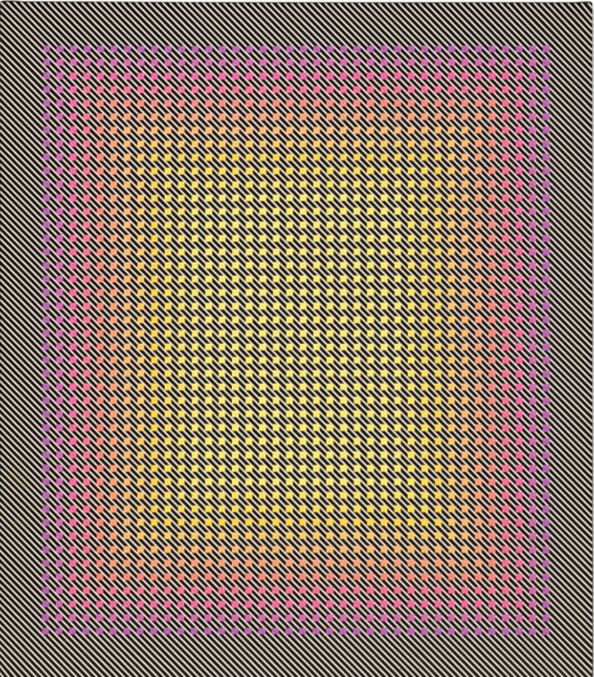
Lot 31. JULIAN STANCZAK (1928-2017). Parallax, signed twice, dated and dedicated ‘J. Stanczak 1985 A token of appreciation – for my friend Aggie – Julian’ (on the reverse); signed again, dated again, and titled ‘JULIAN STANCZAK “PARALLAX” 1985’ (on the stretcher), acrylic on canvas, 50 x 437⁄8 in. (127 x 111.4 cm.). Painted in 1985. Provenance: Gift of the artist to the late owner, 1988. Estimate $40,000 – 60,000. Christie’s. 11/23/26
Julian Stańczak był bardzo konsekwentym artystą w rozwijaniu swej wizji op-artu. Artysta ten ma swoją mocną pozycję w historii malarstwa. Christie’s sprzedaje jeden z jego subtelnie skontruowanych obrazów opartych na zmianie barwy i pewnym powtarzającym się wzorze. Będzie to spory sukces aukcyjny, tego się spodziewam, gdyż jego prace są kupowane przez kolekcjonerów amerykańskich, choć najwyższe ceny sa oczywiście na polskim, wtórnym handlarskim rynku.

Z drugiej strony na rynku niemieckim pojawiło się wyraźny falsyfikat jego pracy (niemieckie scheisse, ale nie wykluczam, że generowane w Polsce). To curiosum podpisane jest TRZYKROTNIE oraz posiada dołączony ogromny poemat napisany wyraźnie przez twórcę/zleceniodawcę tego falsa. O tym jak ważny dla sprzedającego jest ten obraz świadczy długość opisu (pamiętajcie starą zasadę: czysty tym nodycki i bez mydła jest czysty?). Niemcy przyjmują teraz z Polski każde gówno na sprzedaż. Nie pisałbym o falsie, gdyby nie pojawił się ten prawdziwy obraz Stańczaka i back-to-back warto je porównać. Drobne prace Fangora są fałszowane to chyba teraz przyszła kolej na prace Stańczaka? Wyszło jednak bardzo prymitywnie.
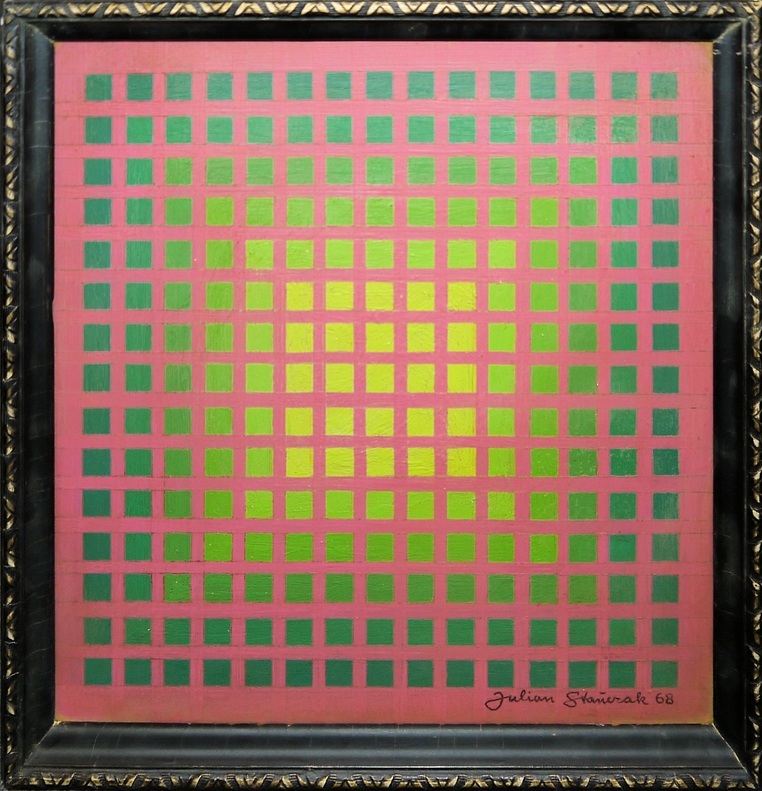
Lot 447. Julian Stanczak, “Melting in Late Colour” (Roztapianie się w późnych barwach), oil painting from 1968. Julian Stanczak, 1928 Borownica – 2017 Seven Hills, Ohio, Polish-American painter and printmaker, one of the pioneers and leading figures of Op Art, a pupil of Josef Albers; shown here: “Melting in Late Colour”, Op Art – a composition featuring a green structure extending into the depth against a pink-red grid, oil on panel, 25 x 25 cm, signed and dated lower right 68, inscribed on the reverse, dated and signed again. Estimate €6,000 – 9,000. Kunst und Kuriosa. 11/06/26
This painting is significant within Stanczak’s oeuvre in that it is an early, small-format composition with a title, which was followed from 1972 onwards by a series of large-format works. A large-scale ‘Melting in Late Colour’ from 1972 is a very famous, monumental acrylic painting (238.8 x 182.9 cm), which was exhibited at the renowned Corcoran Gallery of Art in Washington, D.C. shortly after its creation in the autumn of 1972, and was followed by a series of works bearing the same title. (This painting occupies a significant place in Stanczak’s oeuvre as an early, small-scale composition, the title of which was later used for a series of large-scale works, begun in 1972. One such large-scale work is the famous, monumental acrylic painting *Melting in Late Colour* (1972), measuring 238.8 x 182.9 cm; shortly after its creation in the autumn of 1972, it was exhibited at the prestigious Corcoran Gallery of Art in Washington, and subsequently gave rise to a series of works bearing the same title).
About the artist: During the Second World War, Julian Stanczak was deported to a Siberian labour camp in 1939. Due to the harsh conditions, he permanently lost the use of his right arm – even though he was right-handed. He had to painstakingly learn to paint with his left hand. After escaping via Africa, he lived in London and studied at the Borough Polytechnic Institute. In 1950, he emigrated to the USA, where he obtained his Bachelor’s degree at the Cleveland Institute of Art. He completed his Master’s degree at Yale University under the supervision of the renowned Bauhaus master Josef Albers, whose theory of colour had a profound influence on Stanczak’s work. Julian Stanczak became famous for his geometrically precise works, which, through the interplay of colour and line, create optical illusions, vibrations and a sense of movement on the canvas. His first major solo exhibition in 1964 was entitled ‘Julian Stanczak: Optical Paintings’, which historically coined the term ‘Op Art’. In 1965, he took part in the legendary exhibition ‘The Responsive Eye’ at the Museum of Modern Art (MoMA) in New York, which helped Op Art achieve its worldwide breakthrough.

