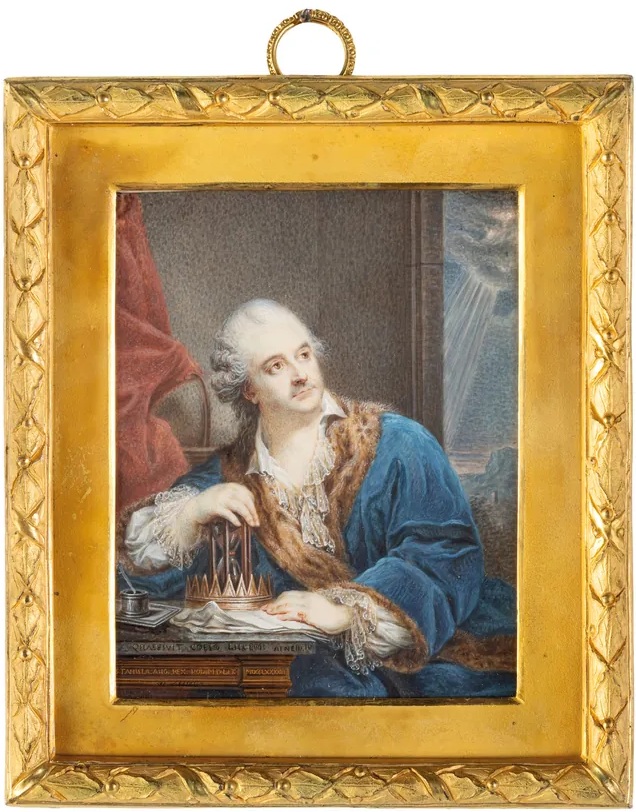
Lot 15. A PORTRAIT OF STANISLAW AUGUST PONIATOWSKI BY WINCENTY DE LESSEUR. Wincenty de Lesseur (1745/46–1813). Miniature painted on ivory, in a gilded bronze frame, 1793. Signed ‘W. Lesseur’ and dated 1793 The miniature: 9.2 x 7.5 cm The frame: 13.3 x 11.4 A PORTRAIT OF STANISLAW AUGUST PONIATOWSKI BY WINCENTY DE LESSEUR *The lot is accompanied by CITES certificate no. IT/CE/2026/GE/00068 Provenance: Private collection Estimate €1,500 – 2,000. Wannenes. 12/01/26
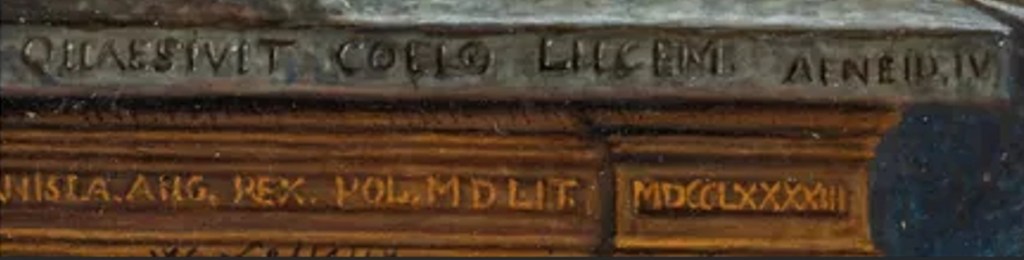
Among the leading miniaturists active at the Polish court in the final decades of the 18th century, Wincenty de Lesseur, also known as Lesserowicz (1745/46–1813), distinguished himself for the refinement of his portraits and his particular sensitivity in rendering faces. He received his training in the artistic circles of Warsaw, where he was significantly influenced by Marcello Bacciarelli (1731–1818), court painter to Stanisław August Poniatowski, and by Bacciarelli’s wife, Johanna Juliana Friederike Richter. Lesseur devoted himself primarily to miniature painting, creating portraits of the royal family and the Polish aristocracy, often inspired by the conventions of official portraiture. The miniature depicts Stanisław August Poniatowski (1732–1798), the last king of Poland, according to a composition conceived by Marcello Bacciarelli. The sovereign is depicted seated at a table, wrapped in a large blue cloak edged with fur, his gaze turned upward and one hand resting on his crown. Behind him, a heavy red curtain frames the scene, while on the right a glimpse of a landscape bathed in rays of light opens up. The composition, rich in symbolic meaning, conveys an image of the monarch lost in meditation on his own destiny and that of the kingdom. The quality of the execution is evident in the delicacy of the skin tones, the meticulous rendering of the embroidery and lace, and above all in the depiction of the crown’s reflections, painted with extraordinary precision. Particularly refined is the contrast between the intense blue of the cloak, the red of the curtain, and the luminosity of the face, which, despite its small size, retains all the expressive power of the pictorial model. The miniature is set within a rectangular gilded bronze frame, adorned along the edge by a delicate ribbon entwined with a foliage motif. The date 1793 lends the work particular historical significance. In that year, with the Second Partition of Poland, the kingdom suffered a new and extremely severe territorial loss, a prelude to the definitive dissolution of the Polish-Lithuanian Commonwealth in 1795 and the abdication of Stanisław August. A ruler educated in the Enlightenment tradition and a champion of important political and cultural reforms, Poniatowski had sought to preserve the country’s independence in the face of pressure from neighboring powers. Lesseur’s portrait, painted during one of the most dramatic moments of his reign, thus takes on a significance that goes beyond that of a mere dynastic effigy, preserving the memory of a monarchy now nearing its end. Signs of wear, defects, minor scratches, a few very minor traces of oxidation WORN, DEFECTS, MINOR SCRATCHES, FEW AND VERY MINOR OXIDATION TRACES
Myślę, że ta miniatura pojawi sie na łamach blogu p. Marka Klimka (https://miniatury.wordpress.com/) zwłaszcza, że o innej replice tej miniatury, namalowanej w 1798 roku, napisał już raz https://miniatury.wordpress.com/2012/12/27/wydarzenie-roku-2012-miniatury-z-kolekcji-stanislawa-augusta-poniatowskiego-na-aukcji-da-christies/

