Jakże inny w swojej prostocie i formie jest ten Pokłon trzech Króli w porównaniu do typowo religijnych prac gdzie królowie ociekają złotem i przepychem. Tajemnica narodzin Jezusa pokazana została jedynie przez bijące w pustce i ciemności światło. Jeden z piękniejszych obrazów Lambert-Ruckiego warty umieszczenia zarówno w nowoczesnym kościele jak i w domu.
Lot 337. Jean LAMBERT RUCKI. Adoration des Mages. 1934. Gouache, 45 x 32. Signée et datée en bas à droite. Sous verre et passe-partout. Défauts au passe-partout. Certificat du comité Jean Lambert-Rucki disponible sur demande au frais de l’acquéreur. Estimate 3,000 – 4,000 euro. Maisone Lhomme. 10/26/19
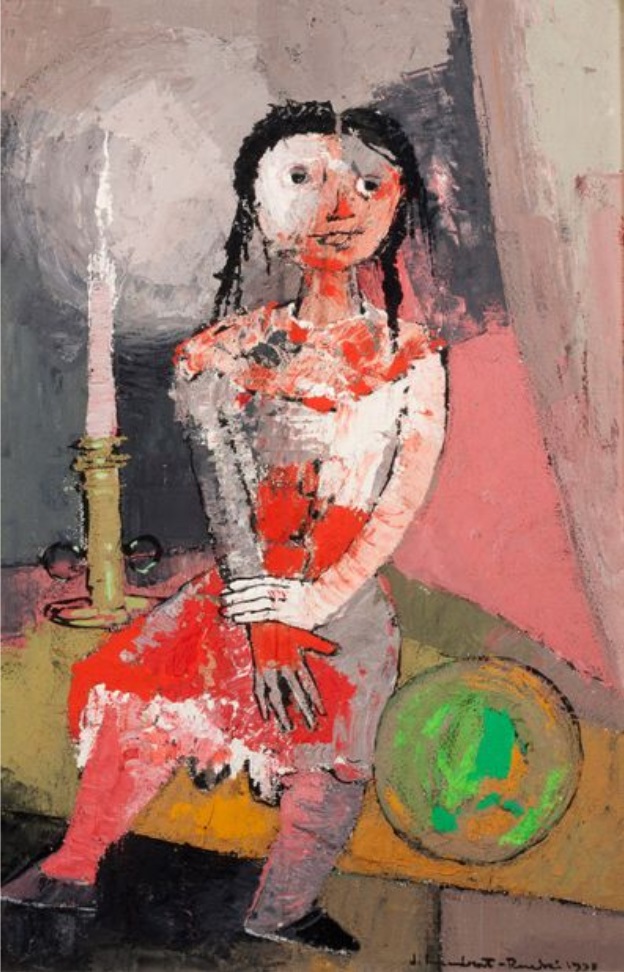
Lot 39. JEAN LAMBERT RUCKI (1888 1967). Poupée à la bougie, 1930. Gouache et technique mixte sur carton, signé et daté en bas à droite, 57 x 36 cm – 22 1/2 x 14 1/8 in. Gouache and mixed media on cardboard, signed and dated lower right. Le certificat rédigé par Léonie Lambert-Rucki, la veuve de l’artiste et de Théano Lambert-Rucki, sa fille; en date du 25 juin 1968 sera remis à l’acquéreur. Estimate 3 000 – 5 000 €. Aguttes. 10/20/19
Byc może podobnymi scenkami z dziećmi czy z lalkami inspirował się Rajmund Kanelba. Podobne są okresy życia Lambert-Ruckiego i Kanelby lecz w Polsce zdecydowanie bardziej popularny jest Kanelba jako portrecista kobiet i malarz dzieci, zaś Lambert-Rucki znany jest w kraju głównie jest z prac i rzeźb o charakterze religijnym a to jest jedynie wycinek jego bogatej twórczości. Te dwie liryczne akwarele nie są tanie ale bardzo ożywiają postać tego malarza i rzeżbiarza.
Jean Lambert-Rucki. Poupées à l’âne, 1931
Lot 40. JEAN LAMBERT RUCKI (1888 1967). Poupées à l’âne, 1931. Huile sur carton, signée et datée en bas à gauche, 56.5 x 38 cm – 22 1/4 x 15 in. Oil on cardboard, signed and dated lower left. Le certificat rédigé par Léonie Lambert-Rucki, la veuve de l’artiste et de Théano Lambert-Rucki, sa fille; en date du 25 juin 1968 sera remis à l’acquéreur. Estimate 4 000 – 6 000 €. Aguttes. 10/20/19
Dorzucam szybko, bo aukcja tuż, tuż i kolekcjonerzy Mitoraja niecierpliwie czekają; poza tym blog rozpali sie do czerwoności w chwili gdy już robi się chłodno. Litografia wyprodukowana w nakładzie plakatu. Cena również podobna do ceny plakatu tyle, że praca jest numerowana i sygnowana przez artystę.
Lot 30. IGOR MITORAJ (1944-2014). Lithographie. Signée et numérotée 309/500; 39,5 x 29,5cm. Estimate 80 – 120 euro. Binoche et Giquello. 10/10/19
Nie mam problemu i zgodzam się w 100%, że obraz ten ‘sygnowany jest B.Biegas’ oraz, że jest to ‘polska szkoła’. Nie moge jedynie zgodzić sie, że ta praca warta jest aż 1,500 do 2,000 euro.
Lot 155. École polonaise du XXe siècle. “Portrait de femme“. Huile sur panneau. Porte une signature “B. Biegas” en bas à gauche. Haut. : 65,5 cm ; Larg. : 50 cm. Estimate 1,500 – 2,000. Mirabaud – Mercier. 10/11/19
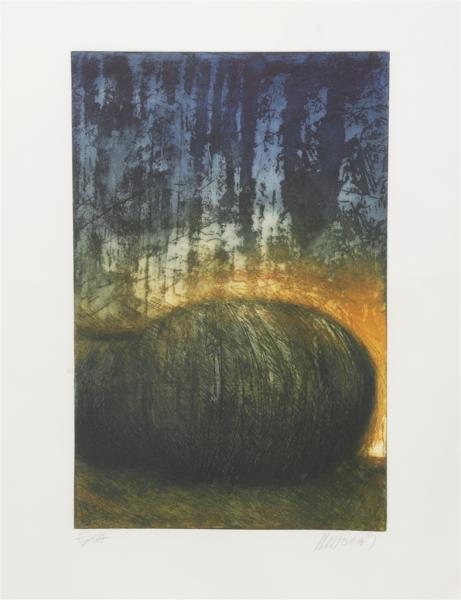
Kolorowa kompozycja Igora Mitoraja na papierze (sucha igła) wydrukowana w nieznanym nakładzie. Podobno praca powstała w 2000 roku. Prawdopodobnie, ze względu na technikę, można sie spodziewać, że powstało nie więcej niż 100 odbitek, choć te prace nie są numerowane.
Lot 625. IGOR MITORAJ (1944-2014). “HEAD” Engraving, E/A. Signed & numbered in pancil. 53 x 35 cm. (impression); 74 x 53 cm. (paper); 100 x 71 cm. (frame). Estimate 400-520 euro. Subastas de Barcelona Subarna. 11/17/19
Igor Mitoraj. Helios, 1988 (nr, 312/1,000)
Również kolejny egzemplarz Heliosa pojawił się we Francji (nr 312/1,000). Tym razem rzeźba wyceniona jest wysoko. Tego samego dnia będzie licytowany w innym domu aukcyjnym inny egzemplarz z wyceną 2,500 – 3,000 euro (https://polishartcorner.com/2019/10/05/igor-mitoraj-1944-2014-27/). Generalnie, mam duży problem tymi rzeźbami Mitoraja tłoczonymi w nakładzie 1,000 egzemplarzy i więcej; inni powinni mieć ten sam problem.
Igor MITORAJ (1944-2014) – Helios – Bronze sculpture – 31 x 30 cm. Estimate 5,000 – 6,000 euro. Expertisez.com. 10/16/19
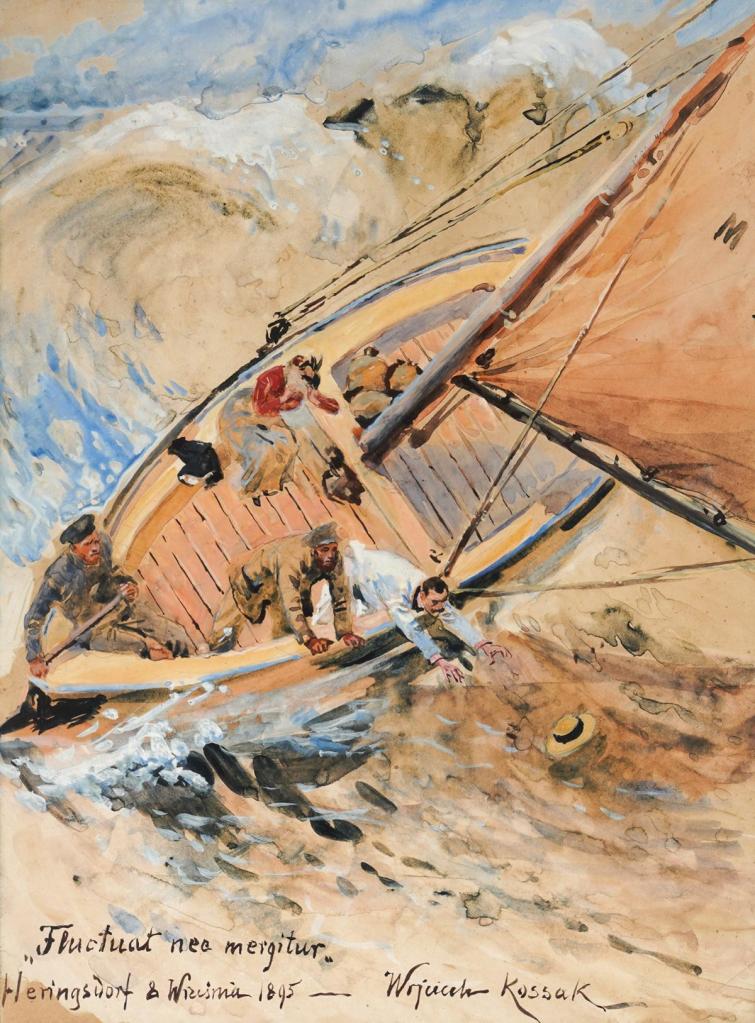
Wydaje mi sie, że może to być bardzo nietypowa praca, akwarela Wojciecha Kossaka, z 1895 roku z Herigsdorfu (zwanego również Kaiserbad) na wyspie Uznam. Widomo, że w 1895 roku Kossak pracował głównie w Berlinie z Fałatem, miał bardzo dobre układy z kaiserem Wilhelmem i to jest udokumentowane w jego pamiętnikach. To nadmorskie miasto (Kaiser-bad) nie pojawia się w pamietnikach Kossaka, lecz całkiem prawdopodobne, że w letnim okresie wyjeżdżał ‘do wód’ by odpocząć od rozpalonego w 1895 roku Berlina. Bardzo sprawnie namalowana akwarela i najprawdopodobniej Wojciecha Kossaka.
Lot 100. Wojciech Adalbert Kossack, Poland (1857-1942) Watercolor on paper, signed lower right. Sailboat in distress, hat overboard, matted and mounted in wood frame. Measures 23.75″H x 18.75″W framed; 15.75″H x 11.75″W unframed. Estimate $600 – 800. Abington Auction Gallery. 10/17/19
Wydawałoby się, że jest to mało znany polski malarz a jednak tak nie jest. Ignacy Szczodrowski to jeden z artystów polskiego pochodzenia, który wrósł w rosyjskie środowisko z wyboru (może z konieczności) i nie ma podstaw by kwestionować jego rosyjskości. Innym malarzem i Rosjaninem z wyboru był Witold Kajetanowicz Białynicki-Birula (1872 – 1957), pochodzący z polskiej rodziny szlacheckiej z mińszczyzny. Z rodziny zruszczonej pochodził również Michał Wróbel (1856 – 1910), syn filomaty zesłanego do Kazania oraz Paweł Kowalewski (1843 – 1903), malarz batalista. Szczodrowski, jak i ci wymienieni zaliczają się do malarzy rosyjskich jednak w tym przypadku prezentuję jego pracę jako ciekawy polonik. Jego akwarela nie jest sygnowana cyrylicą lecz łaciną a także jest opisana jako Częstochowa. Jest to może mało znaczący obrazek z tego miasta mający jedynie przedstawiać typy tam mieszkające i podobno zamieszczony (po modyfikacji) w postaci litografi w książce o obrazach z życia narodu rosyjskiego. Z radościa chcę potwierdzić, że historia narodu rosyjskiego potoczyła się jednak nie tak jak planowano.
Lot 863. Russische Kunst – – Shchodrovskij, Ignatij S. Ehefrau (des Kutschers) und Schuhnäherin (Frau des Soldaten). Aquarell auf Papier. Links unten signiert (in polnischer Schreibweise) und datiert. Czestochowa, 1837. Blattgröße: 31 x 25,5 cm. Vor allem durch seine Lithographien macht Ignatij S. Shchodrovskij (1815-1870), russischer Künstler mit polnisch-litauischen Wurzeln (Szodrovski), als einer der Ersten Darstellungen des Alltags einfacher Leute in der russischen Kunst bildwürdig. – Das Sujet fand, um eine männliche Figur ergänzt (Kutscher in Winterkleidung), Aufnahme in eine Lithographie-Serie “Znaj nashih” (1845, erste Auflage). Das vorliegende Aquarell war offenbar bereits für eine vorausgehende Serie “Sceny narodnogo russkogo byta” (1839/40) vorgesehen. – Blatt in den Rändern etwas knickspurig, leicht fleckig. Reserve 400 euro. Nosbüsch & Stucke GmbH Auktionen Berlin. 10/25/19
Bernardo Bellotto. Landscape capriccio with classical and medieval motifs and some buildings from Dresden
Malarz mający istotne miejsce w polskiej historii. Ten obraz Bellotta powstał sporo wcześniej przed przyjazdem do Warszawy ale warto go zachować i poczytać o jego proweniencji, wystawach, publikacjach i ogólnych informacjach o malarzu i obiekcie malowania. Dużo ciekawego do czytania poniżej z katalogu aukcyjnego. A propos proweniencji to chciałoby się taką skrupulatną widzieć w przypadku każdej innej sprzedawanej pracy. Inna uwaga to, moim zdaniem, absurdalnie niskie widełki wyceny za ten obraz. Gdyby ta praca została sprzedana za jedyne 100,000 euro to potrzeba sprzedać 4-5 podobnych prac tego artysty by zrównoważyc cenę jednego ‘koła’ Fangora. Kompletny absurd z cenami na ‘koła’.
Lot 28. Bernardo Bellotto (Venice 1721–1780 Warsaw). Landscape capriccio with classical and medieval motifs and some buildings from Dresden, oil on canvas, 49.5 x 80.5 cm, framed. Estimate 100,000 – 150,000 euro. Dorotheum. 10/23/19
Provenance: Collection of Sir William James Farrer (1822–1911), Sandhurst Lodge, Berkshire; his sale, Christie, Manson & Woods, London, 23 March 1912, lot 36; bought by Lippmann; Collection of Robert Zahn (1861–1914), Plauen; his sale, Hugo Helbig, Munich, 21 November 1917, lot 5; bought by A. S. Drey, Munich; Collection of Camillo Castiglioni (1897–1957), Vienna; his sale, F. Muller & Cie., Amsterdam, 17 November 1925, lot 29; with Thomas Agnew & Sons, London, 1926; Collection Sigmund Sachsel (1873–1928), Vienna; his sale, Dorotheum, Vienna, 5 June 1931, lot 1; with Galerie Sanct Lucas, Vienna, 1965; Private collection, Austria
Exhibited: Vienna, Belvedere Museum, Bernardo Bellotto genannt Canaletto, 29 April – 25 July 1965, no. 44; Houston, Museum of Fine Arts, Bernardo Bellotto and the Capitals of Europe, 29 July – 21 October 2001, no. 83
Literature: I. Haumann, Das oberitalienische Landschaftsbild des Settecento, Strasbourg 1927, p. 79; H. A. Fritzsche, Bernardo Belotto genannt Canaletto, Magdeburg 1936, pp. 65, 99–100, p. 124, VG 180, p. 125, mentioned under VG 189; S. Kozakiewicz, Bernardo Bellotto genannt Canaletto: Ausstellung unter der Leitung von: Staatliche Kunstsammlungen Dresden, Nationalmuseum Warschau, Kunsthistorische Museum Wien, exhibition catalogue, Vienna 1965, p. 59, no. 44, ill. no. 91; S. Kozakiewicz, Bernardo Bellotto, Milan 1972, vol. I, p. 138, vol. II, pp. 283-284, no. 358, ill. p. 285; E. Camesasca, L’opera completa del Bellotto, Milan 1974, no. 199; A. Rizzi, Bernardo Bellotto. Dresda Vienna Monaco (1747-1766), Venice 1996, p. 161, no. 141; E. P. Bowron, in: E. P. Bowron (ed.), Bernardo Bellotto and the Capitals of Europe, exhibition catalogue, New Haven/London 2001, p. 242, no. 83, ill. p. 243
The present painting is an important example of Bernardo Bellotto’s work during his second Dresden period, around 1765. At this time the painter concentrated on creating idealised views and capriccio paintings, a genre he had experimented with during his youth in Italy. These imaginary landscapes include real elements, as is the case with the present painting which represents an idyllic hilly landscape. In the background there are buildings inspired by the antique and the middle-ages, as well as recognisable monuments from the city of Dresden. On the left the still extant Zwinger Palace can be recognised, while the ruins at the centre are a probable reference to the Prussian bombardment of Dresden in 1760, during which time Bellotto also saw his home destroyed.
In the foreground a path cuts through the scene diagonally, leading to a bridge on the right. Under the arch of the bridge, another city is visible in the distance. The statue on a pedestal to the left hand side of the bridge is reminiscent of the same subject depicted by Bellotto in his earlier painting of the Karlskirche in Vienna (see Kozakiewicz 1972, vol. II, p. 200, no. 257). In the present painting the scene is animated by a number of country-folk, including a man in the foreground seated with his dog; this bearded figure is shown in different poses in other compositions by the artist, including the Imaginary view with Bellotto’s self-portrait in the National Museum, Warsaw.
The figures in the present painting are typical of Bellotto’s production during his second Dresden period, when the artist modelled the humble figures of his paintings directly from reality, almost with the intent of portraiture. The representation of the poor and marginal classes of society was rare in eighteenth century Italian painting, and the dignity with which Bellotto imbues them is reminiscent of Giacomo Ceruti’s paintings of mendicants and farming-folk. The style of the painting is typical of Bellotto during these years, it is characterised by bold fluid brushstrokes and the deployment of cool colours in compositions poised between the real and the imaginary, capturing a melancholy tone, which possibly reflects the suffering the artist himself experienced as a result of the war in the German city.
The present painting is known in another version that differs in some details: probably made by Bellotto in collaboration with his son Lorenzo (see Kozakiewicz 1972, vol. II, p. 284, no. 358a).
Bernardo Bellotto trained in Venice it is believed, under his uncle, Canaletto and from the outset he focused on the depiction of views of the city. His pictorial language attained an independence thanks to the journeys he took during the 1740s through the Veneto, Lombardy, Tuscany and to Rome. He travelled to Dresden for the first time in 1747 where he became court painter to Frederick Augustus II, Elector of Saxony. Here, he dedicated himself to the depiction of views of the city which was being remodelled during this period into one of the most important cultural centres of Europe. At the close of the next decade, he moved to Vienna, and then to Munich, thereafter returning to Dresden in 1761. Bellotto spent the final years of his career in Warsaw where he was engaged in the decoration of the royal palaces and he continued to produce view paintings for which he was celebrated throughout Europe.
Każda praca Lebensteina jest inna i warta zatrzymania się nad nią. By lepiej zrozumieć tego artystę i jego prace trzeba poczytać o życiu tego artysty, przeprowadzone z nim wywiady i wspomienia osób z którymi sie przyjaźnił. Wyłoni się wtedy niezwykła osoba a jego twórczość stanie się bardziej czytelna.
Lot 766. Lebenstein, Jan. Ohne Titel. Aquarell auf Papier. Rechts unten signiert und datiert. 1962. Blattgröße: 28 x 43 cm. Unter Passepartout montiert. Reserve 400 euro. Nosbüsch & Stucke GmbH Auktionen Berlin. 10/25/19
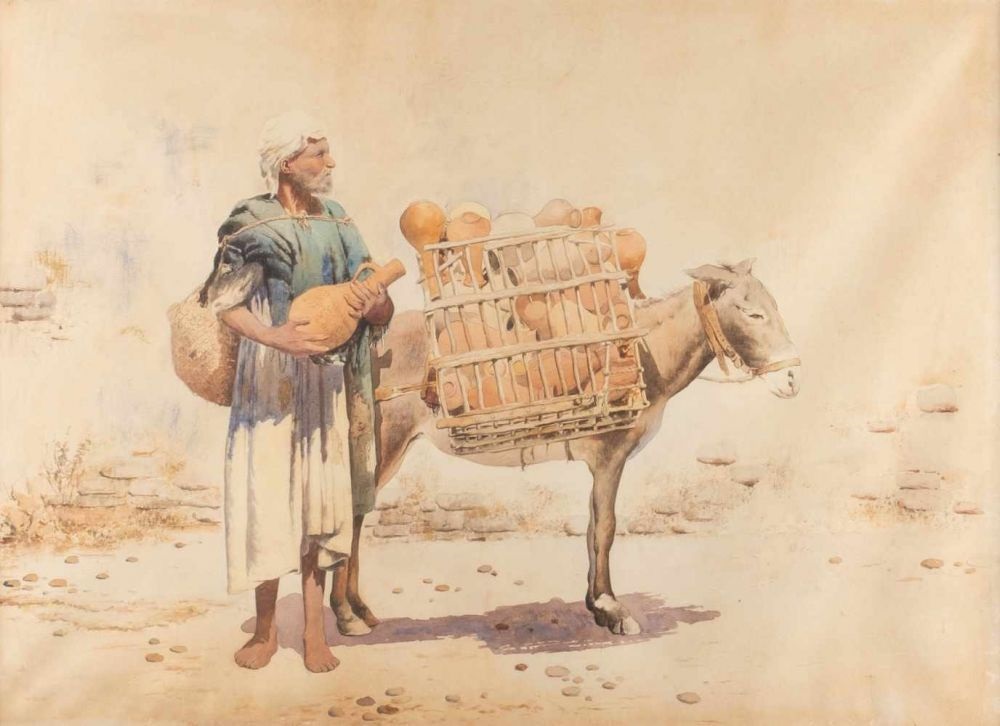
Wilhelm Kotarbiński.An oriental merchant with hollow-ware
Lot 1783. WILHELM (VASSILI) ALEXANDROVICH KOTARBINSKI 1848 Nieborow/ Poland – Kiev 1921. An oriental merchant with hollow-ware. Water colour on paper, visible size 52,5 by 73 cm, min. damaged, partially browned, behind glass. A comparable work of the painter was sold in London by Sotheby’s (25. Nov. 2008 Lot 435). Reserve 2,000 euro. Hargesheimer. 11/16/19
Dwie akwarele przypisane Wilhelmowi Kotarbińskiemu. Obie zostały opisane jako mające uszkodzenia (mechaniczne?), w obu papier został zbrązowiały (od słońca?), obie nie są sygnowane, dla każdej z nich cena rezerwowa została ustalona na 2,000 euro oraz każdej atrybucja została ustalona na podstawie innej akwareli Kotarbińskiego sprzedanej w Sotheby’s 10 lat temu za 12,500 funtów, pokazanej na dole wpisu. Trzeba teraz się przyjrzeć tej akwareli z Sotheby’s. Wygląda, że jest w dobrym stanie, jest sygnowana i to podwójnie i jest wykończoną dobrą kompozycją. Wracając do obu akwarel, żadna z nich nie wygląda na wykończoną pracę, raczej są to studia, dla obu brakuje słowa o proweniencji. Zastanawiam się czy aby na pewno obie malował Kotarbiński. Bardzo nie podobają mi się, choćby na jednej z nich, ręce Araba trzymającego dzban, wyglądające jak wielkie, nieforemne łopaty. W sumie, moim zdaniem jest to ryzykowna atrybucja dla tych dwóch prac…choć oczywiście szanuję odmienne zdanie innych osób.
Wilhelm Kotarbiński.An oriental street scene
Lot 1784. WILHELM (VASSILI) ALEXANDROVICH KOTARBINSKI 1848 Nieborow/ Poland – Kiev 1921. An oriental street scene. Water colour on paper, visible size 53,5 by 73 cm, min. damaged, partially browned, behind glass. A comparable work of the painter was sold in London by Sotheby’s (25. Nov. 2008 Lot 435). Reserve 2,000 euro. Hargesheimer. 11/16/19
Wilhelm Kotarbiński.ORIENTAL SCENE
Lot 435. Vasily Alexandrovich Kotarbinsky 1849-1921. ORIENTAL SCENE, signed twice in Latin l.r. watercolour on paper, image size: 61 by 95cm., 24 by 37 1/2 in. Estimate 10,000 – 15,000 GBP. Sotheby’s. 11/25/2008. Sold 12,500 GBP