Portret zamyślonej i smutnej zamężnej kobiety pędzla braci Seidenbeutl. Portret bardzo dobry lecz ręce ułożone i upozowane sztucznie i niezdarnie. Każda praca obu artystów to spora rzadkość.
Lot 48. Efraim and Menasze SEIDENBEUTL (1907 Warsaw – 1945 Flossenbürg concentration camp ). Portrait of a woman. Oil on canvas, 84 x 72 cm. Signed top left Seidenbeutl. The twin brothers Efraim and Menasze had a unique way of working. One began the composition and the other finished it, a phenomenon that seems to be unique in the art world. Estimate 4,000 – 5000 euro. Millon. 11/10/20
Lot 26. Zygmunt MENKES (Lviv 1896 – New York 1986). The painter’s palette. Oil on canvas, 92 x 74 cm. Signed in the middle right “Menkes”. On the back, on the stretcher, handwritten indications in white chalk “Pechon Av. Foch”. Estimate 15,000 – 20,000 euro. Millon. 11/10/20
Aż trzy oleje Menkesa z lat 20-tych XX wieku u Millona, wszystkie bardzo ciemne, w brązach. Jeden z nich, Portret rodzinny jest sprzedawany jako (chyba) najdroższy do tej pory obraz tego artysty. Bardzo silna promocja tej pracy, choć zdecydowanie ciekawsza dla mnie jest Paleta artysty, również droga, choć nie znaczona tak silnym pierwiastkiem żydowskim jak te pozostałe. Menkes jest dla mnie mistrzem współczenej martwej natury.
Zygmunt Menkes.The family
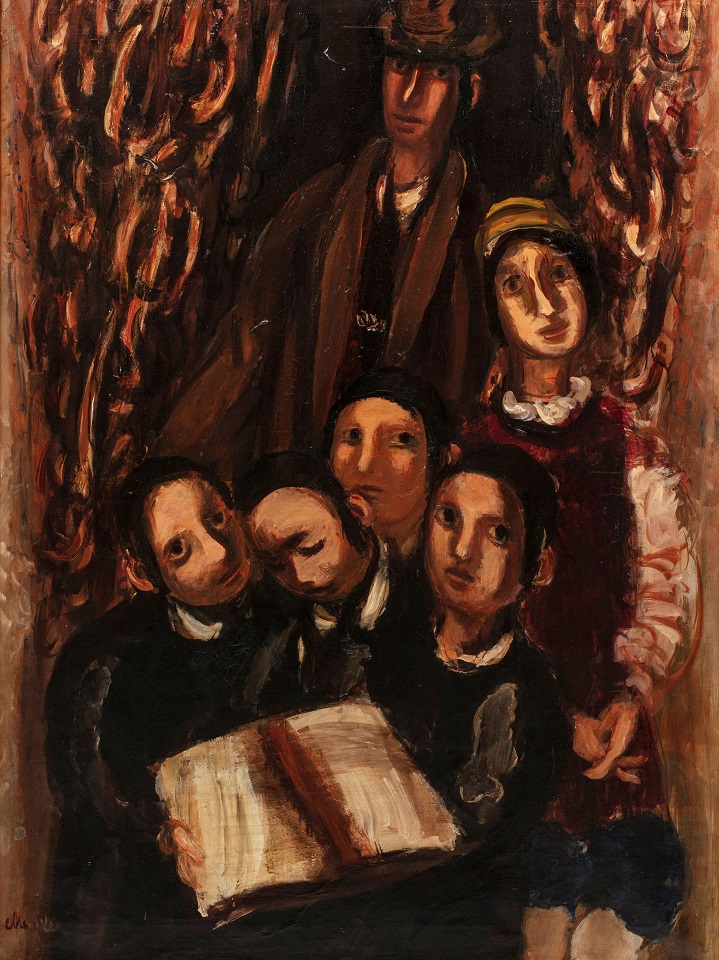
Lot 25. Zygmunt MENKES (Lviv 1896- New York 1986). The family. Painted in 1928. Oil on canvas, 130 x 97 cm. Signed lower left “Menkes” Provenance: Former Niko Mazaraki collection, Private collection, Paris. Exhibition: L’art Polonais Moderne, 19 October – 8 November, Galerie Bonaparte, Paris, 1929, reproduced p.59.
Bibliography: E. TERIADE, Menkes, Edition le Triangle, 1932, reproduced. Avram Kampf, Jewish experience in the Art of the twentieth century, 1984, reproduced p.185. Zygmunt Menkes, born in Lwow (Poland) in 1896, spent his childhood in an environment that he himself defines as sad. He escapes through imagination by drawing. In 1914 he began studying at the Art Institute in his native town. In 1919, he enrolled at the Academy of Fine Arts in Krakow and left for Berlin three years later. He understood that he had to go to Paris and finally arrived there in 1923. After a year, without resources, he is forced to return to Poland. He returned to Paris the same year with the firm intention of staying there. He appeared at the Salon d’Automne and the Salon des Indépendants from 1924 to 1927. He exhibited from 1926 until 1951 at the Salon des Tuileries. Menkes became one of the most original and important painters of the Ecole de Paris. In 1935, he moved to New York where he participated in numerous exhibitions, gained public recognition and received awards. He exhibited in Paris, Warsaw, Lviv, Berlin, New York, Tel Aviv, Toronto. His works are in the collections of the following New York museums: Museum of Art; Jewish Museum; Metropolitan Museum of Art; Whitney Museum of American Art, the Jerusalem Museum of Art, the National Museum of Warsaw, the Museum of Modern Art in Lodz and the Centre Pompidou. E. Tériade, the famous art critic, whose real name was Eleftheriadis, born in Lesbos, Greece, noticed the artist during one of his exhibitions in Paris. Tériade introduces the painter to a Greek millionaire, dealer and collector: Nico Mazaraki. The latter becomes his agent; he allocates him a fixed monthly sum and selects for himself a number of works by Menkes. The work presented here comes from the Nico Mazaraki collection. The artist portrays himself here at the centre of the composition surrounding a group of four young Talmudists. Throughout his life, the artist has been passionate about self-portraiture; he portrays himself alone, accompanied, as a musician, with his palette, inventing situations, playing with his moods and the viewer. The painter offers a world of softness and gaiety lulled by lyricism. A variant of this painting measuring (65×54 cm) is kept in the Philadelphia Museum (donated by Bernard Davis in 1950). Estimate 50,000 – 60,000 euro. Millon. 11/10/20
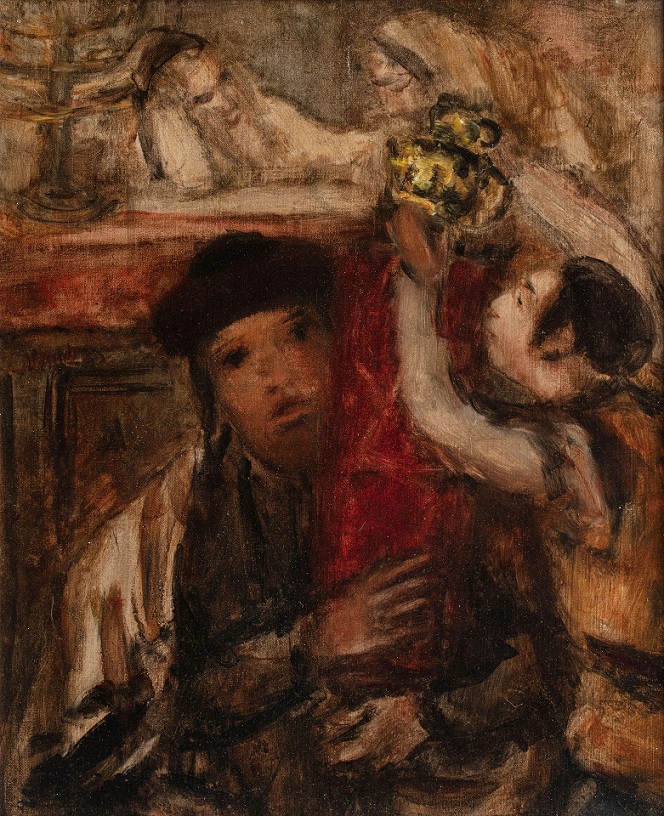
Zygmunt Menkes.Tora, father and son
Lot 30. Zygmunt MENKES (Lviv 1896 – New York 1986). Tora, father and son. Circa 1927. Oil on canvas, 46 x 38 cm. Signed in the middle left “Menkes”. Estimate 6,000 – 8,000 euro. Millon. 11/10/20
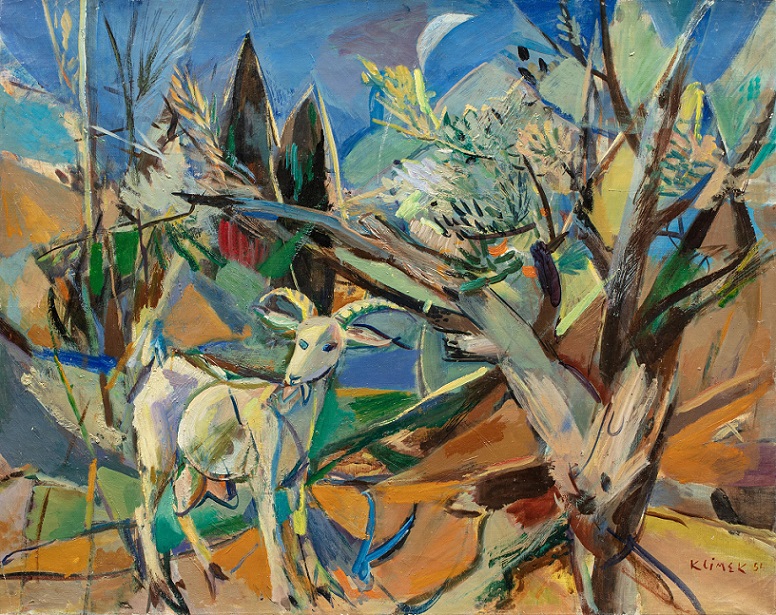
Nawet Millon posiada w swoim katalogu olej Ludwika Klimka. Pejzaż z kozą nie jest zły lecz figlarne akty z paniami lepiej cieszą oko.
Lot 59. Ludwig KLIMEK (Skoczów 1912 – Nice 1992). Landscape. Made in 1951. Oil on canvas, 73 x 92 cm. Signed and dated bottom right “Klimek 51. Estimate 600 – 800 euro. Millon. 11/10/20
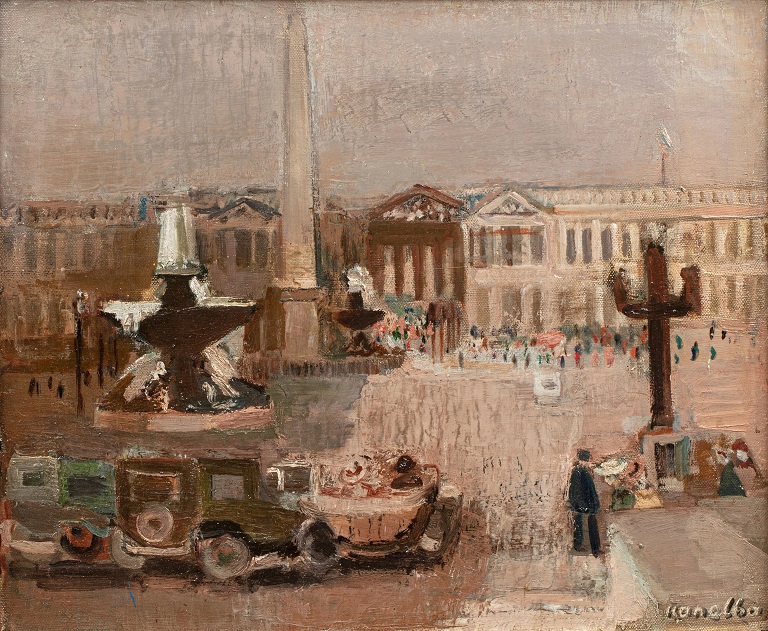
Prace Kanelby zawsze lubie oglądać i cieszę się, że później zajął się później malowaniem subtelnych portretów kobiecych jak też dzieci zamiast widoków miast. Praca z aukcji jest kolorystycznie dla mnie bez zarzutu, choć ten meksykański ‘kaktus’ trochę mnie razi.
Lot 19. Rajmund KANELBA (Warsaw 1897 – London 1960). Place de la Concorde. Circa 1935. Oil on canvas, 51 x 61 cm. Signed lower right “Kanelba”. Estimate 4,000 – 6,000 euro. Millon. 11/10/20
Stanisław Eleszkiewicz.Portrait of a man with a newspaper and a red scarf
Lot 14. Stanislas ELESZKIEWICZ (Czutowie k.Poltawy 1900 – Paris 1963). Portrait of a man with a newspaper and a red scarf. Circa 1930. Oil on cardboard. 65 x 50 cm. Signed lower left “S. Eleszkiewicz” Stanislas Eleszkiewicz was born in 1900 in Czutowie, Poland. He studied at the Academy of Fine Arts in Warsaw and then at the Fine Arts Academy in Athens. He travelled to Italy and became known mainly as a stained glass decorator. He also specialises in mosaic and glass engraving. Stanislas Eleszkiewicz is known mainly for his self-portraits, portraits, landscapes and street scenes. The Portrait of a Man with a Newspaper and Red Scarf is typical of the 1930s. Stanislas Eleszkiewicz depicts his model in a dark street in front with his face in profile. The hands are highlighted. The model is holding a newspaper in one hand and a cigarette in the other, creating a contrast with the black of the jacket. The red scarf, cigarette, newspaper and cap are accessories often associated with her male models. The artist’s pictorial universe is manifested in this work, the forms are moving, the palette used reveals a dominant of dark and contrasting colours. Estimate 8,000 – 12,000 euro. Millon. 11/10/20
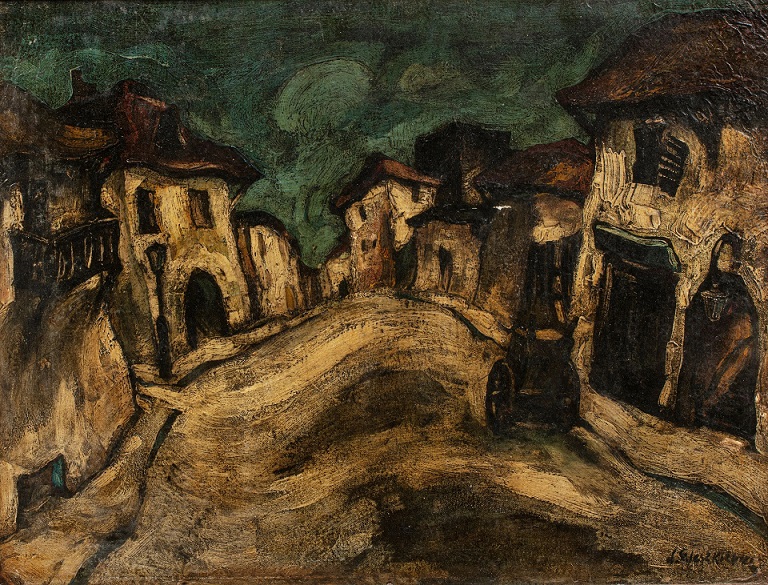
Millon na aukcji tematycznej Ecole de Paris proponuje nie tylko w przypadku Eleszkiewicza rekordowo wysokie ceny estymacyjne. Eleszkiewicz malował dużo i bardzo podobnie zniekształcał postaci. Górny obraz jest smutny, ciemny, drogi, choć dobry.
Stanisław Eleszkiewicz.The undulating street
Lot 15. Stanislas ELESZKIEWICZ (Czutowie k.Poltawy 1900 – Paris 1963). The undulating street. Oil on cardboard. 46 x 60 cm. Signed lower right “S. Eleszkiewicz”. Estimate 6,000 – 8,000 euro. Millon. 11/10/20
Jan Konarski. Polnischer Bauer auf einem Pferdekarren
O dziwo, w zasadzie mogę zgodzić się z opisem przedstawionym przez Schloss Ahlden, tudzież z wyceną. Skąd jednak pewność, że jest to polski chłop? Ale to drobiazg.
Lot 2665. Jan Konarski (Polnischer Maler. Tätig um 1900). Polnischer Bauer auf einem Pferdekarren. Mit nunanciertem Duktus ausgeführtes Kabinettbild des polnischen Künstlers, der von Alfred v. Wierusz-Kowalski beeinflusst war und dem seine Gemälde oft als Pseudonym zugeschrieben werden. Konarski schuf mit virtuos flottem Duktus und temperamentvoll gemalte, inhaltlich fesselnde, oft winterlich gestimmte Darstellungen aus dem russisch-polnischen Volksleben mit Schlitten und Kutschen. Öl/Eichenholztafel. L. u. sign. “J. Konarski”. 17,8 cm x 24 cm. Rahmen. Oil on oak panel. Signed “J. Konarski”. Starting 460 euro. Schloss Ahlden. 11/26/20
Skłaniam się, że jest to praca Iwana Trusza, lecz tchu nie zapiera. Wycena adekwatna.
PS. Dom aukcyjny Arnold nie pakuje i nie wysyła sam prac a zatem koszta pakowania i transporu przez obcą firmę będą niewspółmiernie wysokie – każdy przecież musi zarobić.
Lot 505. Iwan Trusz, l.u.sig. Wysocko 1869 – 1941 Lwiw, ‘Abend über dem Jordan’, betitelt, Öl/Ktn., 50 x 70 cm, Kratzspur. Opening 1,200 euro. Arnold. 11/21/20
Od czytelnika z Ukrainy nadszeł taki list (drukuję z przyjemnością i podziękowaniem) nt tej pracy Iwana Trusza, jak również poprzednio pokazywanego ‘Pejzażu znad Dniestru’ sprzedawanego w Bonhams (https://polishartcorner.com/2020/10/29/iwan-trusz-1869-1941-7/):
Here is some info I came across which may interest you:
About the Evening over the Iordan river. An oil on cardboard version of the same landscape exists in a Ukrainian private collection, pfa. Signed and named in the low right corner in Ukrainian. The Arnold’s oil on canvas is signed in Latin and evidently named in Polish. It is quite possible that both variants are done by Trusz, but a vice versa variant is possible as well. It is not uncommon for Trusz both to make several versions or author’s copies of the same painting (pls see below if this is the case) and also to have the name of the picture signed in the corner along with the signature (there are samples from his Italian pictures), but the Arnold’s one has the name written in different color than the signature and so far I failed to find another example of such signing.
As for the Bonham’s Dnieper landscape, another version of this painting was exhibited in Kyiv 2 years ago https://nuart.com.ua/en/paintings/dnepr/ (at the gallery of highly respected Kyiv collector), this is evidently different from both version you refer to. I can not tell if all three are authors’ copies or not, but personally the one in Kyiv looks most genuine to me, the Bonham’s one looks more like an early version and the one of Agra looks doubtful, but I may be mistaken.
Sorry for bothering , just wanted to share the information.
Szokuje dwuznaczność, celowa nieścisłość granicząca z przekłamaniem, niemieckiego opisu życiorysu Juliana Stańczaka: „Julian Stanczak fled to Uganda as a teenager following deportation”. To jest oczywista nieprawda, że on ‘fled to Uganda’. Najpierw był napad Niemców na Polskę, potem rosyjski ‘nóż w plecy’ 17-go września 1939, następnie stalinowskie deportacje Polaków na Syberię, po czym pakt sowietów z polskim rządem i amnestia dla zesłanych Polaków. Sporo dzieci zesłanych na Syberię, ta jak Stańczak, przez Irak, Palestynę (czasami Indie), lądowało tymczasowo w Afryce. Dalej w opisie jest prawda.
Warto zauważyć, że obraz przywędrował z Kalifornii do Polski a teraz do Niemiec… a może stąd znowu do Polski, bo gdzie indziej?. Czyżby oscylator finansowy?
Lot 214. Julian Stanczak. Sway in warm light. 3- part work: each acrylic on canvas Each 122 x 62 cm. Overall dimensions 122 x 186 cm. Framed together. Signed and dated ‘Stanczak 98’ verso on canvas. Signed, dated and titled ‘JULIAN STANCZAK “SWAY IN WARM LIGHT” 1998’ verso on stretcher. – Minor traces of age. Provenance Selker Fine Art, Rancho Santa Fe/California; private collection, Poland Born in Poland in 1928, Julian Stanczak fled to Uganda as a teenager following deportation. In Africa, he experienced a diversity of colour and intensity of light that made a great impression on him. These laid the foundation of his artistic development and his life-long preoccupation with colour. In 1950, Stanczak emigrated to the USA; at Yale his teacher was Josef Albers. In 1950 - inspired by Albers – he applied himself to an abstract visual language which evoked visual interaction by means of densely arranged variegated shapes. Stanczak thus became one of first representatives of Op Art, just as his fellow student Richard Anuszkiewicz. Stanczak followed this path consistently in subsequent years, experimenting with grid patterns of stripes, squares and waves in vibrant colours. In contrast to other representatives of Op Art, Stanczak was not primarily interested in flamboyant effects or in optically challenging the viewer, but in the visualisation of fleeting, subtle impressions. “Er sucht nach einer universalen Formgebung für die unscheinbarsten, aber lebenswichtigen Kostbarkeiten des Alltags, die uns mit dem „Jetzt“ verbinden, mit dem lebendigen Augenblick, der sich nicht festhalten lässt […] eine Veränderung des Lichts, eine Bewegung, verursacht von unbeachteten kleinen Geschehen, die man nur aus dem Augenwinkel miterlebt.“ (Elizabeth McClelland, in: (Elizabeth McClelland: exhib.cat. Julian Stanczak, A Retrospective, Youngstown/Ohio i.a. 1998, p.155). Estimate 60,000 – 80,000 euro. Lempertz. 12/08/20
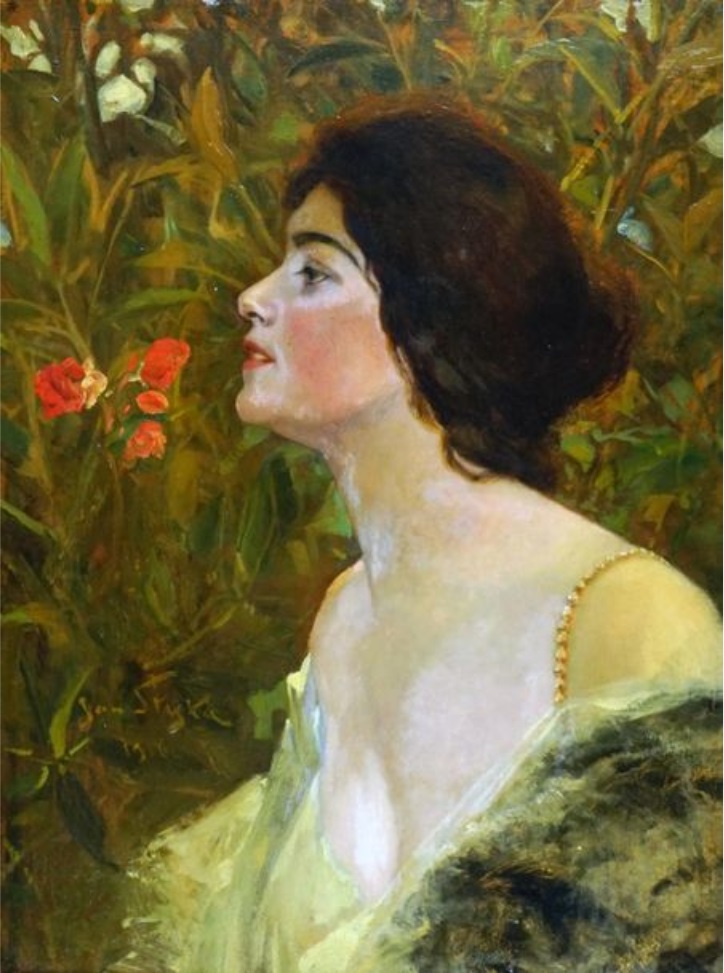
Jan Styka.Portrait of Zofia, daughter of the artist, as Polycaste
Jana Stykę należy bardzo cenić za pracowitość i niezwykle dobry charakter, lecz chyba nie był najlepszym portercistą. Portret córki artysty może powienien wrócić do rodziny Styków, choć to już chyba możemy mieć czwarte i piąte ich pokolenie, począwszy od Jana. Praca koszmarnie wysoko została wyceniona.
Lot 16. STYKA, Jan (1858-1925). Portrait of Zofia, daughter of the artist, as Polycaste. Oil on board. Signed and dated on the lower left: Jan Styka 1916. 70,5 x 53cm – 27,75 x 20,75″. Estimate CAD 12,000 – 18,000. Iegor. 11/17/20
On the reverse, a poem, handwritten by the artis:
“Heureuse la beauté que le poête adore! Heureux le nom qu’il a chanté! Tu peux, tu peux mourir: dans la postérité Il lègue à ce qu’il aime une éternelle vie; Et l’amante et l’amant sur l’aile du génie Montent, d’un vole égal, à l’immortalité.
Ainsi le voyageur qui dans son court passage Se repose un moment à l’abri du vallon, Sur l’arbre hosptalier dont il goûta l’ombrage Avant de partir aime à graver son nom.”
Provenance: Pivare collection of a Polish lady, Hudson, Québec. From the artist’s family
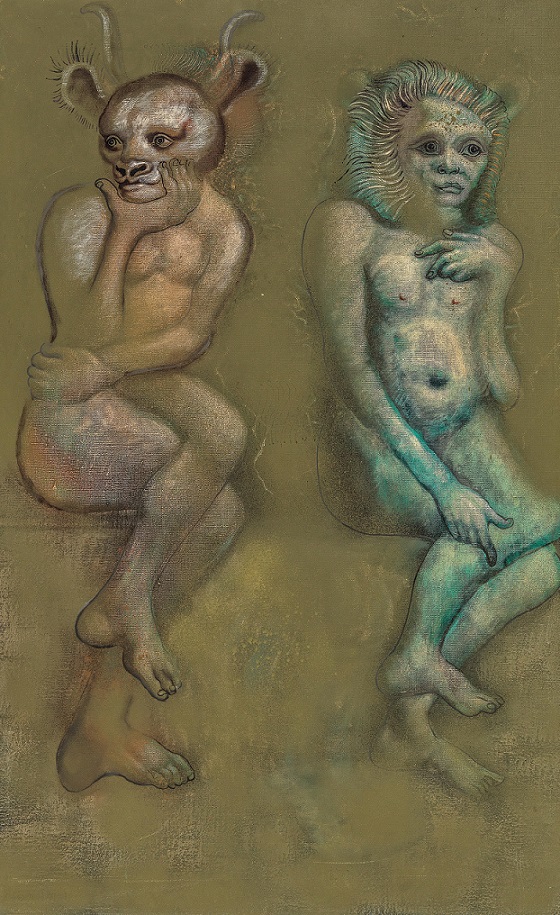
W Polsce, chwilowo prace Lebensteina nie świecą tak jak dawniej i może dlatego jest dobra pora by zainteresować się jego lepszymi olejami, tak jak ten z Dorotheum, by je zbierać do kolekcji.
Lot 532. Jan Lebenstein * (Brzesc nad Bugiem 1930–1999 Krakow). Derrière de paradis, 1971, titled, signed and dated Lebenstein 1971 on the reverse, oil and acrylic on canvas, 116 x 73 cm, framed. Provenance: Galerie Montjoie, Brussels, acquired from the above by the present owner. Private Collection, Belgium. Exhibited: Warsaw, Galeria Zacheta, May 1992 (label on the reverse). Estimate 13,000 euro. Dorotheum. 11/26/20





 Polish Art Corner