Malarz współczesny ze sporą siła przebicia na rynkach zachodnich. Większośc jego prac stanowią opowieści przy których warto się zatrzymać i przemyśleć.
Lot 1067. Jaroslaw Modzelewski, 1955 Warschau. “Caritas – dziewczynki” (Caritas girls), 1998. Eitempera auf Leinwand. 140 x 200cm. Signiert, betitelt, datiert und bezeichnet verso: Jaroslaw Modzelewski “Caritas – dziewczynki” 1998 140 x 200 temp.z. Provenienz: – Galeria ZDERZAK, Krakau (Aufkleber). Estimate 8,000 – 12,000 euro. Van Ham. 06/23/21
Napoleon Michał Juliusz Iłłakowicz.Portrait of a Noble Woman
Niezwykle rzadki malarz a w dodatku przegapiłem aukcję jego obrazu na aukcji w Wilnie. Portret dostojnej kobiety Napoleona Iłłakowicza, może obecnie niezbyt atrakcyjny, o dziwo znalazł zwolennikow skoro licytacja z wyjściowych 7,800 euro zakończyła sie na 16,000 euro. Może portretowaną byla dość znana osoba? Przedstawiam z opóźnieniem.
Lot 149. Napoleon Michał Juliusz Iłłakowicz (1811 – 1861). A portrait of an Unknown Noble Woman. Oil on canvas, 73 x 59 cm. Estimate 7,800 euro. Vilnaus Auktionas. 05/28/21
Wincenty Wodzinowski.Sunny summer landscape with a boy presenting his mother with a flower, 1905
Lot 902/282. Wincenty Wodzinowski (b. Igolomia 1866, d. Krakow 1940). Sunny summer landscape with a boy presenting his mother with a flower. Signed and dated W. Wodzinowski 1905. Oil on canvas. 80×58 cm. On the reverse of the frame a Polish frame label. Provenance: Bruun Rasmussen auction 763, 2006 no. 1508. Estimate 50,000–60,000 kr. Bruun Rasmussen. 06/02/21. Sold 40,000 kr (ca 5,400 euro)
Warto przeglądać katalogi, zwłaszcza te z malarstwem rosyjskim bo trafić może się dobre polskie malarstwo zagrzebane wśród prac artystów rosyjskich. Nie musi to być jednak Siemiradzki czy Żukowski. Tak się stało na aukcji skandynawskaiej, gdzie w katalogu znalazła się nadzwyczaj dobra praca Wincentego Wodzinowskiego z 1905 roku. Artysta z biegiem czasu rozwodnił swój talent malując niezliczone wersje wieśniaczek z kogutami – jedną z takich prac niedawno pokazywałem. Ten olej z obecnej aukcji pochodzi z dobrego okresu malarza ze znakomitym światłem an płótnie. Wodzinowski podchodził w tym okresie do podobnego tematu, rodzaju sielanki wiejskiej, zapewnie niejednokrotnie czego dowodem jest pocztówka poniżej, przedstawiająca tego samego chłopca-blondasa. Zaninteresowanie tą pracą winno być spore.
Wincenty Wodzinowski.Pieszczoszek. Reprodukcja pracy ukazała się również w Tygodniku Ilustrowanym, 1907
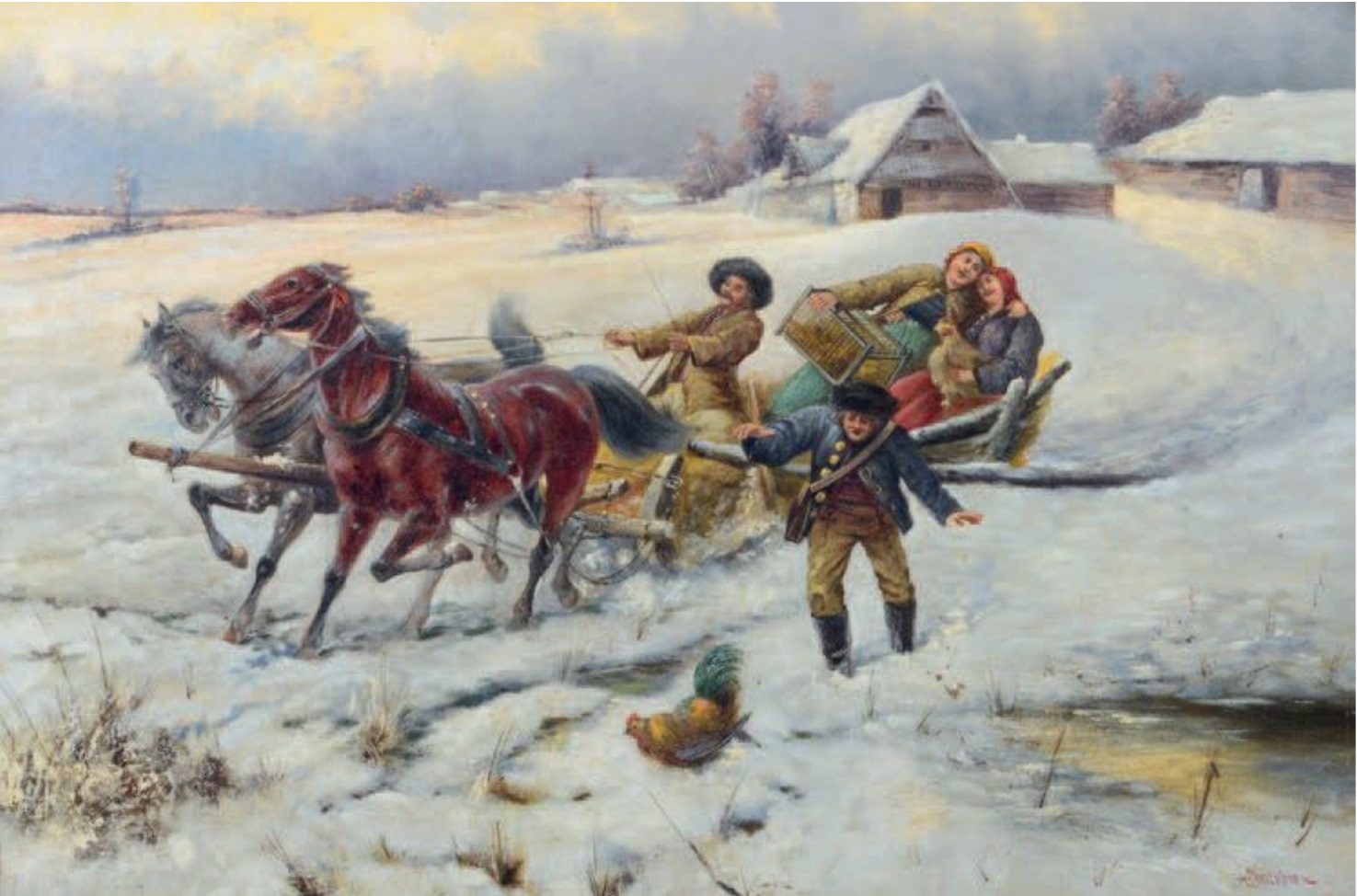
Dość zabawny kuriozalny obrazek nieznanego mi, chyba polskiego(?) ‘monachijczyka’. Wierusz wprowadził temat samotnego lub atakującego wilka zaś A. Wilkow wprowadził temat uciekającego koguta z klatki parze siedzącej w saniach. W razie powodzenia sprzedaży tej wysoko wycenionej pracy można spodziewać się rozmnożenia podobnych tematów. Medal za pomysł!
Lot 226. A.WILKOW, école polonaise de la fin du XIXe siècle. Le coq échappé du traîneau. Huile sur toile, signée en bas à droite. Dans son cadre d’origine en bois doré. 53 x 80 cm. Estimate 600 – 800 euro. Tierry et Maigret. 06/16/21
Praca Anny Guntner są bardzo rzadkie na rynkach zachodnich oraz na rynkach antykwarycznych w Polsce. Są już bardzo drogie. Artystka wyprzedziła swoim surrealizmem o kilkadziesiąt lat Rafała Olbińskiego, który wygląda przy niej (moim zdaniem) nijako. Kilka prac Anny Guntner było sprzedanych w ostatnich kilku latach do $20,000 lecz kominem cenowym była w 2018 roku jej praca w USA za $55,000: https://polishartcorner.com/2019/07/26/anna-guntner-1933-2013/. Obecnie, w Szkokholmie może paść kolejny rekord.
1623649. ANNA GÜNTNER (POLISH 1933-2013). Untitled. Signed and dated on verso Anna Güntner 1963. Oil on canvas, about 133 x 83 cm. Signed and dated. Oil on canvas. In writing on verso “Oddac do desy” and exhibition label. PROVENANCE: Private collection in Stockholm. Estimate SEK125,000 (ca. 12,300 euro). Current bid SEK 424,425 (ca 42,000 euro). Crafoord Stockholm. 05/30/21. Sold SEK 667,884 (ca 65,930 euro)
Wojciech Kossak.Bildnis eines Fuchses mit weißer Blesse, 1927
To jest najprawdopodobniej praca Wojciecha Kossak ale ta główka końska jest bardzo, bardzo słaba. Dorotheum wyceniło ją solidnie na 400 euro ale widzę, że licytacja obecnie osiągnęła już 550 euro. Nie warto kupować słabej pracy dobrego malarza, tylko po to by wisiało na ścianie znane nazwisko. Zanaczące polskie domy aukcyjne tej pracy nie przyjmą do siebie na aukcję, pozostaną zatem galerie oraz …Allegro, które przyjmie wszystko.
Lot No. 138-073382/0007. Wojciech (Adalbert) Kossak (Paris 1857-1942 Krakau). Bildnis eines Fuchses mit weißer Blesse, signiert und datiert Wojciech Kossak 1927, verso altes polnisches Klebeetikett, Mischtechnik auf Platte, 30 x 24 cm, gerahmt, beschädigt (Sprünge am linken Rand), Rahmen beschädigt. Estimate 400 euro. Dorotheum. 06/08/21
Stanisław Ignacy Witkiewicz. Weibliches Portrait, 1938
Moim zdanie, ten pastel Witkacego bezsprzecznie zostane dołączony do najważniejszych tegorocznych znalezisk na rynkach zachodnich. Trudno sobie wyobrazić cenę w Polsce ale to będzie wielokrotność tej niemieckiej. Dlatego, osoba, która widzi tę pracę u siebie na ścianie winna walczyć o nią w Niemczech. Pozostaje do ustalenia nazwisko kobiety przedstawionej na pracy.
Lot 221. Stanislaw Ignacy Witkiewicz –Weibliches Portrait, 1938. Pastel chalks on black card 64.7 x 48.6 cm Framed under glass. Signed, dated, and inscribed ‘Ign Witkiewicz 1938 30/III (T. B+d) NP/NTT + herb.’ in white lower left. – In fine condition with fresh colours. Mounted on supporting card. Stanislaw Ignacy Witkiewicz (Witkacy) was a writer, philosopher and artist blessed with a number of creative talents. In 1924 Witkacy founded the company “S.I. Witkiewicz”, in whose name he accepted portrait commissions in order to support himself financially. As his only employee he personally compiled something like a set of contractual guidelines for his clients, containing 17 paragraphs. These dictated, for example, that clients had no right to have the work destroyed if they were unsatisfied, that they were not allowed to see it before completion, that they were to appear punctually as models and that they were not allowed to express any criticism of the final artistic product. In addition, Witkacy defined seven types of portraits: clients could choose among them and the price was also determined according to them (cf. Stanislaw Ignacy Witkiewicz, Rules of the S.I. Witkiewicz Portrait-Painting Firm, Warschau 1932 [trans. from Polish by Beata Zgodzinska and Beata Brodniewicz], cited in: The Polish Journal of Aesthetics, vol. 31 4/2014, pp. 53-58).
The artist often consumed various stimulants or other drugs during the process of creating his work, and he always placed their abbreviations prominently in his pictures, together with his signature, the date and the selected portrait type. The inscription on our intense portrait indicates that Witkacy found himself in a more abstinent phase of his work and that, in the context of this portrait’s production, he did not smoke (“NP”), did not drink alcohol (“NTT”) and did drink tea (“herb.”) (cf. Stanislaw Ignacy Witkiewicz, Narcotics – Nicotine, Alcohol, Cocaine, Peyote, Morphine, Ether + Appendices, Prag 2018, trans. from Polish by Soren Gauger, pp. 9 f.). As a type “B+d”, this work brings out the character of the female model and simultaneously underscores her beauty. Portraits from this category can display caricature-like tendencies, for example, in the slight enlargement of individual passages of the face (cf. op. cit., pp. 54-58).
Witkacy put an end to his life with a decisiveness resembling that of his personal perspective on art. Fleeing from advancing German troops, he died in 1939 from an overdose of sleeping pills. His lover Czeslawa Okninska survived the attempted double suicide. Estimate 20,000 – 30,000 euro. Lempertz. 06/18/21. Sold 90,000 euro (hammer)
Martwa natura kwiatowa Mojżesza Kislinga po bardzo autrakcyjnej cenie wyjściowej. Na tę niską cenę składa się brak proweniencji oraz brak informacji o potwierdzeniu autentyczności przez Marca Ottaviego. Obraz może okazać się prawdziwy a może to być bust. Praca ma bardzo mocną fakturę malarską, zwłaszcza na partii wazonu. Przed licytacją warto popytać i poczytać.
Lot 898. Kisling, Moise (1891 – 1953), Vase de Fleurs, wohl 1940/50er Jahre, re. u. sign., ca. 27,5 x 19 cm, gerahmt. M. Kisling war ein französischer Maler polnisch-jüdischer Herkunft. Kisling lebte u. arbeitete im Viertel Montparnasse, wo er in der Künstlersiedlung La Ruche verkehrte. Der in seinen Landschaftsmalereien verwendete Stil ist dem von Marc Chagall ähnlich, aber er war ein Meister der Darstellung des weiblichen Körpers, u. seine surrealen Aktbilder und Porträts fanden den größten Beifall. Starting 8,000 euro. Kunst- und Auktionshaus. 06/08/21
Lot 49. BOLESLAS BIEGAS (1877-1954). CHWILA (UN MOMENT), VERS 1903-1904. Bronze de patine brun-roux. Signé et titré. Fonte d’époque. Bronze with red-brown patina; signed and titled; cast during artist’s lifetime. 38 CM • 15 IN. Un avis d’inclusion dans le catalogue raisonné Boleslas Biegas du Comité Biegas avec le soutien de la Société Historique et Littéraire Polonaise (SHLP), signé par Monsieur Xavier Deryng et Madame Anna Czarnocka le 24 novembre 2020, sera remis à l’acquéreur. PROVENANCE: Offert par l’artiste à l’écrivain Louis Mouilleseaux (1895-1967) dans les années 1930 puis par descendance. Collection particulière, France. EXPOSITION: Paris, Galerie des Artistes Modernes, 23 mars-4 avril 1908, n° 31. ŒUVRE EN RAPPORT Boleslas Biegas (1877-1954), William Shakespeare, 1929, huile sur panneau, 82,5 x 61,5 CM, collection particulière. “La première impression, en pénétrant dans cet atelier de Vaugirard où travaille solitairement le plus doux des révoltés polonais, c’est la stupeur. Des échevèlements de corps diaphanes, des filles-fleurs, des nonnes extatiques, des sanglots concrétisés, des étreintes, des mains crispées, des cauchemars, des sphinx, tout un monde d’imaginations, tourmentées, mystiques, déréglées, d’une étrangeté irréelle, systématiquement éloignée de la nature. La statuaire de M. Biegas nous est quasi-impénétrable. Il semble qu’il ait voulu réaliser des hallucinations. Son symbolisme déconcerte, terrifie. II m’apparaît bien qu’au lieu d’équilibrer des plans, des masses et des volumes (comme ont fait ingénument tous les sculpteurs depuis Scopas jusqu’à Rodin, en passant par Donatello, Claus Sluter, Michel Colombe, Michel-Ange et Pierre Puget). M. Biegas a tenté d’intégrer dans l’art plastique le plus concret qui soit, – la sculpture, – tout ce qui ressortit plutôt à la littérature, à la musique et même à la peinture. Entreprise hardie, singulière et respectable profondément, comme ce qui cherche à innover et à s’élever, que M. Biegas se soit trompé parfois, il se peut. Mais le poète en statuaire qu’est M. Biegas est trop indépendant pour ne pas admettre qu’on le discute. II a lutté contre l’École et la férule officielle en son pays. Il devra lutter aussi chez nous. Mais cette perspective n’est point pour effrayer une telle âme. Faire ouïr – par le moyen du ciseau et du bloc – les voix élémentales, exprimer le mystère, le fugace, l’infini, fixer dans le bronze l’insaisissable, quelle plus noble chimère ? Je m’empresse d’ajouter qu’à tous ces concepts d’une statuaire philosophique et poétique, M. Boleslas Biegas sait juxtaposer, en ses solides et expressifs bustes (ceux de Mme de Bosznanska, de Verhaeren, de Fontainas), les mérites d’une exécution sobre, volontaire, et puissamment réaliste.” Louis Vauxcelles, “Visite d’Ateliers. M. Boleslas Biegas”, in Gil Blas, Paris, 16 février 1910, n° 12057. Estimate 20,000 – 30,000 euro. Tajan. 06/15/21. Sold 21,000 euro
By zatrzeć przykre wrażenie poprzedniego wpisu, przedstawiam wielki cymes z Francji, czyli orygialną rzeźbę Bolesława Biegasa z 1903/4 roku a także pośmertny odlew innej jego pracy. Kłaniam się nisko Biegasowi-rzeźbiarzowi. Chwila ma piękną historię wystawienniczą oraz znakomitą proweniencję. Być może jest to egzemplarz jednostkowy ale pewności nie mam czy na początku XX wieku we Francji oznaczano ilość odlanych egzemplarzy. W przypadku tego oryginału to nie ma znaczenia.
Bolesław Biegas.L’ÉTREINTE
Lot 48. BOLESLAS BIEGAS (1877-1954). L’ÉTREINTE. Bronze de patine brune contrastée. Signé et numéroté ‘2/8’ avec le cachet de fondeur ‘Rosini/Fondeur d’art à la cire/Paris’. Fonte posthume, le modèle en terre cuite conçu en 1925. Bronze with brown patina; signed, numbered ‘2/8’ and stamped with the foundry mark ‘Rosini/Fondeur d’art à la cire/Paris’; posthumous cast, the terracotta model designed in 1925, 36 CM • 14 1/8 IN. PROVENANCE: Collection particulière, France. “Votre pouce de modeleur est expert. La matière obéit admirablement aux moindres inflexions de vos doigts savants et fiévreux. Votre métier n’est pas celui qu’on enseigne, mais celui qui vous est venu, naturellement, de votre cerveau qui concevait et enfantait. Vous faites parler et tressaillir le bloc de glaise comme si tout l’organisme humain y était emprisonné. Une bouche, un front, des yeux sont pour vous bien plus que de la chair : ils sont avant tout une pensée, une volonté, un sentiment. Rien ne vous intéresse, à moins que ce rien ne concoure à l’expression. Voilà pourquoi je vous aime surtout dans votre lutte avec la réalité profonde et frissonnante que vous dotez d’une intensité telle que l’âme humaine y apparaît comme chez les vrais maîtres.” Émile Verhaeren, Boleslas Biegas, sculpteur et peintre : album, Louis Theuveny Éd., Paris : s.d. (1906), p. 11. Estimate 8,000 – 12,000 euro. Tajan. 06/15/21. Sold 6,000 euro






 Polish Art Corner