Dwie komódki z namalowanymi panelami przez Boleslawa Biegasa. Takiego rarytasu jeszcze nie było na rynku. Kolekcjonerów prac Biegasa jest wielu i nie sądzę by przeszli obojętnie. To lepsze od Wierusza i Czachórskiego razem!
Bolesław Biegas. Szafka
Lot 258. Bolesla BIEGAS (1877 – 1954), circa 1905. Suite of two green lacquered wooden furniture, presenting symbolist paintings on the front, 98 x 152 x 36 cm. Provenance: Artist’s studio located at 233 bis, rue du Faubourg Saint-Honoré (Paris). Bibliography: Album of the studio Charles Boleslas Biegas, Sculptor and Painter, published in 1906 by Louis Theuveny in Paris, page 4. A certificate from the Biegas Committee dated May 18, 2009 will be given to the purchaser. Estimate 18,000 – 20,000 euro. Millon. 12/01/20. Sold 42,900 euro
Ciekawe polonicum, Piotr Czartoryski w mundurze generała wojsk rosyjskich, z przypietym orderem Aleksanra Newskiego i jak należy rozumieć, służył Rosji jeszcze przed pierwszym rozbiorem Rzeczypospolitej. Piotr Piotrowicz Czartoryski (czyli sym Piotra), to chyba mało znana postać (jeśli w ogóle znana) w historii Polski a wygląda, że może być znana w Rosjii.
P. Kacper Krasicki przesłał 100% wiarygodną inforomację, że Piotr Czartoryski to postać wymyślona. Zatem, zmieniłem tytuł, zostawiając resztę ku przestrodze kupujących. Dziękuję p. KK za korektę.
Lot 6492. Russian: around 1768/1771. Miniature portrait of General Peter Petrovich Czertoryzhki in blue uniform with medal around 1768/1771. Miniature portrait of General Peter Petrovich Czertoryzhki (1734-13.8.1771) in the blue vice uniform of a general of the Russian cavalry, with a red ribbon and breast star of the Imperial Russian Order of St. Alexander Nevsky. Watercolor and gouache on ivory. 7.4 x 5.9 cm (oval). In a gold-plated metal frame with a grooved border. Old handwritten label in Cyrillic with the name of the sitter on the reverse. The portrayed was a Brigadier in 1767 and General Major from September 22, 1768. The old Cyrillic handwriting on the cover card of the miniature identifies the sitter and describes his uniform as that of the cavalry guard. The inscription is by the same hand as that on the cardboard cover of the portrait of the young Prince Nikolai Sergejewitsch Galitzin, shown in Sergey Podstanitskiy: Portretnaya miniatiura iz chastnyh sobranyi, Moscow 2007, p. Opening 350 euro. Bassenge. 11/26/20
Lista generałów wojsk rosyjskich noszących nazwisko ‘Czartoryski’ lub zbliżone do tego nazwiska, w pisowni języka rosyjskiego. Dane te zawarte są na rosyjskiej stronie: http://www.rusgeneral.ru/general_ch1.html (patrz dyskusja).
Miniatura wykonana przez niezidentyfikowanego artystę (jest sygnowana, lecz sygnatura jest nieczytelna) historycznej postaci, generała Stanisława Gawrońskiego. Więcej o osobie portretowanej w opisie katalogowym, oraz w sieci, włączywszy fotografię grobu na cmentarzu Pere-Lachaise w Paryżu. Na miniatury można patrzeć pod kątem wartości historycznej i artystycznej. Czasami jedno przewyża drugie. Idealna sytuacja to taka, gdy portret znanej osoby wykonał znany artysta. Jak jest w tym przypadku? Wydaje mi się, że historyk, na kanwie tej miniatury, mógłby spróbować dokonać kwerendy by przybliżyć tę postać. Jestem przekonay, że materiału znalazłoby się sporo.
Lot 6498. Polish: around 1830. Miniature portrait of the Polish freedom fighter Stanislaw Gawronski with medal around 1830. Miniature portrait of the Polish freedom fighter Lieutenant Colonel Stanislaw Gawronski (1784-1860) with mustache and whiskers, in dark uniform with white lapels and silver-colored epaulettes and lacing, on the left chest the Polish Order of Merit “Virtuti Militari” and the badge for 15 years of loyal service; against a cloudy sky. Signed “Jos. C […] px” in ascending order along the right edge of the picture (fragmentary preserved). Watercolor and gouache on ivory. 6 x 4.5 cm (oval). In an ivory frame. From 1807 Gawronski fought in the army of the Duchy of Warsaw, in the campaigns of 1809 and 1812 at Sandomierz and Czirikowo. He was captured on the Berezina in 1812. After his release in 1815, he joined the army of the Kingdom of Poland. He served in the 2nd and 5th Uhlan Regiment; On the present miniature he is wearing the uniform of a Lieutenant Colonel of the 2nd Uhlan Regiment of the Kingdom of Poland ( Tsarstvo Pol’skoe ), 1827-1831. He was an activist of the Polish freedom movement against Tsar Nicholas I of Russia. In the battle near Kolacz he was captured by the Russians, but was freed by his soldiers. He fought in Minsk, Kaluszyn, Krynka, Miedzyrzec Podlaski and Rogoznica. After the suppression of the Polish freedom uprising in 1831, he emigrated, like so many other Poles, to France, where he headed an emigre association. He was a member of the Union of Polish National Unity. He lived in Paris and died there in 1860. He was also a member of the Masonic Lodge “Swiatynia Równosci”. Galerie Bassenge thanks Mr. Stanislav Lyulin for his help with the description of the present miniature. Many thanks to Sergey Golovin for identifying the sitter. Estimate 600 euro. Galerie Bassenge. 11/26/20
Eugeniusz Nieczuja Urbański. amenreigen in der Blumenwiese
Sielankowy, secesyjny w stylu, obrazek kilku pań i podlotków zgromadzonych na kwiecistej trawie w letni ciepły dzień. Eugeniusz Urbański herbu Nieczuja był znany z portretów pięknych pań przedstawianych w podobnej radosnej kolorystyce. Zgodziłbym się co do wartości tej pracy, jeśli kupiona będzie razem z premium i transportem do domu.
Lot 138-072591/0001. Eugen Urbanski de Nieczuya (Polen 1877-1957). Damenreigen in der Blumenwiese, signiert E. Urbanski de Neczuja, Öl auf Leinwand, 35 x 49 cm. Starting 450 euro. Dorotheum. 11/17/20. Sold 650 euro.
Lot 44. Czeslaw ZAWADZINSKI (1878-1936). Young model with blond hair. Oil on canvas, 33,5 x 25 cm. Signed lower right “Zawadzinski”. Estimate 1,000 – 1,500 euro. Millon. 11/10/20. Sold 1,200 euro
W tej serii trzech obrazów Czesława Zawadzińskiego, dwóch z odbytej aukcji w Millon a jeden z nadchodzącej aukcji, pierszeństwo dałbym portretowi kobiety. Na blogu zarejestrowałem już kilka innych jego OK prac, lecz ten portret daje wybrażenie o potencjale artysty.
Czesław Zawadziński.Bouquet of flowers
Lot 56. Czeslaw ZAWADZINSKI (1878-1936). Bouquet of flowers. Oil on panel, 26.5 x 34.5 cm. Signed lower right “Zawadzinski. Estimate 200 – 300 euro. Millon. 11/10/20. Sold 500 euro
Czesław Zawadziński.Spring floral composition
Lot 387. Czeslaw ZAWADZINSK.I École polonaise (1878 1936). Oil on panel: Spring floral composition. Signed: Zawadzinski. Size: 59 x 168 cm. Estimate 600 – 800 euro. Horta. 11/17/20
Maria Melania Mutermilch. Still life in Izvestia, 1918
Lot 40. Marie Mela MUTER (Franco-Polish, 1876-1967). Still life in Izvestia, 1918. Canvas. H. 75, W. 81 cm. Provenance: former collection of Eirik Labonne (1888-1971), French ambassador to the Spanish Republic in Barcelona (1937-1938). Exhibition: Barcelona, 1938, 1911 catalogue attached. Bibliography: “Mela Muter, Malarstwo Peinture”, catalogue works of the University Museum in Torun, 2010, to be compared with a still life with melons and grapes, p. 35. Franco-Polish painter Mela Muter was born in Warsaw in 1876. She moved to Paris in 1901 where she remained until her death in 1967. Wife of a socialist journalist, she attended various academies of painting. At the Grande Chaumière where Jules Pascin, Camille Claudel, Estève and Eileen Gray were students for a time, she perfected her art until the Chéron gallery hired her. Various exhibitions follow at the Salon d’automne, in Barcelona, Germany or the United States. Among her friends are Kees van Dongen, with whom she exhibits, and various personalities of the time such as Clemenceau, Ravel, Satie and the young poet Rilke, whose portraits she draws. Her women with children and still lifes with fruit bursting with light are particularly appreciated. The one we are presenting evokes Cézanne and Fauvism. The painter inscribes her composition between two countries, Parisian modernity and Russia discreetly present through the Cyrillic characters of a newspaper. The banality of this table is transcended by apples that become solar stars. Rainer Maria Rilke wrote: “If your daily newspaper seems poor to you, do not accuse it. Accuse yourself of not being a poet enough to call its riches to you. The painter and the poet lived a love affair, the beauty of its few fruits telling the same ideal. Estimate 20,000 – 30,000 euro. Roulliac. 12/05/20. Sold 83,000 euro (z opłatami)
Dobra passa prac Meli Muter. Niezwykły wręcz wysyp jej prac od października do grudnia. Aż strach myśleć co będzie w 2021 roku. Tym razem dwie martwe natury, jeden pejzaż i jeden portret. Warto popatrzeć na te dwie martwe natury ustawione na stołach. Najważniejsze ich elementy leżą na pomiętych gazetach. Pomięta gazeta jako element dekoracji malarskiej – temat na pracę magisterską. Pomyśleć, że niektórzy malarze bardzo precyzyjnie, czyściutko i nienagannie usawiają elementy tworzące podobne tematycznie prace a po wysiłku artystycznym trudno patrzeć na ich finalny produkt. Trochę mnie jednak martwi ta martwa natura z Izwiestią na stole bo gazeta ta nadawała sie jedynie za zawiniecia w nią zdechłego śledzia. Czyżby Mela Muter była w jakimś stopniu sympatyczką komunizmi? Wg starego dowcipu: nie ma PRAWDY w IZWIESTII i nie ma IZWIESTII, czyli wiadomości, w PRAWDZIE. Precz z komuną!
Ciekawy list nadszedł od czytelniczki z Kijowa na temat martwej natury z Izwiestią. Cytuję całość, podając inicjały czytelniczki zamiast imienia i nazwiska:
Dzielę się z Panem swoim przemyśleniem. Izwestia – to była jedyna gazeta w której co dziennie publikowano listę rozstrzelanych danego dnia w trakcie rewolucji. Rok się zgadza 1918. Rodziny, żony codziennie sprawdzały losy mężów, ojców… Po drugie, napis pod słowem Izwestia, jest również dojść czytelny :” Wielki spisek przedstawiciela Francji….” Czy w takim razie, ta martwa natura może mieć większy podtekst? To tylko przemyślenia, skąd taka gazeta pojawiła się na obrazie. Pozdrawiam OB (11/18/20)
Maria Melania Mutermilch. Summer bouquet on a daily newspaper
Lot 2149. Muter (Mutermilch), Mela (Maria Melania) 1876 Warsaw – 1967 Paris. Recto. «Buchtlandschaft (bay landscape)». View of Villeneuve-lès-Avignon. 1940s. Oil on canvas. White shrinking cracks, isolated paint loss. H 49, W 63 cm. Verso. Summer bouquet on a daily newspaper. 1940s. Oil on canvas. Signed lower right and in the depiction lower right on a printed label of the Galerie Gmurzynska, Cologne, handwritten inscribed «M. Muter» and «66 x 51». H 63, W 49 cm. During the cataloging process, the work was detached from its stretcher and the excess layer of paint on the back of the canvas was professionally removed. In the process, the flower still life came to light. The label of the Gmurzynska Gallery was left on the back. In the course of exposing the painting on the back, the front has been professionally cleaned and is newly varnished. Another printed label of the Galerie Gmurzynska, Cologne, with the handwritten rather badly legible work’s data is on the detached stretcher. A separate printed label of the Galerie Bargera, Cologne, again on the stretcher, is handwritten dated, titled, numbered «No 39» as well as inscribed with the work’s and the artist’s data. Galerie Bargera is an alternative name of the Galerie Gmurzynska. Kenda Bargera and Antonina Gmurzynska jointly founded an art gallery in Cologne in 1964, from which the Galerie Gmurzynska, which still exists today, emerged. Mela Muter, who was born in Warsaw, enrolled at several private art schools after moving to Paris in 1901. But she soon lost interest in academic education and developed her style as an autodidact, which was inspired by her role models Vincent van Gogh and the painters of the Pont-Aven school. Perhaps because of her illustrious acquaintances in the Parisian intellectual circles, she soon gained an excellent reputation as a portrait and landscape painter and showed her works at numerous exhibitions in France and her home country. Due to her Jewish-Polish origin, she became a target of the National Socialists, who occupied France from 1940 onwards, which is why she swapped her life in Paris for a discreet retreat near Avignon. Like countless of her works, the present painting shows part of the papal city in the South of France, namely the view of the Tour Philippe-le-Bel and the Fort Saint-André in Villeneuve-lès-Avignon. The still life on the back shows colourful fireworks of typical summer flowers, such as daisies, garden cosmos and zinnias. The flowers are arranged in a yellowish spherical vase, which is placed on a daily newspaper that is draped in a sweeping manner. When she lived in Avignon, Mela Muter often painted both sides of a canvas, as her financial means for supplies were limited at that time. Authentication: We would like to thank Ms Urszula Lazwoski, Kingston, Massachusetts, for the authentication via E-Mail, based on photos, 14.09.2020. Provenance: private possession Wiesbaden. Literature: Galerie Gmurzynska, Mela Muter, Retrospektiv-Ausstellung, Cologne 1967, No. 13 (cf.). Reserve 8,000 euro. Kaupp. 11/20/20. Sold 35,000 euro
Maria Melania Mutermilch. View of Villeneuve-lès-AvignonMaria Melania Mutermilch. Portrait of His Excellency Ambassador Eirik Labonne, 1938
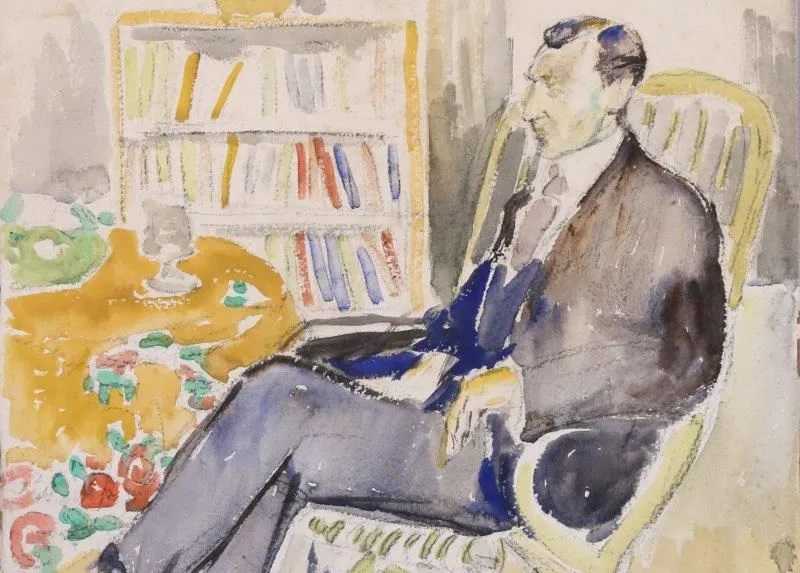
Lot 39. Marie Mela MUTER (Franco-Polish, 1876-1967). Portrait of His Excellency Ambassador Eirik Labonne, 1938. Watercolour and pencil. H. 40.5 L. 38 cm. Provenance: former collection Eirik Labonne (1888-1971), French ambassador to the Spanish Republic in Barcelona (1937-1938). Estimate 800 – 1,200 euro. Roulliac. 12/05/20. Sold 5,500 euro (z opłatami)
Lot 29. MARIAN STRONSKY (Losowa 1892-1977). Bouquet of flowers. Oil on panel, 44.5 x 34.5 cm. Signed lower right “Stronsky. Estimate 800 – 1,000 euro. Millon. 11/10/20. Sold 800 euro
Gwoli mojej (pseudo)dziennikarskiej dokładności przedstawiam dwie martwe natury Mariana Strońskiego, sprzedane w Millon. Olej na drzewie okazał się subiektywnie o niebo lepszy i w dodatku nieco tańszy od uszkodzonej ‘mixed media’ pracy, choć obie martwe natury kwiatowe specjalnie niczym nie wyróżniają się.
Marian Stroński. Bouquet
Lot 27. MARIAN STRONSKY (Losowa 1892-1977). Bouquet. Oil, gouache and pastel on paper, 52 x 33 cm. Signed lower right “M Stronsky”. Estimate 1,000 – 1,500 euro. Millon. 11/10/20. Sold 880 euro.
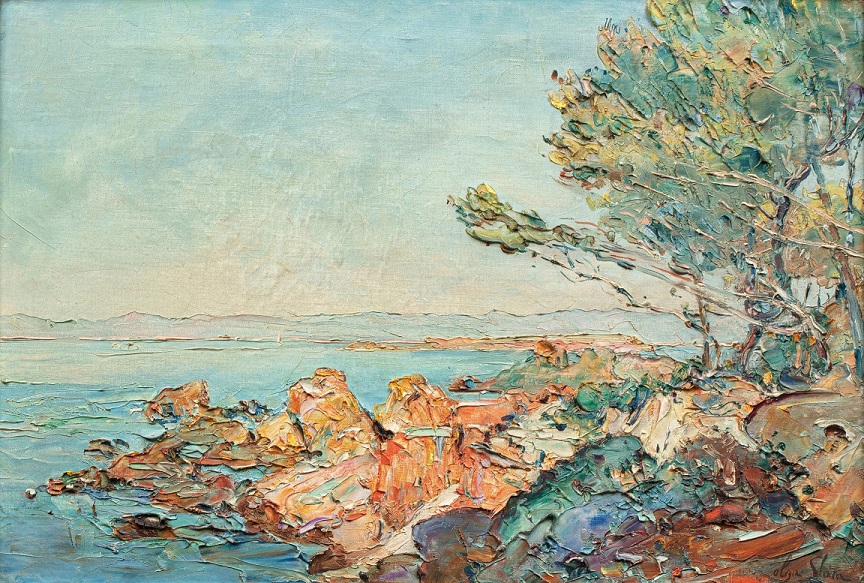
Olga Słomczyńska.Coastal landscape near Saint-Raphäel
Olga Słomczyńska vel Slomszynska vel Slom to artystka polskigo pochodzenia, której prace zaczynają w końcu docierać do Polski. Jest ich niewiele lecz mogą czasami konkurować ze szpachlą Terlikowskiego. Ten olej, wykonany polączeniem grubej pasty drzew i skał z gładkością nieba pokazuje m, że niekoniecznie trzeba być tach nonszalancki jak wspomniany Terlikowski, lecz można bardziej subtelnie tworzyć. Bardzo dobra praca tej artystki.
Lot 61. Olga SLOMSZYNSKA known as Olga SLOM (Switzerland 1881- France 1941). Coastal landscape near Saint-Raphäel. Oil on canvas, 33 x 55 cm. Signed lower right “Olga Slom”. On the back, a charcoal sketch signed and located “Near Saint-Raphaël- The red rocks near Saint-Raphaël Olga Slom”. Estimate 600 – 800 euro. Millon. 11/10/20. Sold 1,200 euro.
To jest bardzo ciekwy obraz ucznia Jana Matejki, Władyslawa Rossowskiego. Mało prac tego artysty było/jest na rynku i zapewne dlatego było małe zainteresowanie tą pracą. Obraz ma charkater historyczny i przedstawia moment, jedynego chyba w Rzeczypospolitej, spalenia na stosie kobiety na rynku w Krakowie w 1539 roku. Kobietą była Katarzyna Melchiorowa lub występująca pod nazwiskiem Weiglowa (https://historiamniejznanaizapomniana.wordpress.com/2016/04/19/spalenie-katarzyny-weiglowej/ ). Była oskarżona o apostazję i jej nie wyrzekłą się do końca. Sam mistrz Matejko ‘podchodził’ do tego tematu i znana jest jego akwarela z 1859 roku przechowywana w Lwowskieg Galerii Obrazów.
Jan Matejko. Spalenie Katarzyny Melchiorowej, 1859. Akwarea. Lwowska Galeria Obrazów
Rossowski, wygląda na to, że znał Matejkowski szkic i podjął sie tego tematu w podobny sposób. Sam obraz jest duży, brudny (werniks do usunięcia), ciemny, płótno dublowane i mało efektywny na pierwszy rzut oka. Był wyceniony nisko a sprzedano go za 3,600 euro. Nie zdążyłęm go wprowadzić przed aukcją z kilku powodów: wiele się obecnie dzieje na rynkach zagranicznych i mało mam czasu by wszystko przedstawić, oraz prowadziłem prywatną korespondencję z osobą nt tej pracy. Osoba nie była zachwycona i sugerowała potencjalny brak zainteresowania tą pracą w Polsce. Moje zdanie było i jest inne. Uważam, że z punktu widzenia historycznego jest to ważna praca (inna rzecz czy wykonanie jej jest ‘mistrzowskie’) oraz była wystawiana na terenach polskich w czasie zaborów na co są ‘podkładki’ katalogowe. Uważałem, za okazję kupienie jej za 2,000 euro a cenę Polską oceniam na ponad 30,000 PLN. Jestem przekonany, że po konserwacji obraz zajaśnieje a moja wycena w Polsce okaże się mizernie nieadekwatna.
Lot 117. Władysław Rossowski (1857 – 1923). De brandstapel. Oil on canvas, 138 x 68 cm. Gesigneerd en gedateerd Krakau 1883 r.o. Vermoedelijk is de vrouw op de brandstapel Katarzyna Weiglowa (circa 1460 – 1539), een katholieke vrouw die zich bekeerde tot het jodendom en beschuldigd werd van afvalligheid. Reserve 800 euro. Estimate 1,000 – 2,000 euro. Vendu Rotterdam.11/10/20. Sold 3,600 euro
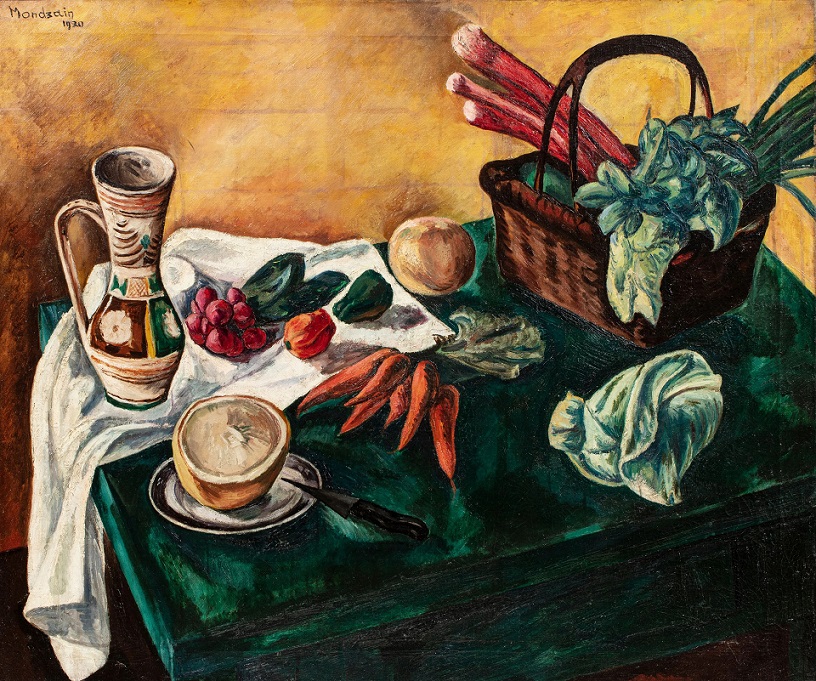
Szymon Mondzain.Composition with pitcher and vegetables, 1920
Lot 41. Simon MONDZAIN (Chelm 1888 – Paris 1979). Composition with pitcher and vegetables. Made in 1920. Oil on canvas, 79 x 94 cm. Signed and dated at the top left “Mondzain 1920”. Contresigned, dated and located on the back of the canvas “Mondzain Paris 1920” Contresigned and numbered on the frame “Mondzain n°3. Estimate 15,000 – 20,000 euro. Millon. 11/10/20
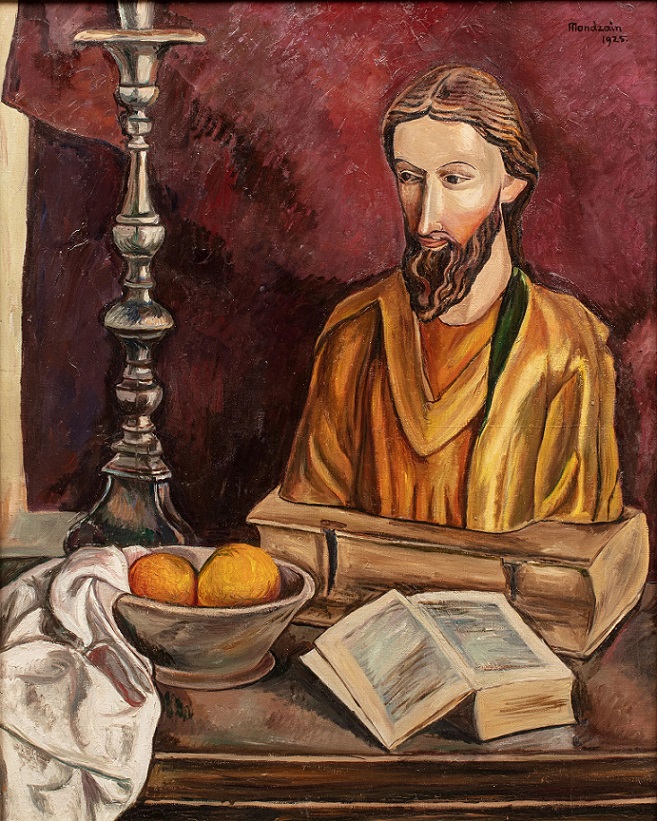
W moich oczach jest to bardzo nierówny malarz i obok dobrych prac pojawia się sporo słabych lub (również w moich oczach) knotów jak np. na samym dole wpisu, martwa natura z popiersiem osoby przypominającej Chrstusa przyglądającego się pomarańczom na talerzu. Martwa natura z warzywami na stole została z kolei chyba uznana za arcydzieło, sądząc po widełkach estymacji. Rok temu dokładnie ta praca została sprzedana za 8,000 euro (https://polishartcorner.com/2019/09/24/szymon-mondzain-1890-1979-6/ ) a teraz ktoś zwietrzył ‘dobry interes’. Zobaczymy czy ta francuska przewałka się uda.
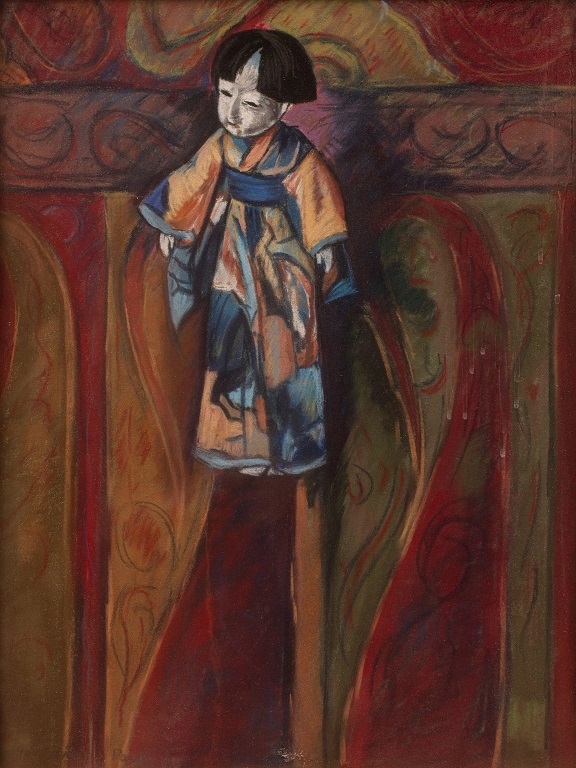
Szymon Mondzain.Japanese composition, 1919
Lot 45. Simon MONDZAIN (Chelm 1888 – Paris 1979). Japanese composition. Made in 1919, 62 x 48 cm. Pastel on paper. Signed, dated and located at the bottom right ” Mondzain 19 Pariz”. Estimate 3,000 – 4,000 euro. Millon. 11/10/20
Szymon Mondzain.Still life with book and candlestick, 1925
Lot 46. Simon MONDZAIN (Chelm 1888 – Paris 1979). Still life with book and candlestick. Made in 1925. Oil on canvas, 81 x 65 cm. Signed and dated top right “Mondzain 1925”. Bibliography: Charles Kunstler, Mondzain, Paris, 1948, Editions Montbrun, reproduction n°IX. Estimate 3,000 – 4,000 euro. Millon. 11/10/20






 Polish Art Corner