Bolesław Biegas (1877 – 1954)

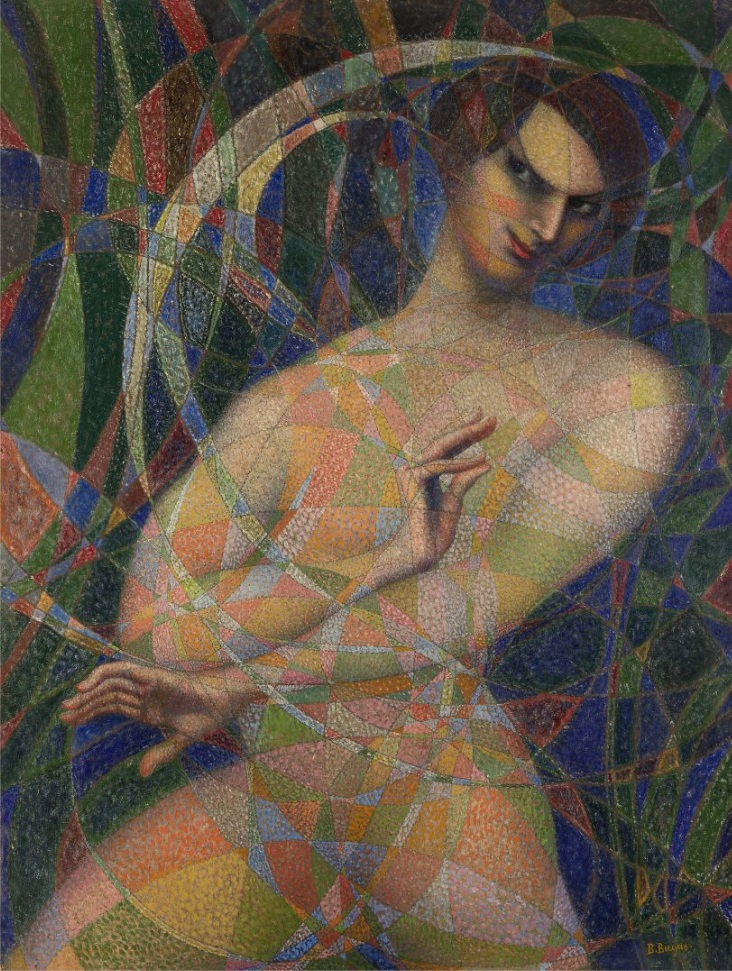
Bolesław Biegas. La danse du mépris

Skopiowałem niemal z obowiązku ten informacyjny opis katalogowy. Znakomita proweniencja oraz relatywna rzadkość prac sferycznych tego artysty na rynku aukcyjnym zaowocowały dużym zainteresowaniem tą pracą i wysoką ceną sprzedaży.

Lot 34. Boleslas BIEGAS (1877-1954). La danse du mépris, circa 1922-1925. Huile sur carton marouflé sur toile signée en bas à droite « B. Biegas ». Au dos sur une étiquette à l’encre : « 1937. APM/87 danse du mépris, 1937 ». 99 x 75 cm. Provenance : – Atelier de l’artiste légué à la Société Historique et Littéraire Polonaise de Paris (1954); – Galerie Jan Krugier, Genève, acquise auprès de la précédente au début des années 1970; – Galerie Valois, Paris, acquise auprès de la précédente au début des années 1980; – « Vente atelier Boleslas Biegas » Me Pierre Cornette de Saint Cyr, 30 juin 1987, Hôtel Drouot, n° 70, reproduit en couleurs. – Collection particulière. Un avis d’inclusion dans le catalogue raisonné du Comité Biegas avec le soutien de la Société Historique et Littéraire Polonaise (SHLP), signé par Monsieur Xavier Deryng et Madame Anna Czarnocka, sera remis à l’acquéreur. Estimate 25,000 – 30,000 euro. Nicolas Nouvelet Commissaire-priseur. 06/27/23. Sold 48,000 euro

Boleslas Biegas probably began painting his first spherical paintings in1912. Guillaume Apollinaire, on the occasion of his exhibition organized from the 21st of June to the 5th of July by the Amicale des Arts, in the Femina Theatre avenue des Champs Élysées, remarked on the circular elements in his paintings in L’Intrangiseant dated June 28th : “The firmament to which his fervor raises him is populated by beings in symbolic colors, in beautiful and simple shapes to which the artist imprints his melodious spherical movement. This elevated art, that should be linked with religious art, is worthy of attention”. Biegas will only start using the term “sphérisme” after WWI, during his participation at the Exposition des artistes Peintres et Sculpteurs Polonais, a fundraiser for the Polish soldiers wounded in France, open to the public on November 30th, 1918 in the Palace of the Count Nicolas Potocki, 27 avenue de Friedland, and to which Biegas had sent 49 paintings and 7 sculptures.

In the catalog of the exhibition, 6 pieces are preceded by the statement “Biegas’s invention of spherical paintings”. Biegas painted more than a hundred spherical paintings which he presented at the Salon d’Automne of 1919, at the Salon des Indépendants in 1920, 1921, 1922 and 1923, and especially at the Pavillon de Magny, located 55 avenue Victor Hugo. Unfortunately, no catalog of this exhibition entirely dedicated to spherism was ever published. However, several articles make it possible to establish that it took place from the 20th of March to the beginning of May 1919 and that it included about forty paintings. Spherism had a real impact on the Parisian artistic scene then, as shown by the articles from Pascal Forthuny, Michel Georges-Michel, Gustave Kahn, Louis Vauxcelles and Claude Chauvière. L’Éclair’s columnist entitled his article dated March 20th : “Art or mystification ? Cubism is dead ! We now know “spherism”…which would almost make us regret its predecessor!” In l’Heure dated May 19th, Claude Chauvière entitles his article “Round-Round” and defined Biegas as “the master of circles” : “Biegas sees everything round and he explains it logically : the Earth is round, the moon is round : humans have brain convolutions, blood circulation and the belt-railway make the circular motion uniform ; liquids’ concave or convex menisci ; the spheroidal embryo ; the sound that spreads through waves, sensibility which is projected and perceived through waves, etc…”

Until 1914, Biegas had not shown any kind of interest for the motion of the human body. After WWI, dance occupied a special place in spherism, as well as in the Mystique de l’Infini. The Danse du Mépris perfectly illustrates Biegas’ art’s new orientation, which gave rise to connections that had not yet been explored. In the early 20’s, Biegas was very close to the American dancer Paul Swan “ The Most Beautiful Man in the World”(1) who was very successful with Isadora Duncan and animated his parties in his studio on rue Bagneux. Biegas also knew Jan Reszke, who was approached by Vaclav Nijinsky in 1919 to get Polish citizenship. Starting in 1917, Nijinsky realized drawings based on circles that present, for some of them, astonishing kinship with Spherism. It is difficult to date the Danse du Mépris with precision because Biegas signed his paintings but never dated them, unlike his sculptures. We can assume that the Danse du Mépris was painted around 1922-1925 because after 1925, Biegas only exposed paintings from the Mystique de l’Infini. Xavier Deryng

Adam Styka (1890 – 1959) – falsa kolejna odsłona

Adam Styka. Lovers in the desert. Fals

Pisałem już o tym skunksie w 2020 roku, który wraca teraz jak zły szeląg na rynek (https://polishartcorner.com/2020/11/26/adam-styka-1890-1959-na-pewno-nie-nagel-niemcy-i-desa-unicum-polska/). Warto raz jeszcze zerknąć do tego linku, bo jest tam również o falsie sprzedanym w sławnej Desie-Unicum, falsie tej samej kompozycji(!). Okazuje się, że Nagel sprzedał ten obraz już dwa razy: w 2020 roku za 4,500 euro, potem w 2021 za 5,500 euro (lot 3009, 12/16/21) a obecnie zabrał się zań francuski dom aukcyjny z wyceną 2,000 – 4,000 euro. Może by tak Desa go teraz okazyjnie kupiła by trzymać do pary z tamtym poprzednim, sprzedanym w 2017 roku za 65,000 złotych jako reference samples for a case study w celu kształcenia swoich ekspertów? A propos obecnej sprzedaży we Francji: czy tam nie potrafia się zastanowić nad ceną sprzedaży w Nagel a obecną wyceną by wyciągnąć jakieś wnioski? Warto obecnie porównać ten obraz do prawdziwej i znakomitej kompozycji Adama Styki sprzedanej dzisiaj w Dorotheum: https://polishartcorner.com/2023/06/26/adam-styka-1890-1959-87/.

Przykro było patrzeć jak dwóch frajerów (sala vs internet) biło się o tego falsa, począwszy do 1,500 euro. Cena osiągnięta jednak niższa od tej z Nagel.

Lot 27. STYKA Adam 1890-1959 : Lovers in the desert. Oil on canvas SBG 66 x 76.5 cm. Provenance: Sale Nagel Germany 16/12/21, Private collection. Estimate 2,000 – 4,000 euro. Chaville Enchères. 07/09/23. Sold 4,200 euro

Jerzy Kossak (1886 – 1955)

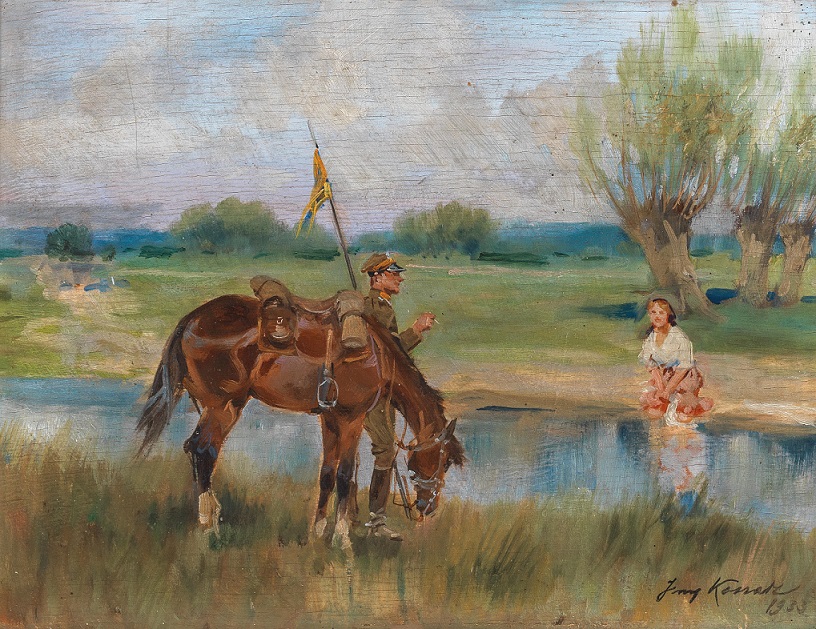
Jerzy Kossak. An Encounter by the River

Lot 246. Jerzy Kossak (Krakow 1886-1955). An Encounter by the River, signed, dated Jerzy Kossak 1933, oil on board, 30 x 40 cm, framed (frame slightly damaged). Estimate 3,400 – 4,000. Dorotheum. 06/26/23. Not sold

Jeden byle jaki obrazek Jerzego Kossaka i niewiele warty (Spotkanie przy rzece) a drugi z wczesnego okresu, być może z okresu I wojny światowej (Walka ułana). Ten drugi wygląda na unikatowy i gdyby w Dorotheum ktoś zdecydowałby się wyjąć ten obraz z ramy to pewnie pojawiłaby się data wykonania. A tak, to właściciel będzie miał miłą niespodziankę i obraz zdąży na jesenną aukcję Kossaków w Desie.

Jerzy Kossak. A Uhlan in Combat

Lot 247. Jerzy Kossak (Krakow 1886-1955). A Uhlan in Combat, signed Jerzy Kossak, oil on board, 50 x 39.5 cm, heavily curved, framed. Estimate 3,800 – 4,500 euro. Dorotheum. 06/26/23. Sold 3,600 euro

J. Konarski (XIX/XX w.)

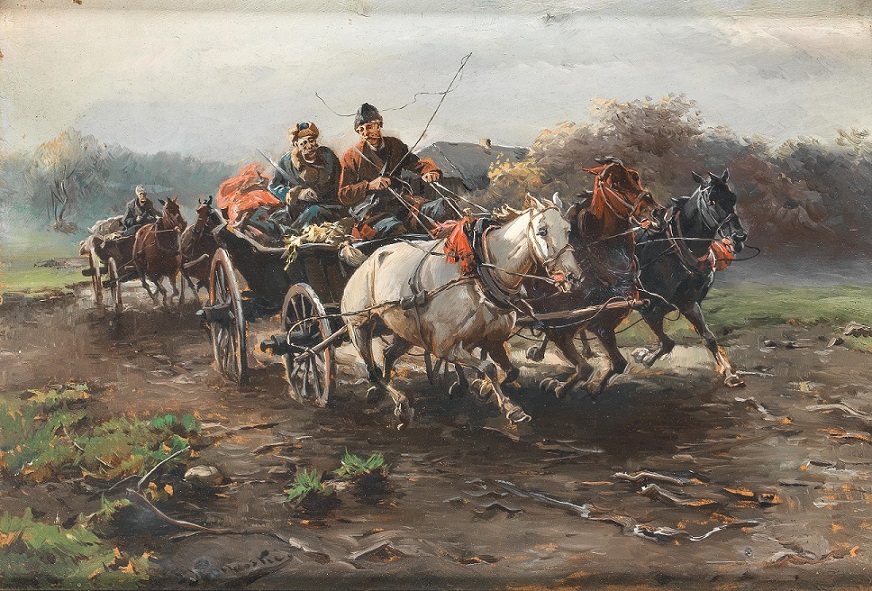
J. Konarski. Die Heimkehr vom Markt

Lot 243. J. Konarski “Die Heimkehr vom Markt“, old title on the reverse, signed J. Konarski, oil on board, 26 x 38.5 cm, framed (behind glass). Estimate 2,800 – 3,400 euro. Dorotheum. 06/26/23. Sold 2,600 euro

Nie wiem dlaczego te ersatze sprzedają się tak dobrze.

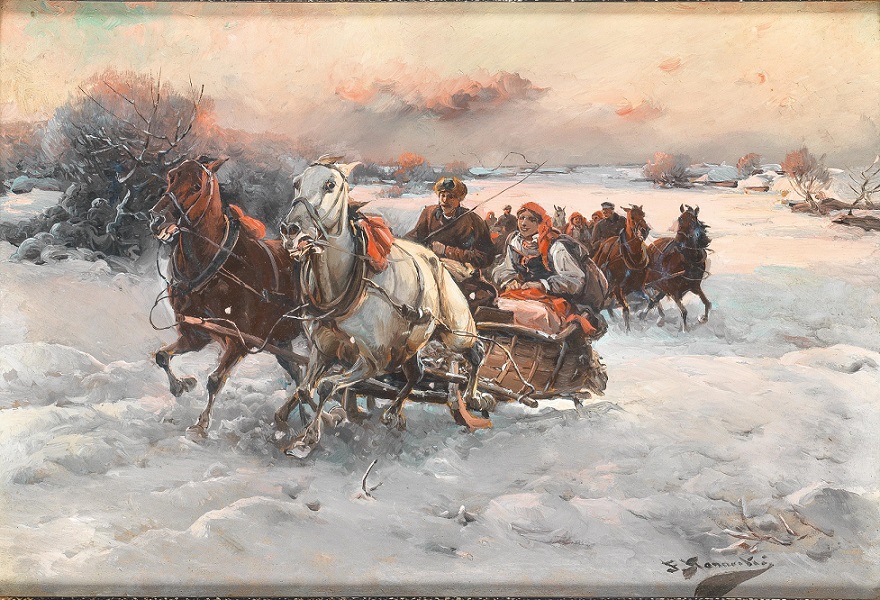
J. Konarski. Aufbruch zur Stadt

Lot. 244. J. Konarski. “Aufbruch zur Stadt“, old title on the reverse, signed J. Konarski, oil on board, 26 x 38.5 cm, framed (behind glass). Estimate 2,800 – 3,400 euro. Dorotheum. 06/26/23. Sold 2,600 euro

Adam Styka (1890 – 1959)

Adam Styka. A Happy Couple in the Desert, 1935

Najlepszy polonik z czerwcowego katalogu Dorotheum. Tak wygląda para rozpalona słońcem i zakochana w wykonaniu Adama Styki. Godna pochwały ostra walka aukcyjna w ostatnich minutach.

Lot 234. Adam Styka (Kielce 1890-1959 Doylestown, Pennsylvania). A Happy Couple in the Desert, signed, dated Adam Styka 1935, verso old exhibition label no. 36073, Adam Styka, oil on canvas, 81 x 65.5 cm. Estimate 6,000 – 8,000 euro. Dorotheum. 06/26/23. Sold 11,000 euro

Tadeusz Rybkowski (1848 – 1926)

Tadeusz Rybkowski. A Sunday ride in a horse-drawn carriage, 1882

Scenka rodzajowa z wczesnego okresu Tadeusza Rybkowskiego przedstawiająca matkę z córką(?) oraz niańkę z dzieckiem siedzących w dorożce zaprzężonej w dwa konie i prowadzonej przez odświetnie ubranego dorożkaża, stojących i czekających aż Żyd podniesie im szlaban na drodze. Życie ziemianina 140 lat temu

Lot 104. Tadeusz Rybkowski (Kielce 1848-1926 Lemberg [Lviv]). A Sunday ride in a horse-drawn carriage, signed, dated Tad. Rybkowski 1882, verso old labels, oil on canvas, 21 x 34 cm, framed, frame damaged, Estimate 2,400 – 3,000 euro. Dorotheum. 06/25/23. Sold 2,000 euro

Katarzyna Kobro (1898 – 1951) ?

ECOLE XX SIECLE dans le goût de Katarzyna KOBRO

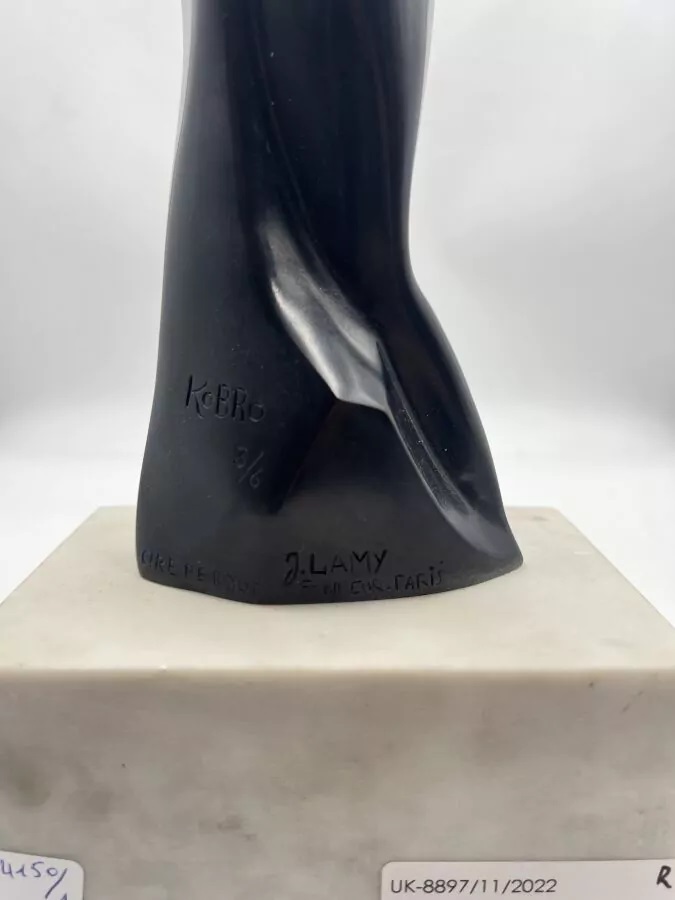
Francuska firma Boisgirard-Antonini wymyśliła, że skoro na rzeźbie znajduje się nazwisko ‘Kobro’, to można ją przypisać tej artystce. Katarzyma Kobro podobnych ‘murzyńskich’ prac kobiecych nie tworzyła ale to nic nie szkodzi. Skoro rzeźba ma czarną patynę, foundry mark, numer odlewu to czemuż nie wycenić jej na 10,000 euro. Jakby ktoś na pejzażu dopisał nazwisko Monet to pewnie w Boisgirand-Antonini wyceniono by go na miliony euro, z dopiskiem ‘w stylu’. Piszę o tym bo to kolejny raz ten dokładnie odlew (3/6) kursuje na rynku, nawet raz sprzedany za ponad 20,000 euro: https://polishartcorner.com/2020/10/07/katarzyna-kobro-1898-1951-6/. Belgijska Louiza specjalizowała się wielokrotnie w sprzedaży tego odlewu a teraz kolej przyszła na Francję. Moja propozycja: sprzedać na wagę złomu.

Foundy mark

Lot 161. ECOLE XX SIECLE dans le goût de Katarzyna KOBRO (1898-1951). Nu cubisant, c.1960 Bronze à patine noire, cire perdue, porte la signature KOBRO sur la base, tirage 3/6, cachet du fondeur J.Lamy. Hauteur 57 cm, avec socle : 64 cm. Estimation: 8,000 – 10,000 EUR. Boisgirard Antonini. 07/04/23. Usunięto z licytacji

Jerzy Kossak (1886 – 1955)

Jerzy Kossak. Zimowy Patrol, 1939

Obraz Jerzego Kossaka kupiony w 2008 roku w Rempeksie i mający certyfikat autentyczności sygnowany przez p. Konopackiego z Art Konsultant. Może zdąży na nadchodzącą jesienną aukcję Kossaków w Polsce? Oscylator aukcyjny?

Lot 164. Jerzy Kossak (Polish 1886-1955), “Zimowy Patrol“, oil on canvas, signed and dated “1939” lower left and titled verso. 27 1/4″ x 38 1/2″. Replaced stretchers. Disassembled frame comes with the painting measuring square: 39″ x 49 1/2″. Very good condition. Polish letter of Authentication. Estimate $2,500 – 4,000. San Rafael Auction Gallery. 06/24/23. Sold $4,750

Bronisława Rychter-Janowska (1868 – 1953)

Bronisława Rychter-Janowska. Sur le perron d’un manoir en Pologne, 1920

Bardzo dobra praca Bronisławy Rychter-Janowskiej z dobrego jej okresu.

Lot 186. Bronislawa RYCHTER-JANOWSKA (1868-1953) “Sur le perron d’un manoir en Pologne” 1920. Huile sur carton signée en bas à droite et datée 35 x 46 cm. Dans un beau cadre de style Régence. Estimation : 800 € – 1 000 €. Hotel des vendes de Pau. 06/24/23. Sold 1,900 euro

Czesław Wasilewski (1875 – 1947)

Czesław Wasilewski. Winterliche Bärenjagd

Skoro obrazy Kossaków są obecnie reklamowane polskim klientom jako ‘na wagę złota‘ to podobna masówka Wasilewskiego vel Zygmuntowicza vel Baranowskiego winna wpaść do tej samej kategorii. Różnica jednak polega na tym, że każdy z Kosaków był postacia z krwi i kości i miał dokładną datę urodzenia i śmierci oraz była znana szerokiej publiczności kupa plotek i faktów oraz przyjaźni i animozji. Natomiast o Wasilewskiem czy Zygmuntowiczu nie ma żadnych faktów w ich życiorysach bo były to postacie fikcyjne o wymyślonej dacie urodzin i śmierci. W dodatku, żaden ze znanych malarzy z nimi się nie przyjaźnił, ich nie wspominał w swoich pamietnikach oraz nie pił wódki z żadnym z nich. Inna sprawa ma się z Henrykiem Baranowskim bo ten malował za siebie i tych dwóch pozostałych. Milczenie publiczności w tej sprawie jedynie potwierdza moją tezę. Żaden z domów aukcyjnych nie będzie zaprzeczał i wiadomo dlaczego.

Lot 183. Wasilewski, Czeslaw 1875 Warschau, Polen – 1947 Lodz, Polen. Winterliche Bärenjagd. Öl auf Leinwand · 50 x 80 cm. Unten rechts signiert: Cz. Wasilewski. Rahmen. Opening 1,500 euro. Gailer. 06/24/23. Sold 2,000 euro