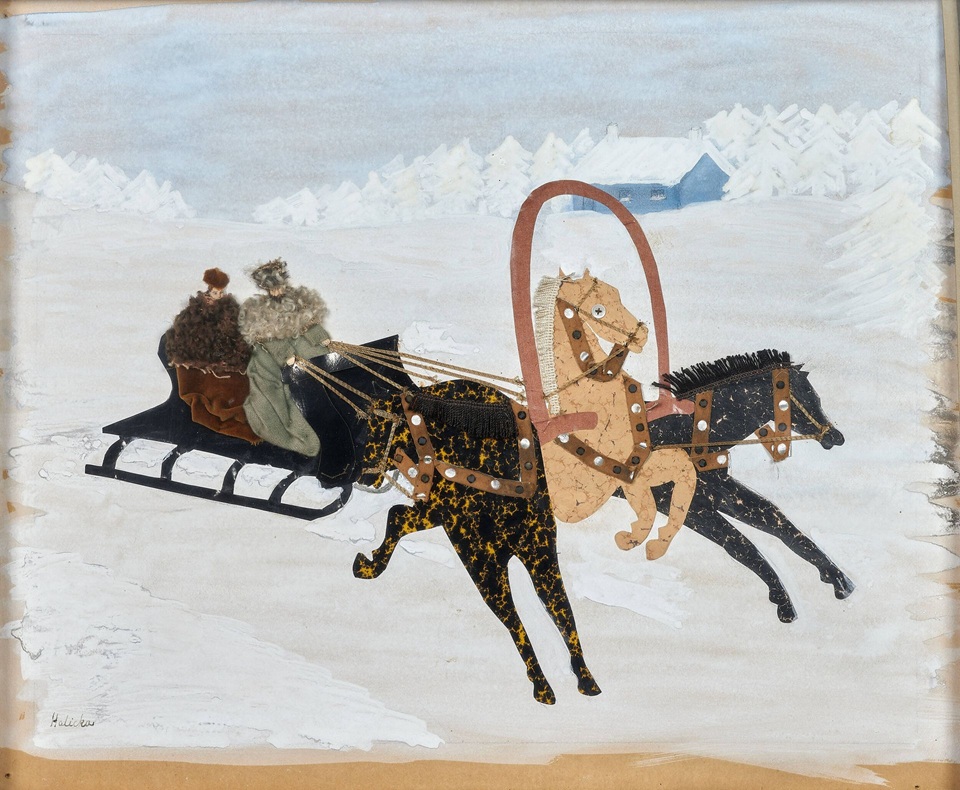
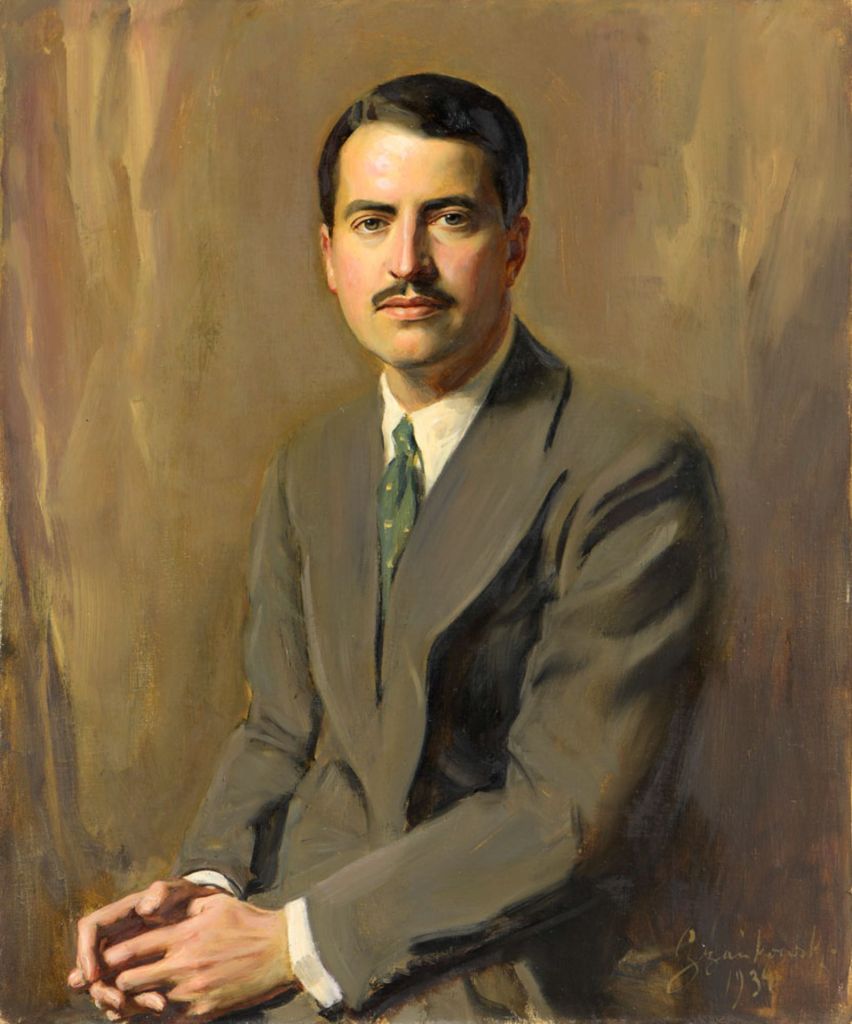
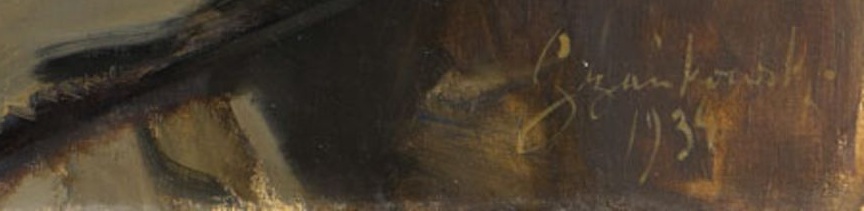
Bronisława Rychter-Janowska (1868 – 1953)

Bronisława Rychter-Janowska. Interieur mit Lesender

Lot 756. Bronislawa Rychter-Janowska, Interieur mit Lesender, Ölgemälde, gerahmtBronislawa Anna Waleria Rychter-Janowska, 1868 Krakau – 1953 ebd., polnische Malerin und Publizistin, Großes Wohnzimmer-Interieur mit Durchblick zu einem weiteren Zimmer mit einer Lesenden, Öl/Bristolkarton, li. u. sign., 50 x 70 cm. Estimate 2,500 – 3,500 euro. Kunst und Kuriosa. 03/07/25. Sold 2,800 euro

Sygnatura

Duży i dekoracyjny olej Bronisławy Rychter-Janowskiej. Warty byłby szcególnego polecenia, gdyby artystka nie namalowała aż tak wiele podobnych prac przedstawiających oświetlony słońcem i zadbany salon, z kanapami, obrazami wiszącymi na ścianach, żyrandolem, podłogą ułożoną z klepek drewnianych. Ta powtarzalność, co prawda mniejszych formatów, jest jedynym frasunkiem lecz trzeba pamiętać, że artyści malowali czasami to co narzucał rynek, tj. co udawało się sprzedawać (podobnie jak niedawno pokazane “Pojenie konia” w wykonaniu Jerzego Kossaka i jego ‘stajni’). Nie jest to jednak wierna kopia innych prac lecz wykorzystanie pomysłu przez Bronisławę Rychter-Janowską do pokazania mędzywojennych salonów. Takich salonów obecnie już nie ma. Oby obraz ten pasował do obecnych ‘salonów’.

Amedeo Modigliani (1884 – 1920)

Amedeo Modigliani. Portrait de Lunia Czechowska

Lot 9. AMEDEO MODIGLIANI (1884-1920). Portrait de Lunia Czechowska, signed ‘Modigliani’ (upper right), oil on canvas laid on board, 18 1⁄8 x 14 7⁄8 in. (46 x 37.8 cm.). Painted circa 1917-1918. Provenance: Walther Halvorsen, Oslo & Paris, by whom probably acquired from the artist. Galerie Bernheim-Jeune, Paris (no. 22306), by whom acquired from the above on 3 September 1920. Biassano, by whom acquired from the above on 27 November 1920. Jos Hessel, Paris, by 1930. Marcelle Bourdon, Paris, by 1952; her sale, Guy Loudmer, Paris, 25 March 1990, lot 35. Corporate collection; sale, Briest, Paris, 28 November 1996, lot 33. Private collection, Europe, by whom acquired at the above sale. Acquired from the above in 2003, and thence by descent to the present owner. Estimate GBP 4,000,000 – GBP 7,000,000. Christie’s. 03/05/25. Sold 6,290,000 GBP (bp)

Portret Luni Czechowskiej wykonany przez Amedeo Modiglianiego. Polonik o którym można pomarzyć. W pracy tej zawiera się opowieść o znakomitym malarzu, kobiecie którą wielokrotnie portretował, oraz marszandzie artysty Leopoldzie Zborowskim. Zamiast więcej pisać zacytuję poniej esej opublikowny przez dom aukcyjny Christie’s. Na zakup tej pracy mogłoby pozwolic sobie kilku zamożnych polskich kolekcjonerów tyle, że sprowadzenie jej do kraju pewnie wiązałoby się z pozostawieniem jej w Polsce na stałe a tym samym trudności z odsprzedażą w przyszłości na rynkach światowych.

Rendered in soft, expressive brushstrokes, Amedeo Modigliani’s Portrait de Lunia Czechowska was painted circa 1917-1918, and is a depiction of one of the artist’s most loyal and cherished friends. Known in his day and admired among his circle of friends primarily as a portraitist, Modigliani prided himself on his skill as an acute observer of the variety and nuances of human character, and his ability to evoke the serene, beatific beauty of l’éternel féminin in his paintings of women. ‘To do any work, I must have a living person,’ he explained to the painter Léopold Survage, ‘I must be able to see him opposite me’ (quoted in J. Modigliani, Modigliani: Man and Myth, New York, 1958, p. 82). Modigliani constantly sought to capture the essence of his sitter, not as a naturalistic likeness, but as an abstract, depersonalized representation stemming from his own pictorial synthesis of seeing and style.
Born Ludwika Makowska in Prague in 1894, Lunia’s father was a Polish patriot who actively opposed the Russian and Austrian partition of the Polish homeland. In 1907, after serving two years of a fifteen-year prison sentence for his role in a workers’ strike in Warsaw, Makowski moved his family to Krakow in the Austrian zone. Upon graduating from the gymnasium in 1913, Lunia followed her father’s wishes and moved to Paris. There she met Kazimierz Czechowski, another recent Polish émigré, also a patriot, with whom she fell in love; they married on 21 June 1915. Czechowski was a childhood friend of Léopold Zborowski, who was to become Modigliani’s devoted dealer and friend from 1916 until the end of the artist’s life. It was the painter Moïse Kisling who introduced Zborowski to Modigliani, and the aspiring dealer first saw the Italian artist’s paintings later that year, in a group show at the Lyre et Palette, the Montparnasse atelier of the Swiss painter Émile Lejeune.
According to Les Souvenirs – Lunia’s autobiographical recollections of Modigliani that she wrote in 1953 and was published in Ambrogio Ceroni’s 1958 monograph on the artist – this 1916 event at the Lyre et Palette was where the artist and muse met. In an interview with William Fifield in the 1970s she recalled: ‘We went to the exhibition,’ she recalled for Fifield, ‘it was the Lyre et Palette, and Modigliani was present… He said he hadn’t time for Léopold, but seeing that we women were with him he returned and said we should perhaps meet in an hour. And we went to the Rotonde’ (quoted in W. Fifield, Modigliani: The Biography, New York, 1976, pp. 222 and 274).
‘He came and sat next to me,’ Lunia wrote in Les Souvenirs. ‘I was struck by his distinctiveness, his luminosity, and the beauty of his eyes. He was at once very simple and very noble’ (‘Les Souvenirs de Lunia Czechowska,’ in A. Ceroni, Amedeo Modigliani, Peintre, Milan, 1958, pp. 20, 21). Modigliani began to sketch Lunia. ‘I was quite young and very shy,’ she continued ‘and I became frightened, when Modigliani asked, after several minutes, in the presence of my husband, to go out with me that very night. Because to Modigliani, I was alone. He felt so strongly towards me he would have liked me to abandon everything to follow him. Confused, I responded that I was not free. Poor dear friend, what seemed so natural to him seemed to me so strange! Zborowski came to my rescue, saying that plans for the evening had already been made, and he invited Modigliani to join us. He refused. Turning towards me, he asked, while offering the drawing he had made of me, to come pose the next day for a portrait’ (ibid.).
Despite all signs that she would remain faithful to her marriage with Czechowski, the artist persisted in seeking a romantic liaison with Lunia. ‘I was always the mysterious woman to him,’ Lunia told Fifield, ‘the Sphinx, Cleopatra, there were things he did not know’ (op. cit., p. 222). Modigliani must have felt especially encouraged in 1917, when in the wake of the February Revolution in Russia, which resulted in the abdication of Tsar Nicholas II, Czechowski decided to return to his homeland and agitate for independence. He joined Lenin’s Red Army following the October Bolshevik Revolution, making arrangements for Lunia to stay with Zborowski and his partner Anna (“Hanka”). Now that she lived with the artist’s dealer, Modigliani saw Lunia often, regularly coming to the apartment to paint during the afternoon, as it was at Zborowski’s that Modigliani had his studio. Czechowski did not live to see Poland freed from foreign hegemony, however. In 1918, while in a hospital recovering from wounds, his Russian comrades learned he was a Polish revolutionary – someone who would eventually turn against and fight them – and had him summarily shot. Lunia did not learn of her husband’s fate until 1921.
‘Happiness is an angel with a serious face,’ Modigliani wrote to Paul Alexandre, his earliest patron, on a postcard from Livorno, dated June 1913 (quoted in D. Krystof, Modigliani: The Poetry of Seeing, Cologne, 2006, p. 88). Lunia’s ethereal features perfectly suited the artist’s fascination with this type; her serious demeanour and youthfully lithe, feminine figure lent themselves well to the primary influences the artist liked to incorporate and show off in his portraits. The plunging ‘V’ of Lunia’s cylindrical neckline and her blade-like décolleté, stark against her white shirt in the present painting, allude to the hallmark swan-like neck and tilted head in the works of the Italian Mannerists of the Sixteenth Century, such as Parmigianino and Pontormo.
Between 1916 and 1918, Modigliani painted a small number of fully-clothed portraits of Lunia (Ceroni, nos. 169-172), including the present work, and completed another series of her in 1919 (Ceroni, nos. 317-322). Fifield stated that Lunia ‘almost certainly’ posed for Le grand nu (Ceroni, no. 200; The Museum of Modern Art, New York), ‘though she would never admit it’ (op. cit., 1976, p. 160). Among the named portraits of Lunia, the artist depicts his sitter in a variety of stances and poses – painting her standing and seated, in profile and square on. In the present work her head is softly tilted, and she regards the viewer with a collected gaze. Modigliani explored the geometry of her form with gestural brushstrokes, masterfully varying the lengths of his strokes to imbue the composition with a dynamic vitality. A powerful sense of élan vital emanates from Lunia, conveyed by the rich colour palette of the composition – accentuated by the vibrant highlights of carmine and deep blue that skirt her features. Her physicality is also emphasised by the impasto effect of the medium, where on her cheeks and neck the artist delicately tapped the oil paint onto the canvas with his fingers. With this meticulous eye for detail in play, Modigliani endowed Portrait de Lunia Czechowska with the loving admiration he held for Lunia herself. As Simonetta Fraquelli has noted, Modigliani’s portraits of Lunia differed from those of his other sitters during this time: ‘with an understanding and inquisitive air, she appears more at one with herself than the other women and Modigliani would seem to be implying that she is his equal’ (‘A Personal Universe: Modigliani’s Portraits and Figure Paintings,’ in Modigliani and His Models, exh. cat., Royal Academy of Arts, London, 2006, p. 36).
Lunia and Modigliani remained close friends after the artist met his young muse and the future mother of his child, Jeanne Hébuterne in 1917. Modigliani had relocated to the South of France in April 1918 as the Germans approached Paris, while Lunia had remained in the city. Following the artist’s return in May 1919, they resumed their close relationship and Lunia recalled: ‘after dinner, we would go for a walk in Le petit Luxembourg; it was very hot that summer. Sometimes we would go to the movies, other nights we would leisurely stroll the streets of Paris… He had so much to say that it was difficult to separate when we arrived home’ (op. cit., 1958, pp. 28-29). When Jeanne returned to Paris that summer with her and Modigliani’s infant daughter, Lunia stepped in to care for the child, her support for her friend unwavering. Though Lunia had to move south later that year for her health, the two remained inextricably intertwined, and Lunia wrote in Les Souvenirs that she dreamt of Modigliani’s death, the night before she found out about it from a friend.

Tamara Lempicka (1898 – 1980)

Tamara Lempicka. Portrait du Docteur Boucard

Lot 25. TAMARA DE LEMPICKA (1898-1980). Portrait du Docteur Boucard, signed ‘T. DE LEMPICKA’ (lower left), oil on canvas, 53 7⁄8 x 30 ¾ in. (137 x 78 cm.). Painted in 1928

Provenance: Dr Pierre Boucard, Paris, by whom commissioned directly from the artist in 1928, and thence by descent. Anonymous sale, Sotheby’s, New York, 14 November 1985, lot 278. Acquired at the above sale, and thence by descent to the present owner.

Estimate: GBP 5,000,000 – GBP 8,000,000. Christie’s. 03/05/25, Sold 5,500,000 GBP (hammer); 6,635,000 GBP (bp)

Portret doktora Boucarda Tamary Łempickiej pochodzi z najbardziej poszukiwanego okresu artystki, z lat 30-tych XX wieku. Praca opisana była w literaturze oraz wielokrotnie wystawiana. Obraz licytowano od 3,500,000 GBP.

Mojżesz (Moise) Kisling (1891 – 1953)

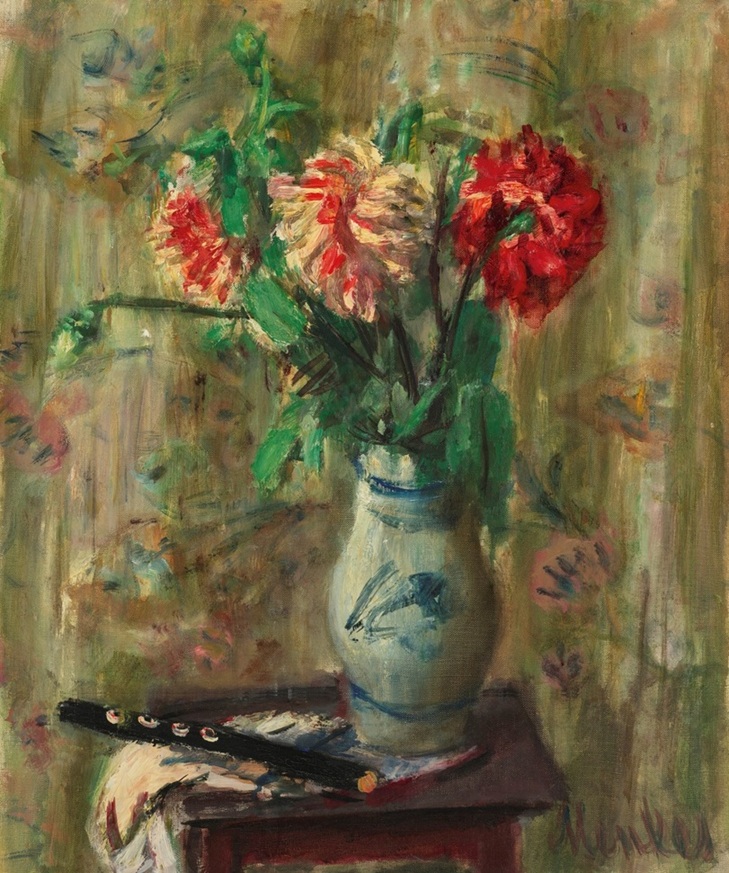
Mojżesz (Moise) Kisling. Vase de fleurs sur un tabouret

Moïse Kisling. Vase de fleurs sur un tabouret, signed Kisling (lower left), oil on canvas, 73 by 54.6 cm. Executed in 1934. Provenance: Private Collection, Paris (acquired by 1971). Private Collection, New York (acquired in the early 1970s). Thence by descent to the present owner. Literature: Joseph Kessel and Jean Kisling, Kisling 1891-1953, New York, 1971, p. 205, illustrated in color. Price upon request. Sotheby’s.

Dwa z trzech olejów Mojżesza Kislinga zostało dzisiaj sprzedanych w Sotheby’s. Inny obraz tego artysty, może najlepszy spośród tych będących na aukcji, można kupić bezpośrednio z tego domu aukcyjnego. Cena tego obrazu nie jest podana i trzeba zapytać o nią w Sotheby’s. Zwraca uwagę bardzo bogate tło tej martwej natury.


Mojżesz (Moise) Kisling. Paysage de Saint-Tropez, 1918

Lot 303. Moïse Kisling 1891 – 1953. Paysage de Saint-Tropez, signed Kisling, dated 1918 and dedicated à Mlle Lucette Descaves (lower right), oil on panel, 32.9 by 41 cm. 13 by 16⅛ in. Framed: 51 by 58.9 cm. 20 by 23⅛ in. Executed in 1918. To be included in the Volume IV et Additifs aux Tomes I, II, et III of the Catalogue Raisonné de l’Œuvre de Moïse Kisling currently being prepared by Marc Ottavi. Estimate 20,000 – 30,000 GBP. Sotheby’s. 03/05/25. Sold 38,100 GBP (bp)


Mojżesz (Moise) Kisling. Jeune paysanne, 1916

Lot 276. Moise Kisling 1891 – 1953. Jeune paysanne, signed Kisling and dated 1916 (lower right), oil on canvas, 85.1 by 48.2 cm. 33½ by 19 in. Framed: 98.4 by 61.4 cm. 38¾ by 24¼ in. Executed in 1916. Provenance Jonas Netter, Paris. Private Collection, Europe (acquired by descent from the above). Christie’s, London, 8 February 2012, lot 465 (consigned by the above). Acquired from the above sale by the present owner. Literature: Jean Kisling and Henri Troyat, Kisling 1891-1953, vol. II, Turin, 1982, no. 17, p. 106, illustrated. Chiba, Kawamura Museum; Osaka, Kintetsu Museum of Art; Yamagata, Museum of Art; Niigata, Municipal Museum of Art; Miyazaki, Prefectural Museum of Art; Kitakyushu, Municipal Museum of Art; and Tokyo, Daîmaru Museum of Art, Modigliani et son époque, Paris 1910-20, 1997, no. 31, p. 82, illustrated. Estimate 60,000 80,000 GBP. Sothebys. 03/05/25. Sold 45,720 GBP (bp)


Mojżesz (Moise) Kisling. Bouquet de bleuets

Lot 301. Moïse Kisling 1891 – 1953. Bouquet de bleuets, signed Kisling (lower right), oil on canvas, 45 by 28.5 cm. 17¾ by 11¼ in. Framed: 64.1 by 47.4 cm. 25¼ by 18⅝ in. Executed circa 1943. To be included in the Volume IV et Additifs aux Tomes I, II, et III of the Catalogue Raisonné de l’Œuvre de Moïse Kisling currently being prepared by Marc Ottavi. Provenance: Bellonni Collection, New York. Galerie Adler, Paris. Christie’s, Tel Aviv, 25 October 1997, lot 23. Christie’s, London, 8 February 2012, lot 495. Acquired from the above sale by the present owner. Estimate 25,000 – 35,000 GBP. Sotheby’s. 03/05/25. Passed

Witold Chomicz (1910 – 1984). Plakat

Witold Chomicz. Fetes de Cracovie, 1937

Lot 761. WITOLD CHOMICZ 1910-1984. Fetes de Cracovie 1937. Color lithograph, Zaklady Graficzne, Krakowie.Condition: B+. 38.98 x 27.56 in. Starting 150 euro. Estimate 200 – 250 euro. Aste Bolaffi. 03/06/25. Sold 400 euro

Oryginalny, rzadki plakat, w niezłej B+ kondycji, autorstwa Witolda Chomicza, malarza, grafika, drzeworytnika, wydrukowany w 1937 roku z okazji Dni Krakowa. Autor wielu innych międzywojennych plakatów. MN w Krakowie jest posiadaczem indentycznego plakatu wydrukowanego w 1938 roku, z polskimi napisami. Spora gratka dla krakusów i może zdążą go kupić. Plakat niezwykle dekoracyjny

Roman Kochanowski (1857 – 1945)

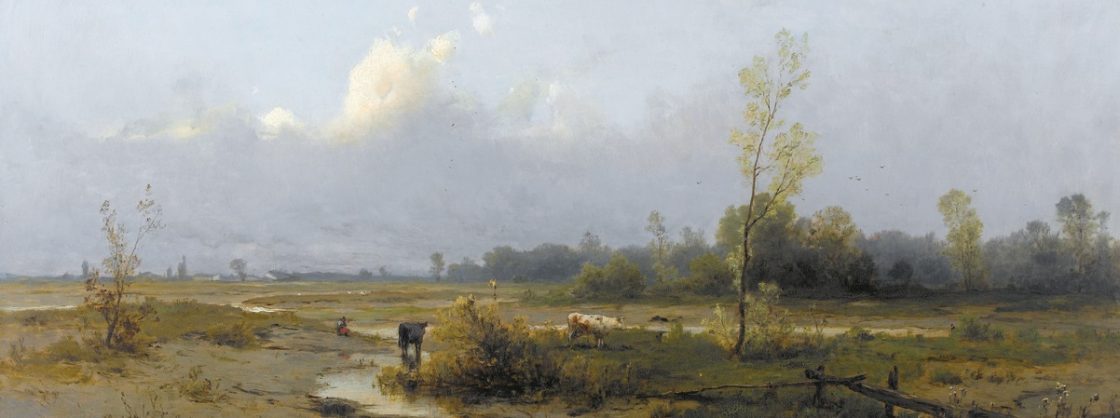
Roman Kochanowski. Landschaft mit See

Lot 614. KOCHANOWSKI, ROMAN 1857 Krakau – 1945 Freising. Landschaft mit See. Öl auf Holz. L. u. signiert.14 x 19 cm. Rahmen. Estimate 1,800 euro. Scheublein Art & Auktionen. 03/27/25. Sold €2,800

Spory wybór prac Romana Kochanowskiego w Monachium. Wyróżnia się en grisaille pejzaż nadwodny z domkami. Każdy z tych małych olejów może zapoczątkować kolekcję RK lub ją uzupełnić.


Roman Kochanowski. Landschaft mit Reisigsammlern

Lot 615. KOCHANOWSKI, ROMAN 1857 Krakau – 1945 Freising. Landschaft mit Reisigsammlern. Öl auf Papier auf Holz. L. u. signiert. 16 x 22 cm. Rahmen. Estimate 1,800 euro. Scheublein Art & Auktionen. 03/27/25. Sold €1,800


Roman Kochanowski. Herbstlicher Waldrand

Lot 616. KOCHANOWSKI, ROMAN 1857 Krakau – 1945 Freising. Herbstlicher Waldrand. Öl auf Holz. L. u. signiert. 11,5 x 21 cm. Rahmen. Estimate 1,800 euro. Scheublein Art & Auktionen. 03/27/25. SOld €1,800

Władysław Szerner (1836 – 1915) ?

Władysław Szerner? Lisowczyk

Lot 85. Wladyslaw Szerner (Polish, 1836-1915). ‘Lisowczyk‘, oil on panel, signed, 27 x 21cm. Oil on panel in good clean condition, tiny chippings in the lower left corner, not framed, 1967 Stacy-Marks label giving the title as ‘A mounted Cossack’. Estimate £500 – £800. Gorringe’s. 03/11/25. Passed

Sygnatura

Podobny przykład do omawianego w poprzednim wpisie, tj. liczy się pierwsze wrażenie. Lisowszczyk rzekomo Władysława Szernera (ojca) był sprzedany w 2017 roku za 5,000 GBP (https://polishartcorner.com/2017/01/11/wladyslaw-szerner-1836-1915-4/), po czym cztery miesiące temu pojawił się z niziutka wyceną 500 – 800 GBP. Ktoś z czytelników wyraził żal, że przegapił ten obraz sprzedany wowczas za 1,200 GBP (https://polishartcorner.com/2024/12/03/wladyslaw-szerner-1836-1915-8/). Obecnie ta sama praca jest już po raz trzeci na aukcji w UK z identycznie jak poprzednio wyceną. Obawiam się, że dom aukcyjny wiele nie ugra na nim. Lisowszczyk mógłby uchodzić zakopię wykonaną przez Władysława Karola Szernera, czyli syna, lecz ten dodawał do sygnatury ‘iun.’, czego tutaj nie ma.

Adam Styka (1890 – 1959) ? w Bonhams

Adam Styka? Bedouin with camels before the Temple of Philae

Lot 33. Adam Styka (Polish, 1890-1959). Bedouin with camels before the Temple of Philae, signed ‘ADAM/STYKA’ (lower left), oil on canvas, 80.7 x 121.3cm (31 3/4 x 47 3/4in). Provenance: Anon. sale, Farsetti, Prato, 28 October 2016, lot 371. Private collection, Italy. Estimate £20,000 – £30,000 (US$25,000 – US$38,000). Bonhams. 03/26/25. Passed

Sygnatura

Bonhams nie odrobił swojej lekcji. Oceniam ich ekspertów twórczości Adama Styki na równi z ekspertami z Sopockiego Domu Aukcyjnego czy też z Desy-Unicum. Ze mnie również żaden ekspert ale mam przewagę nad wymienionymi bo mam więcej od nich czasu by przyjrzeć się obrazowi oraz zero czasu poświęcam na wycenianiu. To drugie zajęcie chyba za bardzo pochłania wymienionych. Przykłady? Bardzo proszę bo niedawno o nich było na tym blogu: https://polishartcorner.com/2025/02/08/adam-styka-1890-1959-w-sopockim-domu-aukcyjnym/; https://polishartcorner.com/2020/11/26/adam-styka-1890-1959-na-pewno-nie-nagel-niemcy-i-desa-unicum-polska/.

Historia sprzedaży wyżej pokazanego obrazu została być może celowo nieprzyzwoicie skrócona przez Bonhams by zwiększyć poczytność Polish Art Corner. Można bowiem przeczytać na moim blogu, że w 2016 roku obraz ten był wyceniony we włoskim domu Fersettiarte na 25,000 – 35,000 euro i pięknie go sprzedano za 28,000 euro (https://polishartcorner.com/2016/10/20/adam-styka-1890-1959-40/). Siedem lat później, w 2023 roku wyceniono tę pracę również we Włoszech, lecz zakakująco niżej, na 18,000 – 24,000 euro (Colasanti Casa D’ Aste), i sprzedano ją za rozpaczliwe 12,000 euro (https://polishartcorner.com/2022/03/07/adam-styka-1890-1959-72/). W latach 2016-2023 nie było żadnego krachu na rynku antykwarycznym we Włoszech a jednak obraz ten stracił ok 60% na wartości. Dziwne to bo obrazy Adama Styki systematycznie rosną w cenie i decyzja o sprzedaży z taką stratą wygląda na desperację właściciela. W pierwszej sprzedaży, włoski dom dodał do opisu obrazu wywar biograficzny o artyście, być może z Wikipedii (Elon Musk oferował właścicielowi lewackiej Wikipedii 1 miliard dolarów za zgodę zmiany jej nazwy na Dickipedia, od słowa …., zresztą mniejsza z tym). Ten ciepły bulion pomógł skoro firma skasowała wówczas 28,000 euro. Takie wywary biograficzne są serwowane powszechnie w celu rozwodnienia nasuwających się czasami klientom wątpliwości; niektórzy czerpią swoją wiedzę wyłącznie z opisów katalogowych.

Wracając do obrazu z Bonhams, kilka lat temu wyraziłem już swoje wąpliwości a obecnie mogę jedynie je potwierdzić. Po powiększeniu sygnatury wyraźnie wyłania się amatorskość jej wykonania (litery) jak też miejsce jej położenia. Zawsze pisałem, że nie sygnatura powinna być miernikiem autentyczności. Ważniejsze od niej jest wrażenie płynące z pierwszego sporzenia na pracę, tj. zła jest ‘brudna’ kolorystyka, nie ma impasta, inaczej namalowane są np. fale na wodzie, etc. etc. etc. Możnaby napisac pracę magisterską wykazując różnice.

Aby nie pisać za dużo, pokazuję poniżej inną lecz prawdziwą pracę Adama Styki, również pejzaż z Temple of Philae. Obraz ten był sprzedany w Sotheby’s 14 lat temu. Warto porównac detale obu obrazów.

Jestem przekonany, że pierwowzór oleju z Bonhams, czyli oryginalna praca wykonana przez Adama Stykę, wisi u kogoś na ścianie i pewnie kiedyś wypłynie na rynek. Bardzo dużo jest kopii prac tego malarza uchodzących na rynku za oryginały i dlatego ostrożność jest wskazana. Kliencie, broń się sam!

Adam Styka. Ile de Philae. Olej, płótno, 73 by 92cm. Sotheby’s, sold 05/11/2011 for 28,125 GBP (bp)
Sygnatura

Olga Boznańska (1865 – 1940)

Olga Boznańska.

Lot 148. Olga BOZNAŃSKA (1865-1940). Portrait of a man, Oil on cardboard. Signed lower right. Dedicated and countersigned on the back: “A Monsieur Monin / Olga Boznańska”. (Restorations and missing parts). 47 x 39 cm A similar portrait dated “circa 1925” is in the National Museum in Krakow (MNK II-b-3122). Estimate 15,000 – 20,000 euro. Ader. 03/20/25. Sold 15,000 euro

Napis na odwrociu

Mocno sterany przez życie olej Olgi Boznańskiej. Nie potrafię doszukać się sygnatury ‘lower right’.


Ad vocem Lot 148. Olga BOZNAŃSKA (1865-1940). Portrait of a man, Oil on cardboard. 

Prezentowany obraz na tekturze faktycznie jest mocno uszkodzony po krawędziach. Natomiast wrażenie zamglenia malunku jest akurat charakterystyczne dla prac porterowych Olgi Boznańskiej w latach 20-30. Być może jest to tylko studium postaci do obrazu (co też w tym okresie występowało o czym poniżej).

1. Adler wskazuje na podobieństwo tego obrazu z: Studium postaci męskiej (MNK II-b-3122)

Ja osobiście wskazałbym raczej na portret panny Syrewicz 1926-załączam.

Numer inwentarzowy, MP 4835 MNW

oraz Study of a Female Figure ok. 1930 r.-załączam. Object number: MNK II-b-3116

Warto zwrócić uwagę na charakterystyczny motyw fotela z pracowni Boznańskiej. Ponadto zielona tkanina tła lub obicia fotelu b. często występuje w tle portretów Boznańskiej (znana również z innych obrazów jak „Portret Julii Ginzberg” zb. MNK, „Portret Amerykanina” zb.MNK). 2. Uważam, że po lewej stronie jest widoczny zarys jednego z ulubionych piesków Boznańskiej: -Study of the Artist’s Dog – około 1925 roku -załączam.

Object number: MNK II-b-3114/b 

3. Sygnatura jest widoczna po prawej stronie (załączam) ale w latach 30 Boznańska akurat przeciągała bardzo mocno w lewo ale literę “A” 

a tutaj jest “K”.Pozdrawiam. Adartem


Inny czytelnik:

Dzień dobry, napisałem do domu aukcyjnego o info nt. pracy Boznańskiej. Ciekawa historia. Oto odpowiedź:

Nasz sprzedawca zakupił ten obraz przez przypadek… Na aukcji na południu Francji, sygnatura przeszła niezauważona, portret został sprzedany razem z innym obrazem. Była to tak zwana « aukcja klasyczna », bez ekspertów, obiekt byl opisany jako « lot de deux portraits » (« dwa portrety »)…

Obraz wymaga konserwacji, brzegi są dość zniszczone, przede wszystkim dolny prawy róg (za sygnaturą). Fragment tektury jest wymieniony u góry (i podklejony na odwrociu). Generalnie obraz był źle przechowywanym najwidoczniej w jakimś wilgotnym miejscu. Tektura jest też podniszczona na dole (widać to na odwrociu). Nie widać żadnych przemalowań pod lampą UV. Parę śladów po złotej farbie (obraz pewnie był w złotej ramie i zostawiła ślady). Tutaj może Pan pobrać dodatkowe zdjęcia : https://we.tl/t-yJxA9IcP8X. Ktoś może miał mega farta kupując lot dwóch obrazów. 

Ignacy Krasicki (1735 – 1801) – portret

Portret Ignacego Krasickiego, 1761

Lot 144. 18th century school Portrait of Ignacy Krasicki, 1761. Oil on canvas. Dedicated and dated on the back (in French): “IGNACE COMTE KRASICKI / PREVOT DE LA CATH DE PREMISLIE / OFFRE SON PORTRAIT GAGE D’UNE PARFAITE AMITIÉ ESTIME ET RECONNAISSANCE / ROME 24 JUILLET 1761”. 74 x 62.5 cm. Estimate 5,000 – 7,000 euro. Ader. 03/20/25. Sold 7,500 euro

Ignacy Krasicki arrived in Rome in 1759 to complete his studies as a clergyman. He stayed at the Polish Hospice of St. Stanislaus. His stay was punctuated by various missions entrusted to him by his patrons, notably Franciszek Salezy Potocki. His rich correspondence does not reveal many details of his stay in Rome: the letters he sent during this period are mainly concerned with his financial problems; very little space is devoted to his daily life. The last entry concerning his stay at the Hospice dates from May 1761. The last letter sent from Rome was to his brother, Antoni Krasicki, on March 28, 1761. The next letter, sent from Pleszowice, is dated January 21, 1762. After his return to Poland, Krasicki became close to King Stanislaus II Augustus. In 1766 he was appointed Prince-Bishop of Varmie, and in 1795 Primate of Poland. At court, he rubbed shoulders with artists such as Marcello Bacciarelli and Per Krafft (see portraits in the National Museum in Warsaw MP4528 and the National Museum in Krakow MNK II-a-671). He himself became an art collector. Today, he is best known for his literary work, which is typical of the Enlightenment period.

Verso

Warto by któreś z polskich muzeów zainteresowało się tym portretem Ignacego Krasickiego, namalowanym w Rzymie w 1761 roku. Przyzwyczajeni jesteśmy do dostojeństwa portretu namalowanego przez szwedzkiego artystę Per Kraffta Starszego z około 1767 roku. Na aukcji we Francji mamy portet o kilka lat młodszego Ignacego Krasickiego, jeszcze nie tak dostojnego bo zaledwie 26-cioletniego księdza.

Peter Krafft the Elder. Portret Ignacego Krasickiego, ok 1767

Miły list, który potrzymałem od Pani Magdaleny Marzec, prowadzącej aukcję poloników w domu aukcyjnym Ader:

“Pozwalam sobie wysłać wiadomość, bo wyraził Pan nadzieję, że któreś z polskich muzeów zainteresuje się portretem,  który sprzedawaliśmy wczoraj w Aderze.  Obraz trafi do zamku w Lidzbarku Warmińskim. Dostałam pozwolenie na pochwalenie się tą informacją, a że bardzo się z niej cieszę, to nie mogłam się nie podzielić! Z wyrazami szacunku, Magdalena Marzec”