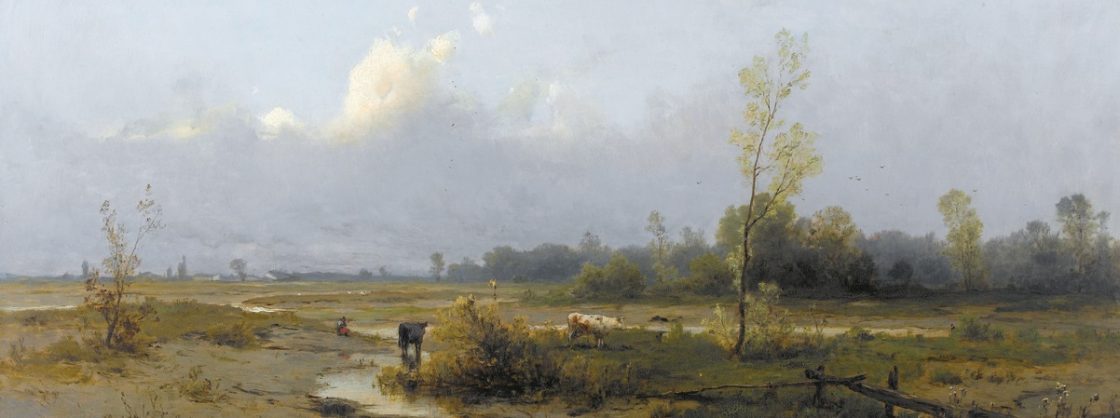
Stanisław Stückgold (1868 – 1933)

Stanisław Stückgold. Bauernhof

Malarz o bardzo ciekawym życiorycie. Osobiście, nie widzę jego pracy na ścianie ale inni proszą mnie bym je pokazywał.

Lot 529. Stanislaus Stückgold. Bauernhof. Öl auf Rupfen. (Ca. 1911-1915). Ca. 48,5 x 56,5 cm. Monogrammiert unten links, verso signiert. Estimate 3,500 euro. Karl & Faber Kunstauktionen. 07/16/20

Verso auf Keilrahmen und Rupfen diverse Bezeichnungen, kleine Etiketten und Zollstempel. Als Spätberufener kommt Stanislaus Stückgold erst mit 38 Jahren zur Malerei. Nach internationaler Karriere als Chemiker und Ingenieur sowie revolutionär-politischem Engagement für die Befreiung Polens von russischer Herrschaft einschließlich Verhaftung und Inhaftierung, studiert er noch einmal, zunächst Bildhauerei in Warschau, ab 1907 Malerei in München bei Simon Hollósy sowie in dessen Malerkolonie in Nagybánya in Ungarn. 1908 zieht Stückgold nach Paris, er wird Schüler bei Henri Matisse, lernt Henri Rousseau kennen und stellt bereits 1909 erstmals im Salon des Indépendants aus. 1913-1923 lebt Stückgold in München und führt dort zwischenzeitlich eine eigene Malschule. Marianne von Werefkin vermittelt ihm eine Ausstellung in der renommierten Galerie Hans Goltz, über Herwarth Walden ist er am Ersten Deutschen Herbstsalon in Berlin beteiligt, wo August Macke und Franz Marc auf ihn aufmerksam werden. Ab 1923 lebt er bis zu seinem Tod 1926 in Paris. Stückgolds Œuvre umfasst feinfühlig charakterisierende Porträts, u.a. von Albert Einstein und Else Lasker-Schüler, sowie leuchtend farbige Landschaften und Blumenbilder, die trotz des deutlichen Einflusses seines Lehrers Matisse seine künstlerische Eigenständigkeit zeigen.
Stanislaus Stückgold, Galerie Neue Kunst Hans Goltz, München 1917 (wohl Kat.-Nr. 13 o. 58, o.Abb.), verso auf dem Keilrahmen mit dem Etikett. Diese Ausstellung ging weiter zur Kunsthandlung Ludwig Schames, Frankfurt/Main und zur Kestner Gesellschaft, Hannover (wohl Kat.-Nr. 12 o. 52, o.Abb.).

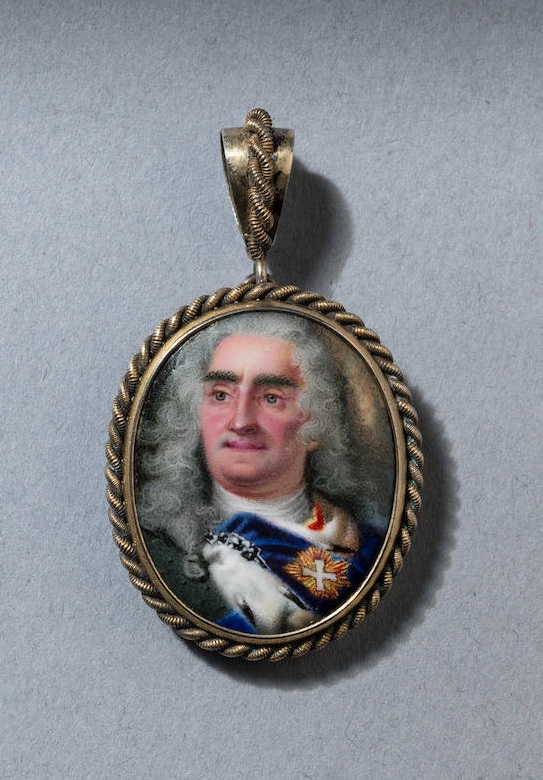
Miniatury. August II Mocny

Dwie miniaturki przedstawiające Augusta II Mocnego z dobrą proweniencją, wzorowane na znanych portretach. Gdyby to był inny król to kto wie.

Lot 6. Two miniature portraits of Augustus the Strong (1670-1733), Elector of Saxony and King of Poland, circa 1720

The first attributed to Georg Friedrich Dinglinger (1666-1720), wearing a powdered wig, in armour with an ermine-lined blue cloak and the Star of the Order of the White Eagle; the second attributed to Charles Boit (1662-1727), wearing a powdered wig, armour and a crimson ermine-lined cloak with a star, enamel on copper, the first with gold rope-twist frame and suspension loop, the second with a later gilt-metal pierced floral scrollwork frame surmounted by a crown, the first: 2.8cm high, 4.6cm high overall; the second: 3.5cm high, 7.1cm overall (2). Estimate £ 1,000 – 1,500. Bonhams. 07/22/20

Provenance: Collection of Gustav von Klemperer (1852-1926), Dresden; Thence by descent until sold at Sotheby’s London, 16 December 1998; Purchased at the above sale by the present owner.
Literature: Hans Buchheit, Miniaturen aus der Sammlung Gustav von Klemperer (1928), nos. 63 and 209 (illustrated on pl. 3); M. Cassidy-Geiger, Porcelain and Prestige. Princely Gifts and “White Gold” from Meissen, in M. Cassidy-Geiger (ed.), Fragile Diplomacy (2007), p. 6, fig. 1-9
Exhibited: New York, The Bard Graduate Centre, ‘Fagile Diplomacy’, 15 November 2007-10 February 2008, nos. 4 and 5
Both miniatures are after portraits of Augustus the Strong by Louis de Silvestre of 1716-18. Charles Boit also made an almost full-length miniature after a Silvestre portrait that was possibly recorded in the Pretiosenkammer by 1725 and is now in the Green Vaults in Dresden. A similar miniature attributed to Georg Friedrich Dinglinger, once in the possession of the Radziwill family, is now in the collection of the Royal Castle in Warsaw. See W. Schmidt/D. Syndram (eds.), Unter einer Krone (1997), nos. 506 (Silvestre), 510 (Boit) and 511 (attr. G.F. Dinglinger).

Wlastimil Hofman (1881 – 1970)

Wlastimil Hofman. Melancholia, 1960

Jest to bardzo, bardzo słaba praca Wlastimila Hofmana z jego końcowgo okresu tworzenia. Praca wygląda na prawdziwą, choć nie zdziwiłbym się, gdyby inni mieli wątpliwości. Cena estymacyjna ustawiona jest na pracę dobrą. Trudno ją niestety rekomedować komukolwiek.

Lot 215. Vlastimil Hofman (Poland, 1881-1970) – Melancholia, Oil on Board, 1960. Signed and dated. Framed. 44x17cm. Frame: 58x31cm. Estimate $2,000 – 4,000. Reserve $1,000. Pasarel. 07/02/20

Jan Cybis (1897 – 1972)

Jan Cybis. Blumenstillleben, 1936

Bardzo tanio sprzedana przedwojenna praca Jana Cybisa i w dodatku z pierwszorzędną proweniencją. Dobra praca Cybisa to doprawdę rarytas.

Lot 3222. Jan Cybis (Fröbel 1897–1972 Warschau). Blumenstillleben. 1936. Öl auf Leinwand. Unten rechts signiert und datiert. 61×49,5 cm. Estimate CHF 4,000 – CHF 6,000. Schuler. 06/26/20. Sold CHF 6,000.

Leopold Gottlieb (1883 – 1934)

Leopold Gottlieb. Portrait Anatol Minkowski

O Anatolu Minkowskich można sobie poczytać on-line. Kolega z legionów Gottlieba.

Lot 3316. Leopold Gottlieb (Drohobytsch 1883–1934 Paris). Portrait Anatol Minkowski. Kohle und Farbstift auf Papier. Unten rechts in Bleistift signiert. Unten mittig in Kohle bezeichnet: “Anatol Minkowski”. Oben links mit kaum leserlichen Stempel. Blattgrösse 29,7×28,2 cm. Gerahmt. -Blatt leicht gebräunt. Am oberen und linken Rand winzige Einstichlöcher. Verso partiell an Rückblatt montiert.  Estimate 800 – 1,200 CHF. Schulter. 06/26/20. Sold CHF 900.

Zygmunt Waliszewski (1897 – 1936)

Zygmunt Waliszewski. Don Quichotte

Ktoś się obłowił.

Lot 3326. Zygmunt Waliszewski. (Sankt Petersburg 1897–1936 Krakau). Don Quichotte. Aquarell und Gouache auf Papier. Unten rechts signiert. Blattgrösse 65×50,3 cm. Gerahmt.- Blatt leicht gebräunt und leicht gewellt. Oberer Rand mit winzigen Einstichlöchern, kleinen Einrissen und in der rechten Ecke mit Blattverlust. Verso partiell an Rückkarton montiert. Estimate CHF 1,200 – CHF 1,800. Schulter. 06/26/20. Sold CHF 2,800

Bogdan Kleczyński (1851 – 1916)

Bogdan Kleczyński. Hasenjagd, 1883

Mały obrazek monachijczyka a potem kresowianina Bohdana Kleczyńskiego został sprzedany w Szwajcarii za 3,800 franaciszków. Bliźniaczy obraz tego malarza odnotowalem na aukcji kilka lat temu w Christies, równeż sygnowany czerona farbą (zawsze budzi ostrożność czerwona farba); pokazuję go poniżej. Problem z Kleczyńskim to replikowanie podobnych kompozycji, choć gwiazda tego malarza świeciła krótko, gdyż artysta przerwał malaowanie po powrocie na Kresy i zajął się swoim majątkiem. Wcale bym sie nie zdziwił gdyby ta praca znalazła sie w Polsce i była kreowana w jakims domu aukcyjnym na wielkie dzieło wybitnego monachjijczyka w celu zawrócenia w głowie mało zorientowanemu kolekcjonerowi. Praca wygląda dobrze i wycena w Szwajcarii była adekwatna. Jeśli ktoś będzie robił wodę z mózgu już w Polsce to ciężki grzech bez rozgrzeszenia.

Lot 91. Bohdan von Kleczynski (1851–1916). Hasenjagd, 1883. Öl auf Holz, unten links signiert und datiert Bohdan Kleczynski 1883, 25,3 x 20,2 cm. Schätzpreis: CHF 3’000 – 4’000. Beurret Bailly Auktionen Gallerie Widmer. 06/24/20. Sold CHF.3,800

Bogdan Kleczyński. The hidden prey

Józef Rapacki (1871 – 1929)

Józef Rapacki. Winter landscape, 1914

Raczej wczesno-wiosenny, niż zimowy, polski krajobraz Józefa Rapackiego. Proszę porównać z pejzażem Cylkowa (kilka wpisów wcześniej) by przekonać się o różnicy między rzemieślnikiem a artystą.

PS. Datowany w tym samym roku jak ‘Wampir’ Biegasa z poprzedniego wpisu.

Lot 70. Józef Rapacki (Warsaw 1871–1929 Olszanka). Winter landscape, signed and dated Józef Rapacki 1914, oil on canvas, 56 x 77.5 cm, framed. Provenance: European Private Collection. Estimate 4,000 – 6,000 euro. Dorotheum. 06/23/20

Bolesław Biegas (1877 – 1954)

Bolesław Biegas. Vampire in the form of a grasshopper, 1914

Jedna z bardzo wczesnych (1914 rok) prac Bolesława Biegasa z serii ‘wampirów’. ‘Anatomia konika polnego mocno zachwiana‘, zauważyl jeden entomologów mało znający się na wampirach.

Lot 16. BOLESLAS BIEGAS (1877 1954). Vampire in the form of a grasshopper, 1914. Oil on board. Signed lower right. Oil on pannel. Signed lower right. H_21.3 cm W_17.3 cm. Provenance: – Galerie Jan Kruguer, Geneva, – private collection Boleslas Biegas “I believe that art is the only form of activity through which man as such manifests himself as a true individual. Through it alone, he can go beyond the animal stage, because art is an outlet to regions where neither time nor space dominates”. Estimate 5,000 – 8,000 euro. Pierre Berge & Associes. 07/08/20. Not sold

Henryk Stażewski (1894 – 1988)

Henryk Stażewski. Sans titre, 1980

Kolejne praca Stażewskiego, o adekwatnym tytule, nad którą warto przyklęknąć. Praca z rozciągliwym jak guma marginesem wyceny a warta będzie tyle ile ktoś zapłaci.

Lot 94. Henryk STAZEWSKI (1894-1988). Sans titre, 1980. Acrylique sur isorel, signée, datée, au dos. Provenance : Galerie Denise René, étiquette de la galerie, au dos, 51 x 50, 2 cm. Estimate 15,000 – 25,000 euro. Copages Auction Paris. 06/25/20