Jakub Mącznik (1905 – 1945)

Jakub Mącznik. Self-portrait

Pozostanę przy imieniu i nazwisku Jakub Mącznik bo taką widziałem sygnaturę na jego pracy (Autoportret chyba nie jest sygnowany). Jest wiele wersji jego nazwiska oraz imienia. Stosunkowo dużo można o nim odszukać informacji na internecie, mało w Słowniku Artystów Polskich, choć w tym ostatnim jest wymieniony ten Autoprtret. Wpis obecny jest rodzajem mojego przypomnienia i mojej pamięci o artystach, Żydach i Polakach, zamordowanych przez Niemców, włączywszy Jakuba Mącznika, choć obecnie uważa się, że byli to Naziści. Warto pamiętać, że nie naziści mordowali lecz Niemcy i oni zamordowali Mącznika jak też miliony osób innych narodowości w czasie II wojny światowej. Wracając do aukcji, dodam, ze ani jedna z prac tego artysty nie była jeszcze licytowana w III RP.

Lot 3. Jacob Macznik (Polish, 1905-1945). Self-portrait, oil on canvas, 45 x 37cm (17 11/16 x 14 9/16in). Painted c. 1930. Provenance: Acquired directly from the artist’s studio. Literature: Jewish Artists of the school of Paris 1905-1939, Somogy Éditions d’Art, Paris, 2015, p. 221. Pascale Samuel, catalogue de l’exposition Chagall, Modigliani, Soutine… Paris pour école, 1905-1940, Paris, Musée d’art et d’histoire du Judaïsme, 2020, p. 178. This work will be exhibited in the following exhibition:  “Paris pour Ecole 1905- 1940” MAHJ Paris, April 2020 – August 2020. Estimate £ 2,500 – 3,000. Bonhams. 03/03/21.

Sold for £ 35,250 (US$ 49,053) inc. premium

Jacob Macznik grew up in an orthodox family and left for Warsaw in 1922 to study at the School of Fine Arts. In 1928, he got married and settled in Paris with his wife Stella. In 1930, he met Hersch Fenster with whom became collaborators on the publication of a book dedicated to the synagogues of Poland. On a mission, they started their resistance art journey to Tarnow, Kourov and Barnevto where they organised lectures in the cities they visited. Bearing financial struggles, Macznik had to return to Paris with only a dozen paintings. In 1944 during World War II, Macznik and his wife were killed at the Mauthausen concentration camp. The majority of his paintings were destroyed.
Eugeniusz Zak (1884 – 1926)

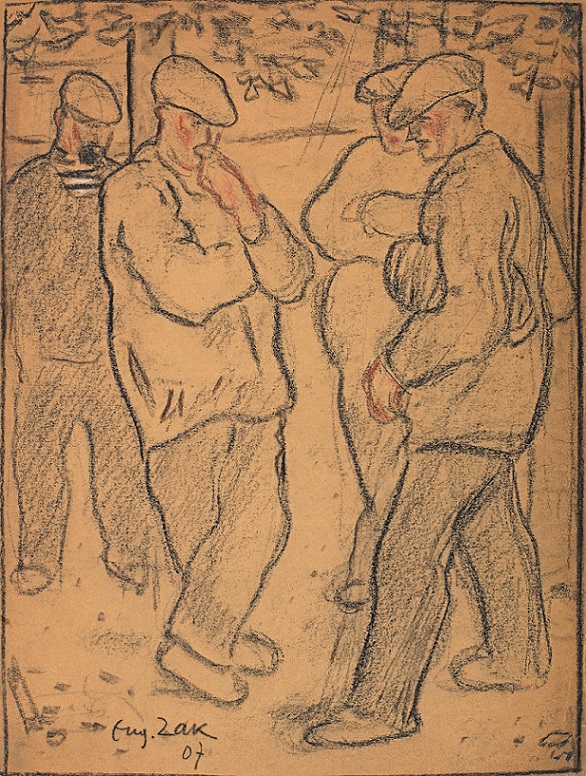
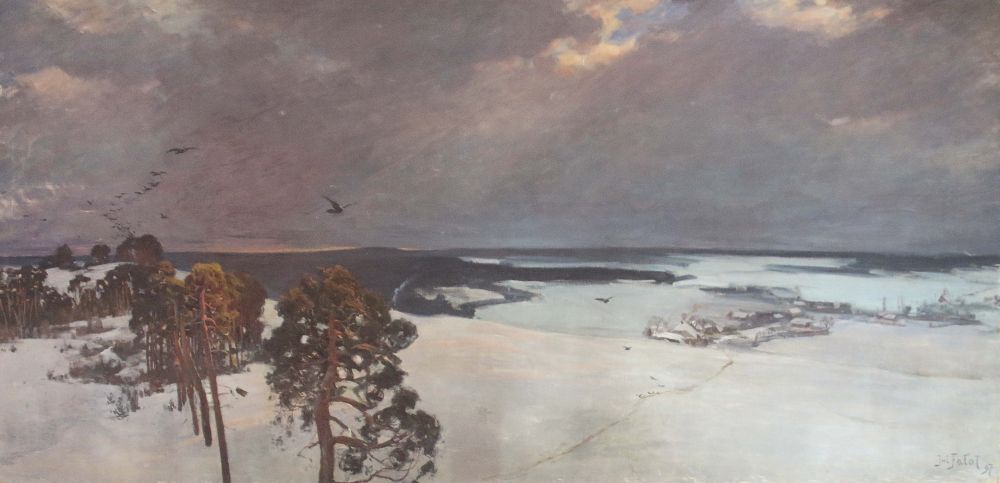
Eugeniusz Zak. Le Breton, 1907

Le Bretons, charcoal on paper, inscribed and signed ‘Eug. Zak/ 07’ (lower left), 65 x 31cm (25 9/16 x 12 3/16in).

Trzy prawdziwe rysunki Eugeniusz Zaka, w dodatku sprzedawane jako jeden ‘lot’, to rzecz mało spotykana. Niska wycena dopełnia tę atrakcyjność (proszę jednak nie liczyć, że te prace dadzą się kupić za cenę podaną w widełkach). Kolekcjonerzy niech się nie obawiają handlarzy, którzy odpadną gdy dostrzegą determinację zakupu do kolekcji.

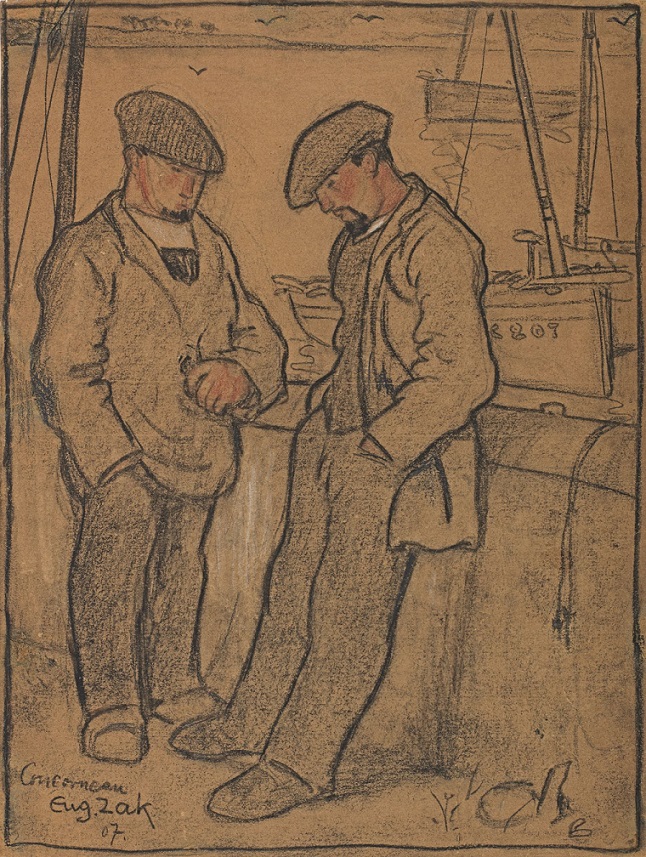
Eugeniusz Zak. Les Bretons, 1907

Les Bretons, charcoal on paper, signed ‘Eug. Zak/ 07’ (lower left), 65 x 31cm (25 9/16 x 12 3/16in).

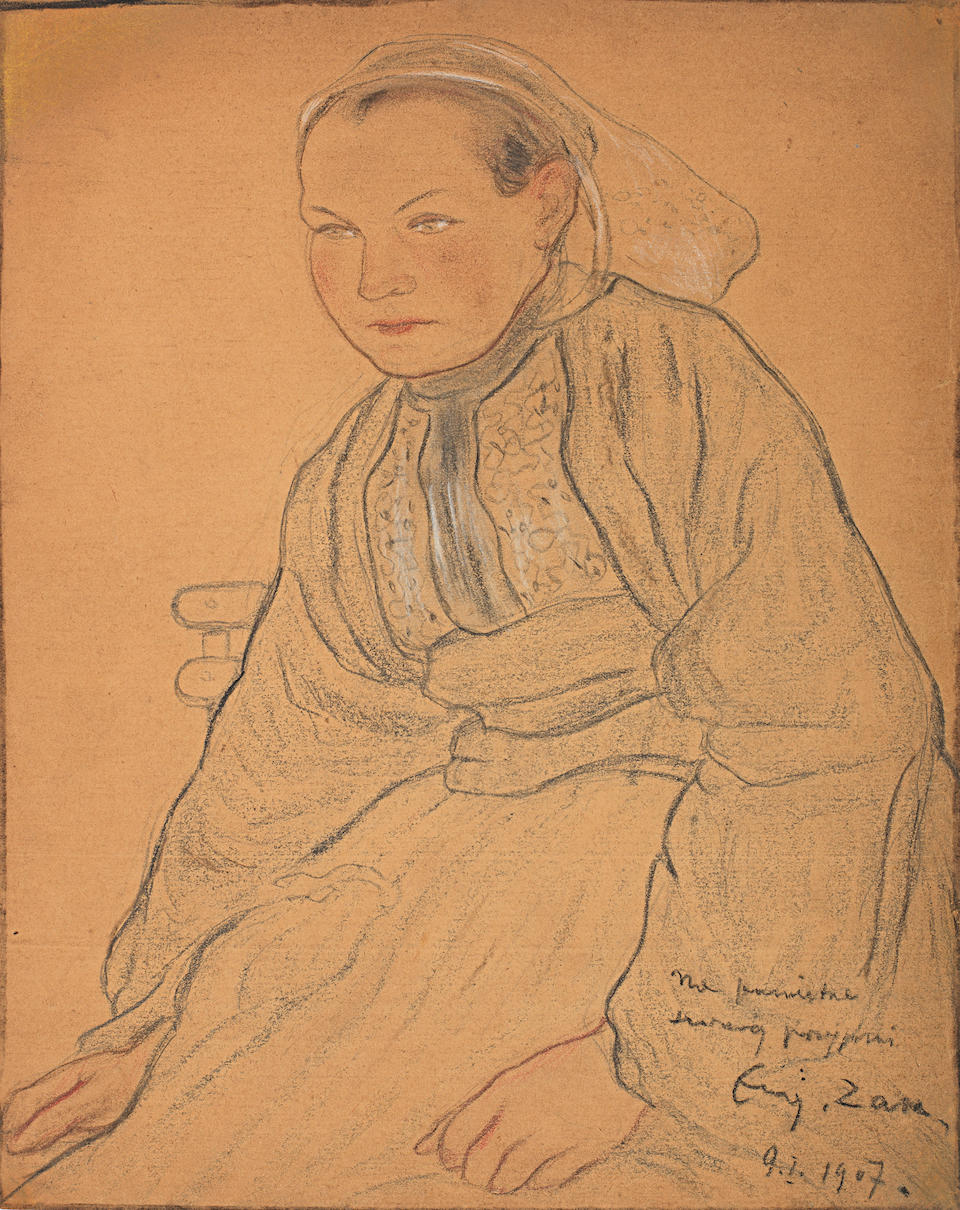
Eugeniusz Zak. Femme Bretonne, 1907

Femme Bretonne, charcoal on paper, inscribed and signed ‘Eug. Zak/ 9. 1. 1907’ (lower right)
65 x 31cm (25 9/16 x 12 3/16in).

Lot 70. Eugène Zak (Polish, 1884-1926). Le Bretons (2) – Femme Breton. In 1900, at the age of 16, Eugène Zak arrived in Paris where he studied at the École des Beaux-Arts, in the studio of Jean-Léon Gérôme, and then at Académie Colarossi in the studio of Albert Besnard. In 1903, he travelled to Italy and later that same year moved to Munich to attend the Royal Academy School of Fine Arts. He did not stay long in Germany and returned to Paris in 1904. There, he participated in the creation of the group Rytm (Rythm), formed by artists of the Polish avant-garde and exhibited his work for the first time at the Salon d’Automne. In 1913, he married Yadwiga Kohn with whom he later had his son Yannek. In 1914, Zak travelled to Vence and Nice in the South of France and two years later left for Poland and stayed in Warsaw. In 1921, he travelled to Germany and was tasked to decorate the house of the Dutch architect Frans Arnold Breuhaus. In 1922, he finally returned to Paris. On January 15, 1926, he died suddenly of a heart attack. A retrospective of his work took place at the Salon des Indépendants in 1926. Following Eugène Zak’s death, his wife Mrs. Jadwiga Zak, ran the Zak gallery in rue de l’Abbaye in Paris until the Second World War. Mrs. Zak and her son Jacques were deported and assassinated in Auschwitz.
Le Bretons and Femme Bretonne are works related to an exhibition which took place at the Breton Departmental Museum of Quimper in 2004. The exhibition presented a collection of works by Polish artists who had stayed and painted in Brittany between 1890 to 1939, and among them: Eugène Zak. Estimate 900 – 1,200 GBP. Bonhams. 03/03/21. Sold for £ 12,750 (US$ 17,789) inc. premium

Zygmunt Menkes (1896 – 1986)

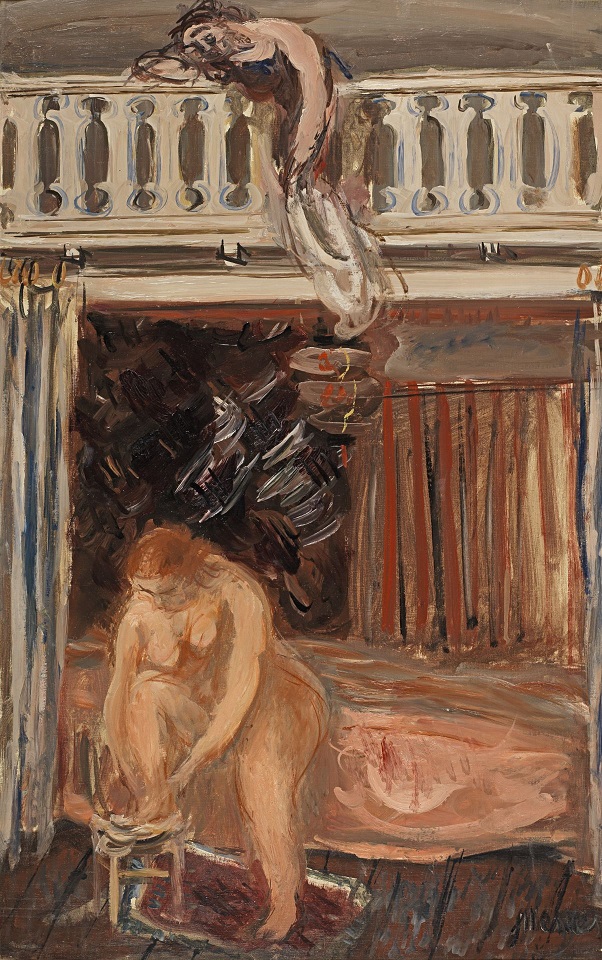
Zygmunt Menkes. Odalisque au tambourin

Lot 21. Sigmund MENKÈS (Galician, 1896-1986). Odalisque au tambourin, signed ‘Menkes’ (lower right), oil on canvas, 54 x 65cm (21 1/4 x 25 9/16in). Painted c. 1930, unframed. Estimate 6,000 – 8,000 GBP. Bonhams. 03/03/21. Sold for £ 17,750 (US$ 24,700) inc. premium

Dwa międzywojenne oleje Zygmunta Menkesa. Jeśli pojawią się w Polsce to będą znacznie droższe.

Zygmunt Menkes. Bethsabée, 1925

Lot 22. Sigmund MENKÈS (Galician, 1896-1986), Bethsabée, signed ‘Menkes’ (lower right), oil on canvas
61 x 38cm (24 x 14 15/16in). Painted in 1925
Literature
Peintres Juifs de l’École de Paris 1905-1939, Éditions Denoël, Paris, 2000, p. 241.
Jewish Artists of the school of Paris 1905-1939, Somogy éditions d’Art, Paris, 2015, p. 239.
In 1912, Menkès started his studies at the Institute of Decorative Arts in Lwow (Lemberg) where he met artist Alfred Aberdam. To financially support himself, he worked as a construction painter while at the same time he studied the fresco technique and worked on the restoration of Orthodox churches. In 1919, Menkès enrolled in the School of Fine Arts in Krakow and joined, in 1922, Alexander Archipenko’s studio in Berlin. After his studies, he moved to Paris in the district of Montparnasse, where he shared a room with Weingart. He further pursued his studies at Douanier Rousseau’s former studio. In the second half of the 1920s, Menkès married Stanislawa Théodora Weiss, known as Stasia. She posed for him as well for other artists like Léopold Gottlieb and Raymond Kanelba. From 1930, he exhibited his work in Paris, Lwow, Toronto, and New York where he settled in 1935.
Menkès received a series of important distinctions for his work, including the Carol H. Beck Medal of the Pennsylvania Academy of Fine Arts (Philadelphia, 1943), the Gold Medal of the Corcoran Gallery (Washington, D.C., 1947), the Andrew Carnegie Award of the National Academy of Design (New York, 1955), and the Alfred Jurzykowski Award (New York, 1967). Estimate 6,000 – 8,000 GBP. Bonhams. 03/03/21. Sold for £ 19,000 (US$ 26,440) inc. premium

Alfred Wierusz-Kowalski (1849 – 1915)

Alfred Wierusz-Kowalski.

To jest również dopiero zapowiedź nadchodzącgo katalogu. Olej, płótno, 56 x 75 cm. Spadek formy u Wierusza, bo nigdy nie widziałem na jego płótnach osiem końskich nóg wiszących w powietrzu (wzbijające się w niebo konie?). Nie należy jednak narzekać bo wycena jak za Konarskiego – jedynie 20,000 euro. Cdn.

Juliusz Kossak (1824 – 1899) ?

Juliusz Kossak ?

Lot 217. Dans le goût de Juliusz Fortunat von KOSSAK. Scènes de bataille Deux aquarelles, portent chacune une signature et une date 1870 et 1880 en bas à droite. (Pour une, légère déchirure en bas à droite). 27 x 18,5 et 31 x 22 cm. Estimate 300 – 400 euro. Beaussant Lefevre. 02/19/21

Juliusz Kossak ?

Juliusz Kossak nie był bez grzechu i kopiował swoje prace, nawet przez kalkę, lecz takich ‘pierdół’ by nie popełnil. Jeśli ktoś nie wierzy to może zaryzykować 300 – 400 euro by mieć w domu erzatze prac: ‘Morsztyn pod Chocimiem’ (1874), własność Muzeum Wojska Polskiego w Warszawie oraz ‘Rotmistrz Chorągwii Pancernej’ (1885), własność Muzeum Narodowego w Krakowie. Obie (prawdziwe) akwarele czytelnicy odnajdą w albumie Kazimierza Olszańskiego ‘Juliusz Kossak’.

Coraz więcej ‘merde’ z francuskich domów aukcyjnych.

Maria Wąsowska (1931 – 1993)

Maria Wąsowska. Komedianci, 1957

Niezwykle udany, pełen życia drzeworyt Marii Wąsowskiej z 1957 roku. Praca dość rzadka i wygląda jak świerzy powiew wiatru, gdy porównam do zatęchłego socrealizu na którym niektórzy polscy artyści pobudowani swoje późniejsze kariery.

Lot 3396. Wasowska, Maria -(polnische Künstlerin des 20. Jhdts.), “Komedianci“. Holzschnitt auf hauchdünnem Bütten. Sign., bezeichnet und dat. 1957. Plattenmaß: 50 x 36 cm; Blattmaß: 58,5 x 40,3 cm. – Unter Passepartout. – Mit kleinem Loch im Rand und Fehlstellen an den Ecken, alt montiert. – Aus der Sammlung K. Friedberg. Estimate 80 -120 euro. Zisska & Lacher. 02/14/21

Michał Leszczyński (Michael Lester) (1906 – 1972)

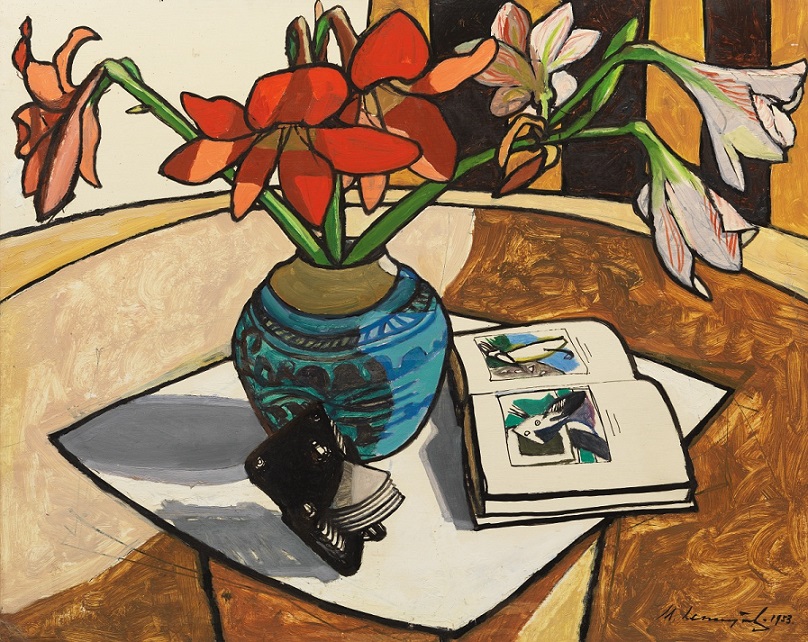
Michał Leszczyński (Michael Lester). Martwa natura, 1953

Malarz, szczycący sie pochodzeniem z linii polskiego króla Stanisława Leszczyńskiego. Marynarz z zawodu, osiadł po wojnie na Jamaice i poświęcił sie malarstwu. Czasami jego prace pojawiają się w USA. W Polsce zupełnie jest nieznany.

Lot 35. Michal Leszczynski (Polish/Jamaican, 1906 – 1972), 23″ x 29″ “Jamaica“, 1953. Oil on masonite, signed and dated lower right, artist, title, and date on verso, in a wooden frame, overall 26 ¼” x 32″. Lester LArt Galleries, Montego Bay, Jamaica label verso. Estimate $400 – 800. Aspire 02/18/21

Jerzy Kossak (1886 – 1955)

Jerzy Kossak. Soldiers in a snowy landscape, 1929

Praca wyglądająca na prawdziwą Jerzego Kossaka i w dodatku jest niezła. Temat napoleoński jest nadal nośny. Na kartonie malarskim znajduje się pieczęć zakładu przyborów malarskich Aleksandrowicza w Krakowie. Tej pieczęci na razie w Polsce się nie fałszuje, choć i na nią przyjdzie kolej. Jerzy Kossak nadal jest bardzo popularnym malarzem w Polsce. Proszę zajrzeć na Allegro by przekonać sie jak wielka jest podaż jego prac a potem natychmiat udać się do okulisty po nowe okulary jeśli któraś z nich się spodobała. Myślę, że ten olej z Aspire zostanie doceniony.

Lot 13. Jerzy Kossak (Polish, 1886 – 1955). Soldiers in a snowy landscape, 1929. Oil, on canvas mounted to board, 19 ½” x 15 ¾”, signed and dated lower right corner, under plexiglass in decorative frame, overall 22″ x 18 ¼”.  The soldier on foot to the left wears the bearskin hat of an imperial guard. The Soldier on horse wears a typical Napoleonic officer’s uniform. Condition: Even under UV light, mounted to board, some cracqelure around the perimeter, appears to be an old tear lower left, no evidence of inpainting. Estimate $2,000 – 4,000. Aspire. 02/18/21. Sold $3,100 (hammer)