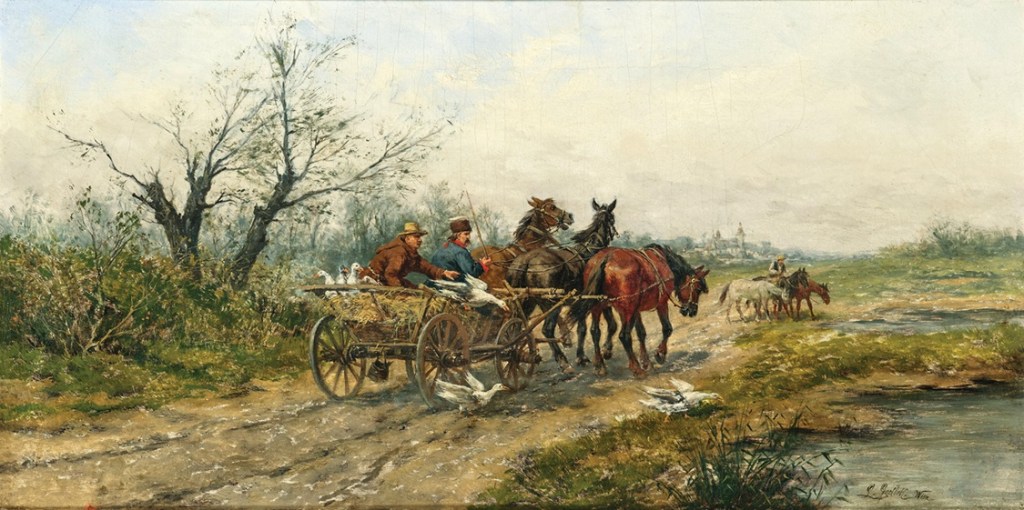
Banalna scenka rodzajowa na której widzimy ‘karetę’ zaprzężoną aż w trzy dziarskie konie, w której siedzi woźnica i rolnik ze swoimi gąskami przeznaczonymi na targ. Gąski uciekaja do pobliskiego jeziorka. Grupa skarłowaciałych koników oddalonych jest kilka metrów od bryczki – knot perspektywiczny. Scenka godna publikacji w gazecie, gdy już nie ma o czym pisać a puste miejsce trzeba czymś wypełnić. Dorotheum upatrzyło sobie, że ta scenka namalowana przez Ludwika Gędłka warta jest 5,000 – 7,000 euro czemu pewnie przytakuje szereg osób znających się bardzo dobrze na polskim malarstwie. Może eksperci z Dorotheum wyobrażają sobie, że ten obraz to wyżyny polskiego malarstwa końca XIX wieku?
Lot 614. Ludwig Gedlek (Krakow 1847–1904). On the Way to the Market, signed L Gedlek Vienna, oil on canvas, 32.5 x 63.5 cm, framed. Estimate 5,000 – 7,000 euro. Dorotheum. 10/23/24. Sold 5,000 euro
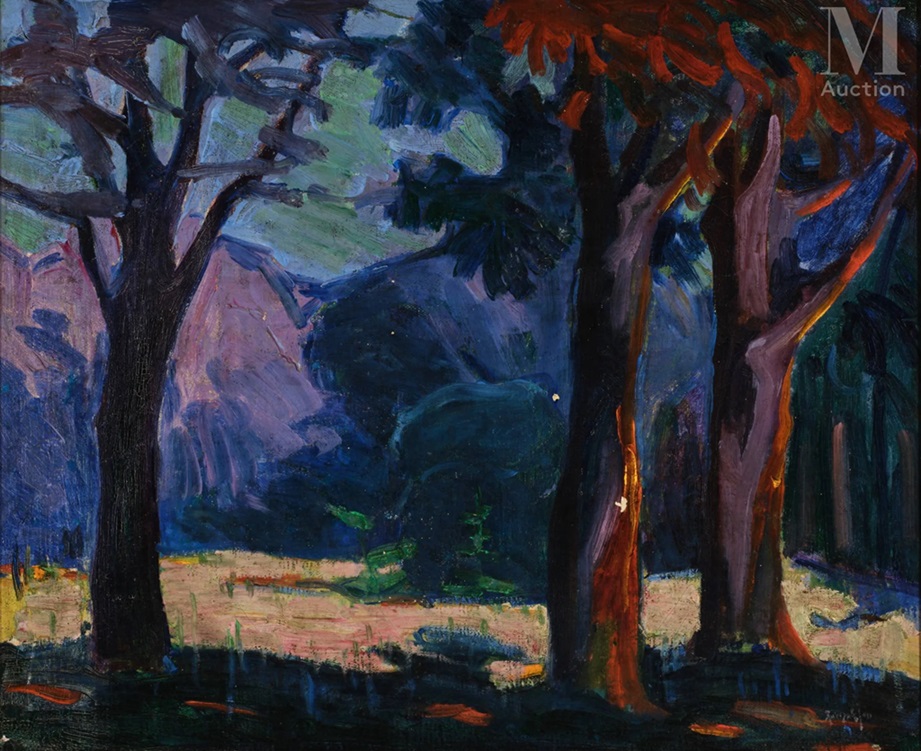
Fowistyczny w stylu pejzaż Jana Rubczaka z niekwestiowaną proweniencją wystawową. Ciekawe, że obraz tak bardzo znudził się Wojtkowi Fibakowi oraz później kolejnym właścicielom, że nadarza się niezwykła okazja by zasilił ścianę mniej nerwowej osoby, kto wie bo może nawet kolekcjonera malarstwa a nie kolejnego handlarza.
Lot 24. Jan RUBCZAK (Stanislawow 1884 – Auschwitz 1942.) Landscape through the trees. Made in 1910. Oil on canvas 38 x 46 cm. Signed lower right “Rubczak Jan”. On the back of the stretcher, the old exhibition label of the Krakow Academy of Fine Arts of 1911 with the handwritten indications “1911 Rubczak Jan n°62 …”. Provenance: Galerie Marek, Paris, 1987. Ewa and Wojtek Fibak Collection, Private collection, Paris Exhibition: Exhibited at the Krakow Academy of Fine Arts, 1911, n°62. Polish painting in the Ewa and Wojtek Fibak Collection, National Museum in Warsaw May 23 – August 9, 1992 – National Museum in Poznań August 22 – October 25, 1992, reproduced p. 136. Estimate 8,000 – 10,000 euro. Millon. 10/22/24. Sold 12,000 euro
Kolejna high-end polonik na rynku francuskim. Za kilka dni licytacja Lampy-ust Aliny Szapocznikow. Podobną pracę sprzedano niedawno w Sotheby’s za ćwierć miliona dolarów.
Lot 23. Alina SZAPOCZNIKOW. Mouth lamp – 1969.Tinted polyester resin and electric cable. Signed with initials and dated below “A.S., 69”. 43.0 x 11.0 x 13.0 cm. Provenance: Private collection, Paris To the present owner by descent. A certificate will be issued by Mr. Hervé Loevenbruck at the purchaser’s expense. Estimate 150,000 – 250,000 euro. Artcurial. 10/18/24. Sold 360,000 euro
Mojżesz (Moise) Kisling. Nude sitting on the grass, 1950
Lot 40. Moïse KISLING (Krakow 1891 – Sanary sur Mer 1953). Nude sitting on the grass. Created in 1950. Original oil on canvas 89 x 70 cm. Signed and dated lower left “Kisling 1950”. On the back, on the stretcher the label of Moise Kisling’s personal collection “M. Kisling 10”, the label “Photo n°30”, the label “Malingue …” and the number 16 in red pencil, the label “International Art Transport ref 3405”. Provenance: Moïse Kisling Collection, Paris Collection of the artist’s family, by inheritance. Private collection, acquired from the latter. Exhibitions : Kisling, April 3-15, 1975, Tokyo, Galeries Seibu, Shibuya, no. 48 (reproduced) Kisling, April 19-May 5, 1975, Osaka, Galeries Seibu Takatsuki, no. 48 (reproduced) Kisling, May 18-June 6, 1984, Tokyo, Grande Galerie Odakyu, no. 74 (reproduced) Kisling, August 4 -26, 1984, Miyazaki, The Miyazaki Prefectural Institution Kisling, August 30-September 11, 1984, Osaka, Daimaru Art Gallery,Shinsaibashi Kisling, September 27-October 2, 1984, Kobe, Daimaru Art Gallery, no. 74 (reproduced) Kisling retrospective, November 1984, Paris, Grand Palais, Salon d’Automne, no. 51. Kisling centenaire, April 18 – July 12, 1991, Paris, Galerie Daniel Malingue, no. 56 (reproduced). Bibliography: Kisling (Jean), Kisling (preface by Joseph Kessel), tome I, Paris, 1971, bilingual edition, p. 310, pl. XI. Jacques Lambert, Kisling Prince de Montparnasse, Les éditions de Paris Max Chaleil, 2011, (reproduced).
The École de Paris department announces the sale of two major works by Moïse Kisling, the emblematic Polish-born painter of the École de Paris. These two works, from Moïse Kisling’s personal collection, remained in the artist’s family through inheritance, and were subsequently acquired from the family by the current owner. These two paintings, “Jeune gitan” (Young Gypsy) and “Nu assis sur l’herbe” (Nude sitting on the grass) were painted in Sanary in the painter’s villa studio “La Baie”, the plans for which were drawn up by his wife Renée. These two works are reproduced in black and white in Volume I of the artist’s catalog raisonné, are reproduced in reference publications and have been exhibited many times in France and abroad, notably in Japan. The painting “Jeune gitan” (“Young Gypsy”), executed in 1952, is an iconic work in the Young Boys series. The model, with his large black eyes, fine features and stylized hair, tenderly embodies the beauty of young manhood that Kisling repeatedly depicted. From the same collection comes a monumental, sculptural nude, Nu assis sur l’herbe, dating from 1950. According to oral tradition in the artist’s family, Kisling had a particular preference for this painting, which he kept at home and which we are presenting here today: Nu assis sur l’herbe.
Moïse Kisling’s fame is partly due to the nude genre, which he esteemed and celebrated throughout his career. Here, there are no famous models reclining on a couch or studio nudes embodying the woman of the ’50s. On the contrary, quite exceptionally, the artist paints here an idealized nude, timeless, almost unreal. The artist unveils a Venus, a nymph or a modern bather. The coiled hair at the temple, extending down to the grass, echoes the ancient myth of the birth of Venus. Hypothetically seated beside a stream, this modern nymph, with her pure, universal gaze and a modest smile on her face, seems to belong to a distant past, while at the same time conveying the painter’s particular modernity.
This non-commissioned work, which the artist keeps in his personal collection, is in a way a manifesto of his vision of the art of the nude in 1950. Kisling works on the nude in the classical sense of the term, delivering a work with multiple references to ancient and modern painting, and probing the essence and artistic codes of the nude genre.
Ancient statuary is one of the fundamental artistic sources for the nude, and Kisling creates a monumental, sculptural reconstruction of a dreamed-of antiquity.
This figure of massive, sculptural proportions recalls some of the canons of Greek and Roman antiquity, while at the same time exaggerating them. The artistic sources appear multiple. The painting also echoes Old Masters such as Titian, as well as the work of Jean-Dominique Ingres. The central position of the subject and anatomical deformations are features that the painter was able to study at the Louvre, particularly in front of La Grande Odalisque and La Baigneuse de Valpinçon. Kisling also drew on the paintings of Renoir and his massive nudes. Indeed, the painter was able to study Reno
Estimate 200,000 – 300,000 euro. Millon. 10/22/24. Sold 220,000 euro
Dwa fantastyczne obrazy, które Mojżesz Kisling namalował pod koniec swojego życia. Mogą stanowić gold standard do których można odnosić pozostałe jego prace. Oba w Millon na nadchodzącej aukcji Ecole de Paris.
Mojżesz (Moise) Kisling. Young gypsy, 1952
Lot 41. Moïse KISLING (Krakow 1891 – Sanary sur Mer 1953). Young gypsy. Realized in 1952 Oil on canvas, 73 x 60 cm. Signed and dated lower left “Kisling 1952”. On the back, on the stretcher the label “Kisling 0107″, the label of Transports André Chenue & Fils Exposition Kisling Prêteur Mr. Jean Kisling n°52 Jeune Gitan”, the label of Transports André Chenue & Fils Exposition Kisling Prêteur Mr Kisling Jeune Gitan, the old label “107” and a Japanese exhibition label on the back of the frame “N°19”. Provenance: Moïse Kisling Collection, Paris Collection of the artist’s family, by inheritance Private collection, acquired from the latter Exhibitions: April 1 – 30, 1953, Cagnes-sur-Mer, Château-Musée, Kisling, Oeuvres récentes, n° 16 Kisling, November 5-24, 1953, Paris, galerie Drouant-David, no. 4 Kisling, December 5-20, 1955, Avignon, galerie “La Calade”, n°4 Kisling, April 3-15, 1975, Tokyo, Galeries Seibu, Shibuya, no. 52 (reproduced) Kisling, April 19 – May 15, 1975, Osaka, Galeries Seibu Takatsuki, no. 52 (reproduced) Modigliani, Utrillo, Kisling, August 29 – September 17, 1980, Tokyo, Tokyu Art Gallery, no. 80 (reproduced) Hommage à Kisling, October 7-25, 1988, Paris, Mairie du XVIème, Salon des artistes du XVIème, (reproduced without number) Kisling centenaire, April 18 – July 12 1991, Paris, Galerie Daniel Malingue, no. 63 (reproduced).
Bibliography : Nacenta (Raymond), Los Pintores y el ambiente artistico de Paris desde 1910, Editorial Rauter, Barcelona, 1960, p. 138 (repr.) ; Kisling (Jean), Kisling (preface by Joseph Kessel), tome I, Paris, 1971, bilingual edition, p. 133, pl. XXXIV. Jacques Lambert, Kisling Prince de Montparnasse, Les éditions de Paris Max Chaleil, 2011, (reproduced)
Estimate 120,000 – 180,000 euro. Passed
Mojżesz (Moise) Kisling. Seated nude
Lot 59. Moïse KISLING (Krakow 1891 – Sanary sur Mer 1953). Seated nude. Circa 1930. Oil on canvas 34.3 x 27.4 cm. Signed lower right “Kisling”. We would like to thank Mr. Marc Ottavi for verbally confirming the authenticity of this work. “Kisling brought realist painting to its highest potential through his frantic need to create. He doesn’t seduce at first. He surprises and conquers by force. Then his enchantments take effect. One never forgets Kisling’s works, for they are as different as their subjects themselves… He never repeats himself, and each of his works is a new experience of color. His love of life, his sensual and paroxysmal temperament, his prodigious health, make him the most powerful colorist of the Ecole de Paris.” Florent Fels, Kisling, artistes juifs, Paris, Edition Le Triangle, 1928, p.16.
Ta pomięta kartka papieru krąży po rynku amerykańskim od kilku lat. Miałem ten shit raz w ręku i przekonałem właścicela galerii by wycofał ze swojej aukcji. Niemniej, krąży i wruje po rynku amerykańskim jak gówno w przeręblu. Najwyższą cenę ten falsyfikat osiągnął w tej samej brooklyńskiej firmie Antique Arena w lutym tego roku bo aż $8,250. Po pół roku staniało o ok $5,000 ale durniów nie brakuje – po co kobiety takich rodzą? Gorzej, bo podobne prace Fangora są następnie sprowadzane do Polski a tam wyceniane są do 140,000 złotych (https://polishartcorner.com/2023/10/22/fangor-z-usa-w-sopockim-domu-aukcyjnym-za-100000-140000-zlotych/). Po co kobiety rodzą takich sopockich ekspertów?
Lot 43. Wojcieck Voy Fangor, Polish, American, 1922 to 2015, oil crayon painting on paper depicting an abstract composition, 1973. Signed and dated, lower right. Framed. Provenance: Chalette International, New York. An original paper label is on the backside. Estimate $100 – 150. Antique Arena. 10/13/24. Sold $3,600.
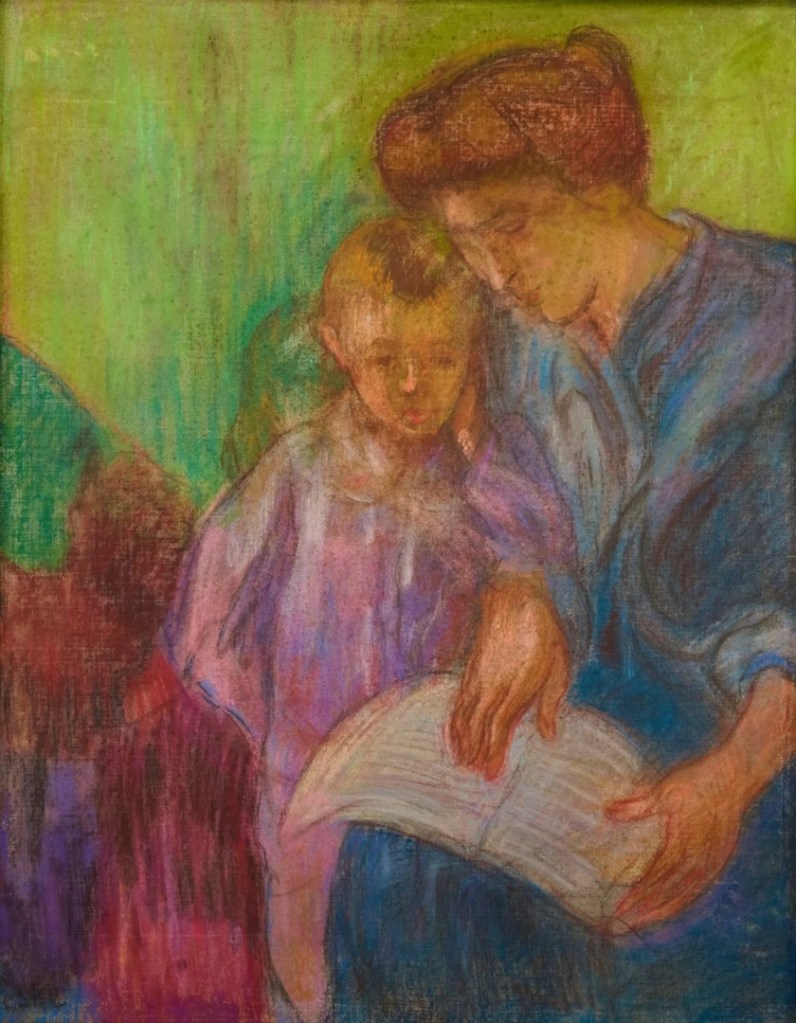
Powoli prace Jeana Peske (Jana Mirosława Peszke) są przerzucane na polski rynek. Nie obyło sie oczywiście bez kompromitacji, gdy niedawno Desa-Unicum umieściła w swoim katalogu pracę innego malarza o podobnie brzmiącym nazwisku, czyli Jean Pesce, jako Jean Peske: https://polishartcorner.com/2022/07/22/jean-peske-1870-1949-czy-jean-pesce-1926-kolejny-blunder-desy-unicum/. Nauka jednak nie idzie w las i chyba od tego momentu jest już lepiej. Jean Peske tworzył chyba szybko i dużo bo wiele jego prac pojawia się na francuskim rynku. Te dzisiejszy pastel to jedynie zwiastun tego co pojawi się w Millon na kilka dni. Zatem nie mam wątpliwości, że znajdą się wkrótce w kraju. Problem jednak nie w ilości a w jakości, czyli ważny jest okres twórczości uznany przez krytyków (oczywiście nie Desy-Unicum) za ten najistotniejszy. Nie tak dawno obiegła Polskę wiadomość, rozpowszechniona przez artinfo.pl, o rekordowej sprzedaży na zachodzie jednej z prac tego artysty. Była to jednak jego praca pointylistyczna. Nie należy spodziewać się podobnych cen za każdy obraz tego malarza, choć kto wie jak będzie w Polsce bo tam da się wszystko wmówić klientom.
PS. Wymieniam czasami nazwy polskich domów aukcyjnych, jak Desa, SDA, etc, reklamując je na świecie z szacunkiem, a one mnie nie wymieniają. Skad się bierze taka dyskryminacja?
Lot 55. Jean PESKE (1870-1949). Mrs. Peske and her son reading. Pastel on canvas signed lower left (pitting). Height 76 cm – Width 60 cm. Estimate 1,200 – 1,800 euro. Le Floc’h. 10/13/24. Sold 2,800 euro
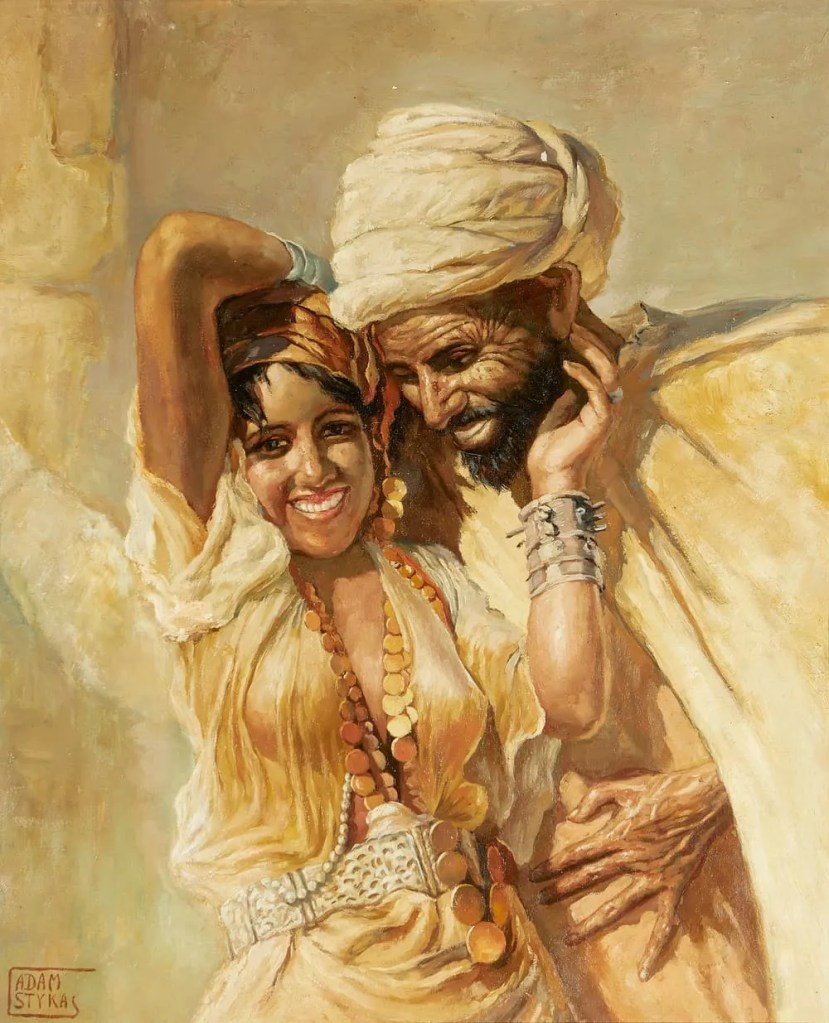
Lot 66. ADAM STYKA (1890-1959). Couple laughing, signed ‘Adam Styka’ (lower left), oil on canvas 60.9 x 52 cm. Estimate 5,000 – 7,000 euro. Hermitage Fine Art. 10/28/24. Sold 5,000 euro
Wpis ten, traktujący o dwóch falsyfikatach prac Adama Styki, polecam szczegółnie pracownikom Desy-Unicum by zastanowili się zanim handlarze przyniosą im je do biura: https://polishartcorner.com/2020/11/26/adam-styka-1890-1959-na-pewno-nie-nagel-niemcy-i-desa-unicum-polska/. Heritage Fine Art wygląda mi na firmę mającą afiliację ze środowiskiem rosyjskim i stąd wiele w ich katalogach prac wątpliwych. Sprzedają tam wiele prac przypisywanych a również bardzo amatorsko spaprane falsy. Na rozgrzeszenie firmy, estymacja falsyfikatu w kolorze jajecznicy jest niska jak na pracę Adama Styki choć oczywiście bardzo wysokna jak na krzywego falsa. Konstanty Szewczenko malował o niebo lepsze ‘Adamy Styki’.
Obraz sprzedawany na aukcji we włoskim domu Cambi ma co najmniej z 10 lepszych odpowiedników (falsów) krążących po różnych rynkach. Najlepiej na nie popatrzeć na portalu Mutual Art. Warto również odszukać pierwowzory obu falsów namalowane przez Adama Stykę.
Ciekawe, że oba domy aukcyjne mają w swoich katalogach jeszcze po jednym obrazie Adama Styki, wyglądające dużo lepiej. Trudno jednak zdecydować się na opinię i decyzję, skoro te domu sprzedają tak brzydkie falsyfikaty.
Adam Styka? Lovers
Lot 293. Adam Styka 1890-195.9 Lovers; signed lower left. Wt. 73 – Hd. 100 cm, oil on canvas. Already Sotheby’s Auction , Paris, 18/11/2013, reproduction page 131 of the catalog. Estimate 2,000 – 3,000 euro. Cambi. 10/23/24. Sold 2,600 euro
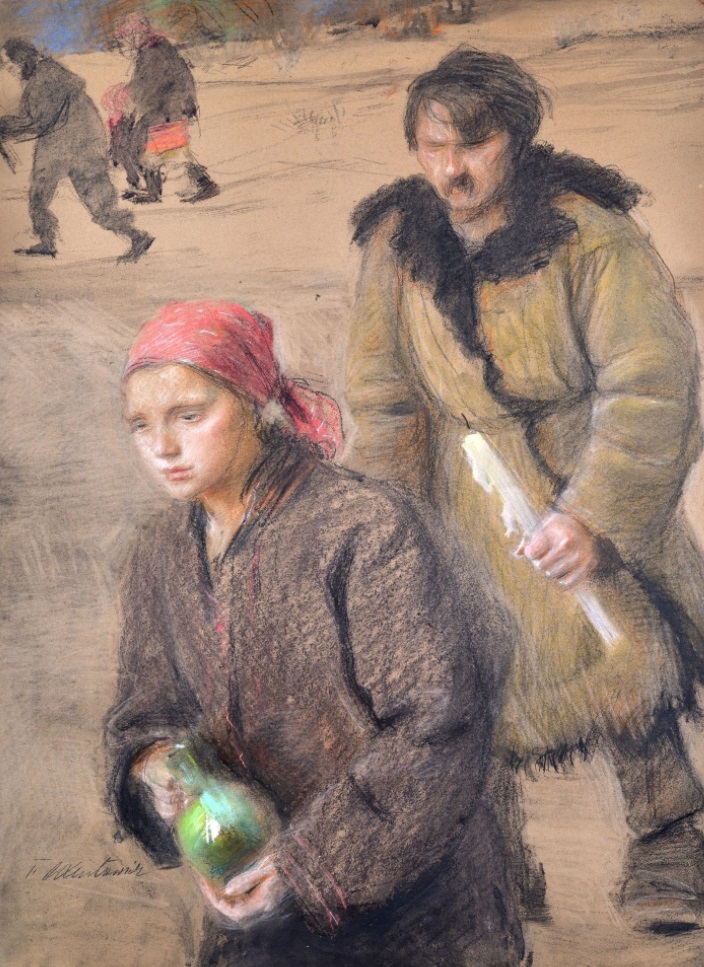
Pastel Teodora Axentowicza wraca po ośmiu latach na włoski rynek: https://polishartcorner.com/2016/03/18/teodor-axentowicz-1859-1938-10/. Praca wygląda na prawdziwą lecz jest to u tego artysty temat powielany w wielu wersjach. Podobnych prac Teodor Axentowicz namalował dużo, podobnie jak Jerzy Kossak namalował wiele np. ‘Napadów wilków’.
Lot 129. Théodor Axentowicz (Brașov, 1859 – Kraków, 1938) – Women Pastels and charcoal on cardboard, 75×56 cm. Signature at lower left. On verso: printed label with Cyrillic text. Estimate 3,000 – 5,000 euro. Galeria Panati. 10/11/24. Sold 3,600 euro
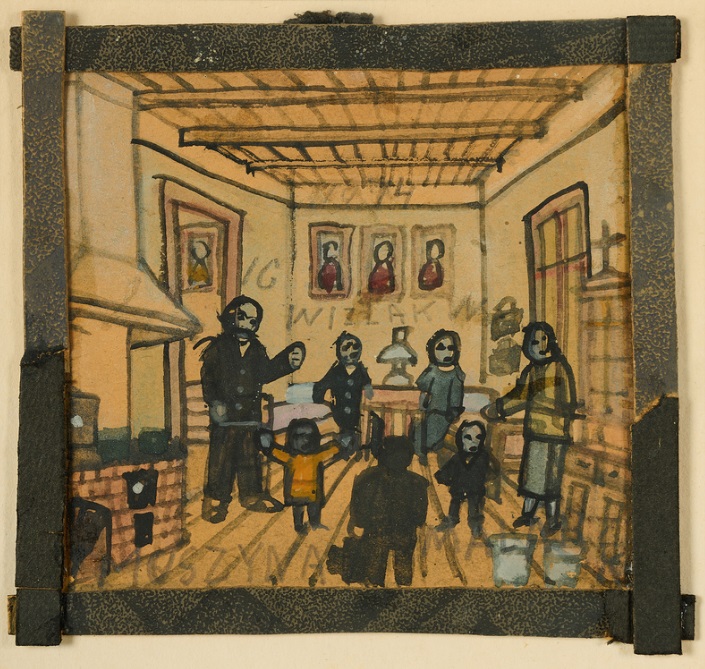
Mało rozpopularyzowana internetowa aukcja w niemieckim Van Ham dostarczyła kolejną prawdziwą akwarelę Nikifora.
Lot 78. Nikifor. Untitled. Gouache und Collage on vellum. 14 x 14cm. Inscribed Centre and bottom edge of the image: in Polish. Framed (22,5 x 25cm). Estimate 800 – 1,200 euro, Van Ham. 10/10/24. Sold 1,600 euro
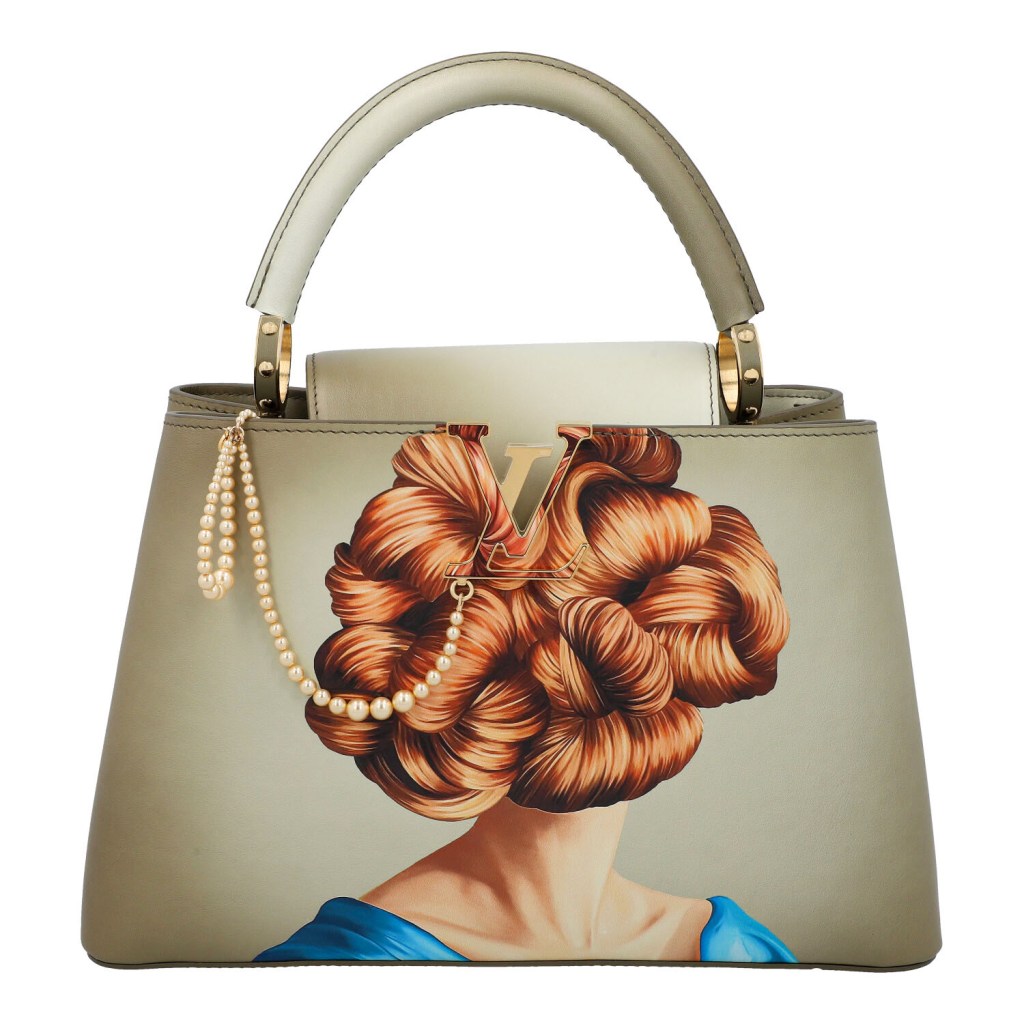
Znakomity pomysł i jakaż to lokata pieniędzy. Torebka Louis Vuittona wykonana jedynie dla 200 osób z całego świata. Prestiż posiadacza zapewniony. Każdy może nosić, nawet kobieta. Czekamy na wynik ostrej licytacji. Gdyby to tej torebki mąż zechciał tylko dokupić prawdziwy obraz, którego fragment mamy na torebce.
Lot 52. LOUIS VUITTON bag “ARTYCAPUCINES”, coll.: 2023. COLLECTOR’S PIECE. RARITY. LIMITED EDITION 154/200 by Ewa Juszkiewicz. Surrealist oil painting ‘Ginger Locks’ from 2021, reminiscent of a 19th century portrait. Fine pearl necklace adorns the page like a necklace, leather envelope hidden inside, alluding to secret love letters from the past. Box, dust bag, shoulder strap, copy of the invoice and certificate enclosed. As good as new. Estimate 9,000 – 15,000 euro. Eppli. 10/12/24



 Polish Art Corner