Eugeniusz Zak (1884 – 1926)

zak
Eugeniusz Zak, Junger Mann mit blauer Kappe, 1923

Lot. 116001585. Eugeniusz Zak. Junger Mann mit blauer Kappe. Um 1923. Oil on canvas. Lower left signed. 100 x 81 cm (39.3 x 31.8 in). Estimate: € 60,000 / $ 67,200. Ketterer. 12/10/16 (16156250)


LITERATURE: H. Ritter, Ewige Romantik, in: Deutsche Kunst und Dekoration: illustr. Monatshefte für moderne Malerei, Plastik, Architektur, Wohnungskunst u. künstlerisches Frauen-Arbeiten, 1925, issue 56, p. 228 wit illu.
Barbara Brus-Malinowska, Eugeniusz Zak: 1884 – 1926, Warszawa 2004, p. 150, no. 196.

Essay

The painter Eugeniusz Zak, an important representative of the École de Paris at the beginning of the 20th century, was born the son of an engineer of Jewish-Polish origin in Moligno, Belarus in 1884. After his father’s death the family relocated to Warsaw in 1892, where Eugeniusz Zak completed secondary school. In 1902 Zak moved to Paris where he studied art at the École des Beaux-Arts under Jean-Léon Gérôme, as well as at the Académie Colarossi at Albert Besnard. In 1903 Zak traveled to Italy and Munich, where he took lessons at the private art school of the Slovenian painter Anton Ažbes. In 1904 Eugeniusz Zak returned to Paris and exhibited his works at the autumn show of the Paris Salon. The graphic and pictorial creation of Eugeniusz Zak is dedicated to figuration and combines aspects of traditional and modern tendencies of the early 20th century.The early period of Zak’s creation is characterized by portraits of common people, peasants and fishermen as well as of children and mothers. His drawings in gouache, red chalk and chalk show the influence of Zak’s journeys to Brittany between 1906 and 1908. After the outbreak of the First World War Zak visited Southern France between 1914 and 1916. From these days onward he made pictures with idyllic scenes of loving couples, lone wanderers, fishermen and mothers in harmonious landscape settings that call reminiscence of works by artists such as Puvis de Chavannes and Cézanne. As of 1917 he developed an increasing interest in scenes of a surreal parallel existence inhibited by jesters, dancers, jugglers and other outsiders such as beggars and vagabonds. These works show the influence of Picasso’s early paintings. Other sources of influences such as Expressionism or the socio-critical German New Objectivity can also be found. Zak’s later works are characterized by neo-classicist tendencies. Among the works from these days we find classic portrait heads and Greek Contrapposto sculptures with stylized faces that call reminiscence of the masterpieces of Botticelli or Leonardo da Vinci. In Zak’s creation they mark the dialog between tradition and the manifold styles of Modernism. Eugeniusz Zak’s art was honored in many international solo shows and publications and was on display at various public collections, mostly in Poland. The Parisian Musée du Luxembourg acquired works by Eugeniusz Zak for its collection as early as in 1910. The same year Zak joined the Association of Polish Artists in Paris, other members were Elie Nadelman, Leopold Gottlieb and Mela Muter. In 1912 Zak was appointed professor at the Académie de la Palette, in 1913 he participated in the acclaimed International Exhibition of Modern Art in New York, the so-called Armory Show. In 1914 his first solo show at the renowned Parisian Galerie Druet followed. In 1916 Zak and his wife Jadwiga Kon, who he had married in Paris in 1913, returned to Czestochowa in Poland. In 1917 Zak participated in the first exhibition of ‘Formizm’, a Polish group of expressionist artists, in Cracow, in 1921 he was one of the founding members of the Polish group of artists called Rytm (Engish: Rhythm). In 1922 Eugeniusz Zak stayed in Berlin and Bonn for some time and eventually returned to Paris in 1923. The counter movement that set in after the Fauves and the German Expressionism put forth New Objectivity in Germany and a form of Neoromanticism in other countries, predominantly in France.The paintings formal arrangement calls reminiscence of Italian Late Renaissance and Picasso’s early works. Thecoloring’s shaded tone underlines the artist’s intention to a closed form of arrangement. In a dreamlike lost world the artist’s broaches the issue of the individual’s isolation, as it can also be found in the art of Karl Hofer. Remote from all forms of Realism Zak sought to give the individual a special form of an own dignity that finds its fulfillment in a precise pictorial interpretation. Eugeniusz Zak died in Paris in 1926. [
Artur Szyk (1894 – 1951)

szyk-1

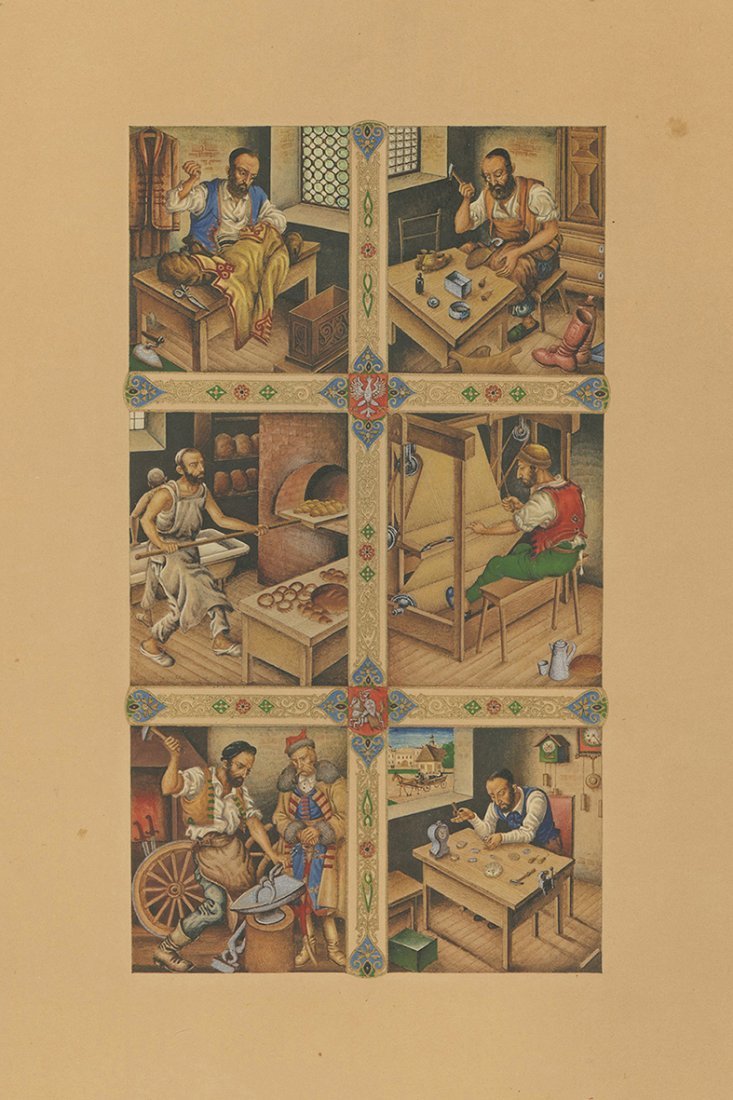
Lot 166. Granting the “Statute of Kalisz” to Jews in Poland, original painting by Arthur Szyk. [late 1920s?].
Gouache and ink on paper. Signed in Hebrew initials “AS”.
The painting depicts Duke BolesÅ‚aw of Kalisz granting the charter known as the “Statute of Kalisz” to representatives of Polish Jewry, in 1264.
In the second half of the 1920s Szyk created a series of about 45 paintings on the subject of the “Statute of Kalisz”. The series was published in a limited edition in 1932 (see next item); this painting is not included in this series.
Painting: 39X26 cm, leaf: 45X37 cm. Good overall condition. Some creases and stains. Upper left corner is missing. Upper part is taped to passe-partout. Ink-stamp (Polish) on verso, inscription in pen and some stains (from old adhesive tape).

Estimate $12,000-15,000. Kedem. 11/15/16

szyk-2

Lot 166. “Statute of Kalisz”, an illustrated adaptation of the General Charter of Jewish Liberties granted to Jews in Poland (1264), created by Arthur Szyk. Facsimile on thick paper. Paris: “Table Ronde”, 1932. English, Hebrew, Yiddish, German, Polish, Italian and Spanish.
45 illustrated plates. A unique artistic adaptation of the first charter of rights granted to the Jews of Poland. Colorful illustrations, diverse decorations, calligraphy and miniatures.
Arthur Szyk (1894-1951), one of the most outstanding Jewish artists in the twentieth century, started his work on the scroll in the mid-1920s, when he resided in Paris. In the face of rising anti-Semitism in Poland, Syzk decided to to create an artistic argument expressing the unique and long affinity between Polish Jews and their homeland. As subject of his work Szyk chose the Statute of Kalisz, the first document of its kind securing the liberties of Jews in Greater Poland Voivodeship, issued by the Duke of Greater Poland Boleslaus the Pious (1224-1276) in 1264.
Szyk illustrated the statute with outstanding figures and scenes from the history of Poland and Polish Jewry. He included the heroic death of Berek Joselewicz, a Jewish officer who died during the Napoleonic wars; the death of the officer Bronislaw Mansperl in World War I, and Jews fighting side by side with the Polish in Lodz again Tzarist Russia.
Szyk’s “Statute of Kalisz” is dedicated (on one of the illustrated plates) to Józef PiÅ‚sudski (1857-1935), the respected military leader and de facto governor of Poland at that time.
Unnumbered copy, from of an edition of 500 copies. Lacking original paper folder.
Total of 47 plates: 46 illustrated plates (one is double) and a colophon (probably missing two leaves – one printed, without illustrations, and one blank). Plates: 32X38.5 cm. Good overall condition. Creases and tears to margins. Stains to several plates (no damage to illustrations). One plate has a 3.5 cm long tear on upper margins, and a 1.5 long tear on right margins, without damage to illustration or text.
Literature: The art and Politics of Arthur Szyk, by Steven Luckert, U.S. Holocaust Memorial Museum, Washington, 2003. pp 16-25.

Estimate 25,000-30,000. Kedem. 11/15/16

szyk-3

Ludwik Klimek (1912 – 1992)

klimek

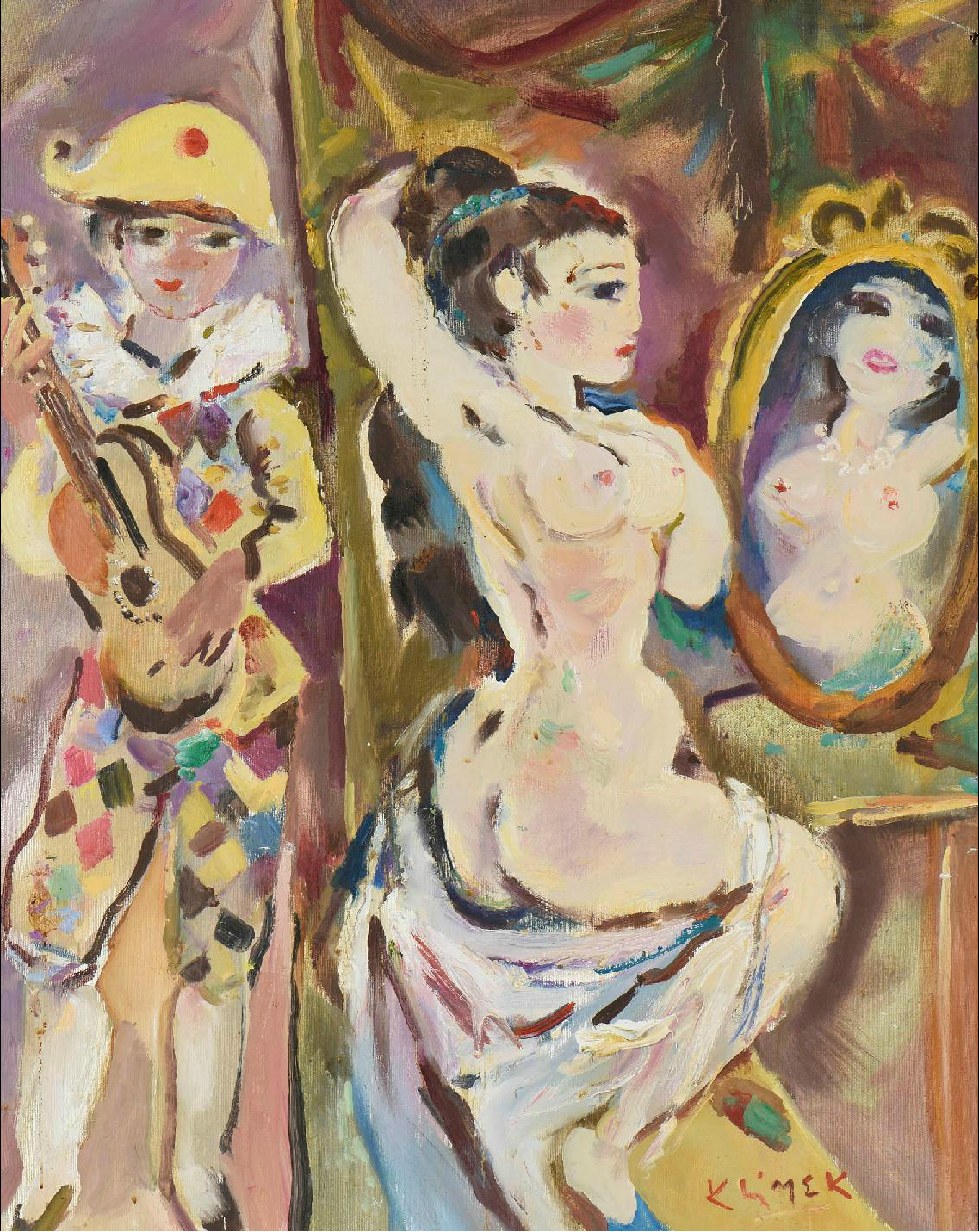
Zapraszam do obejrzenia kolejnej pracy Ludwika Klimka.


Lot 57. Ludwig KLIMEK (1912-1992) Arlequin et sa belle dans sa loge Huile sur toile signée en bas à droite, titrée sur la toile 82x65cm, acc. en haut à droite, Dans un cadre doré modern

Estimate 500-800 euro. Maître Marie-Laure THIOLLET. 10/18/16

Aleksander Raczyński (1822 – 1889)

raczynski

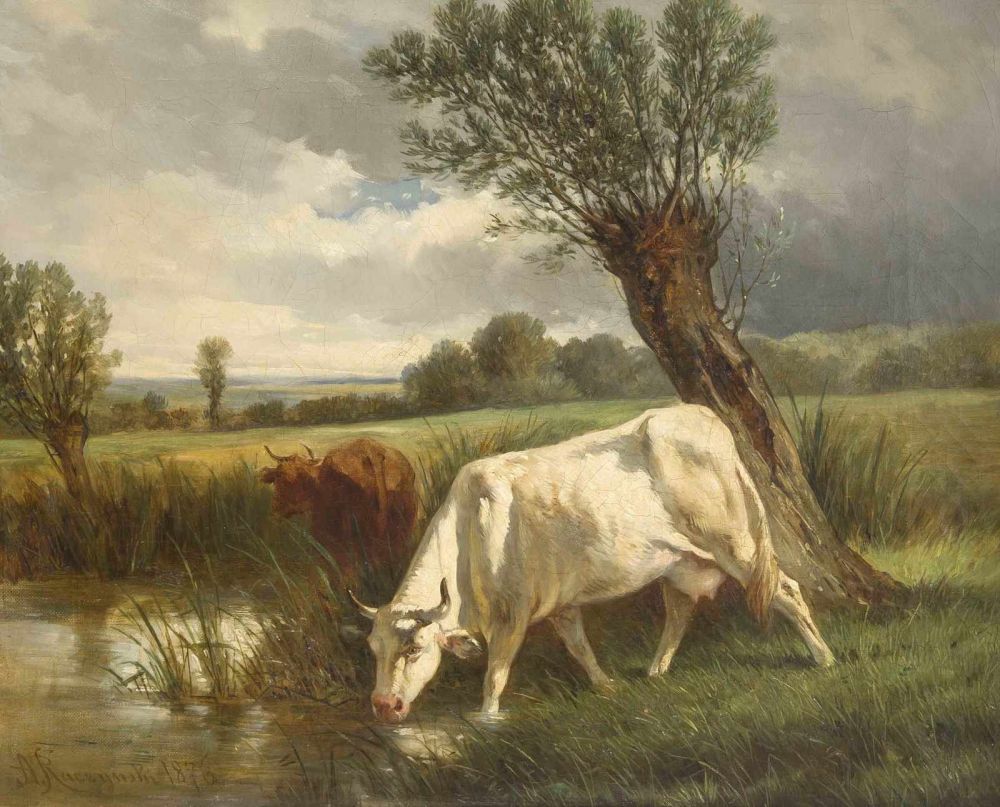
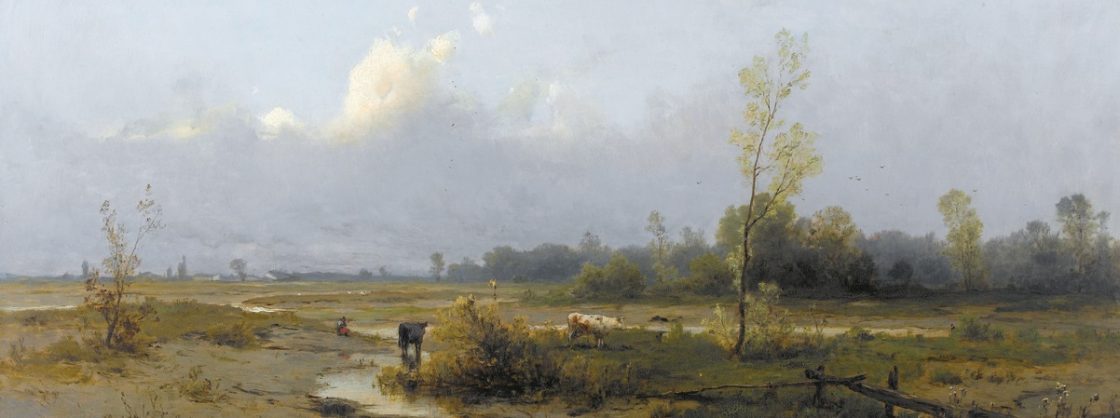
Praca była na rynku kilka lat temu. Niezła, choć gdyby zamiast krów pojawiły się konie to mocno by teraz zyskała. Stanowić może niezłe uzupełnienie kolekcji przedstawiającą polską wieś.

stock-illustration-59244326-thumbs-up-cow


Lot 1573. Raczynski, Aleksander. 1822 – 1889 Lemberg. Polnischer Genre-, Bildnis- und Vedutenmaler.
Kühe an der Tränke, dat. 1876. Öl/Lw., wachsdoubliert(?). Sign. u. dat. u. li. 39 x 48 cm/ R. 46,5 x 55 cm.- “Paysage intime”, wobei die Lichtstimmung auf dem hellen Fell der im Vordergrund stehenden, trinkenden Kuh fokussiert wird. Stud. an der Akad. in Wien u. München. Craquelée, retusch.

Reserve 250 euro. Bolland & Marotz. 11/12/16

Sprzedano za 390 euro. Tę samą pracę Raczyńskiego,  ten sam dom aukcyjny sprzedał w marcu 2007 roku za 1,600 euro, przy wycenie 1,200 euro.  Hmm….co to znaczy?

Franciszek Żmurko (1859 – 1910)

zmurko

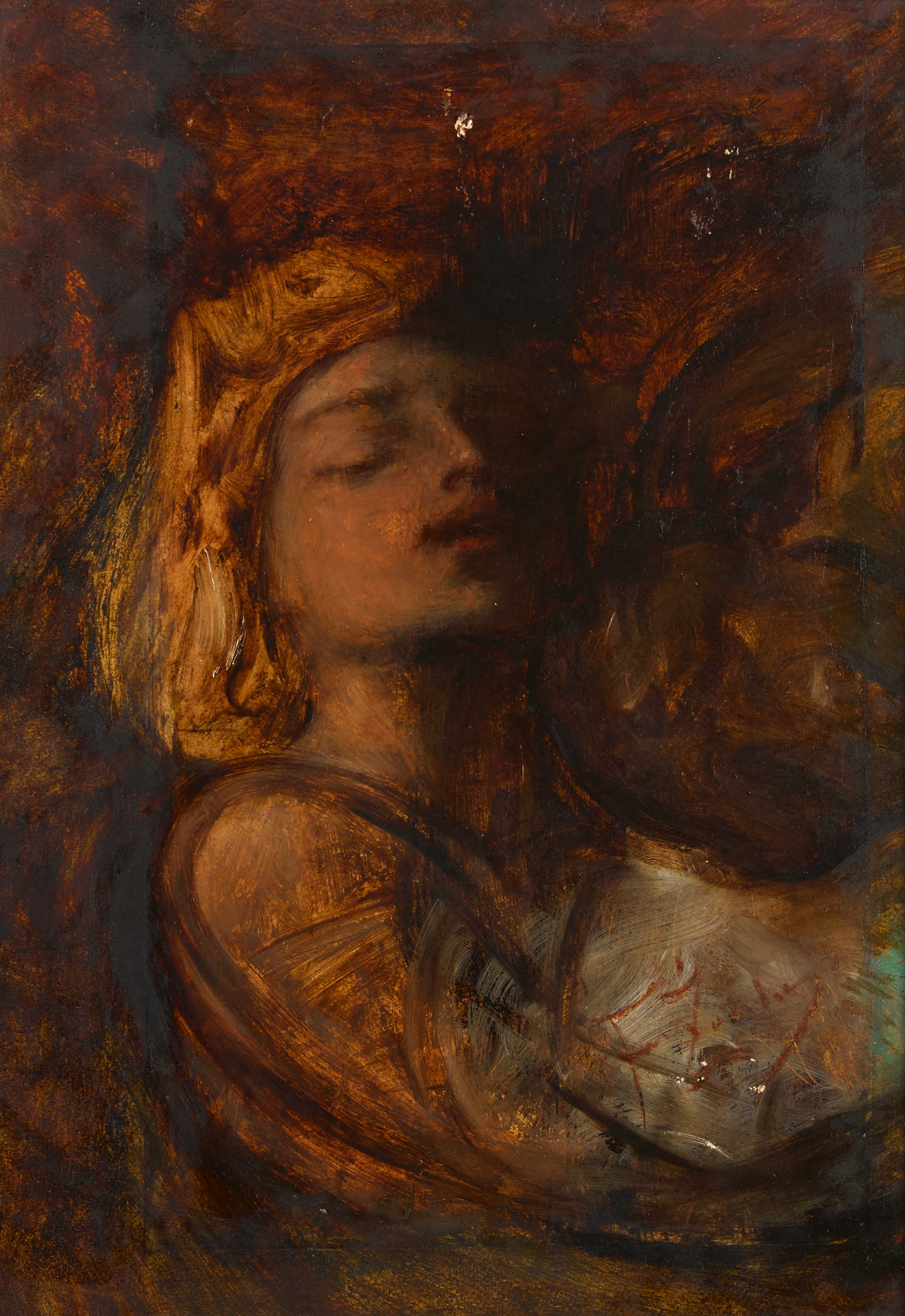
Lot 441. ZMURKO, FRANCISZEK Lwiw/Lemberg 1859 – 1910 Warschau

“Glowa kobieca” (Frauenkopf). Öl auf Malkarton, sig. u.r., 40,5×29 cm

Verso Echtheitsbestätigung: Alexandra Lüde Zmurkowa (Ehefrau des Künstlers).

Estimate CGH 2,000. Dobiashofsky. 11/11/16 (161300)