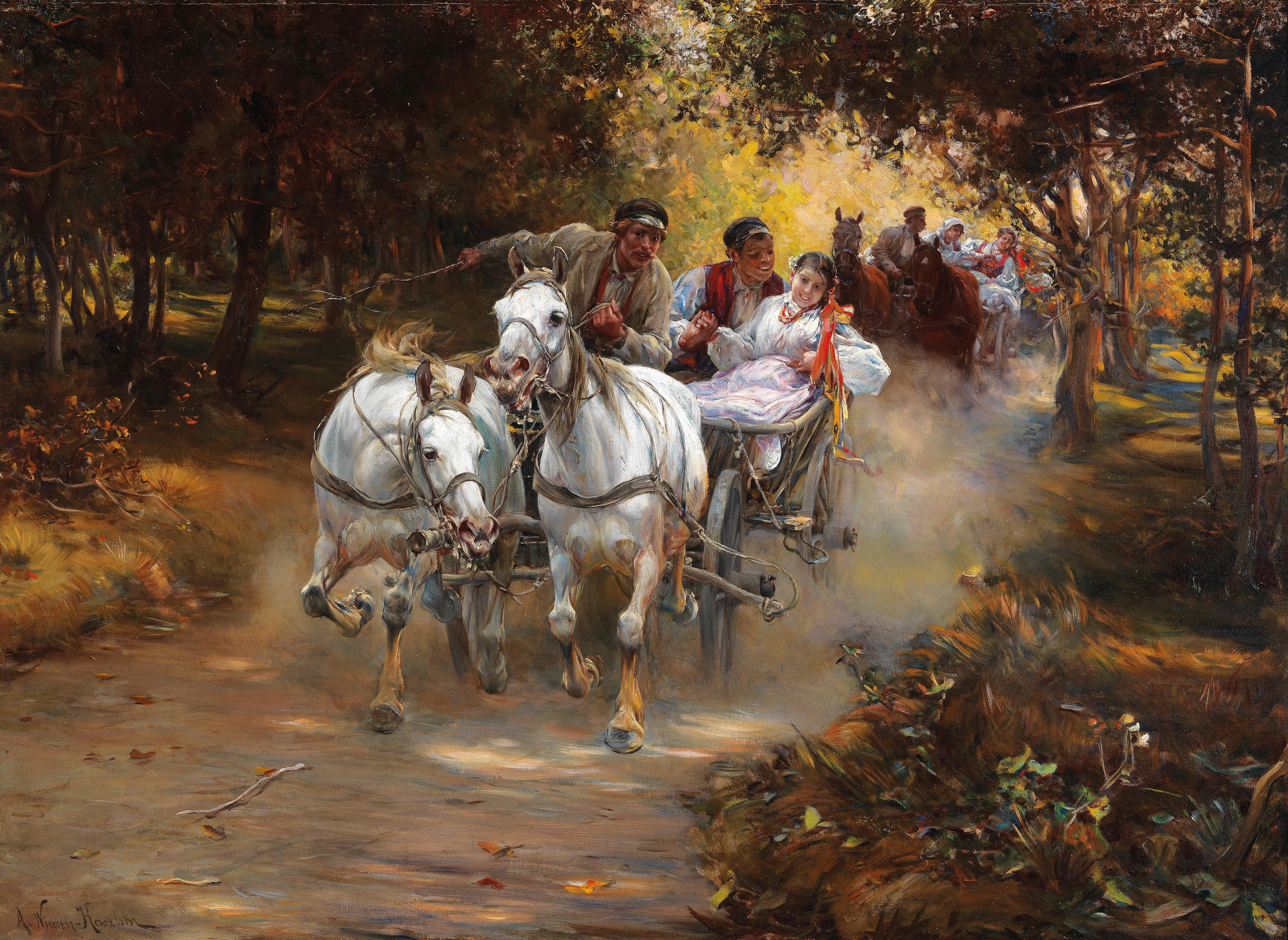
Lot 1129. Alfred von Wierusz-Kowalski (Suwałki 1849–1915 Munich)
Country Wedding, signed A. Wierusz-Kowalski, oil on canvas, 79 x 107 cm, framed,
Certificate from Eliza Ptaszynska, Suwałki Museum, March 2016 available.
Provenance:
Karl Karcher, Kaiserslautern;
Mathilde and Gustav Jacob Adt, Forbach (Moselle);
Carlotta Adt, Forbach (Moselle);
Private collection, Southern Germany
Compare:
Friedrich von Boetticher, Malerwerke des 19. Jahrhunderts, Hofheim am Taunus 1973, Vol. I/2, p.785, no.35
Alfred von Wierusz-Kowalski, born in Suwałki in 1849, was one of the best known Polish-born painters of the 19th Century Munich School. After several years spent enrolled at the academies in Warsaw, Dresden and Prague, Wierusz-Kowalski settled in Munich in 1873 to study with the Polish historical painter Józef Brandt at the Munich Academy. Encouraged by his teacher, he joined the Polish group of artists in Munich, finally advancing to become their most prominent representative. He was appointed professor at the Munich Academy in 1890. Alfred von Wierusz-Kowalski received innumerable prizes and awards during his lifetime as a painter, for his works depicting rural life in Russian Poland and Galicia. Amongst collectors and art dealers his vividly painted and frequently captivating works were some of the most popular of their time. Around the turn of the century, Wierusz-Kowalskis’s paintings were reproduced in illustrated magazines, ensuring their popularity amongst a wider audience.
The present lot depicts a country wedding and demonstrates all Wierusz-Kowalski’s skill in representing movement. A wedding party, divided amongst several carriages, are on their way to the church, or to the subsequent celebrations. The passengers in the carriages are happy and relaxed, which is unsurprising in view of the joyful occasion and the swift journey along the woodland road. Yet here Wierusz-Kowalski takes a standard genre motif and adds fabulously dramatic details. The wildly galloping horses radiate exceptional vitality, and the substance of the swirling dust above the ground appears to the viewer to be almost tangible. As a result of this temperament, paired with his rapid manner of painting and lucid colours, works by Wierusz-Kowalski are consistently judged to be sensational.
Certificate from Eliza Ptaszynska, Suwałki Museum, March 2016
“Alfred Wierusz-Kowalski is the author of the painting. It was created between 1890-1990.
The composition depicts the peasant weeding procession which is rushing through the woods. On the first cart, which is pulled by two grey horses, we can see a coachman. His posture is leaning forward in the scene. Behind him, there is a couple of peasants. The girl(one of the peasants)is smiling. She is dressed in white clothes that are decorated with red ribbons. She is tilting to the back from the young man who is leaning towards her, and who is holding her hand. Behind this cart, there is another one. On the second cart, we can see a coachman and colourfully- dressed peasants. The carts are driving on a wide, sandy, forest road which is led in a slight angle, from the right to the left edge, towards the observer. All around, there is darken-shaded forest with sun-brightened part in front of the foreground cart, and just behind the second cart in the background.
This is a diagonal composition. There are elements drawn in perspective; figurative group in the foreground which is dominant the spectrum of the painting; putting other group in the backgrounds to elicit the narration of the show. Lastly, the dynamics, the expression and the authenticity of the scene.
Harmonized colours, although in the narrow scale, but the richness of tones; the use of colourful accents- red ribbons, colour used to paint the horses, the girls’ clothes-all of these adopted to follow the sight through the surface of the image. The use of reflections of light- sun beams penetrating crowns of trees, leaving golden spots on sandy road, forest floor, leaves, etc.
Formal use of means, the way in which paintbrush is led, precisely drawn figurative group and concise elements of the landscape and the background, these are the characteristics of Alfred Wierusz-Kowalski’s works. Nonetheless, the key argument here is the photograph( presenting this painting) which is left as the painter’s legacy.
In the archived collection of The Suwałki District Museum, among several dozen of models posing in the artist’s studio, there is also a reproduction of Peasant Wedding (Bauernhochzeit).
There is no firm statement concerning the date of this work. Alfred Wierusz-Kowalski rarely put dates on his works. To determine the date of creation of a given work means using the comparison or base the examination on woodcut reproductions presented in the press. Unfortunately, I am not familiar with the woodcut that could be the reproduction of Peasant Wedding (Bauernhochzeit). I cannot recall any other source(for example from literature or archive collection) where I would get the chance to study the painting, except the above mentioned photograph.
The newspaper “Tygodnik Ilustrowany”( from 1892 [2], p. 424) presented the picture of Peasant Wedding (Bauernhochzeit)(il.1). The painting was displayed in Glaspalast, sold on auction in 2006 (Sotheby`s). It was reproduced a few times in the press. That was the only work, with this title, among others created by the artist. The composition shows a procession of festive-dressed peasants going through winter scenery, coming straight into the observer’s eyesight. However, there are several works of this artist whose title relate to the theme of discussed panting. These are the works titled: Polish Wedding (Polnische Hochzeit), Coming back from the Wedding (Heimkehr von den Hochzeit), Cracovian Wedding of Peasants (Krakauer Bauernhochzeit), To the Church-Peasant Wedding(In die Kirche-Bauernhochzeit), Going away to the church in a Festive Day( Kirchenfahrt am Feiertage), Going away to the Church ( Fahrt zur Kirche) {Glaspalast, 1905}, To the Wedding, From the Wedding, Coming back from the Church, On the Way to the Church. That is why, it seems risky to connect Peasant Wedding((Bauernhochzeit) with the work of the same title, displayed in 1892 in Glaspalast. There are no information found concerning the description of this painting or its size.
Comparative analysis could help to date this painting. ‘Tygodnik Ilustrowany’ in 1891(issue 66, the front cover) presented the woodcut similar to Alfred Wierusz-Kowalski’s painting called From the Wedding (il.2). It is the same theme, the same pair of grey horses. It is also the same arrangement of hooves, the angle of horse’s head, the animals drawn in perspective. Although, there is different landscape background, the artist similarly arranged green plant elements in the foreground: triangular clump of plants in the lower right corner and some higher thickets put on the left side, in the line of running horses.
‘”Wędrowiec”(1898/1/p.157) showed Coming Back from the Wedding (il. 3) in 1898 (Neumeister Gallery, 2002,;in similar version was shown around a few times on European auctions, like in Van Ham,2001). Again, the theme is the same just like in Peasant Wedding but here we have a different season, different landscape and grey horses are switched in their places. The one, which has its head down, is running on the right side. The couple of peasants in the foreground has also analogies. In 1896 “Tygodnik Ilustrowany”, issue (1896/1/) 10, p. 191 presented the woodcut called Courtship (il. 4) with a pair of peasants on a low, one-horse sleigh. Their poses, their faces, clothes are the same like those from Peasant Wedding. There is also a group of paintings, known from archive records, which show peasant processions going among trees and bushes. However, they are not dated.
Mentioned examples can be multiplied. Nonetheless, it makes no difference for the sake of argument. Based on comparative analysis, it can be stated that the examined work was created between 1890-1900.
In 1892 AWK won a golden medal for painting „In Februar“ („W lutym“). It was a winter scene with wolfs.
In 1899 in Heinemann Gallery painting „Coming back from the Wedding“ (“Heimhehr nach dem Hochzeit“) – 77 x 107 cm – was sold. It was bought by J. Prowe from Moscow.
Eliza Ptaszyńska
Suwałki, 25.0″
Estimate 70,000-90,000 euro. Dorotheum. 04/21/16.
Sold 137,200 euro




 Polish Art Corner