Franciszek Starowieyski (1930 – 2009)

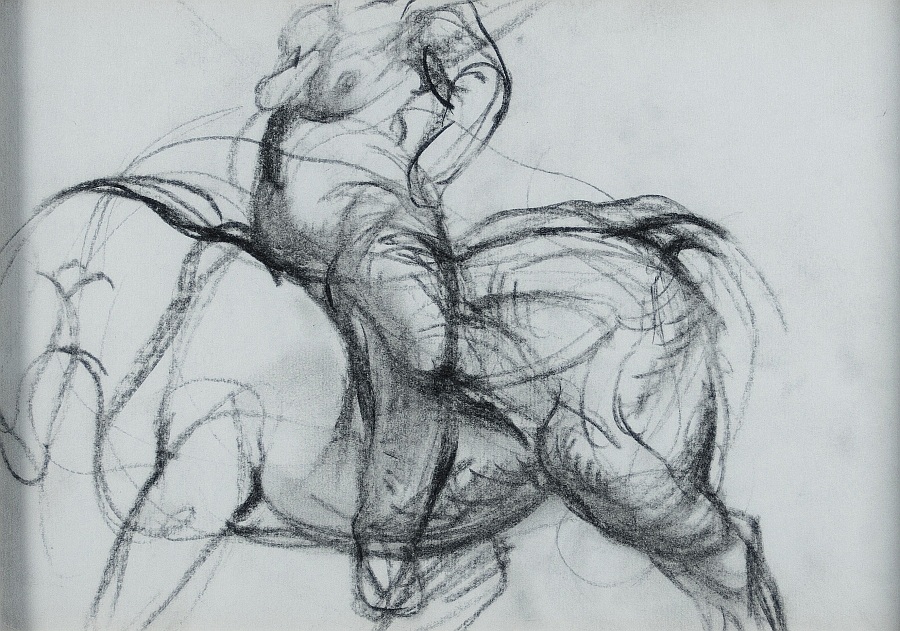
Franciszek Starowieyski. THE BODY, 1985

Lot 222. Franciszek STAROWIEYSKI (1930-2009). THE BODY. Pencil and chalk signed lower right H.: 59 cm; W.: 41 cm. Estimate €2,000 – 3,000. Hôtel des ventes de Mantes-la-Jolie. 10/04/25. Sold € 7,500

Kilka dni temu obserwowalimy aukcję w Ader na której zostało zaprezentowanych ponad 100 prac Franciszka Starowieyskiego. Wszystkie zostały sprzedane a największe trzy z nich (https://polishartcorner.com/2025/08/25/franciszek-starowieyski-1930-2009-24/), jak ćwirkają ptaszki, znalazły się w prywatnej kolekcji. Obecnie mamy możliwość zakupu pojedyńczego rysunku z francuskiej aukcji.

Władysław Bakałowicz (1833 – 1903)

Władysław Bakałowicz. The conversation

Lot 470. Ladislaus BAKALOWICZ (1833-1903). The conversation. Oil on canvas. Signed lower right. 92 x 73 cm (faded). Note: A Polish painter, Bakalowica studied at the Warsaw School of Fine Arts between 1846 and 1852. After the failure of the uprising in January 1863, he went to Paris, where he painted pictures, mainly of figures in 16th and 17th century costumes, scenes from the life of the French court under the reigns of Henri III and Louis XIII. He exhibited his work at the Paris Salons between 1866 and 1889, and also in Europe. He obtained French nationality in 1879 and took the name Ladislas Bakaowicz. Estimate €4,000 – 5,000. Cannes Encheres. 10/17/25. Sold €4,000

Nie wiem jak nazwać tę sztuczną scenę rodzajową wziętą być może z teatru. Nie przetrwała próby czasu. Obraz jest duży, oczekuje się wysokiej sprzedaży ale nie jest to praca z jąkąś głębszą myślą. Tak malowano widać we Francji w drugiej połowie XIX wieku i tak malował Władysław Bakałowicz znajdując klientów na swoje prace. Niewątpliwie obraz ten może zdobić ścianę galerii teatralnej.

Stanisław Żukowski (1873 – 1944)

Stanisław Żukowski. The Night Train

Lot 598. Stanisław Yulianovich Żukowski (Grodno 1873-1944 Pruszkow). The Night Train, signed S. Zukowski, oil on canvas, 54 x 74 cm, holes, unframed. We are grateful to Dr Olga Sugrobova-Roth for her scholarly advice. Estimate €5,000 – 7,000. Dorotheum. 10/22/25. Sold €14,000

Bardzo nietypowy olej Stanisława Żukowskiego. Należało udostępnić kolekcjonerom te naukowe porady przedkazane przez Dr. Olgę Sugrobovą-Roth pracownikom Dorotheum. Warto zauważyć, że w przypadku tego malarza Dorotheum zwraca się o opinię do rosyjskich historyków sztuki a nie polskich. Coż, wiekszość zycia Stanisław Żukowski spędził w Rosji i tam uchodzi za rosyjskiego malarza.

Ludwik Gędłek (1847 -1904)

Ludwik Gędłek. Im Hinterhalt

Lot 341. Paar Gemälde Ludwik Gedlek 1847 Krakau – 1904 Wien “Auf VorpostenIm Hinterhalt” je u. re. sign. u. bez. L. Gedlek. Wien verso auf den Holztafeln m. d. handschr. Titeln in Bleistift. Öl/Holz, je 16 x 21 cm Aufwendige Schmuckrahmen, frisch aufgearbeitet. Opening €4,500. Döbritz Kunst- und Auktionshaus. 10/25/25. Sold €4,000

Małe wymiarami oleje Ludwika Gędłka są zwykle sprzedawane parami (Nieszczęścia chodza parami jak mawia nasze przysłowie). Górny Odpoczynek został niemiłosiernie spaprany przez jakiegoś domowego konserwatora a przemycia sygnatury zostały po amatorsku poprawione choć napisu Wien nie udało się już odtworzyć. Zniechęcony swoimi działaniami ‘konserwator’ ograniczył swoją działalnośc tylko do jednego obrazka. Za wyjściowe 4,500 euro można kupić dwa słabiutkie oleje Ludwika Gędłka, które może da się sprzedać z zyskiem w Polsce jakiemuś amatorowi. Jak zwykle na pracach tego malarzach konie stoją a jeźdźcy patrzą smutno gdzieś w dal. Nie ma życia w pracach tego malarza.


Ludwik Gędłek. Auf Vorposten

Bolesław Biegas (Biegalski) (1877 – 1954)

Bolesław Biegas (Biegalski). Château du cheval mystérieux

Lot 110. BOLESŁAW BIEGAS (1877-1954). Château du cheval mystérieux, signed ‘B. Biegas.’ (lower right), oil on panel, 60 x 80.6cm (23 5/8 x 31 3/4in). Painted in 1924. Estimate £12,000 – £18,000. Bonhams. 10/17/25. Sold £38,000

Pozwoliłem sobie skopiować w całości bardzo ciekawy esej katalogowy dołączony do tego oleju Bolesława Biegasa mającego niepodważalną proweniencję.

The authenticity of this work has been confirmed by the Comité Biegas. This work will be included in the forthcoming Bolesław Biegas catalogue raisonné, currently being prepared by Xavier Deryng. Provenance: Musée Bolesław Biegas (Société Historique et Littéraire Polonaise de Paris), Paris, no. Szymanski 381 (a gift from the artist in 1954). Galerie Jan Krugier, Geneva, no. 1698 (acquired from the above in 1971). Brook Street Gallery, London. Private collection, UK (possibly acquired from the above). Private collection, UK (by descent from the above). Literature: J. Szymanski, Bolesław Biegas inventaire dactylographié, Société Historique et Littéraire Polonaise de Paris, Paris, no. 381. X. Deryng, ‘”La mystique de l’infini”, L’Île des Morts de Boleslas Biegas’, in Hommage à L’Île des Morts d’Arnold Böcklin, exh. cat., Musée Bossuet, Meaux, 2001 (illustrated p. 45).


Bolesław Biegas’s Château du cheval mystérieux stands as one of the most haunting visions of his celebrated Mystique de l’infini cycle, painted in Paris during the 1920s. Architectural yet phantasmagorical, the work presents the viewer with a fantastical citadel, crowned by a spectral bronze Pegasus. Its body gleams with alchemical light, rising against a field of midnight blue, while the citadel itself seems suspended in a realm that is simultaneously dreamlike and unsettling. Flanking the structure, towering cypresses ascend like sentinels, their flame-like silhouettes evoking the mournful associations of Greek myth and the visionary gravitas of Symbolist painting. In the lower right, a lone nude, her blonde hair catching an ethereal glow, provides a fragile human counterpoint to this nocturnal dreamscape.

The scene is one of profound theatricality. Biegas orchestrates his composition like a stage-set of the subconscious: the citadel gleams with touches of turquoise, crimson and pale gold, while the Pegasus’ staring eye and coiled grimace suggest both vigilance and enigma. This strange alchemy of ether, metal and imagination produces an uncanny tension between stillness and implied motion. Soft hints of acid-green light filter through the background, suggesting the first moments of dawn – or perhaps the threshold of another realm entirely. One senses that we have entered a spiritual or cognitive landscape, a land of dreams or nightmares, calm yet eerily charged.

The nude figure, diminutive yet radiant, becomes the counterpoint of this visionary architecture – a glimmer of femininity and sensuality against an otherwise desolate environment. Draped in gossamer folds of lavender and rose, she recalls both Jean-Auguste-Dominique Ingres’s classical nudes and the female protagonists of Paul Delvaux’s surrealist paintings. Her presence is enigmatic: is she a worshipper, a captive, or a dreamer before the threshold of the uncanny? Such ambiguity was deliberate, aligning Biegas with a Symbolist preoccupation with the mysteries of femininity, as well as its narrative strategies of indirection and allegory. Her scale, juxtaposed with the grandeur of the citadel and its guardian trees, evokes the Romantic notion of the sublime, recalling the monumental mythological landscapes of Gustave Moreau. Indeed, as the eye surveys this miniature human presence, one is invited into a meditation on scale, power and wonder.

Since antiquity, the cypress tree has signified mourning and eternal remembrance, rooted in the myth of Cyparissus, who was transformed into a tree to grieve forever. In Arnold Böcklin’s visionary series, Die Toteninsel – a touchstone for Biegas – funereal cypresses transform the Isle of the Dead into a necropolis, their vertical silhouettes architectural in their solemnity. In the present work, the cypresses similarly twist upward like black flames, structuring the landscape and invoking ideas of death, transcendence and passage. Like Vincent van Gogh’s cypresses, they impart emotional intensity and cosmic rhythm to the composition.

Château du cheval mystérieux is a core example of Biegas’s Mystique de l’infini cycle, executed between 1923 and 1929. Arguably his most captivating Symbolist works, these paintings present enchanted palaces, dreamlike architecture and spectral apparitions, often adorned with phosphorescent colour and gleaming with an enamel-like finish. Exhibited in Paris at Galerie Seligmann in 1925 and Galerie Bernheim-Jeune in 1929, such works were described by the critic Gustave Kahn as ‘a beautiful meditative poem of great isolation’ (G. Kahn, ‘Les nuits mystiques par Boleslas Biegas’, in Le Mercure de France, 1 December 1925, p. 509). The present painting stands at the heart of this cycle, with its mysterious castle, guardian Pegasus and solitary nude suffused with ethereal radiance, drawing the viewer into a reflective reverie.

The genesis of these visions lies in Biegas’s early Paris years. At the 22nd Salon des Indépendants in 1906, his paintings were admired by Guillaume Apollinaire as ‘the most profound thing in the exhibition … here is a soul’ (Apollinaire quoted in M. Decaudin, ‘Apollinaire et les peintres en 1906, d’aprés quelques notes inédites,’ in La Gazette des Beaux-Arts, February 1970, p. 118). Subsequently, Biegas absorbed the Symbolist currents of the Revue blanche circle and the Wagnerian ideal of the Gesamtkunstwerk, as his paintings and sculpture fused music, poetry and image into sublime emanations of expression. While he aligned himself with Böcklin and Odilon Redon, his approach remained idiosyncratic, fusing Böcklin’s mythological gravitas and Redon’s dreamy haze into enchanting visual fables of phosphorescent solidity. In the present work, he reconciles Symbolist spirituality with a modern fascination for geometry and architecture, producing a composition that is timeless in its sheer originality.

Ultimately, the present work encapsulates Biegas’s vision of painting as a poem of infinite meditation. It is a work of rare atmospheric power, where Symbolist allegory, erotic nuance and visionary architecture converge. Emerging from a cycle that has remained enigmatic throughout history, the painting exemplifies Biegas’s singular contribution to the École de Paris: an art of luminous invention and symbolic resonance, bridging Romantic imagination and modernist experimentation. Coming from a distinguished family collection of Polish art, Château du cheval mystérieux is one of the most captivating embodiments of early twentieth-century Symbolism remaining in private ownership.

Tadeusz Ajdukiewicz (1852 – 1916)

Tadeusz Ajdukiewicz. A Horse Market

Lot 531. Tadeusz Ajdukiewicz (Wieliczka 1852–1916 Krakow). A Horse Market, signed Tadeusz Ajdukiewicz, oil on canvas, 81 x 170 cm, framed. Provenance: Since two generations – Private Collection, Germany. Estimate €25,000 – 35,000. Dorotheum. 10/22/25. Sold €38,000

Duży wymiarami obraz Tadeusza Ajdukiewicza przedstawiający handel końmi i dobijanie targu gdzieś na Bałkanach. Obraz wyceniono dość nisko porównując np. do cen niektórych dużych i słabych obrazów Ludwika Gędłka, artysty mającego obecnie pik swojej sławy na warszawskiech aukcjach. Niektórym może jednak przeszkadzać scena nieco nam obcego bałkańskiego orientalizmu bo pewnie lepiej obecnie pasowałby targ ‘w małym galicyjskim żydowskim miasteczku‘. Warto zainteresować się jednak tą pracą Tadeusza Ajdukiewicza bo to był nie tylko pierwszorzędny ‘koniarz’ lecz również wzięty i ceniony portrecista.

Leon Tarasewicz (1957)

Leon Tarasewicz. Untitled, 1999

Lot 126. 4541770. LEON TARASEWICZ (POLEN, FÖDD 1957). Untitled. Acrylic on canvas, 50 x 51 cm, including frame 53.5 x 53.5 cm. Signed and dated verso Tarasewicz 1999. Provenance: Nordenhake Gallery, Stockholm. Swedish private collection. Starting €2,260. Stockholms Auktionswerk. 10/14/26. Sold €5,900

Chciałbym dowiedzieć się czy Leon Tarasewicz potrafi namalować postać ludzką czy też tylko zamalowuje płótna z lewa w prawo i z powrotem tak jak kiedyś w przypływie wielkiego natchnienia twórczego zamalował wnętrze warszawskiej Zachęty, łącznie ze schodami. Chętnie posłuchałbym wykładu tego malarza z jego przesłaniem do studentów.

Alfred Wierusz-Kowalski (1849 – 1915)

Alfred Wierusz-Kowalski. A Successful Fox Hunt, 1878

Lot 530. Alfred Wierusz-Kowalski Alfred von Wierusz-Kowalski (Suwalki 1849–1915 Munich). A Successful Fox Hunt, signed, dated Alfred Wierusz-Kowalski (18)78, inscribed on the reverse “From my collection – George Montgomery – purchased for me by my wife Dinah on our 1st wedding anniversary 1944”, oil on panel, 30 x 35 cm, framed Provenance: Private Collection, USA; Gift to the Palm Springs Art Museum from the George Montgomery Trust; Sale, Hindman, Chicago, Illinois, USA, 4 November 2021, lot 322; Private Collection, Great Britain. Estimate €40,000 – 60,000. Dorotheum. 10/22/25. Sold €75,000

Trudno zrozumieć pojawienie się tego obrazu w Dorotheum z wyceną €40,000 – 60,000. Obraz był przeciez licytowany w w 2021 roku amerykańskim domu Hindman i osiągnął $65,000 (hammer), https://polishartcorner.com/2021/10/08/alfred-wierusz-kowalski-1849-1915-59/.  Obecnie, właściciel z UK zdecydował się go sprzedać w Dorotheum mając znacznie bliżej trzy wielkie domy aukcyjne. Być może przewóz z UK do Austrii wiązał się teraz z dodatkowyą opłatą cła. Stąd ta zagadka cenowa.

Oprócz kilku obrazów przedstawiających jeźdźców na koniu w podonym stroju w wykonaniu Wierusza (patrz podany link) znane są również prace Józefa Brandta o tytule Powrót z polowania, jak też z Powrót z jarmarku.

Alfred Wierusz Kowalski. Reiter auf Patrouille, olej deska, 16 x 12 cm
Józef Brandt. Powrót z polowania
Józef Brandt. Powrót z jarmarku, ok 1904. Żródło: Agra-Art

Igor Mitoraj (1944 – 2014)

Igor Mitoraj. AEDO II, 2010 (5/6)

Lot 83. Igor Mitoraj (1944 – 2014). AEDO II, engraved signature and edition number, e.g. 5/6 size without base: 28.5 x 19 x 23 . The work is accompanied by a photographic certificate from the artist. We thank Atelier Mitoraj for confirming the presence of the work in their archives. PROVENANCE Atelier Mitoraj, Pietrasanta Private collection, Milan Technique: Bronze sculpture Measures: 54.0 x 19.0 x 23.0 cm Year 2010. Starting price: 20,000. Estimate: € 40,000 – 50,000. Capitolium Art. 10/16/25. Passed

Warta polecenia rzeźba Igora MItoraja wykonana w zaledwie 6 egzemplarzach. Należy zauważyć, że włoski dom aukcyjny jest bardzo ostrożny i aby potwierdzić autentyczność zwraca się o opinię Atelier Mitoraj. A we Francji i w Polsce nadal panuje ekscytacja aukcyjna gdy pojawi się rzeźba tego artysty wykonana legalnie w tysiącach egzemplarzy plus pewnie już taka sama ilość nielegalnie.

Juliusz Kossak (1824 – 1899). Powtórka

Juliusz Kossak. Ksiaze Jósef Poniatowski na Szumce

Lot 41. Juliusz Kossak Polish, 1824-1899. Ksiaze Jósef Poniatowski na Szumce (Prince Józef Poniatowski on Szumka). Signed and dated Juliusz Kossak/ 1885 (lr). Oil on canvas, 35 x 28 1/2 inches (89 x 72.4 cm). Frame 54 1/2 x 47 1/4 inches (138.5 x 120 cm). Provenance: Wojciech Kossak, Krakow, Poland (the son of the artist); Thaddeus Stec, Moscow, PA, acquired from the above in 1933; Sale, Trinity International Auctions & Appraisals LLC, CT, Jun. 9, 2018, lot 5. Estimate $8,000 – 12,000. Doyle. 10/15/25. Sold $12,800

Obraz mocno potaniał od ostatniej próby sprzedaży w Doyle w maju tego roku (poprzednia estymacja $15,000 – 25,000): https://polishartcorner.com/2025/05/06/juliusz-kossak-1824-1899-prove-it/. Ciekawa była wówczas dyskusja na blogu.