
LOT n°72 Jean LAMBERT-RUCKI (1888-1967)
Masque.
Plâtre polychrome monté sur un support en bois peint en blanc.
Signé sur le support en bas à droite.
19 x 11 cm
Estimate 1,200-1,500 euro. Drouot Estimations. 11/22/17
LOT n°72 Jean LAMBERT-RUCKI (1888-1967)
Masque.
Plâtre polychrome monté sur un support en bois peint en blanc.
Signé sur le support en bas à droite.
19 x 11 cm
Estimate 1,200-1,500 euro. Drouot Estimations. 11/22/17

Lot 163. Leszek NOWOSIELSKI
(1918-2000)
L’hiver, 1983
Huile sur toile, signée, datée et titrée au dos
65 x 50 cm
Estimate 500-600 euro. Boisgirard Antonini Paris. 11/15/17

Lot 6. BAKALOWICZ LADISLAUS, 1833-1903
DAME A LA ROBE ROUGE ET LEVRIER huile sur panneau (fines craquelures et petites restaurations), signé en bas à gauche 25×19 cm
Estimate 1,200-1,800. Rennes Enchères. 11/13/17

Lot 21. Jan Chelminski. Große höfische Jagdgesellschaft, 1877. Oil on canvas, relined. Lower left signed, dated and inscribed “München”. 86 x 185 cm (33.8 x 72.8 in). Verso of stretcher with various numbers and an illegible inscription. PROVENANCE: Private collection Rhineland-Palatinate. Estimate: € 20,000 – 30,000 ($ 23,400 – 35,100). Ketterer. 11/24/17. Sold 92, 500 euro ($104,524)
Essay
Jan Chelminski was born in Brzostów, Poland, in 1851 and had his first art lessons in the drawing class of Juliusz Kossak in Warsaw. In order to make a living he was working part-time as lithographer and retoucher at a photographic institute. In 1873 Chelminski relocated to Munich and studied at the Academy of Fine Arts at Alexander Strähuber and Alexander Wagner. In 1875 he was student of the acclaimed artist Josef von Brandt and a year later of Franz Adam. He was member of the Munich Artist Association from 1874 to 1883. As of around 1875 a circle of young, predominantly Polish artists formed around Josef von Brandt in Munich, the so-called Brandt-School. Apart from Jan Chelminski, other artists in the group were Alfred von Wierusz-Kowalski and Franz Roubaud. Historical illustrations of Cossack and Tatar warriors, depictions of horse markets and hunting scenes contributed to the artists success for many years. Scenes from Napoleons campaigns also were motifs popular with the Polish painters. As of around 1870 Maksymilian Gierymski revived the historic genre of coursing scenes with rococo costumes, over the following years his painter colleagues Wierusz-Kowalski and Chelminski adopted this trend. The large-format painting of a courtly hunt with coach and a pack of hounds offered here is particularly rich in detail. Following his years in Munich, Chelminski initially went to England in 1882 and then traveled throughout Europe for some time. As of 1884 he lived in New York for several years. In 1888 and1899 he made London his home again before he relocated to Paris where he was among the founding members of the Polish Literary Society in 1910. For some years he was also the society’s vice president. Chelminski was also active as translator of Polish literature into French. In 1915 the artist settled in New York, where he died in 1925. Important works by the artist can be found at, among others, the following museums: Kunsthalle, Bremen, National Gallery of Art, Dublin, Picture Gallery, Lwiw (Ukraine), Kósciuszko Foundation, New York, Museum Narodowy, Warsaw


Lot 72. Alfred von Wierusz-Kowalski
Fröhliche Schlittenfahrt, Um 1910.
Oil on panel
Oil on panel, cradled.
Lower right signed. 17.5 x 21.8 cm (6.8 x 8.5 in).
Estimate: € 7,000 – 9,000 ($ 8,190 – 10,530). Ketterer. 11/24/17
PROVENANCE: Private collection Southern Germany.


Lot 122. Ladislaus Bakalowicz
1833 – 1904
POLISH
A FLOWER MARKET AT LA MADELEINE, PARIS
signed Bakalowicz and inscribed Paris (lower right)
oil on canvas
32 by 59 3/4 in.
81.3 by 151.8 cm
Estimate $200,000-300,000. Sothebys. 11/21/17
La place de la Madeleine is named after the nineteenth century neoclassical church at the center of Paris. Since its consecration in 1845, its monumental steps have afforded one of the city’s most famous panoramas. While today La place de la Madeleine is most notable for its gourmet food shops, its famous flower market has attracted crowds since its establishment in 1832. One such flower stall, set below the massive Corinthian columns of the Madeleine, is depicted in Bakalowicz’s present work. Shelves full of various arranged bouquets and groups of vibrant potted plants draw the attention of fashionably dressed shoppers. Bakalowicz sets the scene in a low, long horizontal composition, allowing a series of vignettes to play out among the blooms: a couple’s quiet courtship at the left, the aggressive hand of a bargaining flower seller at center, and a smoking street urchin at the right. The present work has a kinship with the historical and literary paintings that first brought fame to Bakalowicz after his 1863 debut at the Paris Salon. Just as Bakalowicz had described each detail of sixteenth century lavish royal dress and the intricate social graces of courtly life with works like Henri III, His Favorites, and Bussy D’Ambrose Attending the Wedding of Saint Luc (sold in these rooms November 3, 1999, lot 90), A Flower Market at La Madeleine, Paris reveals the social norms of Paris via contemporary fashion and subtle gestures.
Lot sold on November 4, 2010 for $422,500 at Sothebys


Lot 47. Jozef GURANOWSKI
(1852-1922)
Paysage de mer avec voilier, 1917
Aquarelle et gouache, signée et datée « Varsovie 1917 » en bas à gauche
47 x 69 cm
Estimate 400-600 euro. Boisgirard Antonini Paris. 11/15/17

Lot 117. Marcin SAMLICKI
(1878-1945)
Paysage des environs de Paris, 1924
Huile sur toile, signée et datée en bas à droite
Restauration
55 x 46 cm
Estimate 800-1,000 euro. Boisgirard Antonini Paris. 11/15/17

Lot 152. Wlodzimierz TERLIKOWSKI
(1873-1951)
Nature morte à la langouste, 1914 (?)
Huile sur toile, signée et datée en bas à gauche
46 x 55 cm
Estimate 1,000-1,500 euro. Boisgirard Antonini Paris. 11/15/17

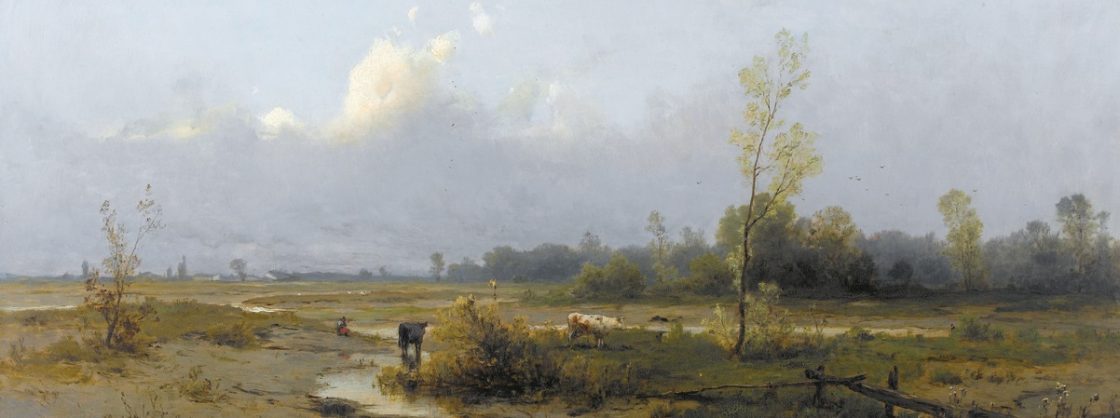
Lot 6177. Swieszewski, Aleksander
Sommerliche Vorgebirgslandschaft.
Öl auf Leinwand. 11,4 x 54,2 cm. Unten rechts signiert “A. Swieszewski”.
Die aufstrebende Kunstmetropole München bot vielen polnischen Künstlern im 19. Jahrhundert Zuflucht, die bedingt durch Repressalien im eigenen Land die künstlerische Freiheit andernorts suchten. Auch Swieszewski, der zunächst an der Warschauer Akademie lernte, wechselte 1863 an die Königliche Akademie der Bildenden Künste nach München und nahm Unterricht bei dem Landschaftsmaler Fitz Bamberger. Wie unser Bild eindrucksvoll zeigt, entwirft Swieszewski, geprägt von der Landschaftsauffassung seines Lehrers Bamberger und der Voralpenregion Münchens, Landschaften von atmosphärischer Klarheit, beeindruckender Tiefe und leuchtendem Kolorit.
Estimate 4,500 euro. Galerie Bassenge. 12/1/17
 Polish Art Corner