Henryk Siemiradzki (1843 – 1902)

Art documentation by Todd-White


Lot 20. SEMIRADSKY, GENRIKH (1843-1902)
Leading Light of Christianity. Nero’s Torches, signed.
Oil on canvas, 88.5 by 175.5 cm. Executed c. 1876.
Provenance: Private collection, Europe.
Acquired from the above by the present owner in 2007.
Private collection, UK.
Authenticity of the work has been confirmed by the expert V. Petrov.
Authenticity has also been confirmed by the experts L. Gladkova and T. Karpova.

Authenticity certificate from the expert L. Gladkova.
Literature: T. Karpova, Genrikh Semiradsky, St Petersburg, Zolotoi vek, 2008, p. 74, mentioned in the text.
On offer for auction, this monumental study of Genrikh Semiradsky’s most famous painting, Leading Light of Christianity. Nero’s Torches, is the only one of the artist’s large-scale preparatory works for this canvas that still remains in private hands.
His four years of intensive work on the seven-metre Leading Light of Christianity. Nero’s Torches (from 1873 to 1876) saw Semiradsky produce many graphic sketches, preparatory studies and a series of preliminary drawings, the majority of which, like the painting itself, now reside in the collection of the National Museum in Kraków (Poland).
The idea to paint this majestic canvas from Roman history first occurred to Semiradsky during a tour of Europe, with the artist sharing his thoughts in a letter dated September 1873 to the conference secretary of the Imperial Academy of Arts, Petr Iseev: “The subject of the painting is taken from the first persecution of the Christians under the Emperor Nero. In the splendid garden of Nero’s Domus Aurea, preparations are being made for a lavish nighttime feast. In a clearing in front of the palatial terrace, a crowd has gathered, impatiently awaiting the start of the grand spectacle: human torches, formed from Christians on top of high posts, bound with straw and coated with tar, positioned at equal intervals. The torches have yet to be set alight, but the emperor has already arrived, brought in on a golden litter and surrounded by an entourage of hired flatterers, women and musicians. The signal has been given and slaves are preparing to set the torches aflame, the light from which will illuminate the most despicable of orgies. Yet these very same torches have dispelled the darkness of the pagan world and, while burning in terrible agony, diffused the light of the new teaching of Christ. That is why I am thinking of naming my painting Christian Lights or Leading Lights of Christianity.”
Work on such a composition could only be started “on the very site of the action, amid the inexhaustible material that is provided by the museums here, the ruins and even the local people”, and so the artist cut short his travels and headed straight for Rome.
In addition to a breathtaking historical subject and a setting that teems with ornate sumptuousness, Semiradsky sought to produce an archaeologically accurate and authentic picture of antiquity, one that was destined to buttress his fame as an erudite artist. Semiradsky derived his descriptions of Nero’s Domus Aurea, which had long since been destroyed by the time he put paint to canvas, from Suetonius’s work The Twelve Caesars. In order to give the greatest possible verisimilitude and genuine colouring to the scene, the artist considered the archaeological material very closely – the evidence of which can be seen, for instance, in the study’s carefully drawn balustrade of Nero’s palace, which Semiradsky copied from the surviving fragments of its gallery.
Tatyana Karpova, the author of a monograph about Semiradsky and a specialist on the artist’s oeuvre, stresses the significance of this particular version of the composition, which is on offer for auction. She notes that “the format, more elongated than in the actual painting, enables Semiradsky to avoid the compositional shortcoming of the original – the overloading of the left-hand side and the excessive nearness of Nero’s “human torches” to the viewers. In the study, the line of torch poles – against the backdrop of a sunset sky – produces a stronger dramatic impression” (T. Karpova, Genrikh Semiradsky, St Petersburg, Zolotoi vek, 2008, p. 74). The study itself is notable for its pictorial freedom and compositional mastery.
Indeed, in the final composition, Semiradsky would reject the effect of presunset lighting, which seems to envelop the whole scene in a delicate pink haze. However, on the whole the artist did retain the colour treatment he had achieved in the study, as well as the plein air accents (specifically, the group of patricians in dark clothing by the wall, the emperor’s scintillating golden litter in the centre, and the figure of a man holding a piece of red material in the foreground, ready to give the signal for the execution to begin).
All this leads us to regard this study not only as the closest we have to the final version of the famous picture, but a separate page in the biography of Semiradsky. This is particularly the case, as according to the recollections of his contemporaries the artist was always as proud of his studies as he was of the finished works (“his studies always won first prizes”). Semiradsky himself admitted to a friend from his Academy days, the historical and religious painter Karl Venig, that “studies are his domain” and that, when composing them, he feels “right at home”.
The immense, Europe-wide furore that accompanied Leading Light of Christianity. Nero’s Torches brought Semiradsky fame in his lifetime, the title of professor, a gold medal at the Paris World’s Fair, the French order of the Légion d’honneur and, indeed, requests for a repetition of this composition. However, despite the abundance of works in Semiradsky’s legacy that are associated with the Leading Light, this study offered here for auction remains one of the most harmonious, inspired and self-contained of the artist’s images.

Estimate 400 000 £ / 500 000 £. MacDougall’s. 06/08/16
Henryk Siemiradzki (1843 – 1902)

Siemiradzki

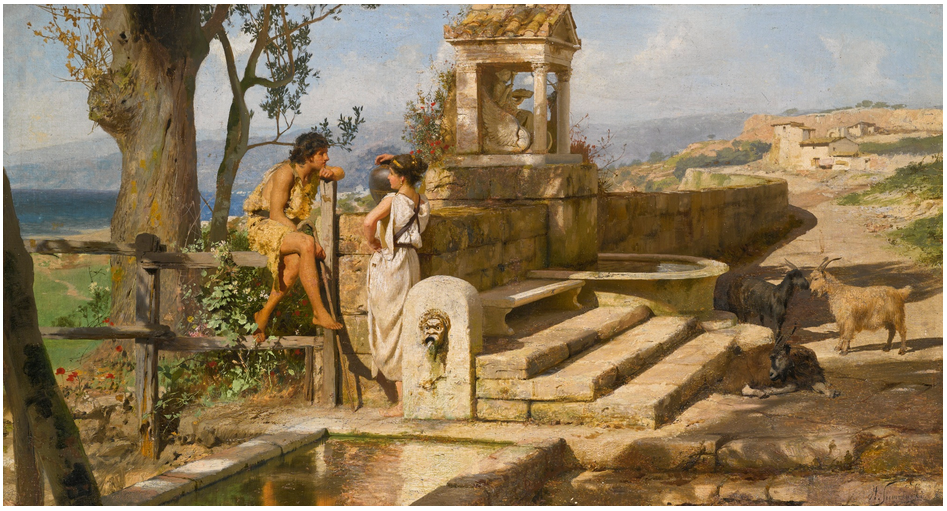
Lot 17. Henryk Siemiradzki 1843 – 1902

CONVERSATION BY THE SPRING

signed in Latin and inscribed Roma l.r.
oil on canvas laid on board
54 by 100cm, 21 1/4 by 39 1/4 in.

Literature: S.Lewandowski, Henryk Siemiradzki, Warsaw: Gebethner & Wolff, 1904, p.37 illustrated in b/w

Catalogue Note: The present lot is a prime example of Siemiradzki’s mature work. The composition is precisely arranged, careful attention is paid to the effects of light and shadow and the palette is particularly refined. In the 1880s and 1890s, subjects from history or everyday scenes of life in ancient Greece and Rome prevail in the artist’s work. This insight into the mythology, history and daily life of these ancient civilisations and the attempt to recreate a Classical image of the world gives rise to a new school of Neo-classicist art – the Neo-Grec.

In these works the ancient world is presented through multi-figured showy spectacles, bloody dramas and intimate idylls, as in the present lot. The end of the 1880s and 1890s was a time when Siemiradzki reigned supreme; he was a constant and a linchpin of the Salon’s exhibitions. During this period his subjects became more intimate and lyrical, but simultaneously his theatrical tendencies come to the fore. This can be explained in no small part by the general developments of European art at the turn of the century.

Siemiradzki depicts the young couple utterly absorbed in their conversation and in each other, which he echoes in the poses of the goats on the right of the composition and the delicate red flowers which tumble around the decorative pool draws in the eye of the viewer with their vivid colour and freshness. In its unabashed celebration of youth and beauty, the present lot is an exceptional example of its genre.

Estimate 200,000 -300,000 GBP. Sothebys. 06/07/16

Henryk Siemiradzki (1843 – 1902)

Siemiradzki-1

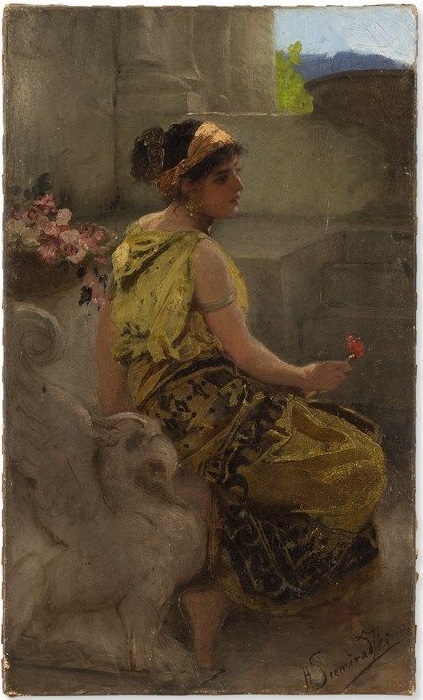
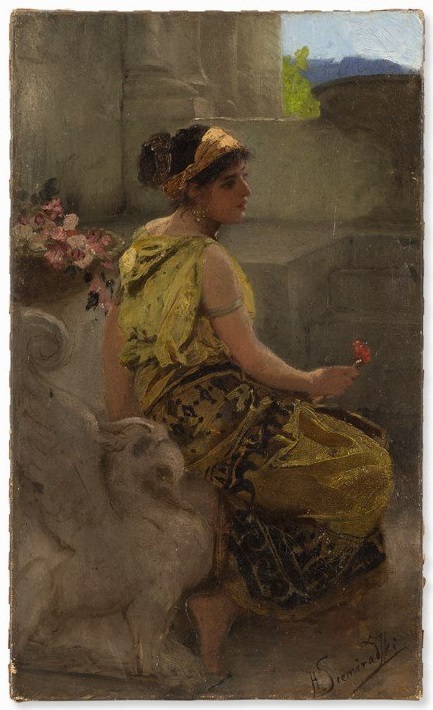
Lot 35. Henryk I. Siemiradzki (1843-1902), Southern Beauty, Oil, 1890s
Oil on canvas, relined along the edges
Probably Russia, 1890s
Henryk Ippolitovich Siemiradzki (1843-1902) – Russian-Polish painter and famous member of the St. Petersburg Art Academy
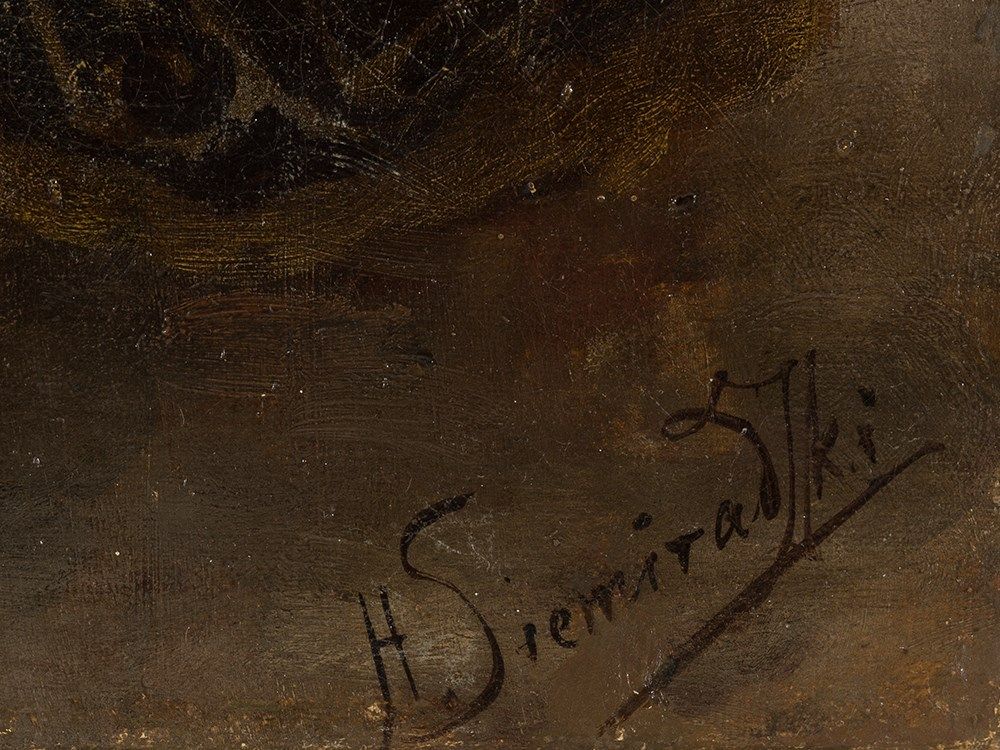
Signed lower right ‘H. Siemiradzki’
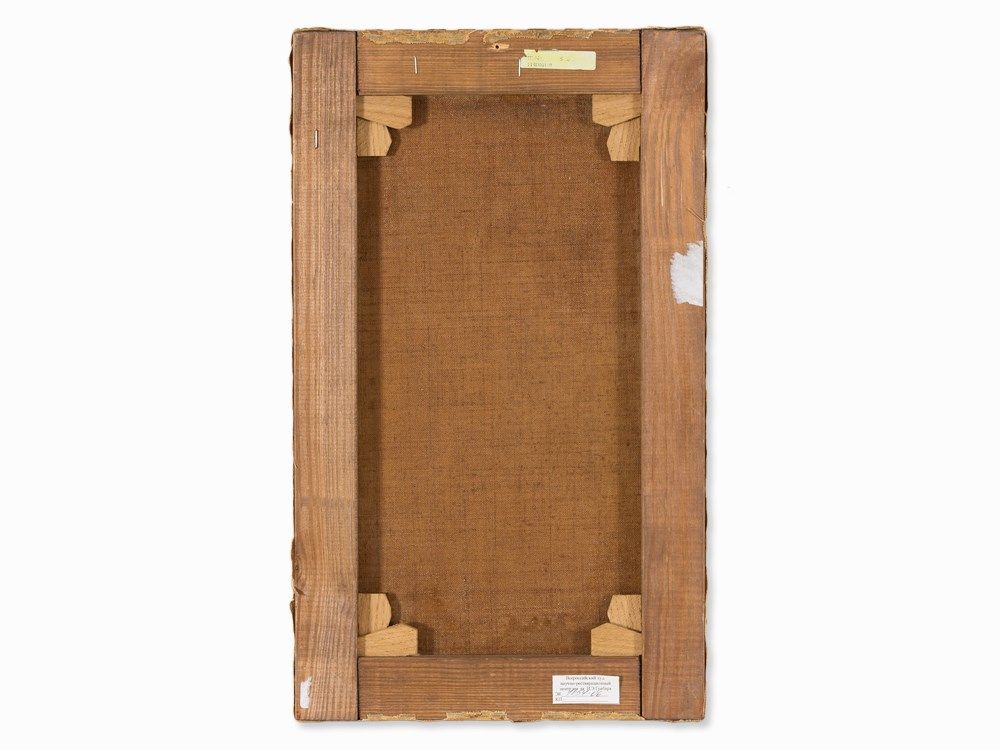
This work is accompanied by a certificate by the Grabar Institute, Moscow, signed by the experts A.R. Kiseleva und T.P. Goryacheva, dated 26/07/2006; verso on the stretcher the institute’s typographic label with the handwritten certificate no. 1054-06
Dimensions: 42 x 25 cm
Good condition
Provenance: Private collection
Literature: Karpova, Tatyana: Henryk Siemiradzki, St. Petersburg 2008, (ill.).

Siem-sign

Henryk Ippolitovich Siemiradzki often rendered his works a sensuous character, created by choosing a female subject surrounded by a delicate play of light. The here present young woman is depicted with a red flower, while sitting on a stone bench. The composition reflects a typical genre motif of the artist, when dealing with the Greek or Roman classic period.
Condition:

The painting is in good condition, consistent with age. The canvas has been relined along the edges and shows light marks, where the frame has rubbed. Inspection under UV light reveals a number of old retouchings to the figure and the background, as well as some more recent retouchings to the upper edge. The stretcher measures 42 x 25 cm.

Siem-2
Henryk Ippolitovich Siemiradzki (1843-1902)
Henryk Siemiradzki was a prominent member of the St. Petersburg Academy of Arts and regularly won a number of silver and gold medals. In 1871 he left Munich, where he had studied at the academy for a year. From 1872 he settled permanently in Rome and established two studios far beyond 1884. Siemiradzki was focused on mythical, historical and religious themes, but was also inspired by the ancient Greece and Rome. He is especially famous for his monumental, stage-like paintings, but he occasionally also painted small idyllic genre scenes. (cbo)

Estimate 15,000-19,500 euro. Auctionata. 04/27/16

Henryk Siemiradzki (1843 – 1902)

Siemiradzki

Lot 65. Hendrik Siemiradzki (Polish, 1843-1902)
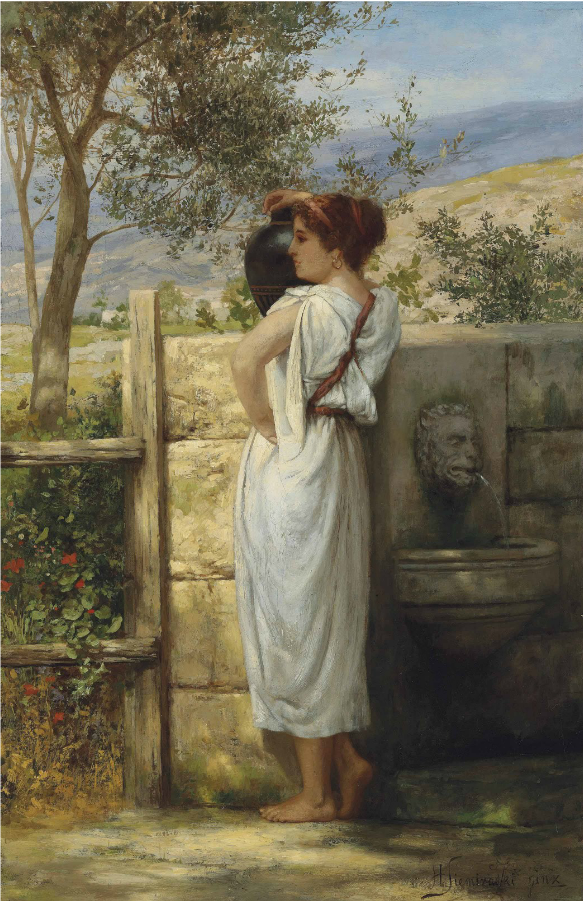
At the Fountain
signed and inscribed ‘H.Siemiradzki pinx’ (lower right)
oil on canvas
20 x 13¼ in. (50.8 x 33.6 cm.)

Provenance

Anonymous sale; Dorotheum, Vienna, 12 October 2010, lot 126.
Acquired at the above sale by the present owner.

Estimate $60,000-80,000. Christies. 04/25/16. Unsold

Henryk Siemiradzki (1843 – 1902)

Siemiradzki

Lot 117. HENRYK SIEMIRADZKI (polish/ukranian 1843-1902)/span
TWO GREEK WOMEN AT A FOUNTAIN
Signed ‘H. Siemiradzki’ bottom right, oil on panel
12 5/8 x 9 3/8 in. (32 x 23.8cm)
provenance:
/spanLempertz, sale of November 21, 2009, lot 1355.
Private Collection, New York, New York.

Estimated Price: $15,000 – $20,000. Freeman’s. 01/25/15

Starting bid $7,500


Henryk Siemiradzki (1843 – 1902)

Siemiradzki

Mon Dieu. Nieprawiona praca Siemiradzkiego ale za to z potwierdzeniem autentyczności aż dwóch ekspertów. Jeden miał wątpliwości i potrzebowano drugiego? A może to praca zespołowa ekspertów (we were always on the same page!)?  W kolejnym wydaniu proponuje trzech ekspertów, etc. W dopełnieniu, znakomity szkic biograficzny o autorze tej pracy  bo któż może znać mało znanego Siemiradzkiego oraz wyjaśnienie treści pracy. Bardzo dużo słów i zdań wypełniających kartkę katalogu. Fotografia nantomiast do….

A niektóre domy aukcyjne w opisach konkretnej pracy publikują jedynie fotografię wysokiej rozdzielczości, nazwisko malarza, tytuł pracy, wymiary i cenę szacunkową. I to  wystarczy.

———————————————-

Lot 14. Henryk I. Siemiradzki (1843-1902), Southern Beauty.

Oil on canvas, relined along the edges
Probably Russia, 1890s
Henryk Ippolitovich Siemiradzki (1843-1902) – Russian-Polish painter and famous member of the St. Petersburg Art Academy
Signed lower right ‘H. Siemiradzki’
This work is accompanied by a certificate by the Grabar Institute, Moscow, signed by the experts A.R. Kiseleva und T.P. Goryacheva, dated 26/07/2006; verso on the stretcher the institute’s typographic label with the handwritten certificate no. 1054-06
Dimensions: 42 x 25 cm
Good condition
Provenance: Private collection
Literature: Karpova, Tatyana: Henryk Siemiradzki, St. Petersburg 2008, (ill.).
Estimate by Auctionata Expert: 36,000 Euro

Henryk Ippolitovich Siemiradzki often rendered his works a sensuous character, created by choosing a female subject surrounded by a delicate play of light. The here present young woman is depicted with a red flower, while sitting on a stone bench. The composition reflects a typical genre motif of the artist, when dealing with the Greek or Roman classic period.
Condition: The painting is in good condition, consistent with age. The canvas has been relined along the edges and shows light marks, where the frame has rubbed. Inspection under UV light reveals a number of old retouchings to the figure and the background, as well as some more recent retouchings to the upper edge. The stretcher measures 42 x 25 cm.
Henryk Ippolitovich Siemiradzki (1843-1902). Henryk Siemiradzki was a prominent member of the St. Petersburg Academy of Arts and regularly won a number of silver and gold medals. In 1871 he left Munich, where he had studied at the academy for a year. From 1872 he settled permanently in Rome and established two studios far beyond 1884. Siemiradzki was focused on mythical, historical and religious themes, but was also inspired by the ancient Greece and Rome. He is especially famous for his monumental, stage-like paintings, but he occasionally also painted small idyllic genre scenes.

Estimate €18,000 – €23,400Auctionata.1/7/16

Henryk Siemiradzki (1843 – 1902)

Siemiradzki-26

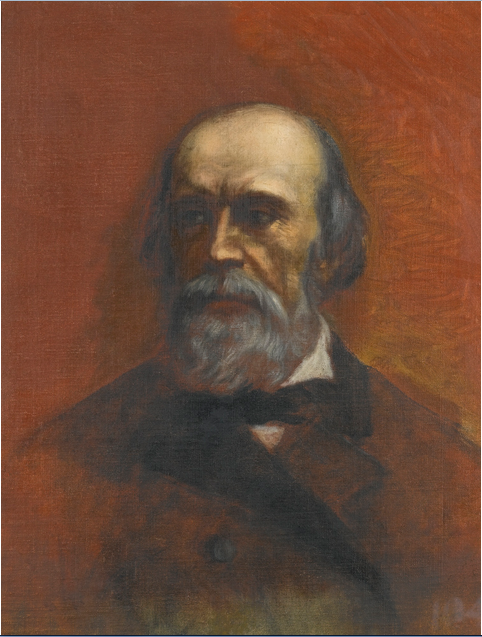
Lot 26. Henryk Siemiradzki 1843 – 1902. PORTRAIT OF A MAN SAID TO BE WALERJAN ZAWISZA LINKOWIEC. Numbered 104 l.r.; further twice faintly stamped with the artist’s signature on the stretcher, oil on canvas, 63 by 50cm, 24 3/4 by 19 3/4 in.

Provenence The artist’s estate
Thence by descent to the present owners

Estimate 5,000-7,000 GBP. Sothebys. 12/1/15


Henryk Siemiradzki (1843 – 1902)

Siemiradzki-25

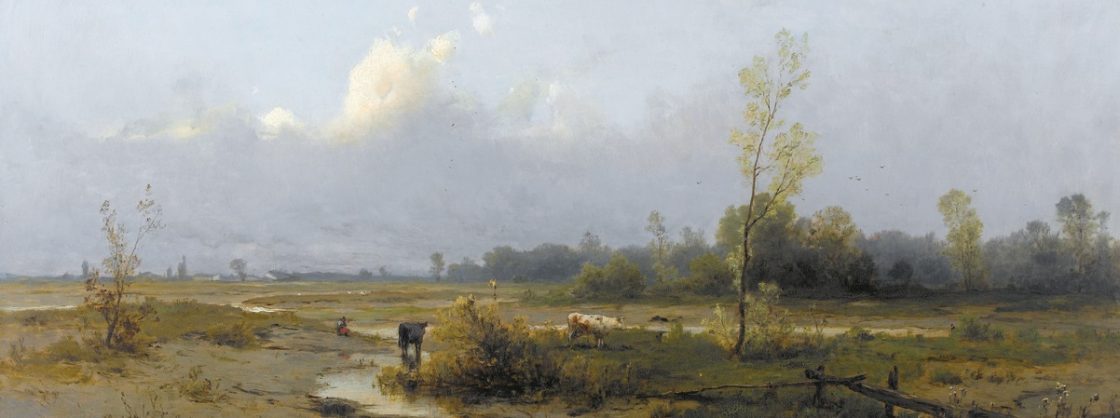
Lot 25. Henryk Siemiradzki 1843 – 1902. BY THE SPRING, bears a label on the stretcher, oil on canvas, 29.5 by 50cm, 11 1/2 by 19 3/4 in.

Provenance The artist’s estate
Thence by descent to the present owners

Estimate 18,000-25,000 GBP. Sothebys. 1/1/15

Jan Kudrewicz, the great-grandfather of the current owner, was a friend of Henryk Siemiradzki. The Siemiradzki family would often visit the Kudrewiczs on their estate in Keidan, in present-day Lithuania, where the artist would paint portraits of their friends and family. The unfinished portrait in this catalogue is believed to depict Walerjan Zawisza Linkowiec, a neighbouring landowner.

According to family lore, Stanislawa the youngest daughter of Kudrewicz and Leon, the youngest son of Siemiradzki, were sweethearts from childhood. Like her father, Stanislawa was drawn to the Eternal City and after they married the couple left Poland for Rome where they lived out the rest of their days. When they died childless, Siemiradzki’s estate passed on to Stanislawa’s nephew Edward Kudrewicz, the father of the present owners, who in 1979 donated the majority to the National Museum in Krakow where they now form part of the Sukiennice Collection. By the Spring and Portrait of a Man said to be Walerjan Zawisza Linkowiec are two of the few paintings which were kept by the family. Girl on a Swing was given to the Kudrewicz family by the artist as a token of his friendship.


Henryk Siemiradzki (1843 – 1902)

Siemiradzki-27

Lot 27. Henryk Siemiradzki 1843 – 1902. GIRL ON A SWING, signed in Latin and dated 97 l.l., oil on paper laid on canvas, 43 by 30cm, 17 by 11 3/4 in.

Provenance: Gift from the artist to Jan Kudrewicz
Thence by descent to the present owners

Estimate 30,000-50,000 GBP. Sothebus. 12/1/15