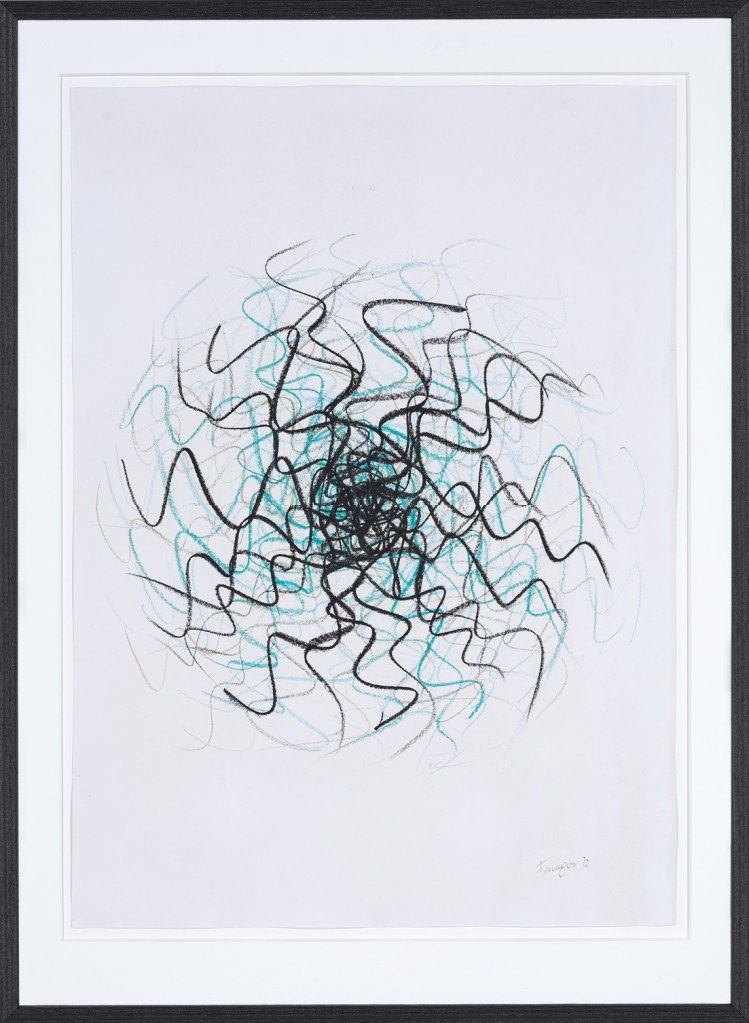
Lot 58. Wojciech Fangor 1922 – 2015. Untitled, signed and dated 72 (lower right), coloured pencil on paper, 70.8 by 50.8 cm. 27¾ by 19⅞ in.; framed: 85.9 by 62.8 cm. 33⅞ by 24¾ in. Executed in 1972. Provenance: Chalette International, New York, Private Collection, Philadelphia, Freeman’s Philadelphia, 25 October 2022, lot 35, Private Collection, Sotheby’s, New York, 16 July 2025, lot 92 (consigned by the above). Acquired from the above by the present owner. Estimate GBP 6,000 – 8,000. Sotheby’s. 01/23/26
Dwa lata temu pozwoliłem sobie na dość obszerny komentarz na tle tej kredki Wojciecha Fangora: https://polishartcorner.com/2024/07/16/wojciech-fangor-1922-2015-40/. Wydaje mi się, że nic się nie zmieniło od tego czasu i nic się nie zestarzało. Sotheby’s próbuje z uporem upłynnić ten obraz. Poprzednio był w 2024 roku w USA (Sotheby’s podaje błędnie, że w 2025 roku) a obecnie jest w filii w UK, gdzi zamiast dolarów królują funty. Obraz ten sam, sprawa ta sama. Czy ktoś się odważy, kupi i prześle ten obraz na polską aukcję i czy na pewno SDA go przyjmie?
PS. Obraz spadł w 2024 roku a zatem w jaki sposób obecny właściciel nabył go wówczas? Może po aukcji za $1.00 bo tak bywa przy sprzedaży domu czy samochodu pomiędzy krewnymi? W 2024 praca ta była wyceniona na $12,000 – 18,000 a obecnie GBP 6,000 – 8,000, tj. ok $8,000 – 11,000, czyli znacznie niżej. Czuję swąd piekielny podając fakty.
Lot 500. Fangor Wojciech Warsaw 1922 – 2015. E 31“, 1966. Oil on canvas, 71 x 71cm. Signed, titled and dated verso upper right: FANGOR E31 1966. For this work an expertise by Katarzyna Jankowska-Cieslik, Poland, is available. The work is listed at the artist’s official website under number P517. (www.catalogue.fangorfoundation.org). Provenance: – Grabowski Gallery, London, – Galerie Thomas, Munich. Exhibitions: – Grabowski Gallery, London 1966. Literature: – Exhib. cat. Wojciech Fangor, Grabowski Gallery, London 1966. Estimate €60,000 – 80,000. Van Ham. 12/04/25. Sold €125,000
Na nadchodzącej aukcji w niemieckim Van Ham znalazł się olej E 31 Wojciecha Fangora z 1966 roku. Praca ta charakteryzuje się znakomitą proweniencją a także obecnością w katalogu raissone https://fangorfoundation.org/catalogue-raisonne/.
Na nadchodzącej aukcji w bliżej nieznanym mi domu aukcyjnym w New Jersey, USA znalazł się olej E 47, również z 1966 roku (rzekomo) Wojciecha Fangora. Praca ta nie posiada żadnej proweniencji, jest wyceniona wysoko choć cena wyjściowa została ustalona bardzo atrakcyjnie na przecietną kieszeń, zaledwie na $1,000. Aż dwie nalepki (rzekomo) galerii Chalette International zostały z tyłu naklejone. Ktoś włożył wiele wysiłku i nieudolnie namalował tę pracę – warto zauważyć jej reklamę w katalogu aukcyjnym (długa epistoła poniżej). Obrazu tego oczywiście nie ma w archiwum Galerii Chalette, dostępnym on-line. Pisanie o tej pracy byłoby zbędne, gdyby nie okazało się, że podobne ‘Fangory’ są sprzedawane w USA np. w śmiejącej się w twarz Antique Arena z Brooklynu za $13,000 (https://antiquearena.com/lot/37476?auction_item_id=72).
Wojciech Fangor ? E 47,
Lot 34. WOJCIECH FANGOR (1922-2015), OIL ON CANVAS. Signed (verso). Image dimensions: 102 x 102 cm (40 x 40 in). Estimate $40,000 – 50,000. Opening $1,000. Oldstone Ventures. 11/17/25
Wojciech Fangor was a leading figure in the Polish avant-garde and one of the few Eastern European artists to achieve significant international recognition during the Cold War era. Trained at the Academy of Fine Arts in Warsaw, Fangor’s early work reflected socialist realism, but by the 1950s he had turned toward abstraction, developing a signature visual language centered on spatial illusions and chromatic vibrations. His relocation to the United States in the 1960s further aligned him with global currents of Op Art and Color Field painting, culminating in his inclusion in the landmark exhibition “The Responsive Eye” at the Museum of Modern Art in 1965.
“E47,” created in 1966, exemplifies Fangor’s mature period, in which color, form, and perceptual depth converge into a mesmerizing whole. The composition centers on a pulsating square of luminous green, encircled by progressively darker rings of violet and crimson that softly diffuse into the surrounding red field. The transitions between colors are seamless yet vibrant, generating a dynamic optical vibration that seems to radiate beyond the canvas. Rather than delineating geometric forms with hard edges, Fangor creates gentle transitions that evoke the sense of an energy field, thus heightening the viewer’s spatial and emotional response.
This work resonates strongly with Fangor’s theory of “positive space,” where color becomes an autonomous force that shapes perceptual experience. The subtle modulation and interplay of hues create a sensation of movement, depth, and atmosphere-hallmarks of Fangor’s contribution to visual perception theory in painting. The piece’s vibrant central core draws the viewer inward, while the outer rings seem to expand infinitely outward, establishing an active dialogue between interior focus and spatial dissipation.
Paintings from this pivotal era in Fangor’s career have been acquired by institutions such as the Solomon R. Guggenheim Museum and the Centre Pompidou. In recent years, his market performance has seen a notable resurgence, with works from the 1960s commanding strong results at international auctions. Notably, paintings from the “E” series-such as “E22,” “E36,” and “E64”-have achieved six-figure prices in both European and American salesrooms, reflecting growing collector interest in Op Art and Cold War-era abstraction.
Visually minimal yet psychologically immersive, “E47” holds a unique place within postwar abstraction. Its vibrant concentric field makes it adaptable to both minimalist and modern architectural interiors, offering a profound visual anchor. As both a meditative object and an emblem of perceptual experimentation, it represents a compelling intersection of aesthetics and science.
Lot 105. Wojciech Fangor SU 12, 1971, oil on canvas, 50.375 h x 50.25 w in (128 x 128 cm). Signed, titled and dated to verso ‘Fangor SU 12 1971’. This work is listed in the Wojciech Fangor Catalogue Raisonne under P.858. Provenance: Acquired c. 1973 by Carolyn and Harold Wachtel | Thence by decent. Estimate $200,000 – 300,000. Rago. 09/26/25. Sold $260,000 ($330,200 with bp))
Lot 114. WOJCIECH FANGOR (1922-2015). B114, 1966. Olio su tela; cm 71×71. Firma, datazione e numero di repertorio al retro. Provenienza: Collezione Adolf Neumeier, Roma; Collezione Privata, Como Estimate 100,000 – 120,000 euro. Studio d’Arte Borromeo. 02/13/25
Verso
Mdłe i chyba ‘niewirujące’ koło Wojciecha Fangora, przypominające pomysłem lub może nawet zainspirowane własnym plakatem z jajecznicą pośrodku z 1960 roku, który pamiętam jeszcze z ulic Warszawy. Artysta wykonał ten plakat 1-szo majowy ponad 5 lat po ‘odwilży’ a pewnie zrobił to z serca, bo przeciez już nie musiał. Jakże lud polski wówczas się radował na widok takiej sztuki podnoszącej nastroje i budzącej najrozmaitsze nadzieje na przyszłość.
Interesująca będzie oczywiście cena sprzedaży B 114 i prównanie jej do cen innych podobnych prac Fangora. Wielkość jego prac mierzę obecnie ceną za 1 cm2 powierzchni. Pewne kalkulacje niedawno opublikowałem: https://polishartcorner.com/2024/11/27/wojciech-fangor-1922-2015-45/.
Wielokrotnie pisałem o obwarzankowym, niebieskim pastelu, rzekomo Wojciecha Fangora, który zwiedza światowe domy aukcyjne z różnym sukcesem. Pojawił się najpierw w USA w Heritage Auctions w 2022 roku, sprzedany za $13,000, później znalazł się w brooklyńskim Antique Arena gdzie został sprzedany za $6,250 (wycena $100 – 150) by zawitać do Sopockiego Domu Aukcyjnego z szaloną wyceną 100,000 – 140,000 złotych. Z tego ostatniego domu pracę wycofano w bólach serca po interwencji Polish Art Corner (SDA nie podziękowało do tej pory za podzielenie się wiedzą). Obecnie mieliśmy kolejny etap odsłony bo obraz przywędrował aż do samego nobliwego domu Wettmann w Niemczech. Był tam zaprezentowany jako
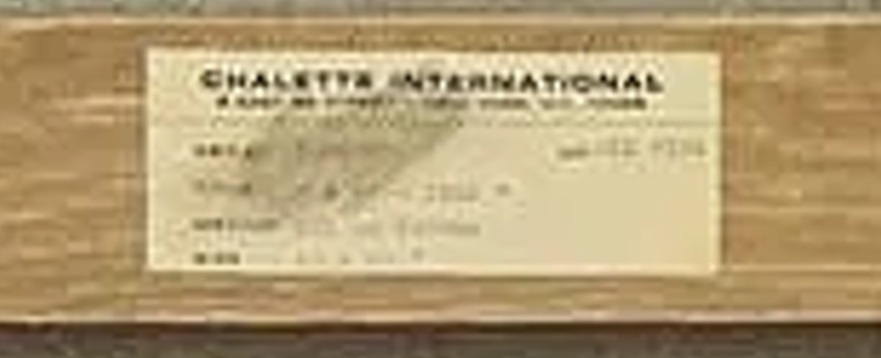
Lot 428. Wojciech Fangor (1922 Warsaw – 2015 ibid.) (F) Composition, oil crayon on paper, 50 cm x 70 cm sheet dimensions, signed, dated 74, mounted under passepartout, partial scratches with surface damage to the paper, slightly wavy, creased, minimal foxing, provenance: Chalette International, New York (verso gallery label). Wettmann. 12/07/24.
Cena estymacyjna była ustalona na kilka lub kilkanaście tysięcy euro (nie zanotowałem). Czekałem z tym wpisem by przekonać się ile czasu zajmie Wettmannowi, sprzedającymi wiele współczenej polskiej sztuki (obecnie są w katalogu prace Krasińskiego, Beksińskiego, Sasnala) by dojść do prawdy. Dopiero wczoraj firma usunęła tego falsa.
Ciekawi mnie jak bardzo to koło pulsowało w oczach ekspertów Wettmanna, bo niewątpliwie mocno pulsowało w oczach Sopockiego Domu Aukcyjnego. Tylu ekspertom to koło wirowało i pulsowało a teraz… przestało.
Dlaczego tylko 300,000 euro? To przecież jedynie €17.75/cm2 zamalowanego płótna.
Inne koło, E43, sprzedane niedawno w Christie’s (https://polishartcorner.com/2023/10/14/wojciech-fangor-1922-2015-34/), o mniejszych wymiarach (70.9 x 70.9 cm), ma przelicznik cenowy £33.82/cm2, czyli €40.58/cm2. Zatem, obraz z Van Ham ma bardzo duży potencjał handlowy i wykazałem to czarno na białym. Czyżby nikt jeszcze na to nie wpadł?
Warto zauważyć, że wirujące koło tegoż artysty, M-14, o wymiarach 91.4 x 91.4 cm, sprzedało Christie’s w 1995 roku za jedyne $1,035 (z opłatami) co czyni $0.12/cm2.
Wniosek: płótna Fangora są oceniane i wyceniane obecnie przez nowe pokolenie, lepiej wyedukowanych krytyków sztuki jak też mamy nowe pokolenie bardzo wysmakowanych kolekcjonerów (Płoński do kosza, Fangor na ścianę!).
Lot 32. FANGOR, WOJCIECH Warschau 1922 – 2015. “B23“, 1965. Öl auf Leinwand. 130 x 130cm. Signiert, betitelt und datiert verso oben rechts: FANGOR B23 1965. Die Arbeit ist auf der offiziellen Internetseite des Künstlers aufgeführt.(www.fangorfoundation.org). Provenienz: – Galerie Wilm Falazik, Bochum (Aufkleber); – Privatsammlung Hessen. Estimate 80,000 – 120,000 euro. Van Ham. 11/27/28. Sold 300,000 euro
Z opisu proweniencji wynika, że ten obraz był stosunkowo tani w 1975 skoro jedna osoba podarowała go drugiej. W latach 70-tych XX wieku nie było zainteresowania tego typu pracami, sam Fangor miał kłopoty by cokolwiek sprzedać i pewnie nawet pierwotny zakup z Galerii Chalette był po cenie symbolicznej. Znam jednego z kolekcjonerów w USA skupującego w latach 90-tych obrazy tego malarza bardzo tanio i wieszającego je nawet na suficie (nie przesadzam!). W Polsce po przemianach i otwarciu rynku doszło do przewartościowania prac Fangora – ci co mieli to zarobili, ci co obecnie mają (tzw. inwestorzy) liczą na kolejne zwyżki i tak te prace kręcą się po rynku. Można pisać mądre artykuły na ich tle ale oczy moje i innych widzą co jest namalowane. Ceny podobnych prac oscylują poza Polską w granicach $200,000 i podaż jest tam duża. W Polsce po raz kolejny podbija się te ceny, jakby ‘inwestorzy’ nie widzieli co się dzieje na innych rynkach i nie mieli sprawności intelektualnej by tam bezpośrednio dokonać zakupu. Kiedyś dojdzie do sytuacji, że ‘inwestorzy’ będa w stanie wymieniać się obrazami Fangora tylko między sobą. Doszło bowiem do absurdalnego stanu, że podobny obraz jest obecnie więcej warty od przeciętnego domu jednorodzinnego.
Na wylicytowaną cenę $300,000 miała wpływ obecna proweniecja czy obecność tej pracy w Carnegie Museum of Art. Carnegie Musem otrzymało ten obraz w 1975 roku jako podarunek, czyli nic go nie kosztowało, a darczyńca odpisał sobie wówczas od dochodu $500- 1,000. Z opisu wynika, że muzeum pozbyło się obecnie pracy Fangora “… to Benefit the Acquisition Fund“. Inaczej mówiąc, zainteresowanie Fangorem spadło w Carnegie Museum i sprzedało ten obraz by kupić, w domyśle, lepszą pracę.
SU 24 (tytuł tego obrazu) to również nazwa modelu samolotu bojowego armii sowieckiej z lat 70-tych, nadal będący w uzbrojeniu Rosji.
Lot 106. Wojciech Fangor 1922 – 2015. SU 24, signed, titled and dated 1971 (on the reverse), oil on canvas, 181.9 by 202.6 cm. Executed in 1971. Provenance: Chalette International, New York. Arthur and Madeleine Chalette Lejwa, New York (acquired from the above). Acquired from the above as a gift in 1975 by the present owner. Estimate $200,000 – 300,000. Sotheby’s. 11/21/24. Sold $300,000
Bardzo anemiczna licytacja, ledwo dopełzła do dolnej estymacji, bez entuzjazmu.
Lot 7. Wojciech Fangor 1922 – 2015. SU 8; signed, titled, dated and inscribed FANGOR / SU 8 1971 / 50 X 50″ (on the reverse); oil on canvas; 127 by 127 cm. 50 by 50 in. Executed in 1971. This work is recorded as SU 8 in the Fangor catalogue raisonné by the Fangor Foundation, catalogued p. 854. Estimate 200,000 – 300,000 euro. Sotheby’s. 11/12/24. Sold 200,000 euro (hammer)
Ta pomięta kartka papieru krąży po rynku amerykańskim od kilku lat. Miałem ten shit raz w ręku i przekonałem właścicela galerii by wycofał ze swojej aukcji. Niemniej, krąży i wruje po rynku amerykańskim jak gówno w przeręblu. Najwyższą cenę ten falsyfikat osiągnął w tej samej brooklyńskiej firmie Antique Arena w lutym tego roku bo aż $8,250. Po pół roku staniało o ok $5,000 ale durniów nie brakuje – po co kobiety takich rodzą? Gorzej, bo podobne prace Fangora są następnie sprowadzane do Polski a tam wyceniane są do 140,000 złotych (https://polishartcorner.com/2023/10/22/fangor-z-usa-w-sopockim-domu-aukcyjnym-za-100000-140000-zlotych/). Po co kobiety rodzą takich sopockich ekspertów?
Lot 43. Wojcieck Voy Fangor, Polish, American, 1922 to 2015, oil crayon painting on paper depicting an abstract composition, 1973. Signed and dated, lower right. Framed. Provenance: Chalette International, New York. An original paper label is on the backside. Estimate $100 – 150. Antique Arena. 10/13/24. Sold $3,600.
Lot 51. Attributed to Wojcieck Voy Fangor, Polish, American, 1922 to 2015, oil crayon painting on paper depicting an abstract composition, 1969. Signed and dated, lower right. Framed. Wojcieck Fangor is known for Abstract illusion and optical art painting, social realism, posters. Mr. Fangor, who was known for his blurred circles, amoebas and cloud shapes in dense, saturated colors that seemed to throb and swirl, first became known in the United States in the 1960s, when his work was included in two group exhibitions at the Museum of Modern Art in New York. In 1970, he had a one man show at the Guggenheim Museum. His work, perched midway between Color Field painting and Op Art, dazzled critics, notably John Canaday of The New York Times, who reviewed the work in rapturous tones. One of a kind artwork.Dimensions: Frame 23 3/4 x 22 1/2 in. Paper 20 3/4 x19 1/2 in. All measurements are approximate. Overall good vintage condition. Signs of age and wear. Has some creases. Estimate $100 – 150. Antique Arena. 09/14/24







 Polish Art Corner