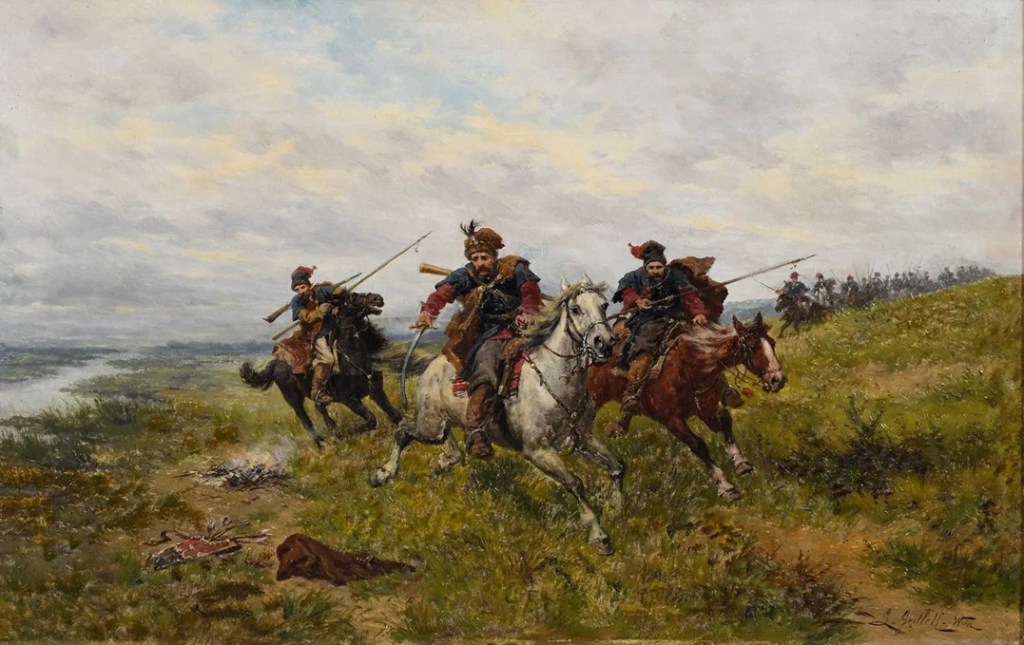
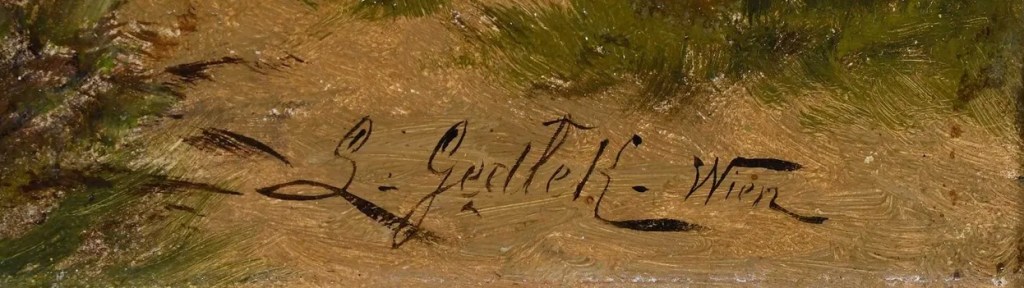
Lot 72. Ludwig Gedlek (Austrian/Polish, 1847-1904). Cavalry Charge, signed lower right “L. Gedlek Wien”, oil on canvas, 14-5/8 x 22-3/4 in.; gilt wood and composition frame, 25 x 23-1/4 x 3-5/8 in. Estimate $1,000 – 2,000. Brunk Auctions. 03/11/25. Sold $6,500
Sygnatura
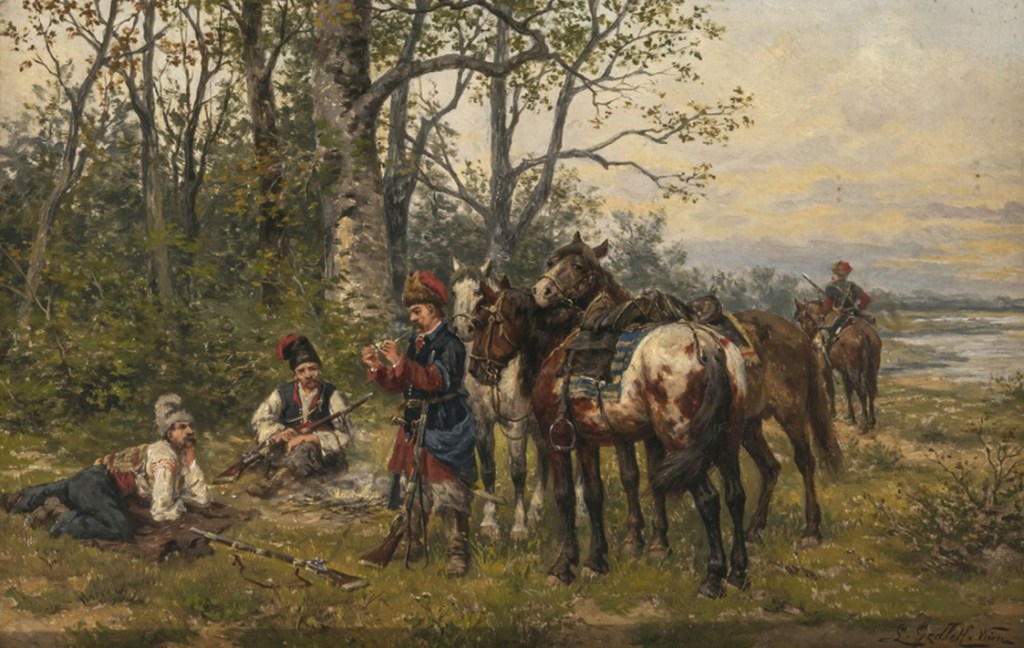
Oleje Ludwika Gędłka są bliźniaczo podobne do siebie, o tej samej palecie, i dlatego nie budzą zaskoczenia. Zwykle są to odpoczywający kozacy ewentualnie stojący na straży. Inne sytuacje są dość rzadkie. Subiektywnie, Cavalry Charge, wyróźnia się pozytywnie na tle innych ze względu na ruch na płótnie pędzącej kawalerii. Powtarzalność strojów, czapek, twarzy, nawet wąsów jest jednak trochę męcząca. Prace Gędłka w Polsce rosną w sile bo skąd brać podobne tematy uzuprpujące szkołę monachijską – dobrych prac innych malarzy jest mało i są drogie i dlatego ‘Gędłek to the rescue’. Materiał na handel. Na pozytywnie, obraz z Neumeister ma dobrą ramę.
Ludwik Gędłek. Resting Cossack riders.
Lot 328. Ludwig Gedlek 1847 Krakau – 1904 Wien. Resting Cossack riders. Signed and inscribed with the place name Wien lower right. Titled “Vorpfosten” and various numbers verso. Oil on panel. 20.5 x 31 cm. Minor rubbing to edges. Minor damage to frame (41 x 51.5 cm). Estimate 4,000 – 6,000 euro. Neumeister. 03/19/25. Sold 5,500 euro
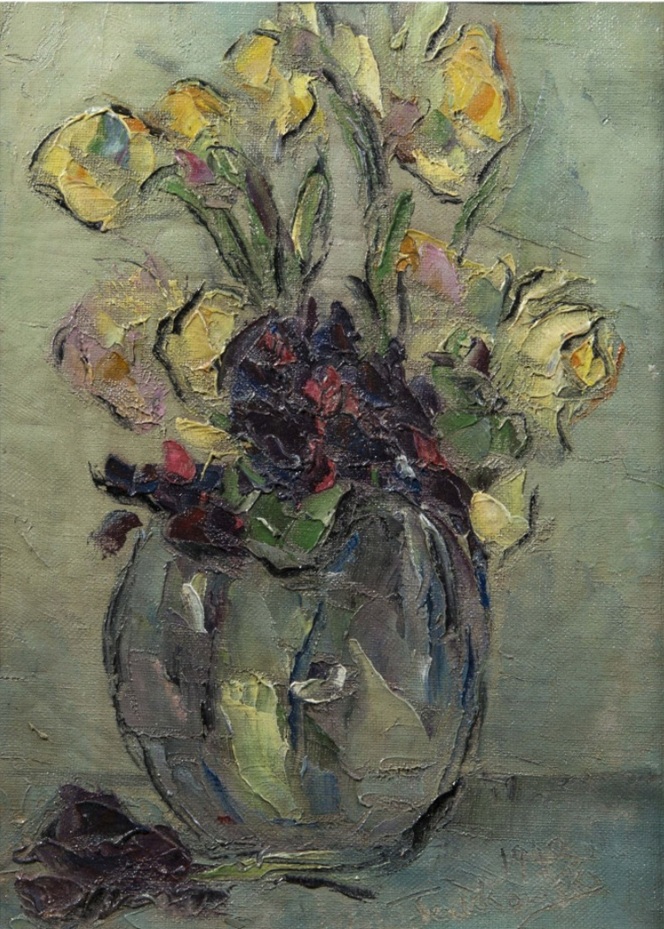
Włodzimierz Terlikowski. Bouquet of yellow and violet flowers, 1940
Lot 72. Wlodzimierz TERLIKOWSKI (1873-1951). Bouquet of yellow and violet flowers. Oil on canvas. Signed and dated ‘1940’ lower right; 35 x 25 cm. Provenance: acquired from the artist’s family. Estimate 800 – 1,200. Osenta. 03/09/25. Sold 1,000 euro
Przekrój twórczości Włodzimierza Terlikowskiego na aukcji w Osenat. Kolekcja wygląda na powstałą z zakupów po śmierci artysty. Niektóe oleje są sygnowane przez artystę lecz na niektórych są obecne jedynie faksymilie sygnatury. Spośród prac ew. wybrałbym martwą naturę z kwiatami w wazonie powstałą w 1940 roku
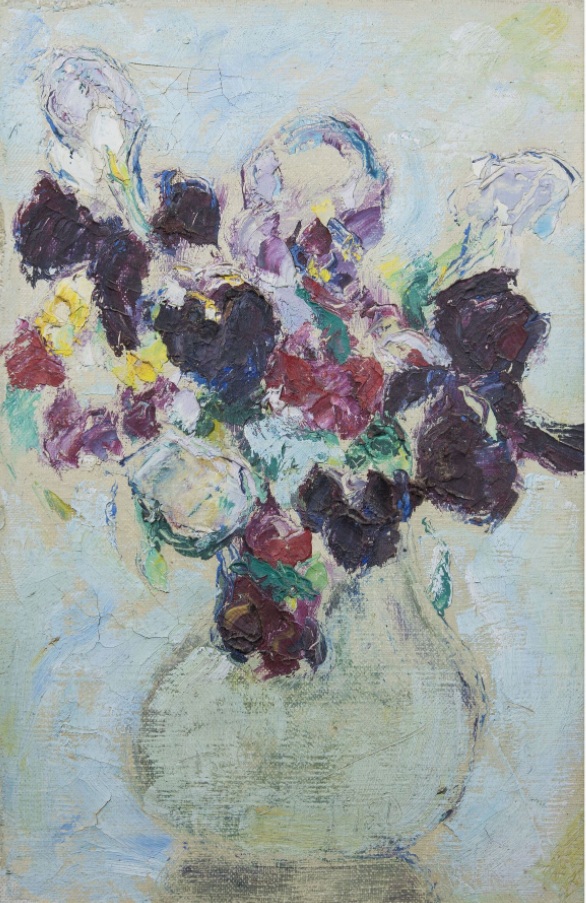
Włodzimierz Terlikowski.Bouquet of violet flowers, 1950
Lot 73. Wlodzimierz TERLIKOWSKI (1873-1951). Bouquet of violet flowers. Oil on canvas. Signed and dated ‘1950’ on the vase, 41 x 28 cm. Provenance: acquired from the artist’s family. Estimate 1,000 – 1,500 euro. Sold 1,300 euro
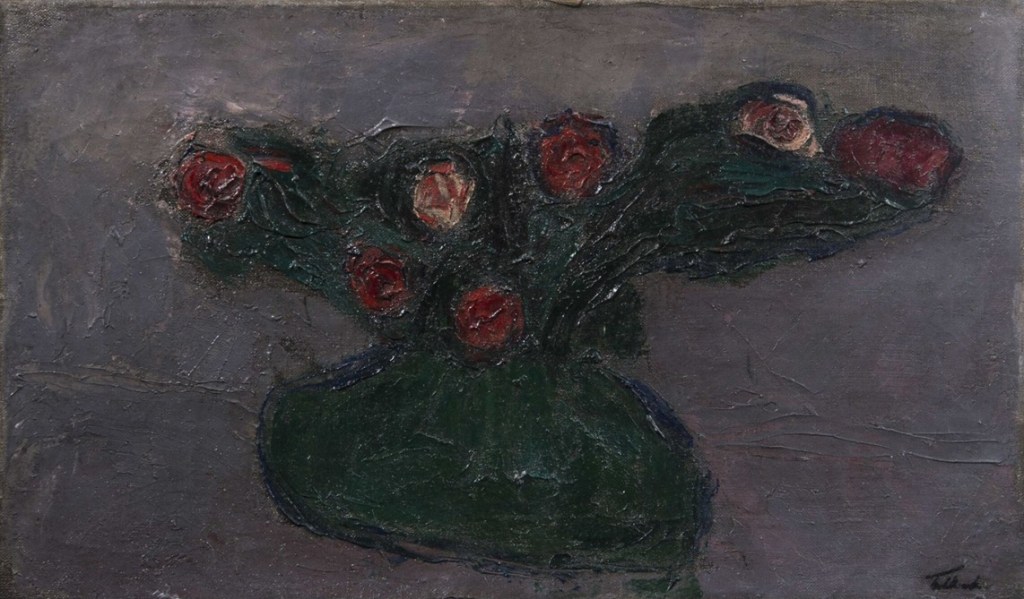
Włodzimierz Terlikowski.Bouquet of flowers in a glass vase
Lot 70. Wlodzimierz TERLIKOWSKI (1873-1951). Bouquet of flowers in a glass vase. Oil on canvas. Signature stamp lower, right 28 x 46 cm. Provenance: acquired from the artist’s family. Estimate 400 – 600 euro. Sold 400 euro
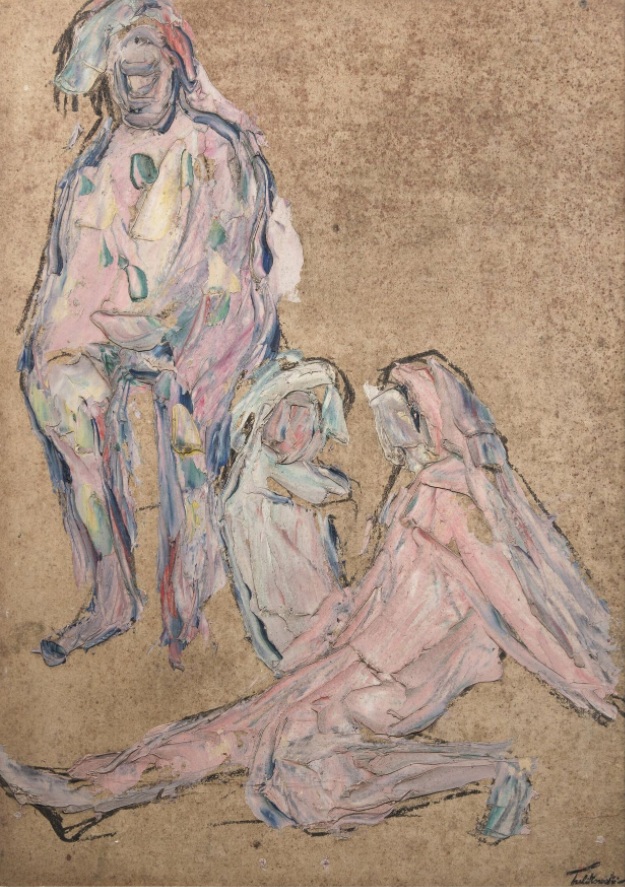
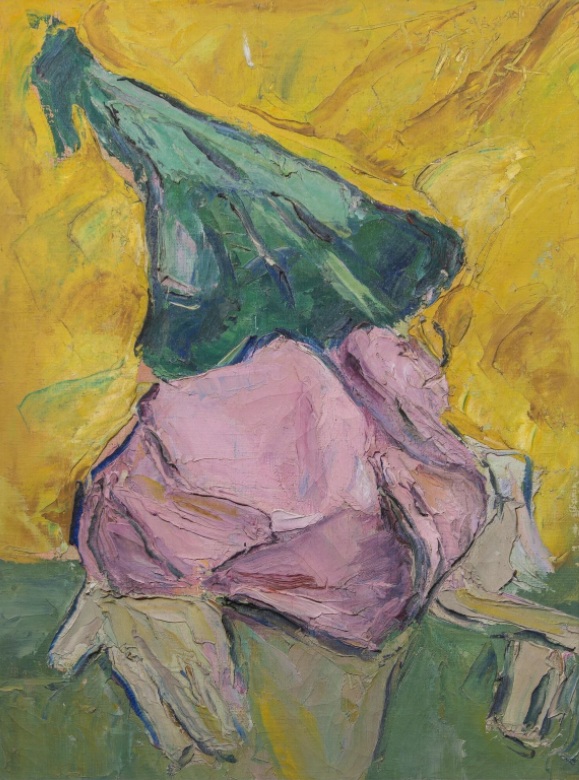
Lot 71. Wlodzimierz TERLIKOWSKI (1873-1951). Vladimir Terlikowski Characters.. Oil on cardboard Signature stamp lower right, 46 x 33 . Provenance: acquired from the artist’s family. Estimate 600 – 800 euro. Sold 600 euro
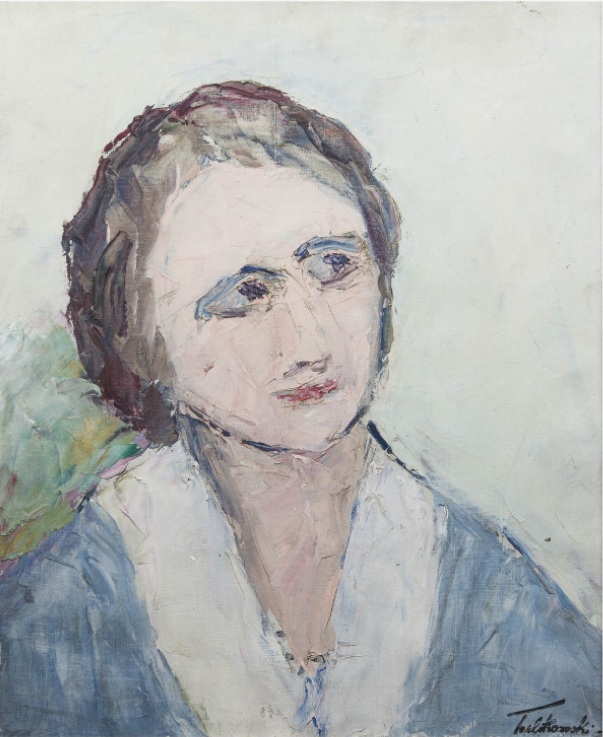
Włodzimierz Terlikowski.Portrait of a woman
Lot 74. Wlodzimierz TERLIKOWSKI (1873-1951). Portrait of a woman. Oil on canvas. Signature stamp lower right, 46 x 38 cm. Provenance: acquired from the artist’s family. Estimate 400 – 600 euro. Sold 500 euro
Lot 75. Wlodzimierz TERLIKOWSKI (1873-1951). Abstract composition. Oil on canvas. Signed and dated ‘1944’ upper right, 43 x 33 cm. Provenance: acquired from the artist’s family. Estimate 400 – 600 euro. Sold 400 euro
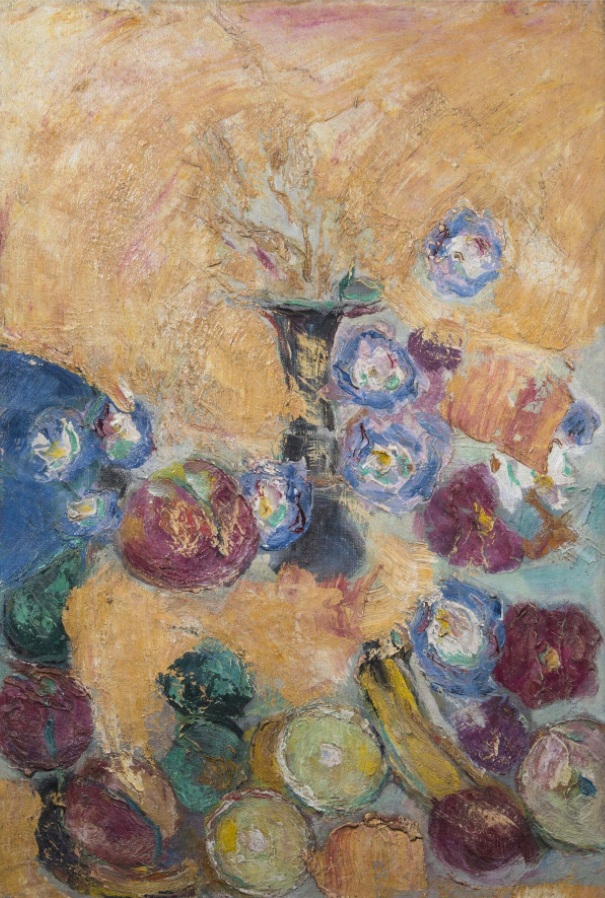
Włodzimierz Terlikowski.Composition with fruit and flowers
Lot 76. Wlodzimierz TERLIKOWSKI (1873-1951). Composition with fruit and flowers. Oil on canvas. Signature stamped on the back top left, 55 x 38 cm. Provenance: acquired from the artist’s family. Estimate 1,000 – 1,500 euro. SOld 1,300 euro
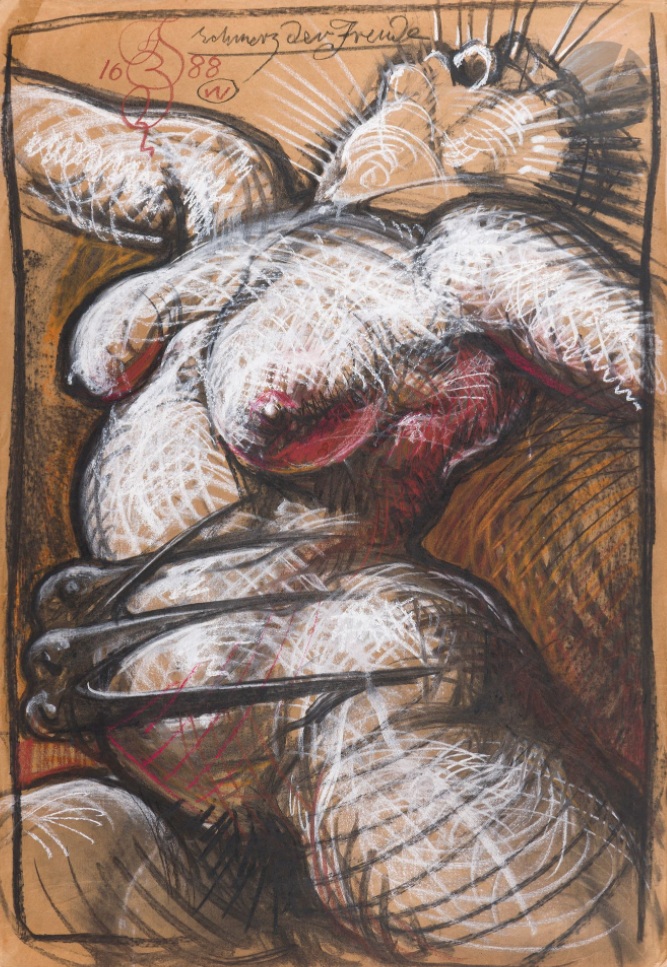
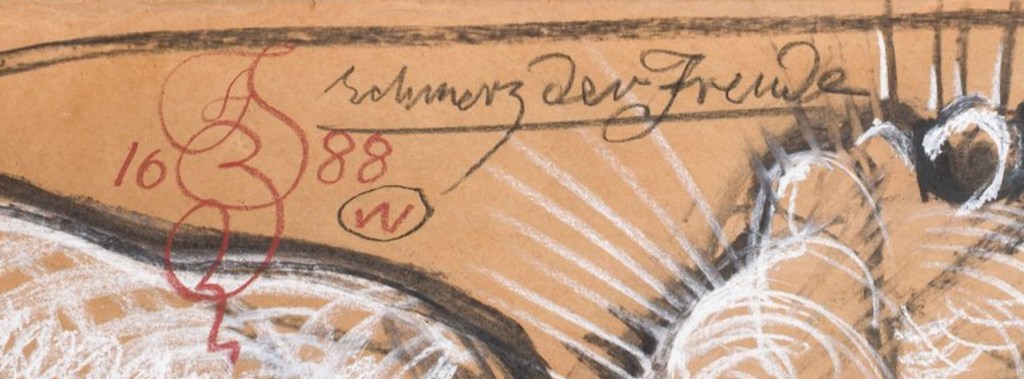
Lot 171. Franciszek STAROWIEYSKI (1930-2009). Schmerz der Freude, 1988. Charcoal and pastel. Signed, titled and backdated 1688 above. 102 x 71 cm. Estimate 3,000 – 4,000 euro. Ader. 03/20/25. Sold 6,000 euro
Sygnatura
Ostatni wielki polski artysta, który potrafił narysować ludzkie ciało.
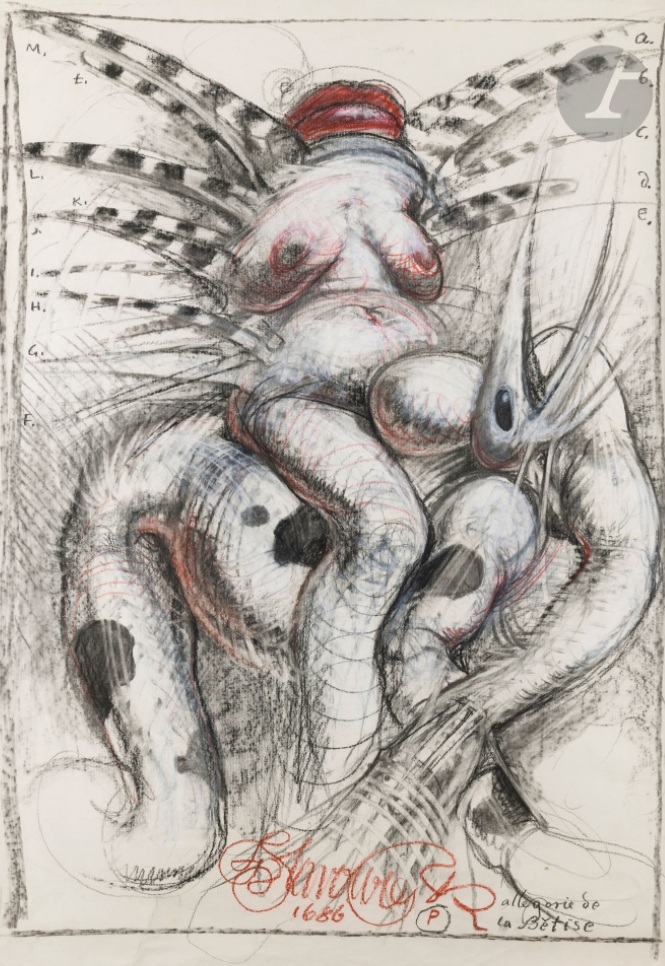
Franciszek Starowieyski. Allegory of stupidity, 1986
Lot 172. Franciszek STAROWIEYSKI (1930-2009). Allegory of stupidity, 1986. Charcoal and pastel. Signed, titled and backdated below. 99 x 69 cm (on view). Estimate 3,000 – 4,000 euro. Ader. 03/20/25. Sold 5,200 euro
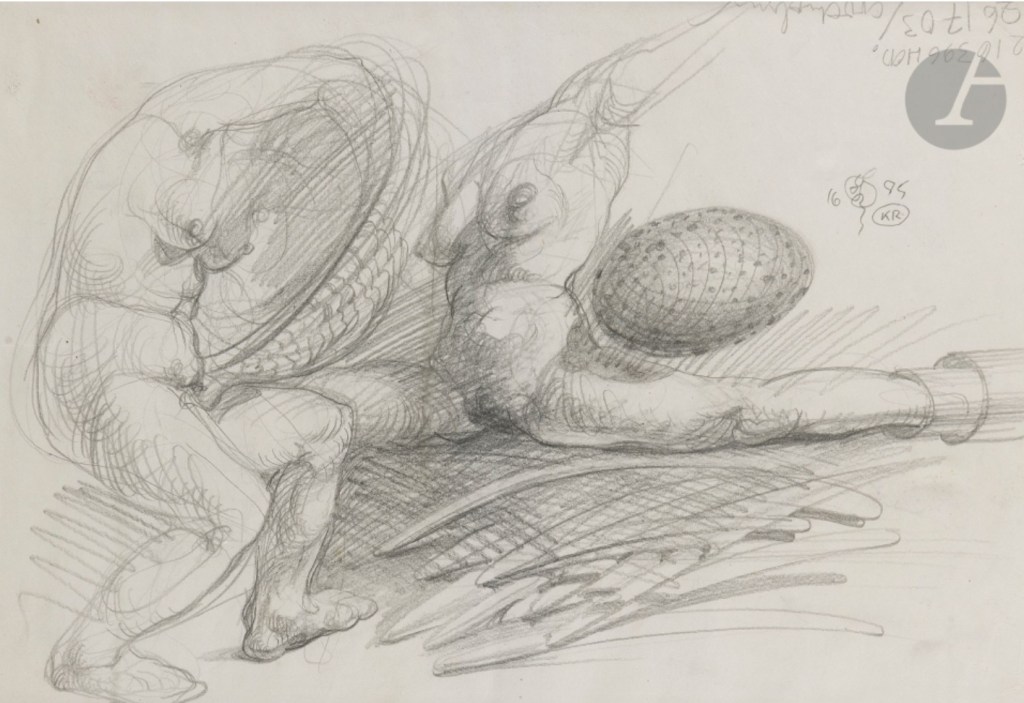
Franciszek Starowieyski. Composition, 1985
Lot 173. Franciszek STAROWIEYSKI (1930-2009.) Composition, 1985. Lead pencil. Signed and backdated on the right. 28 x 41 cm. Estimate 400 – 600 euro. Ader. 03/20/25. Sold 420 euro
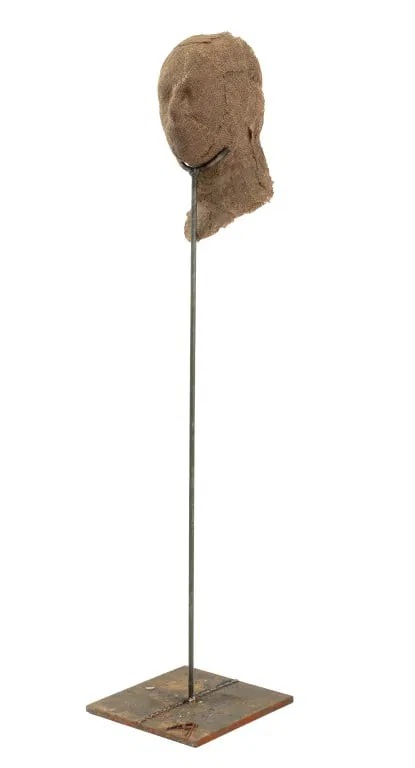
Lot 13. Magdalena Abakanowicz (Polish, 1930-2017) Head Sculpture, circa 2000, burlap and resin mounted on a steel stand, signed “MA” to the square base. Overall: 46″ H x 11.5″ W x 10″ D. Provenance: From a New Jersey Collection. Estimate $8,000 – 12,000. Auctions at Showplace. 03/06/25. Sold $15,000
Sygnatura wyspawana na podstawie
Ciekawi mnie, czy ta rzeźba znajdzie uznanie w oczach Fundacji Madaleny Abakanowicz Kosmowskiej i Jana Kosmowskiego. Przypomnę, że na tej samej aukcji została dzisiaj sprzedana inna rzeźba rzekomo tej artystki za $4,000, pomimo, że Fundacja nie potwierdziła jej autentyczności (https://polishartcorner.com/2025/02/06/magdalena-abakanowicz-1930-2017-62/). Boleję bardzo, że blog ten czyta jedynie garstka ‘inwestorów’ bo przeboleć utratę $4,000 można lecz $15,000 będzie już trudniej. Szkoda, że Fundacja nie reaguje proaktywnie, oficjalnie i stanowczo na podobne przypadki, bo wkrótce będziemy mieli sytuację podobną do pastelowych ‘kół wirujących’ Fangora wyskakujących na aukcjach w USA już co tydzień. Apel do obu Fundacji (Fangora i Abakanowicz): nabierzcie życia i zacznijcie dbać o dobre imię obu artystów lub rozwiążcie się!
Bronisława Rychter-Janowska. Interieur mit Lesender
Lot 756. Bronislawa Rychter-Janowska, Interieur mit Lesender, Ölgemälde, gerahmtBronislawa Anna Waleria Rychter-Janowska, 1868 Krakau – 1953 ebd., polnische Malerin und Publizistin, Großes Wohnzimmer-Interieur mit Durchblick zu einem weiteren Zimmer mit einer Lesenden, Öl/Bristolkarton, li. u. sign., 50 x 70 cm. Estimate 2,500 – 3,500 euro. Kunst und Kuriosa. 03/07/25. Sold 2,800 euro
Sygnatura
Duży i dekoracyjny olej Bronisławy Rychter-Janowskiej. Warty byłby szcególnego polecenia, gdyby artystka nie namalowała aż tak wiele podobnych prac przedstawiających oświetlony słońcem i zadbany salon, z kanapami, obrazami wiszącymi na ścianach, żyrandolem, podłogą ułożoną z klepek drewnianych. Ta powtarzalność, co prawda mniejszych formatów, jest jedynym frasunkiem lecz trzeba pamiętać, że artyści malowali czasami to co narzucał rynek, tj. co udawało się sprzedawać (podobnie jak niedawno pokazane “Pojenie konia” w wykonaniu Jerzego Kossaka i jego ‘stajni’). Nie jest to jednak wierna kopia innych prac lecz wykorzystanie pomysłu przez Bronisławę Rychter-Janowską do pokazania mędzywojennych salonów. Takich salonów obecnie już nie ma. Oby obraz ten pasował do obecnych ‘salonów’.
Lot 9. AMEDEO MODIGLIANI (1884-1920). Portrait de Lunia Czechowska, signed ‘Modigliani’ (upper right), oil on canvas laid on board, 18 1⁄8 x 14 7⁄8 in. (46 x 37.8 cm.). Painted circa 1917-1918. Provenance: Walther Halvorsen, Oslo & Paris, by whom probably acquired from the artist. Galerie Bernheim-Jeune, Paris (no. 22306), by whom acquired from the above on 3 September 1920. Biassano, by whom acquired from the above on 27 November 1920. Jos Hessel, Paris, by 1930. Marcelle Bourdon, Paris, by 1952; her sale, Guy Loudmer, Paris, 25 March 1990, lot 35. Corporate collection; sale, Briest, Paris, 28 November 1996, lot 33. Private collection, Europe, by whom acquired at the above sale. Acquired from the above in 2003, and thence by descent to the present owner. Estimate GBP 4,000,000 – GBP 7,000,000. Christie’s. 03/05/25. Sold 6,290,000 GBP (bp)
Portret Luni Czechowskiej wykonany przez Amedeo Modiglianiego. Polonik o którym można pomarzyć. W pracy tej zawiera się opowieść o znakomitym malarzu, kobiecie którą wielokrotnie portretował, oraz marszandzie artysty Leopoldzie Zborowskim. Zamiast więcej pisać zacytuję poniej esej opublikowny przez dom aukcyjny Christie’s. Na zakup tej pracy mogłoby pozwolic sobie kilku zamożnych polskich kolekcjonerów tyle, że sprowadzenie jej do kraju pewnie wiązałoby się z pozostawieniem jej w Polsce na stałe a tym samym trudności z odsprzedażą w przyszłości na rynkach światowych.
Rendered in soft, expressive brushstrokes, Amedeo Modigliani’s Portrait de Lunia Czechowska was painted circa 1917-1918, and is a depiction of one of the artist’s most loyal and cherished friends. Known in his day and admired among his circle of friends primarily as a portraitist, Modigliani prided himself on his skill as an acute observer of the variety and nuances of human character, and his ability to evoke the serene, beatific beauty of l’éternel féminin in his paintings of women. ‘To do any work, I must have a living person,’ he explained to the painter Léopold Survage, ‘I must be able to see him opposite me’ (quoted in J. Modigliani, Modigliani: Man and Myth, New York, 1958, p. 82). Modigliani constantly sought to capture the essence of his sitter, not as a naturalistic likeness, but as an abstract, depersonalized representation stemming from his own pictorial synthesis of seeing and style. Born Ludwika Makowska in Prague in 1894, Lunia’s father was a Polish patriot who actively opposed the Russian and Austrian partition of the Polish homeland. In 1907, after serving two years of a fifteen-year prison sentence for his role in a workers’ strike in Warsaw, Makowski moved his family to Krakow in the Austrian zone. Upon graduating from the gymnasium in 1913, Lunia followed her father’s wishes and moved to Paris. There she met Kazimierz Czechowski, another recent Polish émigré, also a patriot, with whom she fell in love; they married on 21 June 1915. Czechowski was a childhood friend of Léopold Zborowski, who was to become Modigliani’s devoted dealer and friend from 1916 until the end of the artist’s life. It was the painter Moïse Kisling who introduced Zborowski to Modigliani, and the aspiring dealer first saw the Italian artist’s paintings later that year, in a group show at the Lyre et Palette, the Montparnasse atelier of the Swiss painter Émile Lejeune. According to Les Souvenirs – Lunia’s autobiographical recollections of Modigliani that she wrote in 1953 and was published in Ambrogio Ceroni’s 1958 monograph on the artist – this 1916 event at the Lyre et Palette was where the artist and muse met. In an interview with William Fifield in the 1970s she recalled: ‘We went to the exhibition,’ she recalled for Fifield, ‘it was the Lyre et Palette, and Modigliani was present… He said he hadn’t time for Léopold, but seeing that we women were with him he returned and said we should perhaps meet in an hour. And we went to the Rotonde’ (quoted in W. Fifield, Modigliani: The Biography, New York, 1976, pp. 222 and 274). ‘He came and sat next to me,’ Lunia wrote in Les Souvenirs. ‘I was struck by his distinctiveness, his luminosity, and the beauty of his eyes. He was at once very simple and very noble’ (‘Les Souvenirs de Lunia Czechowska,’ in A. Ceroni, Amedeo Modigliani, Peintre, Milan, 1958, pp. 20, 21). Modigliani began to sketch Lunia. ‘I was quite young and very shy,’ she continued ‘and I became frightened, when Modigliani asked, after several minutes, in the presence of my husband, to go out with me that very night. Because to Modigliani, I was alone. He felt so strongly towards me he would have liked me to abandon everything to follow him. Confused, I responded that I was not free. Poor dear friend, what seemed so natural to him seemed to me so strange! Zborowski came to my rescue, saying that plans for the evening had already been made, and he invited Modigliani to join us. He refused. Turning towards me, he asked, while offering the drawing he had made of me, to come pose the next day for a portrait’ (ibid.). Despite all signs that she would remain faithful to her marriage with Czechowski, the artist persisted in seeking a romantic liaison with Lunia. ‘I was always the mysterious woman to him,’ Lunia told Fifield, ‘the Sphinx, Cleopatra, there were things he did not know’ (op. cit., p. 222). Modigliani must have felt especially encouraged in 1917, when in the wake of the February Revolution in Russia, which resulted in the abdication of Tsar Nicholas II, Czechowski decided to return to his homeland and agitate for independence. He joined Lenin’s Red Army following the October Bolshevik Revolution, making arrangements for Lunia to stay with Zborowski and his partner Anna (“Hanka”). Now that she lived with the artist’s dealer, Modigliani saw Lunia often, regularly coming to the apartment to paint during the afternoon, as it was at Zborowski’s that Modigliani had his studio. Czechowski did not live to see Poland freed from foreign hegemony, however. In 1918, while in a hospital recovering from wounds, his Russian comrades learned he was a Polish revolutionary – someone who would eventually turn against and fight them – and had him summarily shot. Lunia did not learn of her husband’s fate until 1921. ‘Happiness is an angel with a serious face,’ Modigliani wrote to Paul Alexandre, his earliest patron, on a postcard from Livorno, dated June 1913 (quoted in D. Krystof, Modigliani: The Poetry of Seeing, Cologne, 2006, p. 88). Lunia’s ethereal features perfectly suited the artist’s fascination with this type; her serious demeanour and youthfully lithe, feminine figure lent themselves well to the primary influences the artist liked to incorporate and show off in his portraits. The plunging ‘V’ of Lunia’s cylindrical neckline and her blade-like décolleté, stark against her white shirt in the present painting, allude to the hallmark swan-like neck and tilted head in the works of the Italian Mannerists of the Sixteenth Century, such as Parmigianino and Pontormo. Between 1916 and 1918, Modigliani painted a small number of fully-clothed portraits of Lunia (Ceroni, nos. 169-172), including the present work, and completed another series of her in 1919 (Ceroni, nos. 317-322). Fifield stated that Lunia ‘almost certainly’ posed for Le grand nu (Ceroni, no. 200; The Museum of Modern Art, New York), ‘though she would never admit it’ (op. cit., 1976, p. 160). Among the named portraits of Lunia, the artist depicts his sitter in a variety of stances and poses – painting her standing and seated, in profile and square on. In the present work her head is softly tilted, and she regards the viewer with a collected gaze. Modigliani explored the geometry of her form with gestural brushstrokes, masterfully varying the lengths of his strokes to imbue the composition with a dynamic vitality. A powerful sense of élan vital emanates from Lunia, conveyed by the rich colour palette of the composition – accentuated by the vibrant highlights of carmine and deep blue that skirt her features. Her physicality is also emphasised by the impasto effect of the medium, where on her cheeks and neck the artist delicately tapped the oil paint onto the canvas with his fingers. With this meticulous eye for detail in play, Modigliani endowed Portrait de Lunia Czechowska with the loving admiration he held for Lunia herself. As Simonetta Fraquelli has noted, Modigliani’s portraits of Lunia differed from those of his other sitters during this time: ‘with an understanding and inquisitive air, she appears more at one with herself than the other women and Modigliani would seem to be implying that she is his equal’ (‘A Personal Universe: Modigliani’s Portraits and Figure Paintings,’ in Modigliani and His Models, exh. cat., Royal Academy of Arts, London, 2006, p. 36). Lunia and Modigliani remained close friends after the artist met his young muse and the future mother of his child, Jeanne Hébuterne in 1917. Modigliani had relocated to the South of France in April 1918 as the Germans approached Paris, while Lunia had remained in the city. Following the artist’s return in May 1919, they resumed their close relationship and Lunia recalled: ‘after dinner, we would go for a walk in Le petit Luxembourg; it was very hot that summer. Sometimes we would go to the movies, other nights we would leisurely stroll the streets of Paris… He had so much to say that it was difficult to separate when we arrived home’ (op. cit., 1958, pp. 28-29). When Jeanne returned to Paris that summer with her and Modigliani’s infant daughter, Lunia stepped in to care for the child, her support for her friend unwavering. Though Lunia had to move south later that year for her health, the two remained inextricably intertwined, and Lunia wrote in Les Souvenirs that she dreamt of Modigliani’s death, the night before she found out about it from a friend.
Lot 25. TAMARA DE LEMPICKA (1898-1980). Portrait du Docteur Boucard, signed ‘T. DE LEMPICKA’ (lower left), oil on canvas, 53 7⁄8 x 30 ¾ in. (137 x 78 cm.). Painted in 1928
Provenance: Dr Pierre Boucard, Paris, by whom commissioned directly from the artist in 1928, and thence by descent. Anonymous sale, Sotheby’s, New York, 14 November 1985, lot 278. Acquired at the above sale, and thence by descent to the present owner.
Portret doktora Boucarda Tamary Łempickiej pochodzi z najbardziej poszukiwanego okresu artystki, z lat 30-tych XX wieku. Praca opisana była w literaturze oraz wielokrotnie wystawiana. Obraz licytowano od 3,500,000 GBP.
Mojżesz (Moise) Kisling. Vase de fleurs sur un tabouret
Moïse Kisling. Vase de fleurs sur un tabouret, signed Kisling (lower left), oil on canvas, 73 by 54.6 cm. Executed in 1934. Provenance: Private Collection, Paris (acquired by 1971). Private Collection, New York (acquired in the early 1970s). Thence by descent to the present owner. Literature: Joseph Kessel and Jean Kisling, Kisling 1891-1953, New York, 1971, p. 205, illustrated in color. Price upon request. Sotheby’s.
Dwa z trzech olejów Mojżesza Kislinga zostało dzisiaj sprzedanych w Sotheby’s. Inny obraz tego artysty, może najlepszy spośród tych będących na aukcji, można kupić bezpośrednio z tego domu aukcyjnego. Cena tego obrazu nie jest podana i trzeba zapytać o nią w Sotheby’s. Zwraca uwagę bardzo bogate tło tej martwej natury.
Mojżesz (Moise) Kisling.Paysage de Saint-Tropez, 1918
Lot 303. Moïse Kisling 1891 – 1953. Paysage de Saint-Tropez, signed Kisling, dated 1918 and dedicated à Mlle Lucette Descaves (lower right), oil on panel, 32.9 by 41 cm. 13 by 16⅛ in. Framed: 51 by 58.9 cm. 20 by 23⅛ in. Executed in 1918. To be included in the Volume IV et Additifs aux Tomes I, II, et III of the Catalogue Raisonné de l’Œuvre de Moïse Kisling currently being prepared by Marc Ottavi. Estimate 20,000 – 30,000 GBP. Sotheby’s. 03/05/25. Sold 38,100 GBP (bp)
Mojżesz (Moise) Kisling.Jeune paysanne, 1916
Lot 276. Moise Kisling 1891 – 1953. Jeune paysanne, signed Kisling and dated 1916 (lower right), oil on canvas, 85.1 by 48.2 cm. 33½ by 19 in. Framed: 98.4 by 61.4 cm. 38¾ by 24¼ in. Executed in 1916. Provenance Jonas Netter, Paris. Private Collection, Europe (acquired by descent from the above). Christie’s, London, 8 February 2012, lot 465 (consigned by the above). Acquired from the above sale by the present owner. Literature: Jean Kisling and Henri Troyat, Kisling 1891-1953, vol. II, Turin, 1982, no. 17, p. 106, illustrated. Chiba, Kawamura Museum; Osaka, Kintetsu Museum of Art; Yamagata, Museum of Art; Niigata, Municipal Museum of Art; Miyazaki, Prefectural Museum of Art; Kitakyushu, Municipal Museum of Art; and Tokyo, Daîmaru Museum of Art, Modigliani et son époque, Paris 1910-20, 1997, no. 31, p. 82, illustrated. Estimate 60,000 80,000 GBP. Sothebys. 03/05/25. Sold 45,720 GBP (bp)
Mojżesz (Moise) Kisling.Bouquet de bleuets
Lot 301. Moïse Kisling 1891 – 1953. Bouquet de bleuets, signed Kisling (lower right), oil on canvas, 45 by 28.5 cm. 17¾ by 11¼ in. Framed: 64.1 by 47.4 cm. 25¼ by 18⅝ in. Executed circa 1943. To be included in the Volume IV et Additifs aux Tomes I, II, et III of the Catalogue Raisonné de l’Œuvre de Moïse Kisling currently being prepared by Marc Ottavi. Provenance: Bellonni Collection, New York. Galerie Adler, Paris. Christie’s, Tel Aviv, 25 October 1997, lot 23. Christie’s, London, 8 February 2012, lot 495. Acquired from the above sale by the present owner. Estimate 25,000 – 35,000 GBP. Sotheby’s. 03/05/25. Passed
Lot 761. WITOLD CHOMICZ 1910-1984. Fetes de Cracovie 1937. Color lithograph, Zaklady Graficzne, Krakowie.Condition: B+. 38.98 x 27.56 in. Starting 150 euro. Estimate 200 – 250 euro. Aste Bolaffi. 03/06/25. Sold 400 euro
Oryginalny, rzadki plakat, w niezłej B+ kondycji, autorstwa Witolda Chomicza, malarza, grafika, drzeworytnika, wydrukowany w 1937 roku z okazji Dni Krakowa. Autor wielu innych międzywojennych plakatów. MN w Krakowie jest posiadaczem indentycznego plakatu wydrukowanego w 1938 roku, z polskimi napisami. Spora gratka dla krakusów i może zdążą go kupić. Plakat niezwykle dekoracyjny
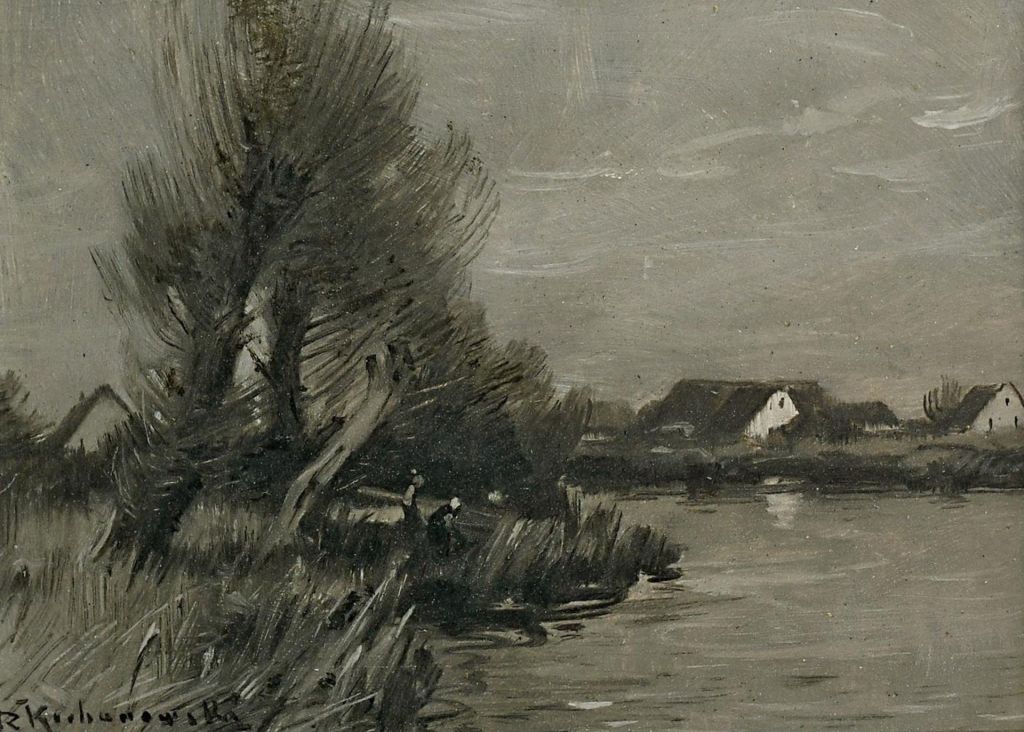
Lot 614. KOCHANOWSKI, ROMAN 1857 Krakau – 1945 Freising. Landschaft mit See. Öl auf Holz. L. u. signiert.14 x 19 cm. Rahmen. Estimate 1,800 euro. Scheublein Art & Auktionen. 03/27/25. Sold €2,800
Spory wybór prac Romana Kochanowskiego w Monachium. Wyróżnia się en grisaille pejzaż nadwodny z domkami. Każdy z tych małych olejów może zapoczątkować kolekcję RK lub ją uzupełnić.
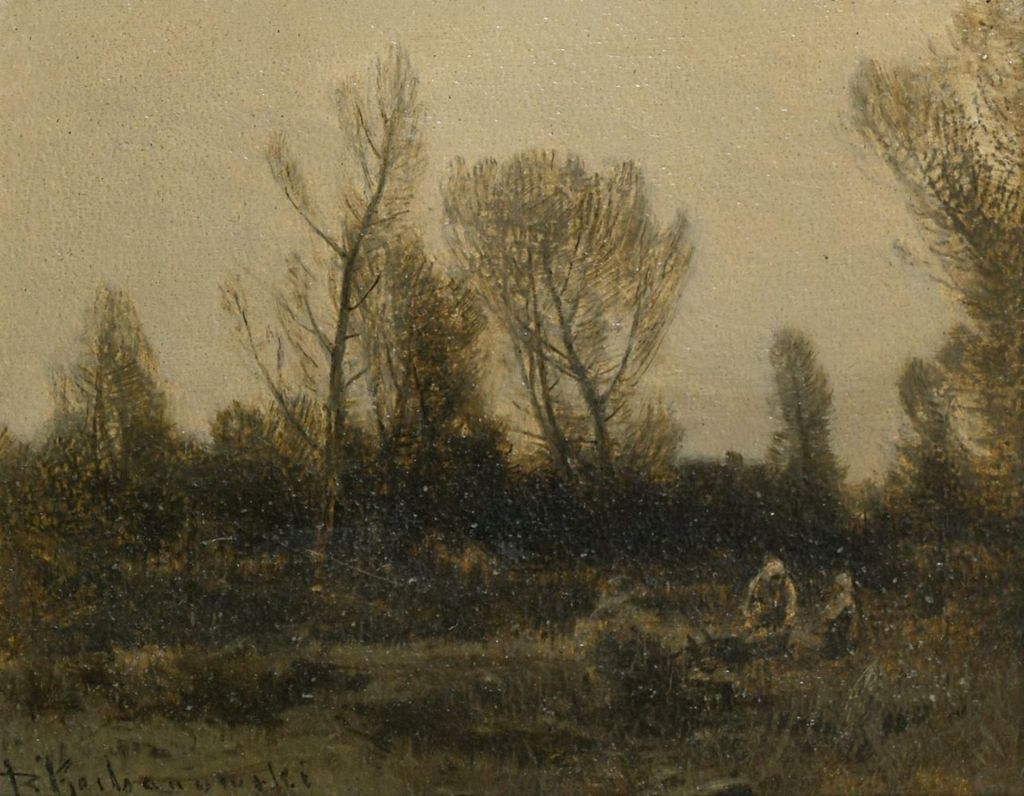
Roman Kochanowski. Landschaft mit Reisigsammlern
Lot 615. KOCHANOWSKI, ROMAN 1857 Krakau – 1945 Freising. Landschaft mit Reisigsammlern. Öl auf Papier auf Holz. L. u. signiert. 16 x 22 cm. Rahmen. Estimate 1,800 euro. Scheublein Art & Auktionen. 03/27/25. Sold €1,800
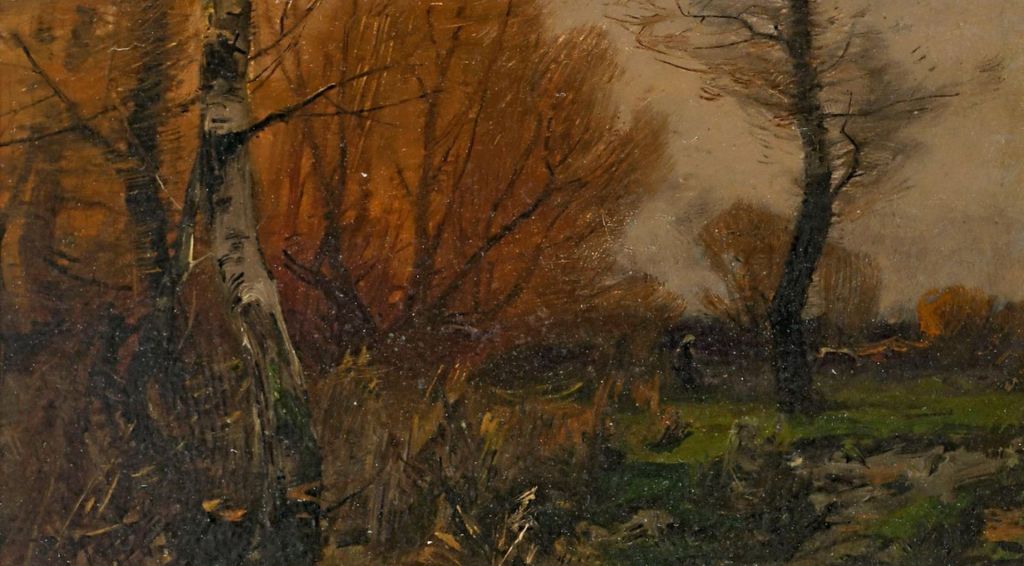
Roman Kochanowski. Herbstlicher Waldrand
Lot 616. KOCHANOWSKI, ROMAN 1857 Krakau – 1945 Freising. Herbstlicher Waldrand. Öl auf Holz. L. u. signiert. 11,5 x 21 cm. Rahmen. Estimate 1,800 euro. Scheublein Art & Auktionen. 03/27/25. SOld €1,800


 Polish Art Corner