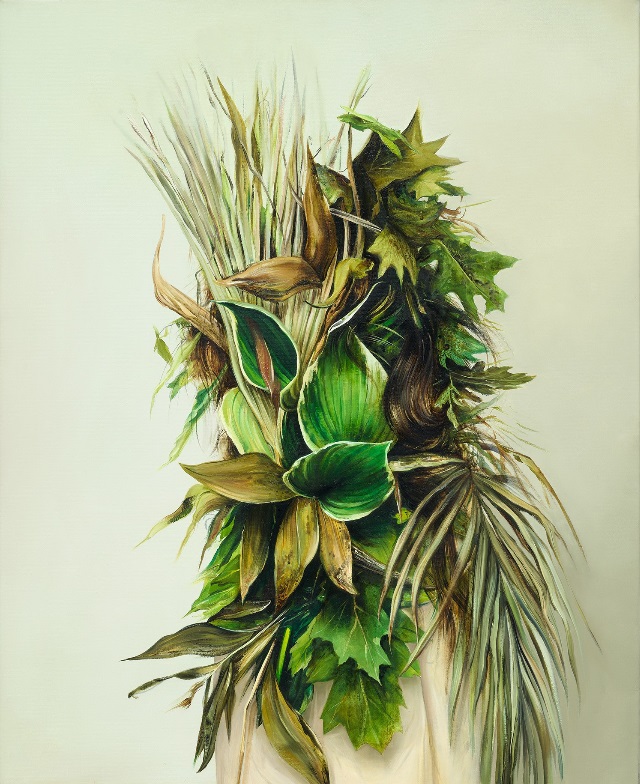
Lot 20. Ewa Juszkiewicz (1984). Grove. signed and dated ‘Ewa Juszkiewicz 2014’ on the reverse, oil on canvas, 100 x 80 cm. (39 3/8 x 31 1/2 in.). Painted in 2014. Estimate HK$2,400,000 – 3,500,000 (€292,000-427,000; $308,000-449,000). Phillips. 11/25/24. Passed
Phillips na aukcji Modern and Contemporary Art sprzedał 21 pozycji z wystawionych 23. Obraz Ewy Juszkiewicz należy do tych dwóch którym się nie powiodło. Poniżej bardzo obfity opis katalogowy Phillipsa do tej pracy wzmiankujący między innymi “technical virtuosity” artystki. Warto uważnie w nim się zgalębić:
“I developed a strong need to reference those portraits, and to establish a dialogue with them. I was driven by a desire to revitalise history, or rather to create my own story on the basis of it.”
— Ewa Juszkiewicz
Rewriting the Narrative
Having been extensively exposed to classical European portraits, Ewa Juszkiewicz found herself both fascinated and perplexed by them. While the artistry in these works is impeccably executed, with intricate brushwork that enlivens each figure, the representation of women remains strikingly monotonous. As Juszkiewicz noted in an interview with ARTNews, “Their poses, gestures, and facial expressions were very similar and showed no deep emotion or individuality”.
In response, Juszkiewicz created artworks that challenge the conventions of European portraiture while honouring the significant aspects of tradition. She draws inspiration from female portraits spanning the Renaissance to the 19th century, meticulously recreating the technical virtuosity and stylistic elements of this historical genre. However, she introduces a radical transformation by obscuring or entirely replacing the subject’s faces. Through this practice of recreation and deliberate obstruction, Juszkiewicz articulates her critique of the complex history of female representation in Western art, where female identity has often been shaped by patriarchal societal expectations. Her works engage in a subtle yet powerful critique of classical portraiture, using its very language to expose the underlying mechanisms of control and display.
Juszkiewicz elaborates on her creative process and the ideas behind her works in the following interview: Ewa Juszkiewicz: Locks with Leaves and Swelling Buds, which was conducted in conjunction with her latest solo exhibition at the 2024 Venice Biennale.
Artistry in Precision
The present work, Grove, exemplifies Juszkiewicz’s mastery of the medium, particularly in portraying the intricate layers of botanical textures. Unlike many of her other pieces, which often showcase sumptuous details of fashion, the torso of the main figure in this painting is barely visible. Instead, she is depicted wearing a monochromatic robe that seamlessly blends with the background. This minimalist approach shifts the focus to the lush vegetation that obscures the figure’s identity. The vertical composition creates a dynamic sense of upward movement, while the interplay between withered brown leaves and vibrant greenery reflects Juskiewicz’s sophisticated understanding of colour dynamics and natural forms. Her brushwork aligns with her classical training, capturing the life cycle of plants with exquisite attention to detail, including the veins and speckles on the leaves.
Conceal, Rebel, and Question
Almost entirely engulfed by foliage, the present work conceals not only the main figure’s face but also a significant portion of her hair, which becomes entwined in the verdant backdrop. The artist has once remarked ‘Hair is very interesting; it’s often a status symbol.’ii This concealment can be interpreted as a means to protect the figure from scrutiny and to obscure any indication of her social status. By completely obscuring both the face and hair, Juszkiewicz disrupts the traditional principles of portraiture, which often rely on visual tropes shaped by societal expectations regarding women’s appearance and behaviour. In this way, Grove presents a potential manifestation of female portraiture in the absence of the male gaze. Through this exploration, Juszkiewicz challenges the patriarchal conventions that permeate society.
“There is also a theme of being overgrown, the fusion of hair and plants, and blurring the boundaries of what is human.”
— Ewa Juszkiewicz
Beyond her critique of social norms, Juszkiewicz’s portrayal of overgrown vegetation on the figure’s head also invites a broader contemplation of humanity. She considers these paintings part of the historical vanitas genre, explicitly exploring the cycle of life. The plants depicted vary in stages of their life cycles–some are fragile new leaves, others are vibrant, while some are withering. This representation of life’s cycles, combined with the subversion of social conventions, enhances the contemplative nature of her work, prompting a direct interrogation of what it means to be human and the implications that entails.
Dorothea Tanning of the 21st Century
Juszkiewicz’s works evoke the artistry of Dorothea Tanning, the American modernist painter profoundly influenced by Surrealism, known for amplifying the female experience of confrontation. Juszkiewicz shares Tanning’s fascination with hair, overgrown plants, and the female figure, presenting an uncanny portrayal that blends realistic brushwork with Surrealist themes. Despite being separated by seven decades, Juszkiewicz’s work resonates with Tanning’s, as both artists contribute to a reimagining of the grand narrative from a female perspective– aggression and power.
“It’s about confrontation. Everyone believes he/she is his/her drama. While they don’t always have giant sunflowers (most aggressive of flowers) to contend with, there are always stairways, hallways, even very private theatres where the suffocations and the finalities are being played out, the blood red carpet or cruel yellows, the attacker, the delighted victim.”
— Dorothea Tanning
Collector’s Digest
Ewa Juszkiewicz holds a PhD from the Academy of Fine Arts in Krakow, Poland, where she graduated in 2013. Before her debut at Gagosian, New York with Ewa Juszkiewicz: In vain her feet in sparkling laces glow, 2020-21, she exhibited extensively across Europe. Her latest solo exhibition, Locks with Leaves and Swelling Buds, in collaboration with Almine Rech, took place at Palazzo Cavanis during the 2024 Venice Biennale. Juszkiewicz’s works are included in several prestigious public collections, such as the Museum of Modern Art, Warsaw; the Albertina Museum, Vienna; the Institute of Contemporary Arts, Miami; and Musée d’Art Moderne de Paris, Paris.

 Polish Art Corner