Wow
——————————————————–
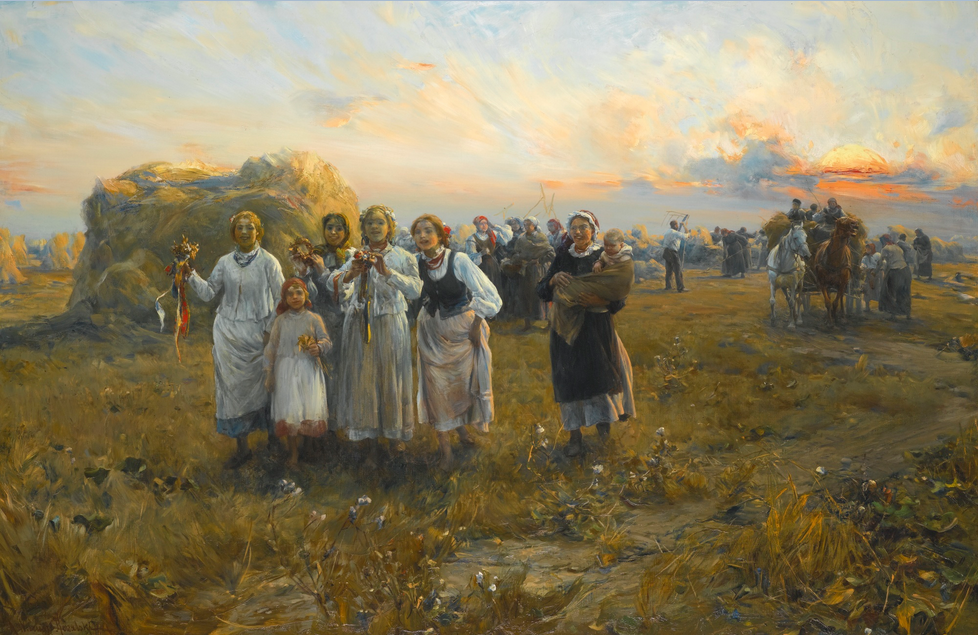
Lot 48. Alfred von Wierusz-Kowalski 1849-1915. POLISH
HARVEST FESTIVAL, signed A. Wierusz-Kowalski lower left, oil on canvas, 90 by 137cm., 35¼ by 54in. 60000
Authentication
We are grateful to Eliza Ptaszynska for her assistance in cataloguing this work.
Provenance
Sale: Neumeister, Munich, 7 December 1988, lot 645
Purchased at the above sale by the family of the late owner; thence by descent
Literature
Laszlo Balogh, Alltagschilderung in der Münchner Malerei, Mainburg, 1989, p. 96, fig. 133, illustrated
Hans-Peter Bühler, Jäger, Kosaken und polnische Reiter, Hildesheim, 1993, p. 31, fig. 22, illustrated; p. 161, catalogued (dated circa 1910)
Eliza Ptaszynska, Alfred Wierusz-Kowalski 1849-1915, Warsaw, 2011, p. 146, illustrated
Catalogue Note
The Polish harvest festival dates back to feudal times, when the nobility and larger landowners rewarded their farmers for their hard work. The popular and colourful Dożynki, as it is called in Polish, is a celebration of the conclusion of the growing season.
The typical Dożynki celebration started with Mass, followed by a harvest procession to the local manor house. Traditional costumes of the region were worn by most participants. In the old days the hardest-working girl harvester, or przodownica, wore a smaller version of the harvest wreath as a head piece, as in the present work.
Resident in Munich from 1873, Alfred Wierusz-Kowalski was a painter of Polish customs and rural life. He became best known for his depictions of sledge and coach rides in the snow, but also of summer scenes such as this. These paintings were valued for their exotic flavour by European and American art dealers and collectors alike.
Wierusz-Kowalski approached his subjects narratively in compositions full of dynamism and attention to detail. Finding great success as an artist in Germany, he nevertheless returned regularly to Poland, whose landscapes would remain the main inspiration for his work.
Estimate 60,000-80,000 GBP. Sothebys. 12/16/15
 Polish Art Corner