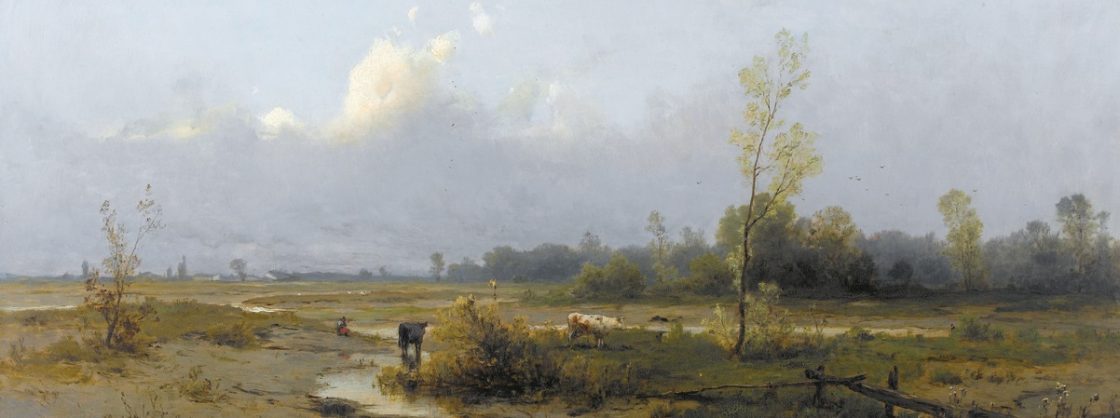

Prawdopodobnie praca tego malarza o tej tematyce, o tym wymiarze płótna i o tej cenie może się znaleźć raczej w muzeum a nie w prywatnej kolekcji. Trzeba jednak zwrócic uwagę w opisie na słowa ‘another version‘ (moje wytluszczenie). Co to znaczy i co to ewentualnie może oznaczać za te pieniądze? Warto również zwrócić uwagę na mnogość słów w opisie a niczego o proweniencji TEGO konkretnie płóna, ani jednego słowa o proweniencji. Dlaczego?
——————————————————–
Lot 18. KOTARBINSKY, VASILY (1849-1921). Roman Orgy, signed, inscribed Roma and indistinctly dated 189?. Oil on canvas, 166 by 221 cm.
Related literature: For another version of the present lot, see G. Romanov,A. Muratov, Zhivopis russkogo salona (1850–1917 gg.). Entsiklopediya, St Petersburg, Zolotoi Vek/Sankt-Peterburg Orkestr, 2004, p. 321, illustrated.
The painting offered here at auction, entitled Roman Orgy, is a version by Vasily Kotarbinsky of the best-known historical composition that he created. According to the 1899 catalogue of the State Russian Museum, a variant of this picture of truly monumental proportions (300 by 500 cm) was in the museum’s first collection, having been acquired from the Imperial Academy of Arts in 1898 using funds provided by Nikolai II. There is another, somewhat scaled-down, version in the collection of Donetsk Art Museum.
There are other, similar examples in Kotarbinsky’s oeuvre addressing the very same subject matter. These are not rare and, as with Aivazovsky and Semiradsky, they are linked to a desire on the part of patrons in the highest circles of St Petersburg society to have their own versions of their favourite works in the Imperial Museum.
Naturally, in addressing a well-known theme and reproducing elements that already existed, the artist introduced certain variations to the composition to give the new canvas individuality and allow particular details to be further developed. So, by comparison with the painting in the Russian Museum, this version has a better portrayal of the old man with the gold coins, and several characters have also been added in the background. There are additional changes to the appearance and pose of the last passenger in the boat, the angle of the cymbals held by the musician and the angle of the girl’s head in the foreground.
In the main, however, the painting remains unchanged: it has a captivating variety and interplay of textures – naked bodies, fabrics, feathers, flowers, water, a variety of poses, unique use of tiers in the composition, and masterly depiction of objects. The centre of the composition is a group of sculptural beauty: a patrician Roman in a dark cloak standing by a balustrade (possibly, the Emperor Nero) next to a half-naked Roman woman and a girl with a fan and bowl.
The scene is given its theatricality and great artistic expressiveness by the idealised figures draped in classical garb, their classical profiles and sculptural poses. Another protagonist of the picture is the warm light of an impending sunset, which embellishes everything in gentle, peach-coloured tones and envelops the composition in a romantic haze that lends it a certain sense of enigma.
This effect of light, conveyed with technical perfection, subtlety and a multitude of nuances, as well as the harmonious way in which tones are combined – from rosy fulvous to deep blue – constitutes one of the main virtues of the work, which comes across as a large decorative panel.
It is no secret that the events and the characters of Ancient Greece and Ancient Rome remained a source of inspiration for Kotarbinsky throughout his life. Devoting himself to the study and reproduction of the history and way of life of antiquity, the artist would often portray on canvas the environment, clothing and utensils of that time with archaeological accuracy. Arriving in Italy for the first time in 1868, Kotarbinsky became irrevocably enchanted with the Eternal City. He lived in Rome for many years, and even when he subsequently returned to Russia and worked in St Petersburg and Kiev, he remained, as before, a “captive” to the beauty of the southern Italian sun, and the luxuriance of the landscape and colours that characterised it, providing such abundant material for creativity.
Kotarbinsky was one of Nicholas II’s favourite artists. He was admired by his contemporaries, compared to Genrikh Semiradsky and Pavel Svedomsky, called the Russian Alma-Tadema and eulogised for the astonishing mastery and fineness of his painting, the beauty of his composition and draughtsmanship and the poetic grace of the subjects he painted. His talent for turning any subject into a vision of beauty, for conveying the delight and sweet remembrance of humanity’s “golden times” was in extraordinary demand at the time.
The painter recreated not so much the history of antiquity but rather the legends associated with it. It goes without saying that Kotarbinsky was not original in his choice of subject matter. As a rule, he borrowed subjects that had already been interpreted by other artists, but dealt with them in his own way and often with no less success. In Munich, Wilhelm von Kaulbach was acknowledged as the master when it came to scenes from the life of Nero, whereas in London the Dutchman Lawrence Alma-Tadema remained the luminary of the Neo-Greek style, with his painting of a banquet in the time of Augustus entitled Roses of Heliogabalus (1888). The Bacchanalian feasts and orgies of Nero and Tiberius were also an attraction for Kotarbinsky’s fellow countrymen. Henryk Sienkiewicz’s novel Quo Vadis came out in 1896, whereas Semiradsky’s Roman Orgy in the Illustrious Time of the Caesars (1871) and Orgy in the Time of Tiberius on the Island of Capri (1881), and Svedomsky’s Orgy (1883) and Buried in Flowers (1886) appeared even earlier.
In all these canvases the world of antiquity is presented as eye-catching spectacle involving many human figures, or as beautifully idyllic scenes and dramas of no less ravishing a nature. The tradition of antiquity is perceived by Kotarbinsky and his contemporaries as the origin and basis of European civilisation, and addressing this subject allows artists and their followers to feel they are not Poles, Russians or Romans, but Europeans in the broad sense of the word – people who are part of a common human history.
Estimate 550,000-900,000 GBP. MacDougall’s. 12/2/15
 Polish Art Corner