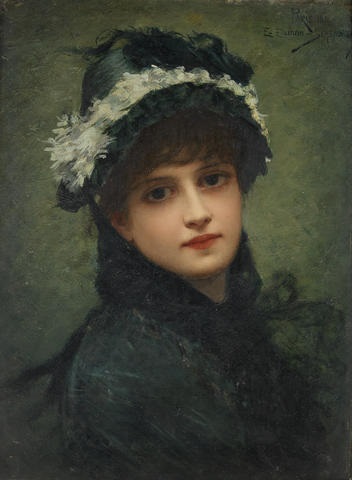
Lot 101. Emile Eisman-Semenowsky (Polish/French, 1857-1911). Portrait of a lady in green, signed, inscribed and dated ‘PARIS 1881./E. Eisman-Semenowsky’ (upper right), oil on panel, 33 x 24cm (13 x 9 7/16in). Estimate £4,000 – 6,000 (US$ 6,700 – 10,000).
Chyba ktoś w pomroczności alkoholowej wycenił powyższą dwumetrową pracę Semenowskiego na 120 tys dolarów. Prawdodpodobnie, ‘specjalista’ słyszał coś o Siemiradzkim (zbieżność nazwisk na literę ‘S’) i w ten sposób pochlebił sobie zadowolony ze staniu swojego umysłu i wiedzy. Rzeczywiście, widziałem już kompozycje Semenowskiego sprzedawane po okolo 12-20 tys dolarów ale takiej wyceny aberracyjnej jeszcze nie było. No, ale jaki dom takie wyceny. Bonhams pcha się nieustannie chcąc być trzecim co do ważności domem aukcyjnym ale trzeba go mieć na oku. Im więcej opisu i pesudo wyjaśnień (patrz niżej) tym praca mniej warta a przecież sprzedać trzeba bo i żyć z tego trzeba.
Śliczny aniołek tańczy z panienką. Inne panienki rżną na fujarkach, jeszcze inne z wiankami tańczą, cieszą się, słowem totalna żeńska idylla. Brakuje ino chłopów by było weselej. W języku polskim taka praca nazywa się ‘kicz’ a w niemieckim i angielskim jest podobne słowo ‘kitsch’.
==================================
Lot 80. Emile Eisman-Semenowsky (Polish/French, 1857-1911). A harvest festival 33.5 x 76.5cm (90 x 194.5cm). US$ 80,000 – 120,000 £48,000 – 72,000.
Footnotes
PROVENANCE: George Parker, Jr.; Sale, Sotheby’s, New York, 29 November 1999, lot 51; Acquired at the above sale by the present owner.Very little is known about the life of Emile Eisman-Semenowsky. He was born in eastern Poland but left his country fairly early on and arrived in Paris in the early 1880s. Here, he became the assistant of the Dutch painter Jan van Beers and established himself as a painter of young fashionable Parisian women, languid oriental odalisques, and reclining neoclassical beauties. The present painting depicts Cerealia, the festival dedicated to Ceres, the Roman goddess of agriculture, grains and fertility, as dedicated in the inscription at left and hinted to by the fruits and vegetables on the altar at right. Her festival took place from mid- to end of April and was led by priestesses from the best Roman families. The festivities included races in the Circus Maximus, theater, music and dancing. The painting is Semenowsky’s most ambitious work known to date, a large format, multi-figured composition, whose size may indicate its intention as an entry to the Paris Salon. One can speculate that Semenowsky became inspired by Sir Lawrence Alma-Tadema’s Spring, an intricate composition from 1894 depicting the same festival and of roughly same dimensions, albeit reversed.
Semenowsky populated his painting with numerous maidens in diaphanous dresses against a neoclassical background of luminescent, veined marble, performing the ritual sacrifices and celebrations of the goddess. While less spectacular than Spring, Semenowsky’s picture is nonetheless a fitting homage to Alma-Tadema
Bonhams. USA. May 7th, 2014.
[Niedoceniłem niektórych. Sold for US$ 106,250 inc. premium]
Łatwiej znależć jest pracę Semenowskiego (inne wersje to m.in. Siemenowski, Siemianowski) niż informację biograficzną o nim. Jedni podają, że był Polakiem, inni Rosjaninem ale prawdopodobnie pochodził z Rosji z polskich terenów mając żydowskie pochodzenie. Wtedy wszystko się zgadza. Malował głownie w Paryżu między innymi portrety pięknych i młodych dam o porcelanowych buziach, dużych oczach, uchylonych w usmiechu ustach, bogatych strojach i biżuterii. Jego portrety wyglądają jak wyretuszowane kolorowe fotografie ale o dziwo cieszą się popytem. Jednym to malarstwo podoba się a ja patrzę na te modelki jak na pięknie ubrane puste lalki. Ot, taka epoka kiedyś była.
Lot 42. Emile EISMAN-SEMENOWSKY (Pologne 1857-France 1911). Femme Espagnole. Huile sur toile, signée et située Paris en haut à droite; 53,5 x 43,5 cm. Estimation : 2 000€ / 2 500€. Boisgirad. April 9, 2014.



 Polish Art Corner