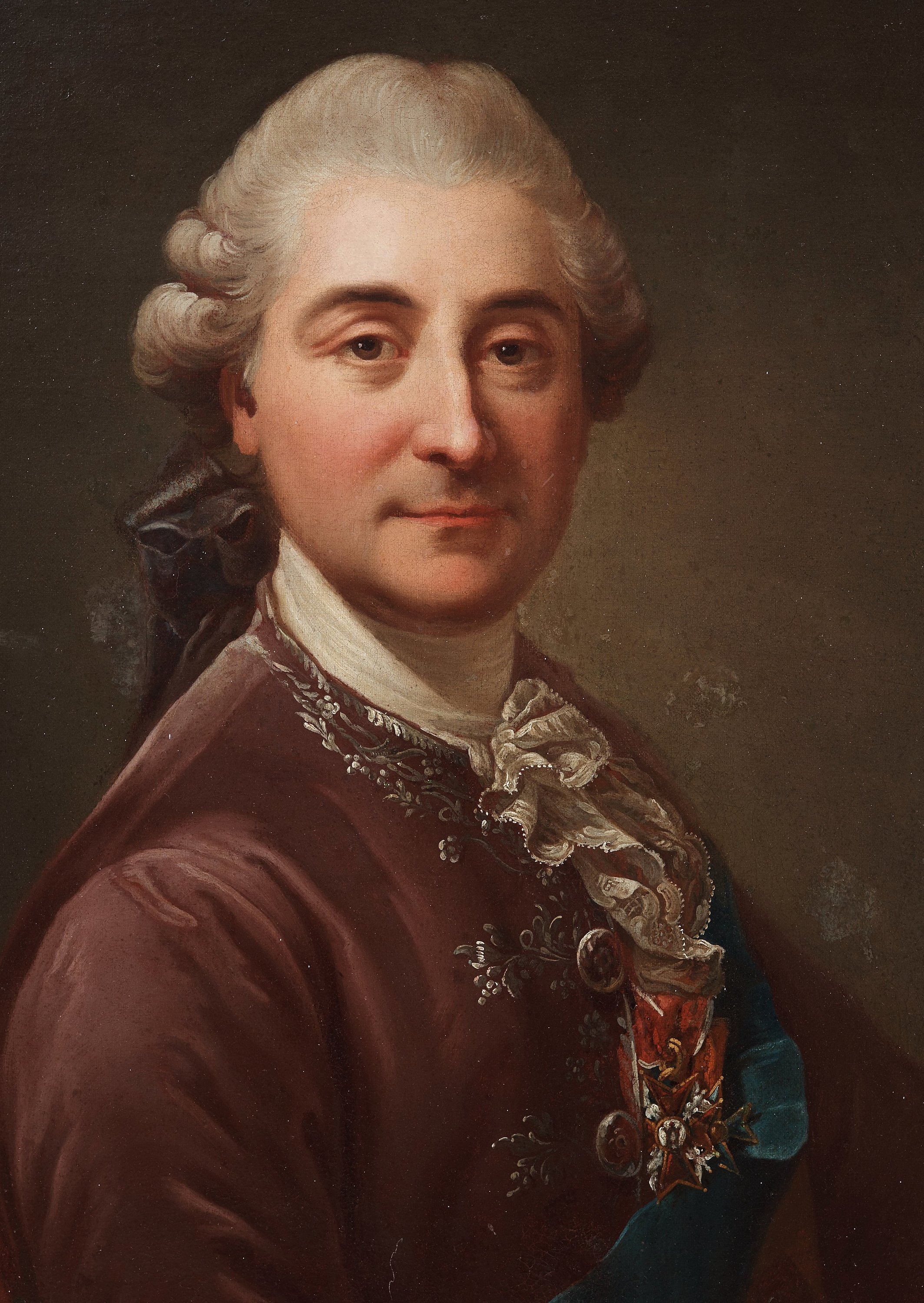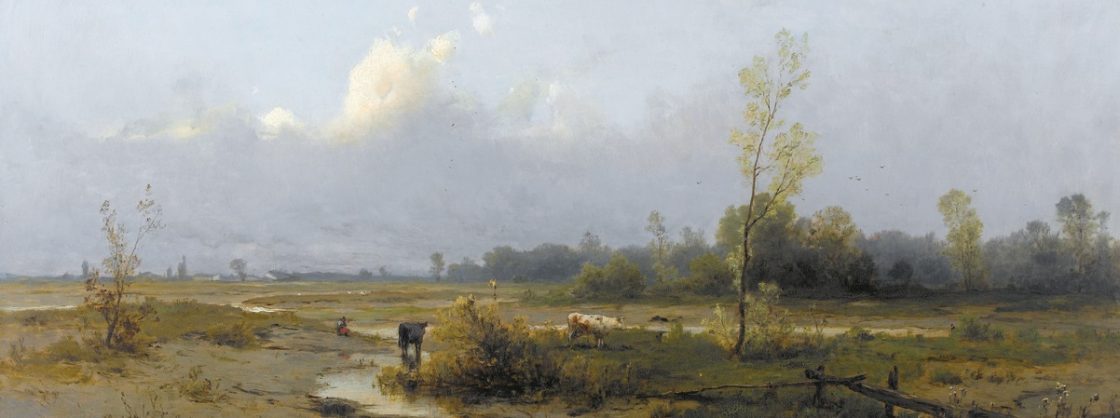
Marcello Baciarelli (1731 – 1818)

Marcello Baciarelli. Portret Andrzeja Poniatowskiego

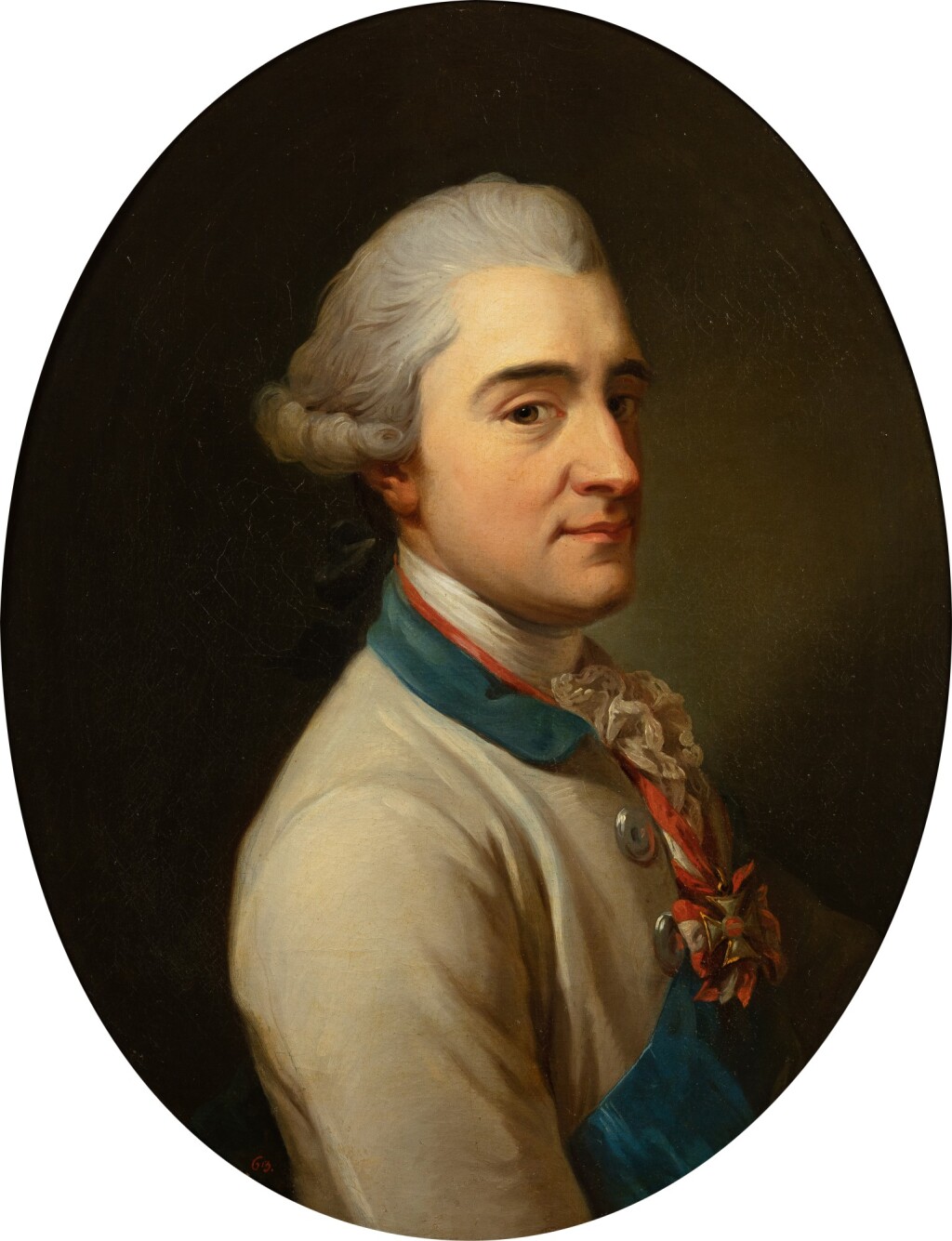
Lot 191. Marcello Bacciarelli Rome 1731 – 1818 Warsaw. Portrait of the prince Andrzej Poniatowski (1734-1773). Bears a red painted number lower left 63.; signed and dated on the reverse PINXIT BACCIARELLI […] 1778. Oil on canvas, an oval, 67,4 x 53 cm ; 26½ by 20⅞ in. Literature: T. Mankowski, Galerja Stanislawa Augusta, Lvov 1932, no. 63. 

Sotheby’s sugeruje, że Marcello Bacciarelli namalował ten obraz Andrzeja Poniatowskiego (1734 – 1773) w roku 1778. Obraz pośmiertny?

Verso

Bacciarelli was born in Rome in 1731, and began his training in Battoni’s workshop before being summoned to the Dresden court by the Elector of Saxony and King of Poland, Augustus III, and then to the court in Vienna by Empress Maria Theresa. When Augustus III died, the artist was summoned by the new king of Poland, Stanislaus II Augustus: he settled in Warsaw in 1765 and became Director of Royal Estates and Buildings, and then Dean of the Fine Arts department at the University, while continuing to train many pupils in his own workshop.

Bacciarelli produced many decorations and historical compositions for the king, but it was at portraiture that he excelled. The most important figures of his age posed for him, including kings, princes and princesses.

On the present painting, the number 63 inscribed in red matches the order number in Stanislaus Augustus’ gallery; the artist also signed the back of the canvas, giving the name and history of the model as well as the date of execution. Works in Stanislaus Augustus’ gallery, dispersed after his abdication in 1795 into museums or private hands, are known to us from various inventories.

Andrzej Poniatowski, portrayed here, was one of the eight children born to Stanislaus and Konstancja Poniatowski, as noted on the back of the canvas. He was also the brother of Stanislaus II Augustus, who appears in a portrait in this sale (see previous lot), and the father of Józef Poniatowski, whose portrait we are also presenting under lot number 207.

Attached by a red and white ribbon around his neck, Andrzej Poniatowski wears the Polish cross of the Order of St Stanislaus, created in 1765 by the king, Stanislaw August Poniatowski, in honour of the country’s patron saint. The blue sash around his waist is that of the Order of the White Eagle, the highest Polish honour, created by Augustus II in the early eighteenth century. Andrzej Poniatowski’s courage in the Seven Years War, when he fought on the side of the Austrian army, resulted in his promotion to Lieutenant General and then Field Marshal in 1771.

The present portrait, dated 1778, emphasises his military experience: the elegance of his apparel is accentuated by skilfully depicted white highlights, while the shimmering silk animates the whole. Although very official in character, the portrait also reveals the model’s personality: his serious and determined gaze underlines the model’s noble qualities.
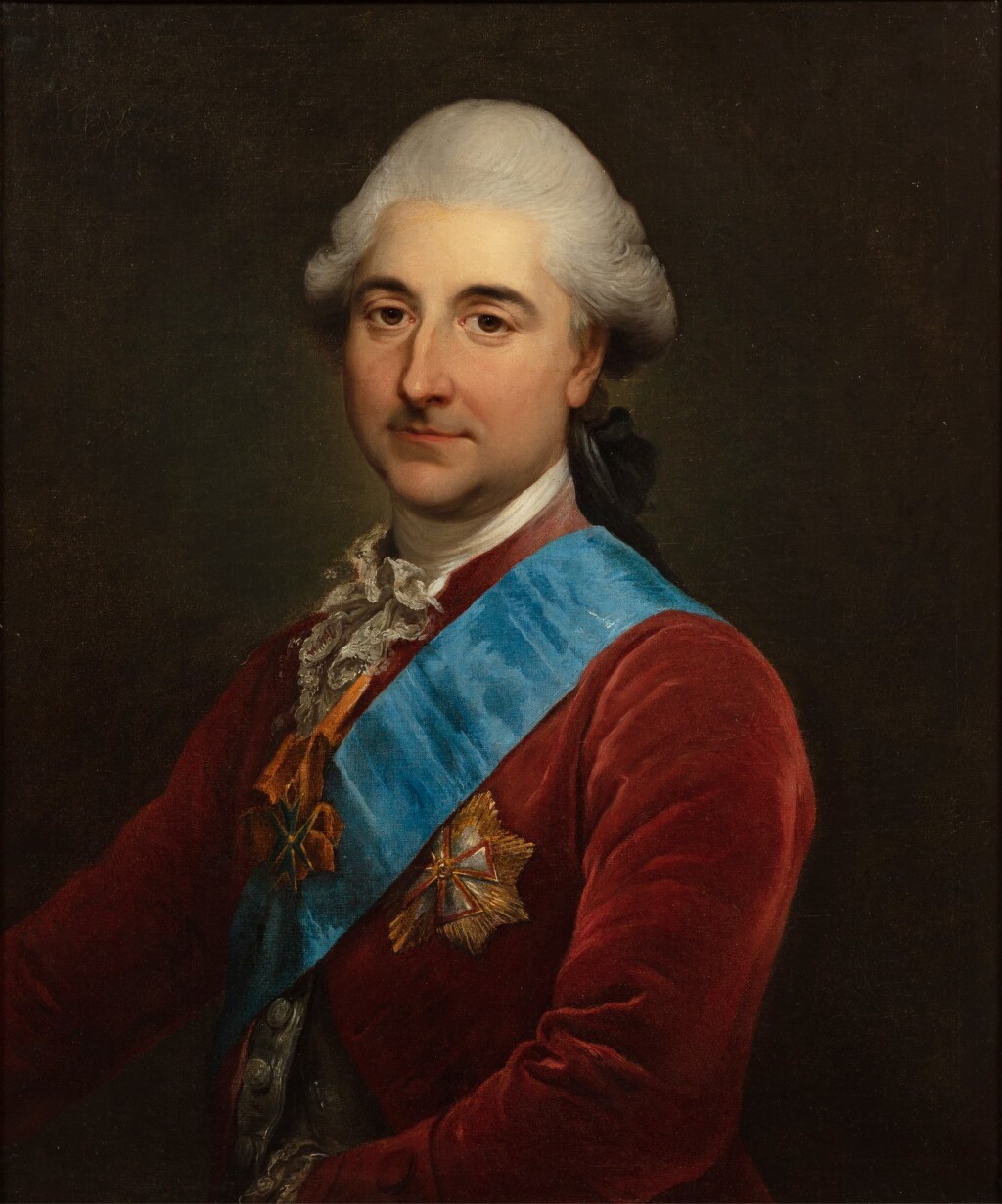
Portret Stanisława Augusta Poniatowskiego

Marcello Bacciarelli (atr.). Portret Stanisława Augusta Poniatowskiego

Lot 190. Attributed to Marcello Bacciarelli Rome 1731 – 1818 Warsaw. Portrait of the King Stanislaw Poniatowski (1732-1798). Oil on canvas. 77,2 x 65 cm ; 30⅜ by 25⅝ in. Estimate 12,000 – 18,000 euro. Sotheby’s. 06/15/22

Portret Stanisława Augusta Poniatowskiego z atrybucja Marcello Bacciarelliego.

Stanislaw II August Poniatowski, born Stanislaw Antoni Poniatowski in 1732, was the brother of Andrzej Poniatowski, whose portrait we are presenting under lot number 191. When their father died, it was Stanislaw Antoni Poniatowski who took the titles of King of Poland and Grand Duke of Lithuania. Continuing with tradition, Stanislaus II Augustus acted as a protector of painters. Deeply interested in literature and art, he regularly attended Madame de Geoffrin’s salon and presided in his own right over gatherings to which intellectuals passing through Warsaw were invited. For his gallery, he commissioned his favourite artists, including the Italians Bacciarelli (one of whose portraits, from his own collection, is in this sale – see next lot) and Grassi, as well as the Swedish painter Krafft.

The size of his personal collection, to which he added continuously during his thirty-one year reign, can be appreciated from several inventories. One of the eighteenth century’s most important collections of paintings, it comprised almost 2,500 works, distributed among his various residences. Most of the paintings were sold when he abdicated in 1795 and are now in private hands or in museums around the world.

The present painting reprises a composition by Bacciarelli: the original is in the museum in Toruń, in Poland. Engraved by Johann Friedrich Bolt (see National Museum of Krakow; inv. MNK III-ryc.-50416), it was copied many times: among other examples, it can be found in a miniature in the Hermitage Museum, St Petersburg (inv. ЭРР-4088).

The king is shown here with the blue sash and medal of the Order of the White Eagle on his breast; around his neck he wears the cross of the Order of the Black Eagle.

Portret Stanisława Augusta Poniatowskiego

Marcello Bacciarelli (atr.). Portret Stanisława Augusta Poniatowskiego

Portret Stanisława Augusta Poniatowskiego, atrybucja ręki Marcellego Bacciarelliego. Wydaje mi się, że NM w Warszawie posiada inną replikę (chyba nie oryginał?) lecz mogę sie mylić, może nawet gorszą replikę. Kupując ten obraz otrzymamy w prezencie drugi, czyli portret księżnej Elisabeth of Württemberg (1767 – 1790), w identycznej ramie i chyba tych samych rozmiarów.

Marcello Bacciarelli (atr.). Portret księżnej Elisabeth of Württemberg

Lot 1135. MARCELLO BACCIARÈLLI (attr. A). (Roma, 1731 – Varsavia, 1818). Ritratto del re di Polonia Stanislao Augusto Poniatowski. Ritratto di Elisabeth of Württemberg. Olio su tela, cm 119 X 80,5 (2). Pittore di Sua Maestà Stanislao Augusto, Re di Polonia, Bacciarelli visse e operò in Polonia per quasi mezzo secolo e svolse un ruolo importante per la pittura polacca dell’epoca. Formatosi con Marco Benefial a Roma, il pittore nel 1753 si trasferì a Dresda fino al 1756, quando a causa della Guerra dei sette anni la corte si trasferì a Varsavia. Primo pittore di corte, l’artista aveva una bottega con innumerevoli allievi e collaboratori che dovevano far fronte alle numerose commissioni. Estimate € 5,000 – 8,000. Wannenes. 06/09/22