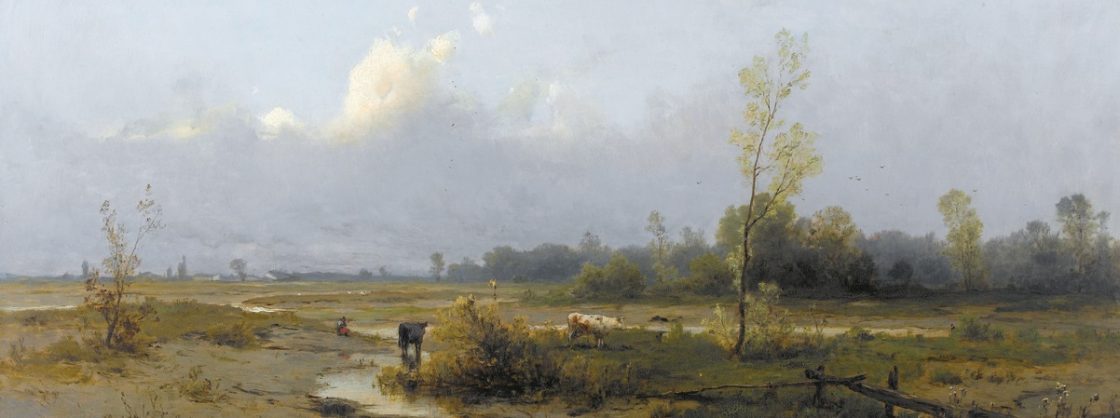

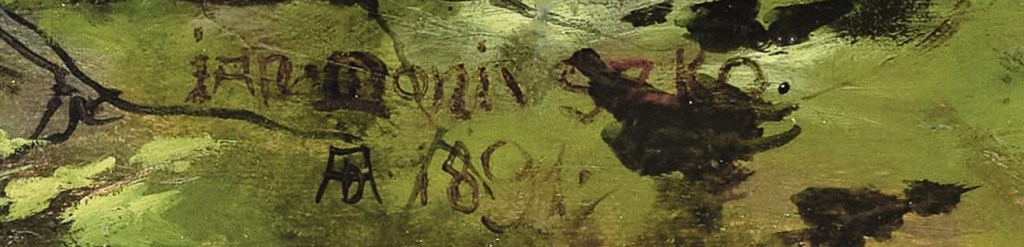
Lot 633. Jan Czesaw Moniuszko (Vilnius 1853–1908 Warsaw). The Siege of Milan by Frederick I Barbarossa, signed, dated Ian Moniuszko AD 1891, oil on canvas, 72 x 118.5 cm, framed. Estimate €4,000 – 6,000. Dorotheum. 10/22/25. Sold €8,500
Jan Czesław Moniuszko was born in 1853 in Vilnius into a family with strong artistic inclinations. His father, Stanisław Moniuszko (1819–1872), is regarded as one of the foremost Polish opera composers of the 19th century. Demonstrating artistic talent from an early age, the young Moniuszko received his training in Warsaw under Wojciech Gerson (1831–1901) before continuing his studies at the Imperial Academy of Fine Arts in St. Petersburg. From 1880 onward, he settled in Warsaw, devoting himself primarily to historical scenes as well as depictions of everyday life and genre subjects.
The present lot portrays a dramatic episode from the siege of Milan by Emperor Frederick I Barbarossa, supported by Bolesław I of Silesia (“the Tall”). At the centre, mounted on a black horse and crowned with the Imperial Crown of the Holy Roman Empire, Barbarossa commands the scene. Behind him unfurls the Habsburg flag on a yellow ground. He is surrounded by embattled knights striving to deflect the stones raining down upon them. To his rear, also dressed in red, Bolesław I. can be discerned, actively engaged in combat among his Polish troops, beside whom a flag bearing the Silesian coat of arms is clearly visible.
Between 1158 and 1162, Emperor Frederick I Barbarossa undertook his second Italian campaign to assert imperial authority in northern Italy. Milan resisted, but after a prolonged siege was compelled to capitulate and was partially destroyed. Barbarossa was supported by princes from Swabia and Bavaria, Bohemian forces under Duke Vladislav II, and Polish auxiliaries under Bolesław I of Silesia. Raised at the imperial court, Bolesław pledged his military service, his cavalry and archers significantly reinforcing the encirclement of the city. As a reward, in 1163 he was able to return to Silesia, where he laid the foundations for a strong Piast principality. In the long term, however, the destruction of Milan provoked the formation of the Lombard League, which would decisively defeat Barbarossa at Legnano in 1176.
Porządnie skomponowana scena historyczna ręki Jana Moniuszki, świeża na rynku, nawet nie uwzględniona w biografii artysty opublikowanej w Słowniku Artystów Polskich. Malarz był autorem prac historycznych, historyczno-rodzajowych jak też rodzajowych. Przewaga tych ostatnich na polskim rynku sprawia, że prace Moniuszki nie znalazły dużego zainteresowania wśród poważnych kolekcjonerów a odnoszę wrażenie, że traktowane są jedynie jako miłe dla oka opowiastki. Dorotheum sprzedaje spore płótno tego malarza z okresu walk Rudobrodego na terenach Włoch mające polski smak w postaci obecności jednego z Piastów. Wycena jest żenująco niska odzwierciedlająca czekanie na ocenę rynku.
 Polish Art Corner