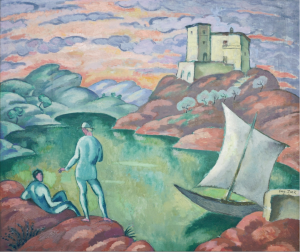
Eugeniusz Zak (1884 – 1926)

Zak

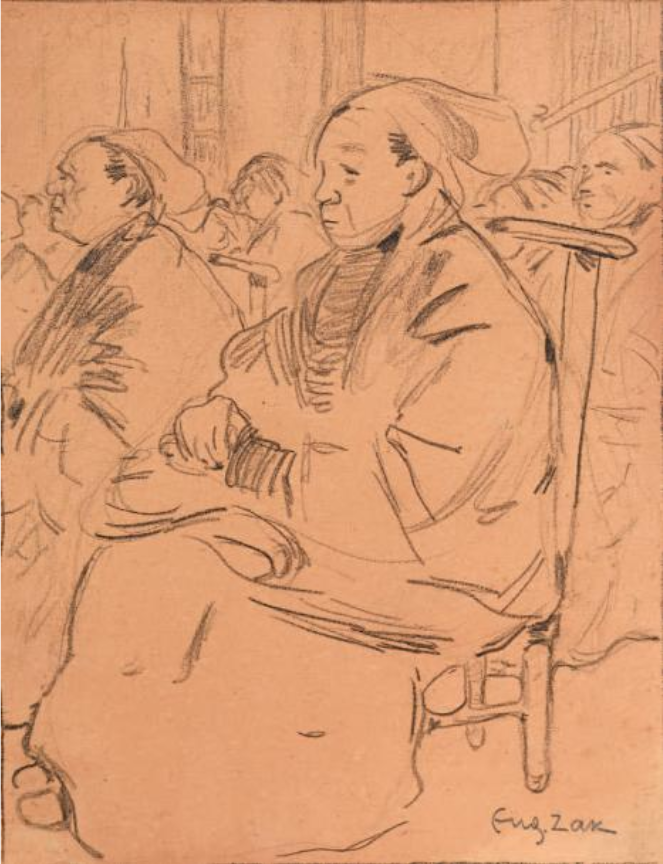
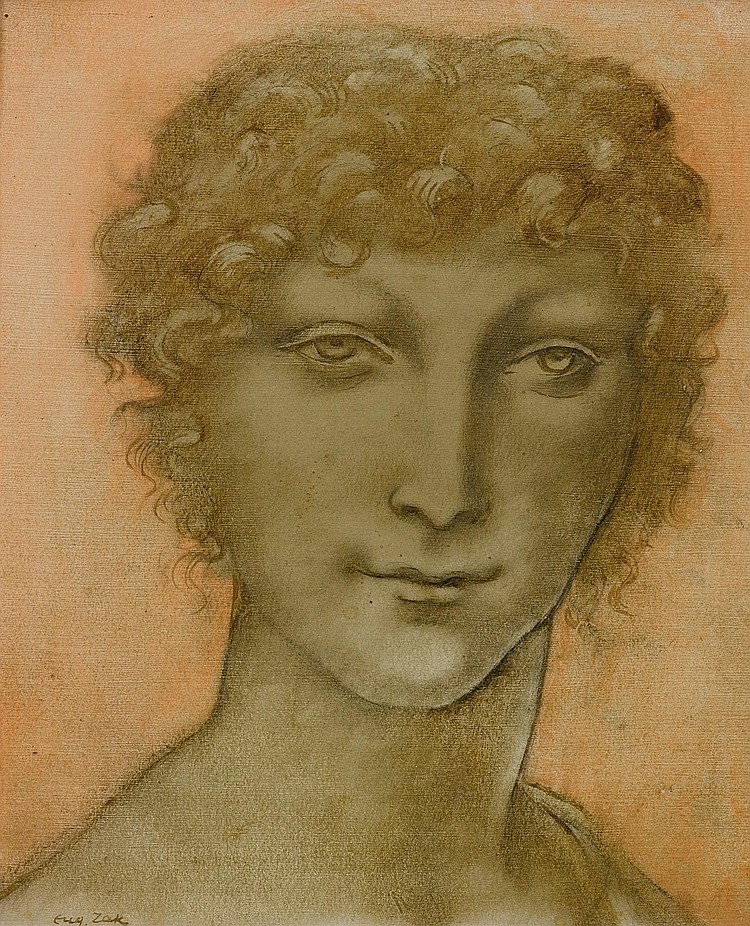
Lot 58. Eugen ZAK 1884 – 1926
Tête d’homme – Circa 1912
Pastel, aquarelle et encre sur papier
Signé en haut à gauche “Eug. Zak”
Porte au dos une étiquette de n° d’exposition «1504»
26,50 x 23 cm (10,43 x 9,06 in.)
Provenance : Ancienne collection Corbin
Collection particulière, Paris
Bibliographie : A. Tanikowski, Eugeniusz Zak, Pogranicze, Sejny, 2003, reproduit en noir et blanc p. 35
Commentaire : Pastel, watercolour and ink on paper; signed upper left

Estimate 8,000-10,000 euro. Artcurial. 10/31/17

Eugeniusz Zak (1884 – 1926)

Zak

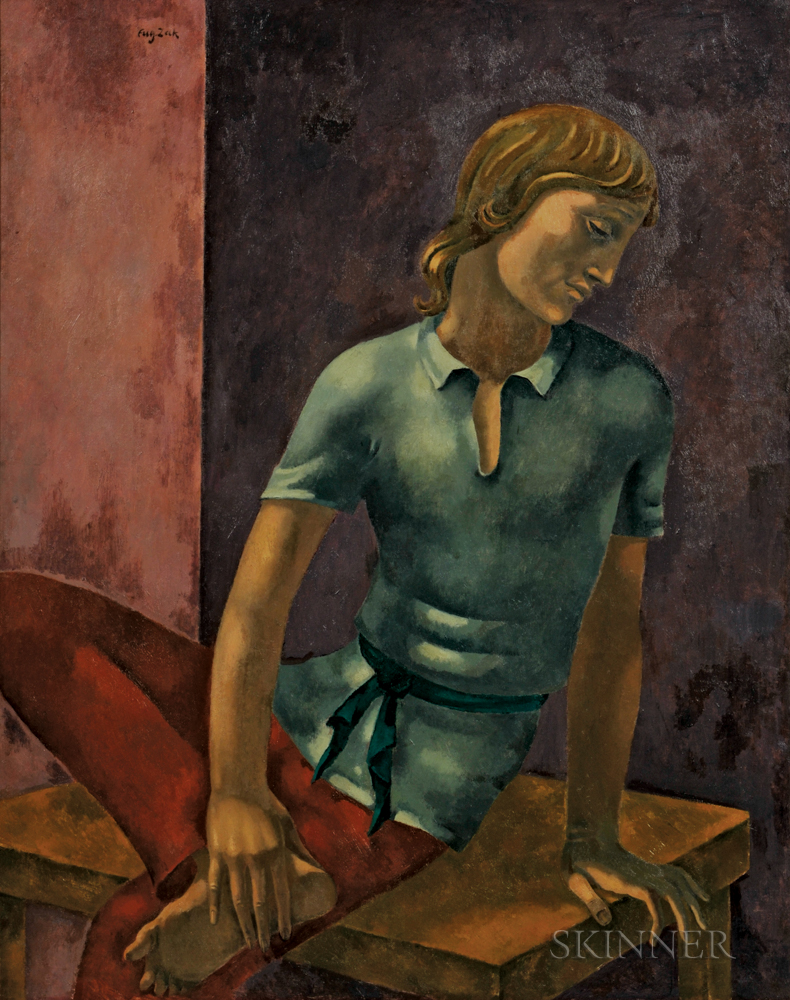
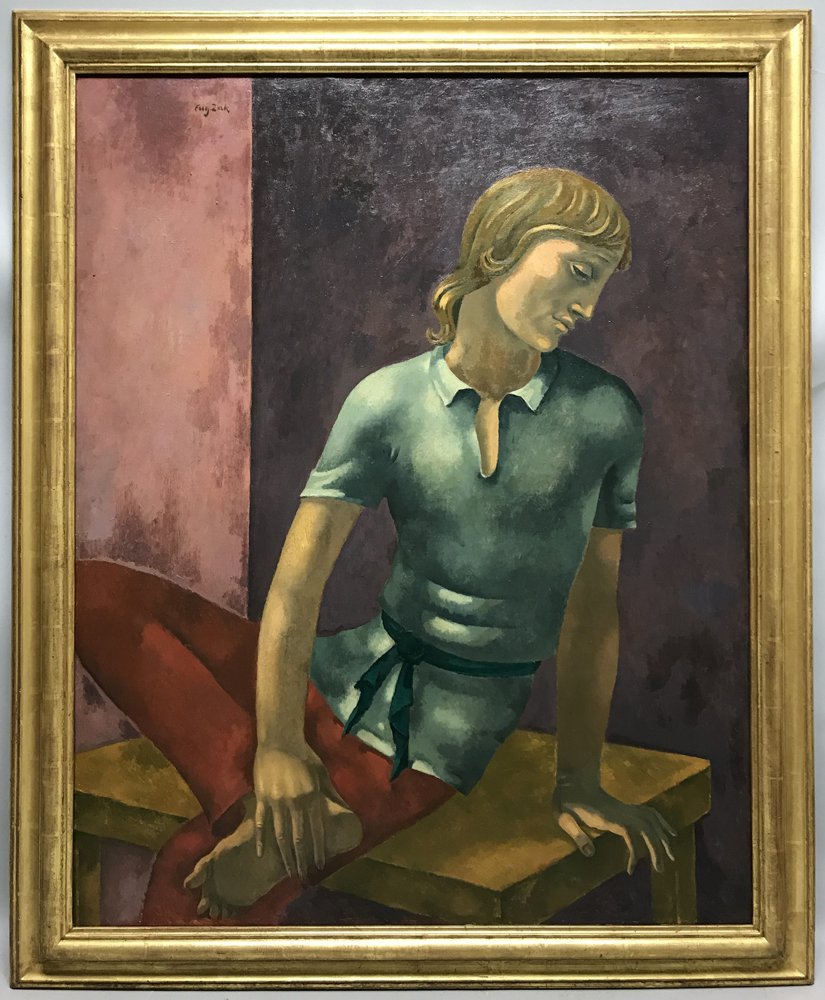
Lot 377. Eugeniusz Zak (Polish, 1884-1926)
Young Acrobat
Signed “Eug. Zak” u.l.
Oil on canvas, 39 1/2 x 31 3/4 in. (101.0 x 81.0 cm), framed.
Condition: Scattered retouch, pinhole to center, varnish inconsistencies, craquelure.

Provenance: Private collection, Massachusetts.

Literature: Heinrich Ritter, “Eugen Zak,” Deutsche Kunst und Dekoration 50, no. 1 (April 1922), pp. 2-10, ill. p. 2; Stanislaw Woznicki, “Od Malowniczosci do Linearyzmu: Sztuka i Rytm,” Poludnie 3, no. 1 (1924), pp. 3-13, ill.; Barbara Brus-Malinowska, Eugeniusz Zak: 1884-1926 (Warsaw: National Museum, 2004), cat. no. 117, ill.

Exhibitions: Annual Salon, Towarzystwo Zachety Sztuk Pieknych, Warsaw, 1919, checklist no. 278.

N.B. Born in Belarus to Polish-Jewish parents, Eugeniusz Zak studied art in Paris at the École des Beaux-Arts under Jean-Léon Gérôme and at the Académie Colarossi with Albert Besnard. He worked on idyllic landscapes and Arcadian scenes populated by shepherds and fishermen during this time. With the outbreak of World War I, Zak moved to Poland and painted several works similar to Young Acrobat. These paintings all depict a solemn figure in a sparse interior setting and recall Pablo Picasso’s Rose and Blue Period paintings, as well as the elongated figures of Amedeo Modigliani’s works. Often associated with the group of early twentieth-century artists known as the École de Paris, Zak was sure to have been familiar with the works of Picasso and Modigliani. Zak’s stylized and graceful figures also bear the influence of his interest in Renaissance artists like Sandro Botticelli. Returning to Paris in 1923, Zak’s works maintained the nostalgic and melancholic tone he had adopted during the war.
Estimate $40,000-60,000. Skinner. September 27, 2017 12:00PM

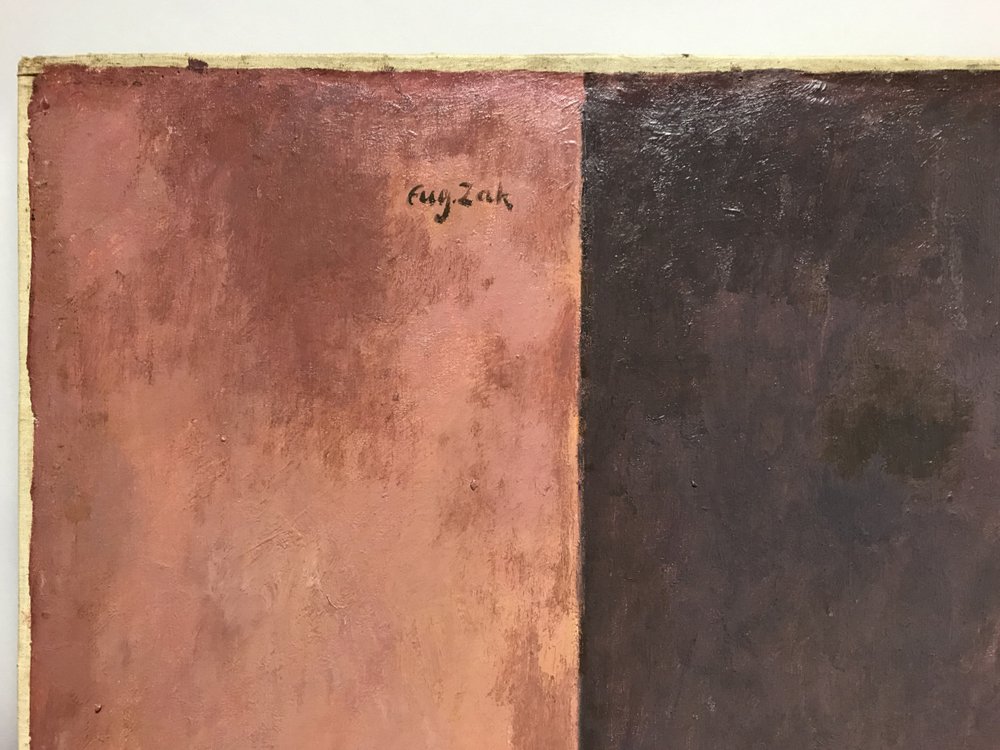
Zak frame

Sign

back

Eugeniusz Zak (1884 – 1926)

zak

Lot 26: EUGÈNE ZAK | Mari’s Head

Pencil, brown ink and sanguine on heavy paper mounted on paperboard, 11 7/8 by 10 in.

Provenance: Zbigniew Legutko, New York
Acquired from the above by the present owner in the 1970s

Literature: Artur Tanikowski, Eugeniusz Zak, Sejny, 2003, no. 73, illustrated p. 88 (with dimensions 42.5 by 26.5 cm)

Estimate: $7,000 – $9,000. Sothebys. 12/15/16

Eugeniusz Zak (1884 – 1926)

zak-134

Lot 134. Eugène ZAK (Mogilno 1884- Paris 1926)
Portrait de Georges Artemoff
Huile sur toile d’origine
35 x 27 cm
Porte au dos la mention manuscrite Zak

Provenance :
Collection Giselle Thomasson
Coollection particulière

Eugène Zak est déjà une artiste réputé, ayant reçu de nombreuses critiques élogieuses dès 1906 de la part de Waldemar George, Guillaume Apollinaire et André Salmon lorsqu’il rencontre Artemoff, accueilli à Paris en 1913 par Ossip Zadkine qui lui prête son atelier de la ruche. Notre tableau porte les caractéristiques du style de Zak dans ces années-là, l’importance du trait et des contours des portraits découvrant cou épaules, des plans simples délimités par la couleur.

Estimate 10,000-12,000 euro. Millon. 11/23/16

zak-135

Lot 135. Eugène ZAK (1884-1926)
Portrait de femme de profil
Fusain et sanguine sur papier doublé
65 x 50 cm
Signé en haut à gauche Eugène Zak

Estimate 10,000-12,000 euro. Millon. 11/23/16

Eugeniusz Zak (1884 – 1926)

zak
Eugeniusz Zak, Junger Mann mit blauer Kappe, 1923

Lot. 116001585. Eugeniusz Zak. Junger Mann mit blauer Kappe. Um 1923. Oil on canvas. Lower left signed. 100 x 81 cm (39.3 x 31.8 in). Estimate: € 60,000 / $ 67,200. Ketterer. 12/10/16 (16156250)


LITERATURE: H. Ritter, Ewige Romantik, in: Deutsche Kunst und Dekoration: illustr. Monatshefte für moderne Malerei, Plastik, Architektur, Wohnungskunst u. künstlerisches Frauen-Arbeiten, 1925, issue 56, p. 228 wit illu.
Barbara Brus-Malinowska, Eugeniusz Zak: 1884 – 1926, Warszawa 2004, p. 150, no. 196.

Essay

The painter Eugeniusz Zak, an important representative of the École de Paris at the beginning of the 20th century, was born the son of an engineer of Jewish-Polish origin in Moligno, Belarus in 1884. After his father’s death the family relocated to Warsaw in 1892, where Eugeniusz Zak completed secondary school. In 1902 Zak moved to Paris where he studied art at the École des Beaux-Arts under Jean-Léon Gérôme, as well as at the Académie Colarossi at Albert Besnard. In 1903 Zak traveled to Italy and Munich, where he took lessons at the private art school of the Slovenian painter Anton Ažbes. In 1904 Eugeniusz Zak returned to Paris and exhibited his works at the autumn show of the Paris Salon. The graphic and pictorial creation of Eugeniusz Zak is dedicated to figuration and combines aspects of traditional and modern tendencies of the early 20th century.The early period of Zak’s creation is characterized by portraits of common people, peasants and fishermen as well as of children and mothers. His drawings in gouache, red chalk and chalk show the influence of Zak’s journeys to Brittany between 1906 and 1908. After the outbreak of the First World War Zak visited Southern France between 1914 and 1916. From these days onward he made pictures with idyllic scenes of loving couples, lone wanderers, fishermen and mothers in harmonious landscape settings that call reminiscence of works by artists such as Puvis de Chavannes and Cézanne. As of 1917 he developed an increasing interest in scenes of a surreal parallel existence inhibited by jesters, dancers, jugglers and other outsiders such as beggars and vagabonds. These works show the influence of Picasso’s early paintings. Other sources of influences such as Expressionism or the socio-critical German New Objectivity can also be found. Zak’s later works are characterized by neo-classicist tendencies. Among the works from these days we find classic portrait heads and Greek Contrapposto sculptures with stylized faces that call reminiscence of the masterpieces of Botticelli or Leonardo da Vinci. In Zak’s creation they mark the dialog between tradition and the manifold styles of Modernism. Eugeniusz Zak’s art was honored in many international solo shows and publications and was on display at various public collections, mostly in Poland. The Parisian Musée du Luxembourg acquired works by Eugeniusz Zak for its collection as early as in 1910. The same year Zak joined the Association of Polish Artists in Paris, other members were Elie Nadelman, Leopold Gottlieb and Mela Muter. In 1912 Zak was appointed professor at the Académie de la Palette, in 1913 he participated in the acclaimed International Exhibition of Modern Art in New York, the so-called Armory Show. In 1914 his first solo show at the renowned Parisian Galerie Druet followed. In 1916 Zak and his wife Jadwiga Kon, who he had married in Paris in 1913, returned to Czestochowa in Poland. In 1917 Zak participated in the first exhibition of ‘Formizm’, a Polish group of expressionist artists, in Cracow, in 1921 he was one of the founding members of the Polish group of artists called Rytm (Engish: Rhythm). In 1922 Eugeniusz Zak stayed in Berlin and Bonn for some time and eventually returned to Paris in 1923. The counter movement that set in after the Fauves and the German Expressionism put forth New Objectivity in Germany and a form of Neoromanticism in other countries, predominantly in France.The paintings formal arrangement calls reminiscence of Italian Late Renaissance and Picasso’s early works. Thecoloring’s shaded tone underlines the artist’s intention to a closed form of arrangement. In a dreamlike lost world the artist’s broaches the issue of the individual’s isolation, as it can also be found in the art of Karl Hofer. Remote from all forms of Realism Zak sought to give the individual a special form of an own dignity that finds its fulfillment in a precise pictorial interpretation. Eugeniusz Zak died in Paris in 1926. [

Eugeniusz Zak (1884 – 1926)

Zak-1

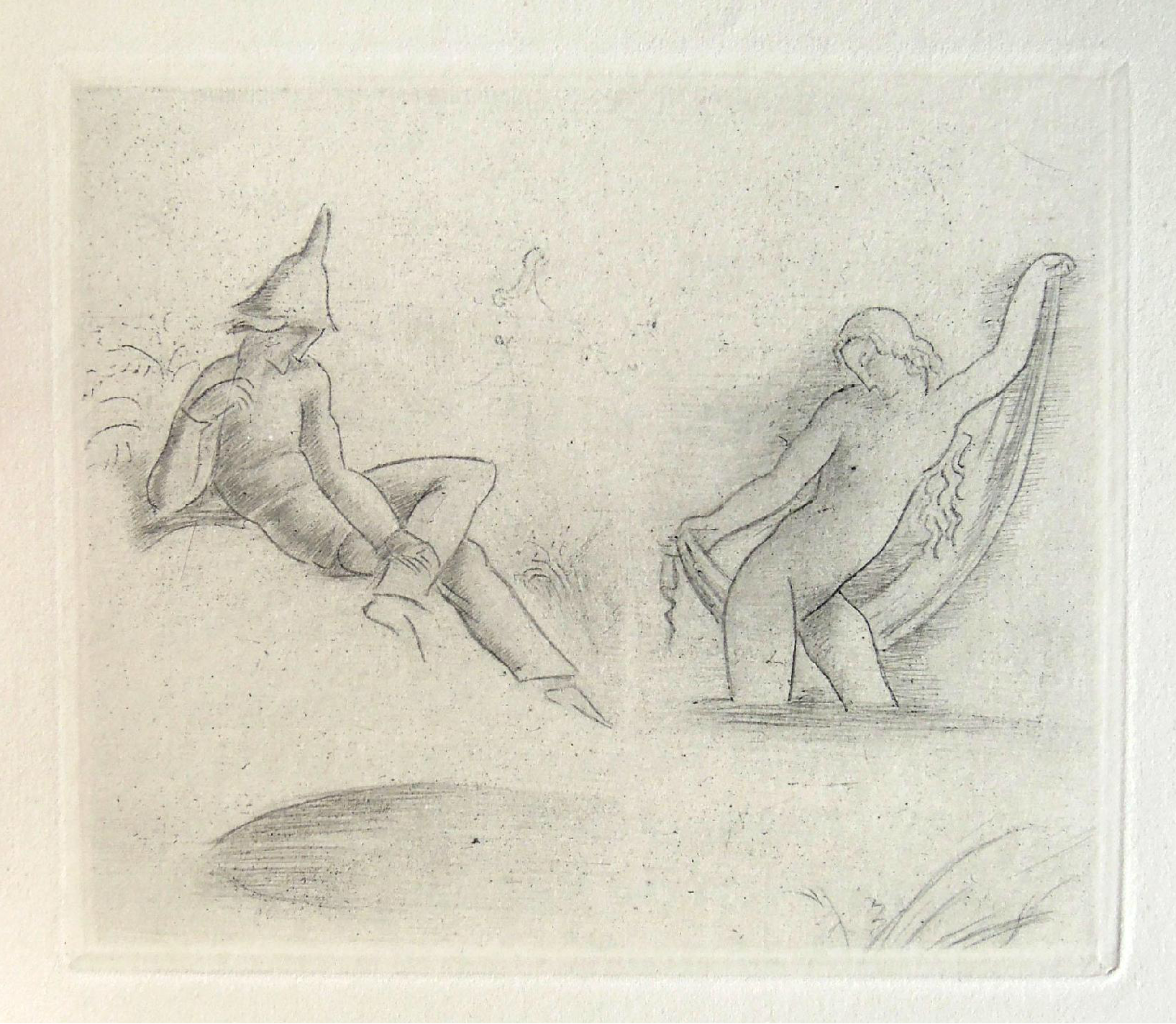
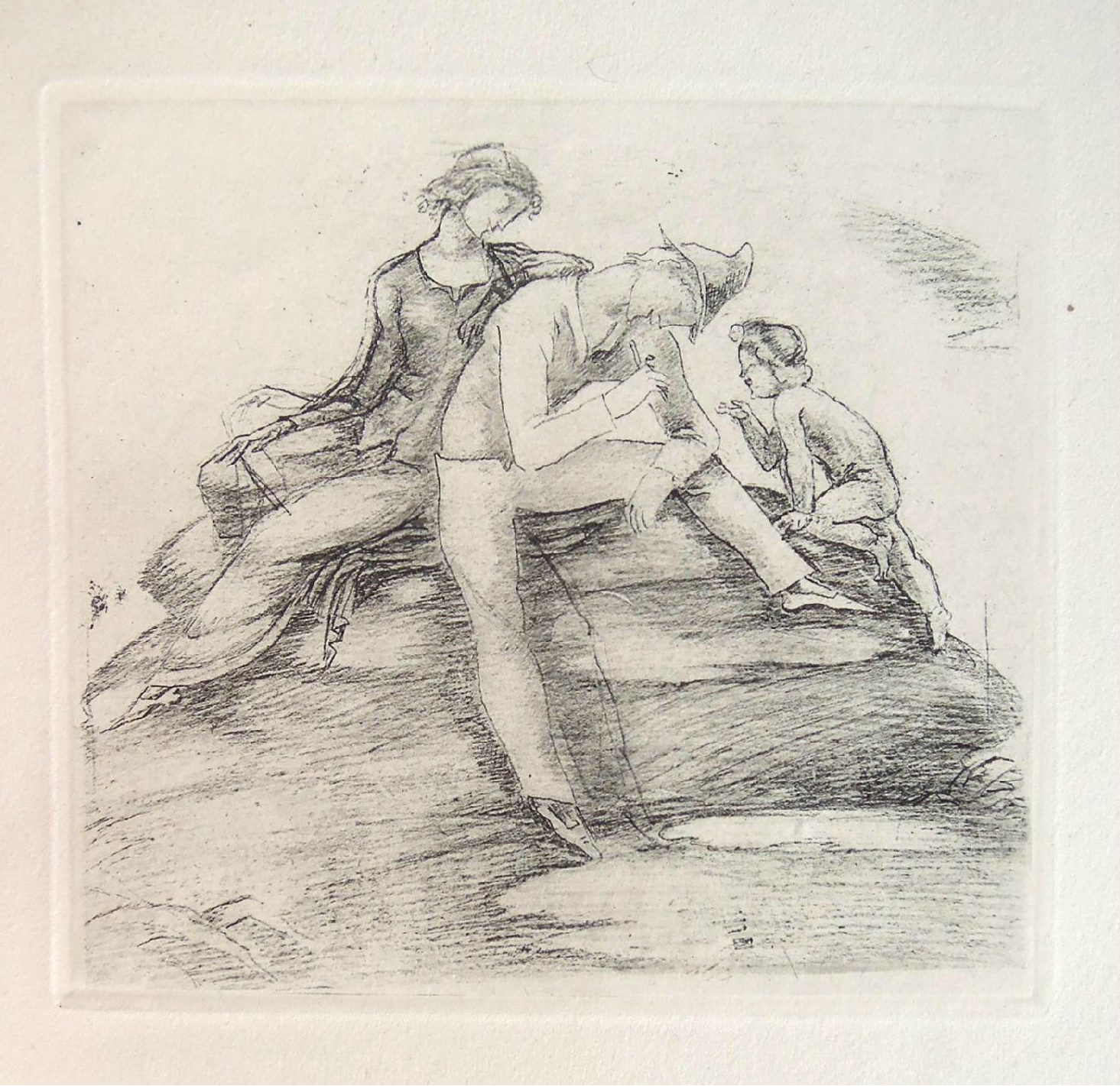
Dwie oryginale odbitki prac Zaka przygotowane specjalnie do książki wydanej w niskim nakladzie.

Zak-2

149.(ZAK). MORAND (René). La Porte Lourde. Poèmes en prose. Dessins hors texte par Eugène Zak. Paris, Éditions de la Galerie Zak, 1929.In-4, broché. Frontispice, 36-(3) pp. et 8 gravures sur cuivre hors texte, tirées par Marcel Seheer. Qq. taches claires sur la première page de garde. Tirage à 321 ex. numérotés dont celui-ci, un des 300 ex. sur vélin d’Arches.Eugène Zak (1884-1926), peintre d’origine polonaise, élève de Gérôme, exposa dès 1904 au Salon d’Automne.

Estimate 250-400 euro. GEOFFROY-BEQUET. 07/27/16

Eugeniusz Zak (1884 – 1926)

Zak

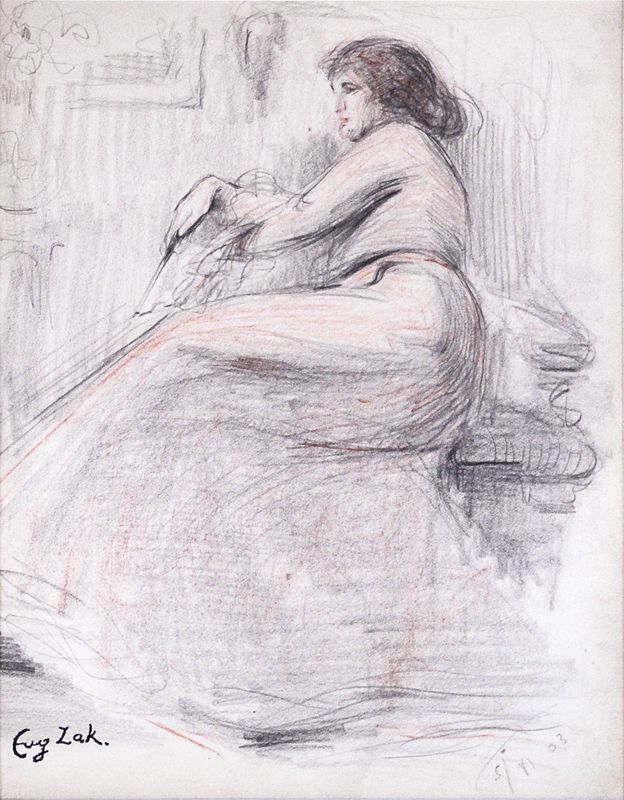
Lot 650. Eugène ZAK (1881-1926).
Femme alanguie – 1903.
Mine de plomb et crayons de couleur sur papier.
Cachet de la signature en bas à gauche.
21,5 x 17 cm.

Provenance : Extrait d’un carnet de dessins offert par.
Madame Zak vers 1940 et resté ensuite dans la même famille jusqu’en 2014 (carnet commencé par l’artiste le 3 octobre 1902).

Estimate 500 € / 600 €. Cannes Enchères, 06400 Cannes. 07/09/16

Eugeniusz Zak (1884 – 1926)

Zak-10

Sale 141 Lot 10. Eugène Zak 1884-1926 (Polish)
Mère et enfant, 1902, pencil (graphite) on paper, h:21 w:17 cm; stamped lower left and dated ’14/X/02′ lower right
Other Notes: This work is listed in the archives under number E.Z /X/02-7.
Estimate $ 500-550. Matsaart.


Zak-11

Sale 141 Lot 11. Eugène Zak 1884-1926 (Polish)
Atelier Gérôme aux Beaux-arts, 1902
pencil (graphite) on paper
h:21 w:17 cm.
stamped lower left

Other Notes: This work is listed in the archives under number E.Z /X/02-7.
Estimate $ 500-550


Zak-12

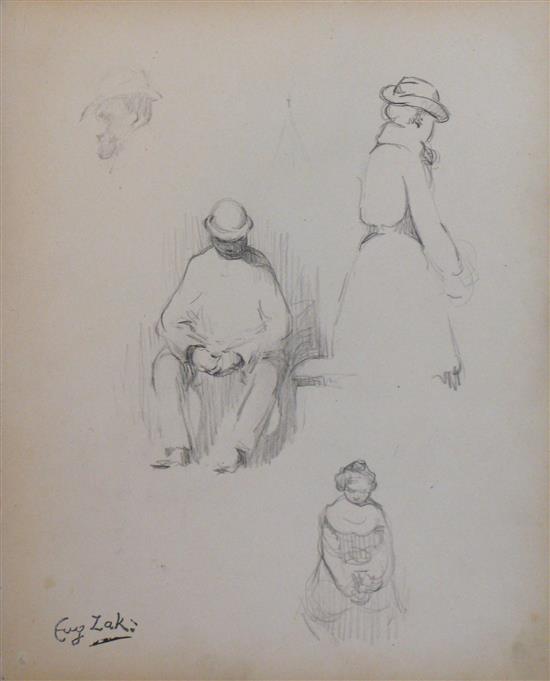
Sale 141 Lot 12. Eugène Zak
1884-1926 (Polish)
Etudes de personnages, 1902
pencil (graphite) on paper
h:21 w:17 cm.
stamped lower left

Other Notes: This work is listed in the archives under number E.Z /X/02-7.
Estimate $ 500-550


Eugeniusz Zak (1884 – 1926)

Zak

Dwie prace Zaka. Jedna w Sothebys z proweniencją sięgającą jedynie Fibaka a zapewnie wcześniej Lippert Gallery z Brooklynu w NY a druga bez w Ader proweniencji. Fibak być może zapłacił 1% obecnej ceny szacunkowej i namaścił ją swoją osobą. Wymiary obu prac te same. Ceny dramatycznie różne, choć podobna tematyka;  być może nawet ten sam malarz. Wnioski!

—————————————–

Lot 63. Eugène Zak 1884 – 1926 POLISH
LANDSCAPE WITH SAILORS, signed Eug. Zak lower right, oil on canvas, 54 by 65cm., 21 by 25½in.

Provenance

Wojciech and Ewa Fibak, Poland (by 1992)
Sale: Polswiss Art, Warsaw, 13 December 2009, lot 36
Purchased at the above sale by the present owner

Exhibited

Warsaw, National Gallery, Polish Painting in the Ewa and Wojciech Fibak Collection, 1992, illustrated in the catalogue
Warsaw, National Gallery, Eugeniusz Zak, 1884 – 1926, 2004, no. 71, illustrated in the catalogue (as dated 1914)

Literature

Artur Tanikowski, Eugeniusz Zak, Sejny, 2003, p. 117, fig. 117, illustrated (as dated circa 1914)

Catalogue Note

Born in Belarus, Eugene Zak trained in Paris at the École des Beaux-Arts under Jean Léon Gérôme and at the Académie Colarossi. Although often grouped with the École de Paris, his main influences are to be found in his numerous travels to Brittany and Italy. Zak was fascinated by the works of the Italian Old Masters and by those of Denis, Besnard and Gauguin, which had attracted to Brittany other Polish artist as well, including Mojżesz Kisling and Mela Muter. Most of all, Zak was attracted to Brittany’s untouched landscapes, which appeared to him removed from civilization. He subsequently became the first Polish 20th century revivalist of the idyllic landscape tradition.

Landscape with Sailors was painted circa 1914, when Zak lived in southern France. The beautiful and unspoiled landscapes of this region became the main subject in the artist’s oeuvre from this period.  Standing on the left are two men absorbed in a conversation. In front of them, hilly landscapes, a rural house on the mountain top and a ship crossing the sea. Time feels frozen, and the view depicted – with its flatness and pastel-colour palette – has an archaic feeling to it which takes the viewer back to a remote golden age.

In 1916 the artist and his wife settled down in Częstochowa, Poland, and joined the Polish Expressionists, later renamed the Formists in 1919. When back in Paris from Poland, Zak’s painting changed dramatically towards more melancholic subjects drawing from Picasso’s Blue and Rose period.

Estimate 120,000-180,000 GPB. Sothebys. 12/2/15

—————————————————
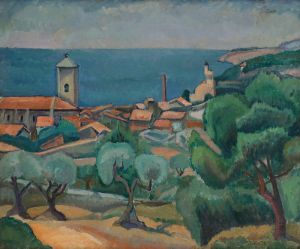
Zak-2

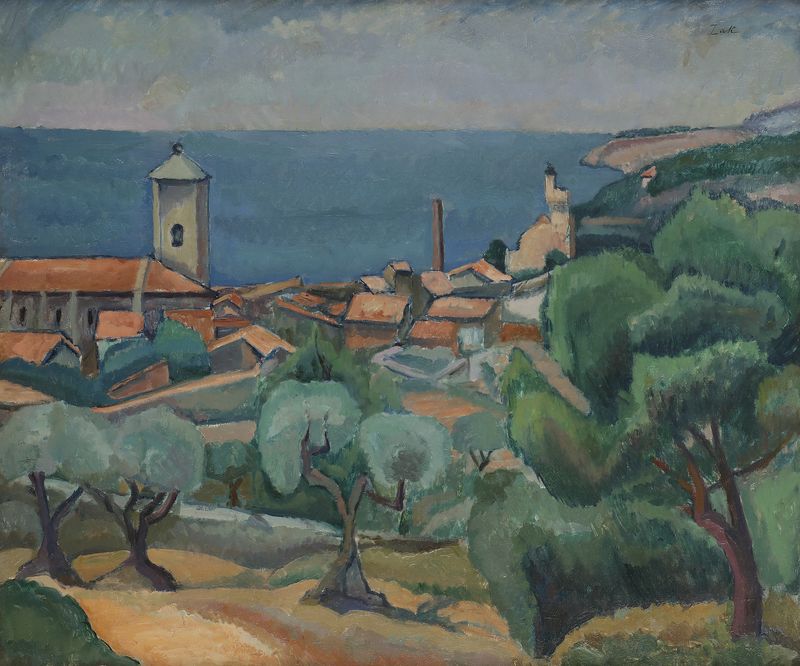
Lot 186. Eugeniusz ZAK (1884-1926)
Paysage de l’Estaque, vers 1920. Huile sur toile. Signée en haut à droite. 54 x 65 cm

Estimate 15,000-20,000. Ader. 11/16/15