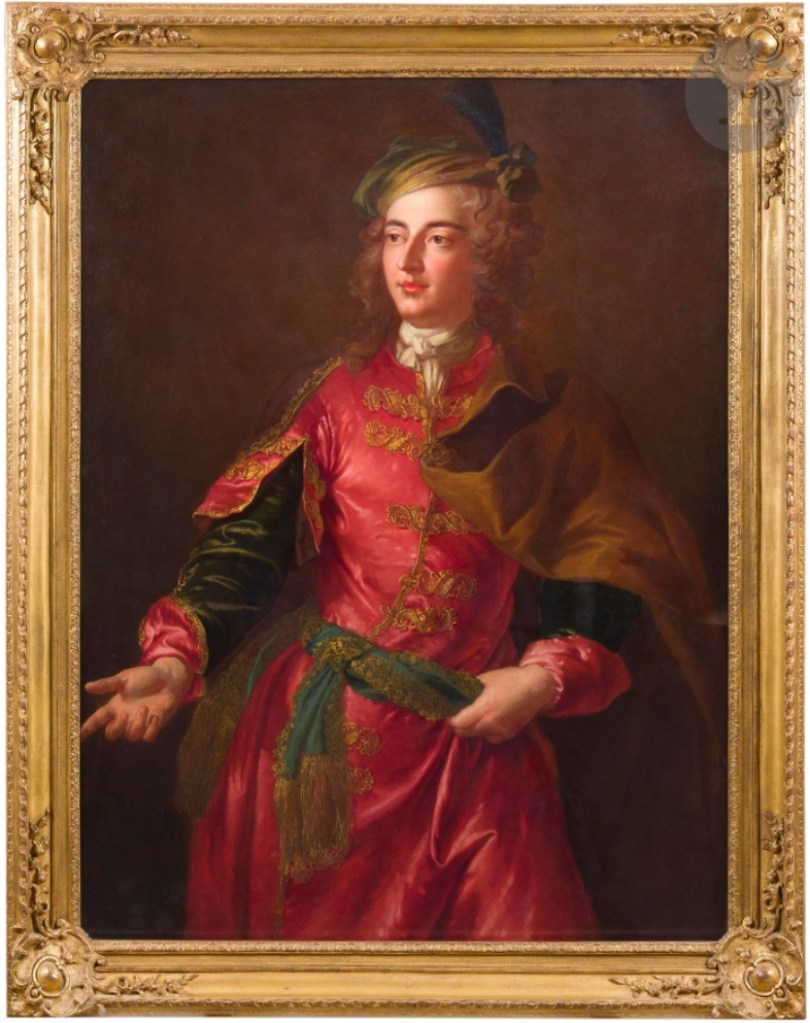
Lot 46. François de TROY (Toulouse 1645 – Paris 1730). Presumed portrait of Prince Constantin Sobieski (1680 – 1726). Canvas 126 x 95 cm (Old restorations). Provenance : Galerie Eric Coatalem, 2013.
Wizerunek portetowanego jest przypisany Konstantemu Sobieskiemu, synowi Jana III Sobieskiego. Artysta, który malował jest przedni i może dlatego Muzeum w Wilanowie zainteresuje się tym obrazem.
Bibliography: Exhibition catalog 1704 Le Salon, les Arts et Le Roi, Sceaux, Musée de l’Ile-de-France, Domaine départemental de Sceaux, March-June 2013, no. 114, reproduced in color. Monsieur Dominique Brême dates the painting to circa 1720, based on the “free and flamboyant execution of the draperies” and the use of “colors that play on the vivid contrast of the orange-pink of the leotard and the duck-blue of the sash”. The “verticalisation of the pose, the supple wiggle of the bust and the model’s gaze ostensibly turned outwards”, enable him to compare our painting with the Portrait de Jean-François de Troy painted by François de Troy around 1716-1719 (known from the print by Simon Vallée, see the booklet published for the exhibition François de Troy 1645-1730, Sceaux, musée de l’Ile-de-France, July 23 – October 13, 1997, G28, reproduced).
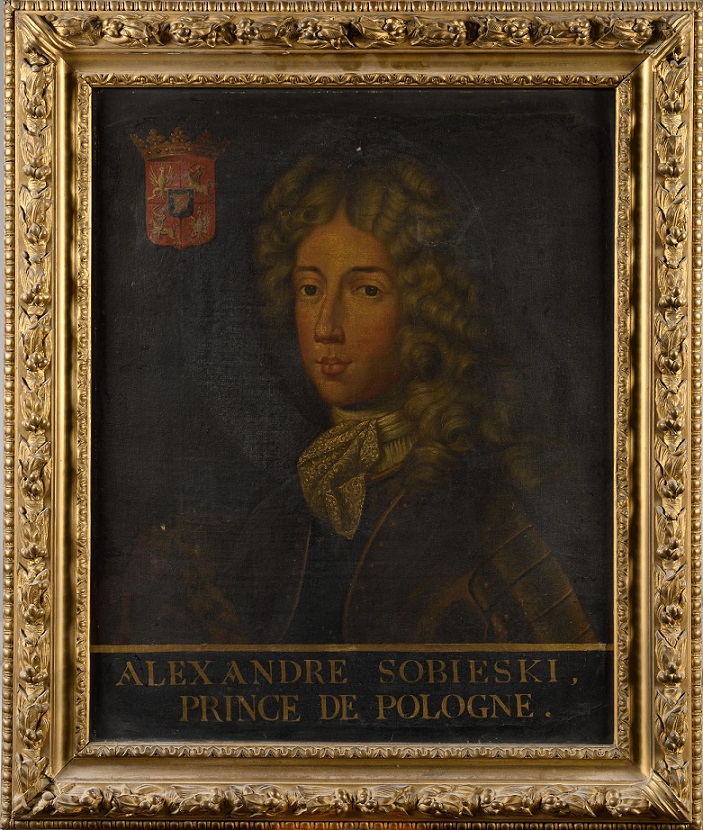
Painted around 1720, our painting could be considered a posthumous portrait of the prince (probably painted after his death in 1726). So our painting cannot be the one exhibited in 1704, as has been suggested in the past. Constantin Sobieski was the third son of John III Sobieski, King of the Polish-Lithuanian Union from 1674 to 1696 and a national hero for his victory over the Turks. King Jean III Sobieski married Marie Casimire Louise de La Grange d’Arquen on July 5, 1665, and received the Order of the Holy Spirit in Poland on November 30, 1676. Marie-Casimire and Jean III are buried in Krakow’s Wawel Castle. Constantin Sobieski receives the Order of the Holy Spirit in Rome in the Church of Saint Louis on December 19, 1700. One of his portraits, formerly attributed to Hyacinthe Rigaud, is preserved in the Palace Museum of King Jan III in Wilanow.
Estimate 30,000 – 50,000 euro. Ader. 03/26/24. Sold 30,000 euro

 Polish Art Corner