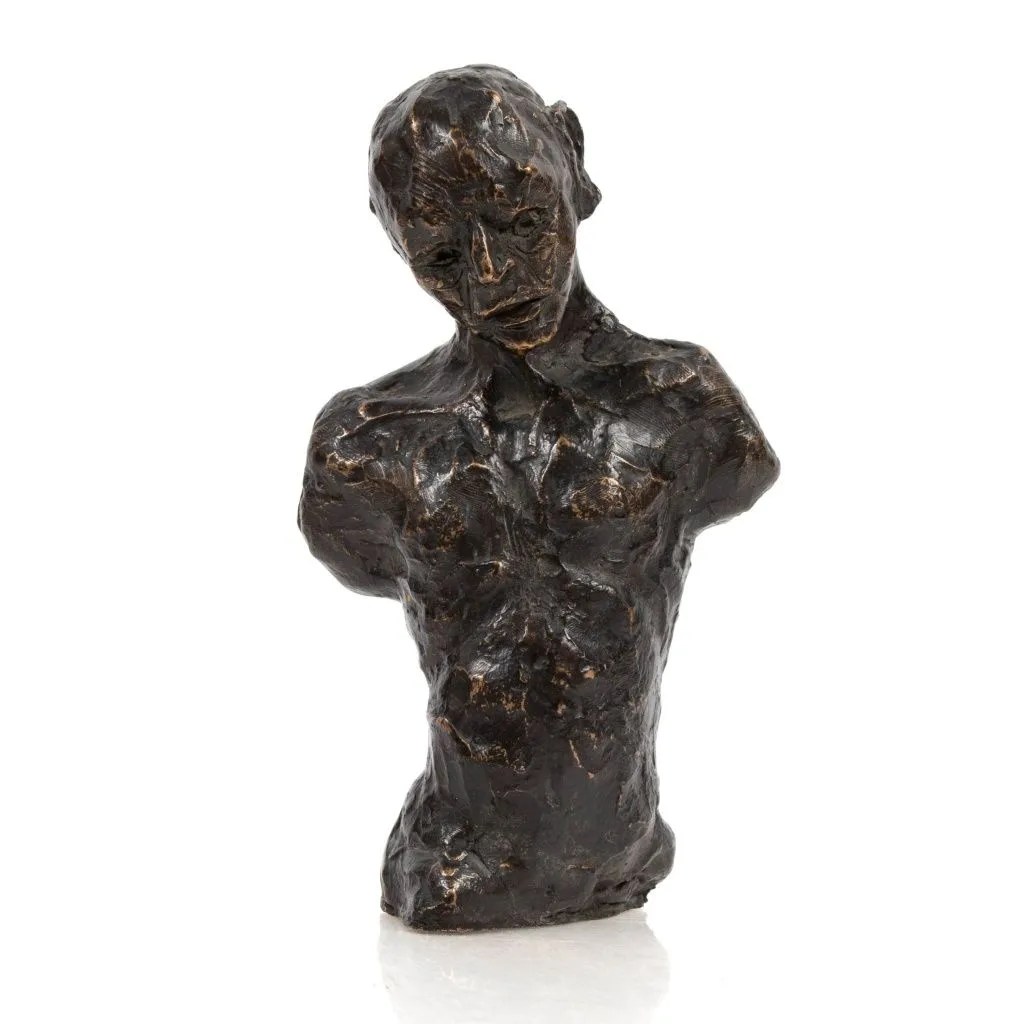
Lot 197. Boleslas BIEGAS (1877 – 1954) Male torso, 1899 bronze sculpture with dark brown patina, signed, justified E.A and dated ’99 H : 19 cm W : 12 cm Depth : 7 cm. Estimate €1,500 – 2,000. Haynault Maison de Ventes aux Enchères. 03/23/26. Sold €1,500
Rzeźba Bolesława Biegasa z 1899 roku czyli z okresu studiów w krakowskiej ASP, w dodatku odlanej chyba w kilku egzemplarzach (napis E.A., épreuve d’artiste, artist’s proof)??? Dom aukcyjny poniosła fantazja.
Sprzedano bez walki za wyjściowe €1,500 co może oznaczać, że miałem rację.
Bolesław Biegas (Biegalski). Château du cheval mystérieux
Lot 110. BOLESŁAW BIEGAS (1877-1954). Château du cheval mystérieux, signed ‘B. Biegas.’ (lower right), oil on panel, 60 x 80.6cm (23 5/8 x 31 3/4in). Painted in 1924. Estimate £12,000 – £18,000. Bonhams. 10/17/25. Sold £38,000
Pozwoliłem sobie skopiować w całości bardzo ciekawy esej katalogowy dołączony do tego oleju Bolesława Biegasa mającego niepodważalną proweniencję.
The authenticity of this work has been confirmed by the Comité Biegas. This work will be included in the forthcoming Bolesław Biegas catalogue raisonné, currently being prepared by Xavier Deryng. Provenance: Musée Bolesław Biegas (Société Historique et Littéraire Polonaise de Paris), Paris, no. Szymanski 381 (a gift from the artist in 1954). Galerie Jan Krugier, Geneva, no. 1698 (acquired from the above in 1971). Brook Street Gallery, London. Private collection, UK (possibly acquired from the above). Private collection, UK (by descent from the above). Literature: J. Szymanski, Bolesław Biegas inventaire dactylographié, Société Historique et Littéraire Polonaise de Paris, Paris, no. 381. X. Deryng, ‘”La mystique de l’infini”, L’Île des Morts de Boleslas Biegas’, in Hommage à L’Île des Morts d’Arnold Böcklin, exh. cat., Musée Bossuet, Meaux, 2001 (illustrated p. 45).
Bolesław Biegas’s Château du cheval mystérieux stands as one of the most haunting visions of his celebrated Mystique de l’infini cycle, painted in Paris during the 1920s. Architectural yet phantasmagorical, the work presents the viewer with a fantastical citadel, crowned by a spectral bronze Pegasus. Its body gleams with alchemical light, rising against a field of midnight blue, while the citadel itself seems suspended in a realm that is simultaneously dreamlike and unsettling. Flanking the structure, towering cypresses ascend like sentinels, their flame-like silhouettes evoking the mournful associations of Greek myth and the visionary gravitas of Symbolist painting. In the lower right, a lone nude, her blonde hair catching an ethereal glow, provides a fragile human counterpoint to this nocturnal dreamscape.
The scene is one of profound theatricality. Biegas orchestrates his composition like a stage-set of the subconscious: the citadel gleams with touches of turquoise, crimson and pale gold, while the Pegasus’ staring eye and coiled grimace suggest both vigilance and enigma. This strange alchemy of ether, metal and imagination produces an uncanny tension between stillness and implied motion. Soft hints of acid-green light filter through the background, suggesting the first moments of dawn – or perhaps the threshold of another realm entirely. One senses that we have entered a spiritual or cognitive landscape, a land of dreams or nightmares, calm yet eerily charged.
The nude figure, diminutive yet radiant, becomes the counterpoint of this visionary architecture – a glimmer of femininity and sensuality against an otherwise desolate environment. Draped in gossamer folds of lavender and rose, she recalls both Jean-Auguste-Dominique Ingres’s classical nudes and the female protagonists of Paul Delvaux’s surrealist paintings. Her presence is enigmatic: is she a worshipper, a captive, or a dreamer before the threshold of the uncanny? Such ambiguity was deliberate, aligning Biegas with a Symbolist preoccupation with the mysteries of femininity, as well as its narrative strategies of indirection and allegory. Her scale, juxtaposed with the grandeur of the citadel and its guardian trees, evokes the Romantic notion of the sublime, recalling the monumental mythological landscapes of Gustave Moreau. Indeed, as the eye surveys this miniature human presence, one is invited into a meditation on scale, power and wonder.
Since antiquity, the cypress tree has signified mourning and eternal remembrance, rooted in the myth of Cyparissus, who was transformed into a tree to grieve forever. In Arnold Böcklin’s visionary series, Die Toteninsel – a touchstone for Biegas – funereal cypresses transform the Isle of the Dead into a necropolis, their vertical silhouettes architectural in their solemnity. In the present work, the cypresses similarly twist upward like black flames, structuring the landscape and invoking ideas of death, transcendence and passage. Like Vincent van Gogh’s cypresses, they impart emotional intensity and cosmic rhythm to the composition.
Château du cheval mystérieux is a core example of Biegas’s Mystique de l’infini cycle, executed between 1923 and 1929. Arguably his most captivating Symbolist works, these paintings present enchanted palaces, dreamlike architecture and spectral apparitions, often adorned with phosphorescent colour and gleaming with an enamel-like finish. Exhibited in Paris at Galerie Seligmann in 1925 and Galerie Bernheim-Jeune in 1929, such works were described by the critic Gustave Kahn as ‘a beautiful meditative poem of great isolation’ (G. Kahn, ‘Les nuits mystiques par Boleslas Biegas’, in Le Mercure de France, 1 December 1925, p. 509). The present painting stands at the heart of this cycle, with its mysterious castle, guardian Pegasus and solitary nude suffused with ethereal radiance, drawing the viewer into a reflective reverie.
The genesis of these visions lies in Biegas’s early Paris years. At the 22nd Salon des Indépendants in 1906, his paintings were admired by Guillaume Apollinaire as ‘the most profound thing in the exhibition … here is a soul’ (Apollinaire quoted in M. Decaudin, ‘Apollinaire et les peintres en 1906, d’aprés quelques notes inédites,’ in La Gazette des Beaux-Arts, February 1970, p. 118). Subsequently, Biegas absorbed the Symbolist currents of the Revue blanche circle and the Wagnerian ideal of the Gesamtkunstwerk, as his paintings and sculpture fused music, poetry and image into sublime emanations of expression. While he aligned himself with Böcklin and Odilon Redon, his approach remained idiosyncratic, fusing Böcklin’s mythological gravitas and Redon’s dreamy haze into enchanting visual fables of phosphorescent solidity. In the present work, he reconciles Symbolist spirituality with a modern fascination for geometry and architecture, producing a composition that is timeless in its sheer originality.
Ultimately, the present work encapsulates Biegas’s vision of painting as a poem of infinite meditation. It is a work of rare atmospheric power, where Symbolist allegory, erotic nuance and visionary architecture converge. Emerging from a cycle that has remained enigmatic throughout history, the painting exemplifies Biegas’s singular contribution to the École de Paris: an art of luminous invention and symbolic resonance, bridging Romantic imagination and modernist experimentation. Coming from a distinguished family collection of Polish art, Château du cheval mystérieux is one of the most captivating embodiments of early twentieth-century Symbolism remaining in private ownership.
Lot 1. BOLESLAS BIEGAS (1877-1954). Les mystères, signed, inscribed and dated ‘Boleslas Biegas Paris 1903’ (on the base on the left face), plaster. Conceived in 1903; 24 7/16 x 5 1/2 x 6 1/8 in. The authenticity of this work has kindly been confirmed by Xavier Deryng under the aegis of the Comité Biegas. This work will be included in the forthcoming Bolesław Biegas Catalogue Raisonné, currently being prepared.
Provenance Collection particulière, France. Collection particulière, France (acquis auprès de celle-ci).
Bibliographie B. Biegas, Wędrówka Ducha Myśli, Cracovie, 1904, p. 59. B. Biegas,M. Cheliga & M. Reja, Boleslas-Biegas, Sculpteur et peintre, Album, Paris, 1906 (illustré p. 59). H. Biegeleisen, Biegas, Lviv, 1911, no. 31, p. 31. M. Domański, Z zagadnień treści i formy rzeźby Bolesława Biegasa do 1914 roku, Varsovie, 1970, no. 3/4, p. 330 & 331.
Estimate €15,000 – 20,000. Bonhams-Cornette de Saint Cyr. 10/06/25
Po dłużej posusze wraca na łamy PAC Bolesław Biegas. Tym razem jest to rzeźba z początków jego pobytu w Paryżu – kruchy plaster wymagający opieki (TLC). W dostępnym mi katalogu prac tego artysty autorstwa Xaviera Derynga rzeźba ta nie jest wymieniona; jak wynika z zapowiedzi zostanie uwzględniona w przyszłości w katalogu raisonne. Zwycięzca tej aukcji będzie miał możliwość zlecenia wykonania odlewu w brązie i jeśli do tego dojdzie może to być to pierwszy taki odlew tej pracy. Początki kariery Bolesława Biegasa w Paryżu były sponsorowane przez baronostwo Henryka i Jadwigę Trutschel, którzy nie tylko pokrywali rachunki pobytu artysty oraz utrzymywali jego pracownię ale również zlecali wykonanie kosztownych odlewów jego prac.
Bolesław Biegas (Biegalski). Zranione życie, (2/8)
Lot 49. Boleslaw Biegas. Zranione życie (Wounded Life), bronze with black patina, incised with the artist’s signature and stamped with the number and foundry mark “Boleslaw Biegas Blanchet Fondeur 2/8” lower edge; 15 x 19 7/8 x 6 1/4 in. (38.1 x 50.5 x 15.9 cm). Conceived in 1907 and cast at a later date, in France, this work is number 2 from an edition of 8. Provenance: Private Collection; Sotheby’s, New York, September 29, 1994, lot 16A; Private Collection (acquired at the above sale); Thence by descent to the present owner. Estimate $8,000 – 12,000. Phillips. 07/02/25. Sold $13,000
Ta rzeźba Bolesława Biegasa opisana jest w albumie Xaviera Deringa pod nazwą Cierpienie (La Vie Blessee), z datą wykonania w 1905 roku. Pokazany jest tam olew w brązie z ciemo-brązowo patyną lecz nie jest podane jaka odlewnia ją wykonanła. Obecna rzeźba o czarnej patynie z domu Phillips pochodzi z kolekcji zmarłych niedawno Alicji i Stanisława Jonasów (część kolekcji malarstwa lictował kilka dni temu Shapiro Auctions). Jest to jeden z ośmiu egzemplarzy i podejrzewam, że może to być produkcja pośmiertna. Początek obecnego lipca jest znakomity dla polskiej rzeźby na zachodnich rynkach.
Lot 750. Biegas, Boleslaw 1877 Koziczyn/Ciechanowa – 1954 Paris. Demon. Bronze. Signiert. Datiert 1922. Exemplar: 4/8. H 44 cm. Starting 1,200 euro. Dusseldorfer. 05/23/25. Sold €7,500
Bolesław Biegas to w moich oczach jeden z najważniejszych polskich rzeźbiarzy. W niemieckim Dusseldorfer Auktionhaus pojawił się niedawno w katalogu odlew w brązie jego rzeźby o nazwie Demon, sprzedanay za €7,500. Ten niemiecki dom aukcyjny coraz bardziej zaniża loty, nie tylko ze względu na ustawianie cen prac niemal od €1 lecz ze względu na brak opisów sprzedawanych prac malarskich, rzeźbiarskich oraz rzemiosła. W zasadzie każdy zainteresowany powinien sam odrobić lekcję skoro przemierza się do kupna lecz dom aukcyjny nie powinien się ograniczać jedynie do opublikowania fotografii, wymiarów pracy i podania prowokacyjnej ceny wyjściowej by przywołać największą ilość ‘succers’. Ciekaw jestem kiedy ten odlew rzeźby został wykonany i podejrzewam, że nie za życia artysty bo nie było go chyba na to stać – artysta żył na garnuszku możnych sponsorów. Brakuje nazwy zakładu odlewniczego (fourdy) oraz daje się zauważyć pewna niedbałość napisu nazwiska autora na odlewie jak też ledwie widoczny numer odlewu. Ten kto mial (ma) model gipsowy decydował o ilości odlewów. Ciekawe, że gips tej rzeźby był na aukcji we Francji ok 11 lat temu: https://polishartcorner.com/2014/03/06/boleslaw-biegas-biegalski-1877-1954/. Dobrze byłoby poznać historię tego odlewu i odlewów innych rzeźb Bolesława Biegasa z serii Demonów bo pojawiają się czasami na aukcjach wykonane w seriach właśnie po 8 sztuk.
Lot 55. Boleslas BIEGAS (Koziczyn 1877- Paris 1954). The Calm. Circa 1907-1908. Bronze sculpture with dark brown patina. Height: 30 cm Width : 10 cm Depth : 10 cm. Signed on the base left “B. B. Biegas. Period cast, unidentified founder Avis d’inclusion dans le catalog raisonné des sculptures de Boleslas Biegas en cours d’élaboration par Xavier Deryng, sous l’égide de la Société Historique et Littéraire Polonaise/Institut Bibliothèque Polonaise de Paris, légataire universel de l’artiste. Exhibition: Biegas, Galerie des Artistes Modernes, March 23 – April 4, 1908. Estimate €5,000 – 7,000. Millon. 04-24-25. Sold €6,500.
Le Calme dates from 1907-1908 and was shown at the Galerie des Artistes Modernes, avenue Caumartin, which organized a major exhibition of Biegas’ work from March 23 to April 4, 1908. This was Biegas’ only solo exhibition in a Paris gallery before the First World War. From 1902 onwards, however, Biegas exhibited regularly at the Salon des Indépendants and the Salon de la Société Nationale des Beaux-Arts. The exhibition at the Galerie des Artistes Modernes included 81 works (41 sculptures, 11 busts and 29 paintings). It was accompanied by a small catalog, invaluable for his sculptures, as it listed those that had been cast in bronze. Le Calme (no. 33) is very similar to Un Moment (no. 31) (Chwila), but unlike the latter sculpture, it bears no title on the base, just Biegas’ signature. Le Calme has the same vertical structure as Un Moment, but is smaller (30 cm – as opposed to 38 cm). Nevertheless, in terms of form, the same intermediate treatment between a high relief and a half-relief is characteristic of Biegas’ three-dimensional creations before his conversion to the ronde bosse. The face of Le Calme is very similar to that of Un Moment, and of L’Innocence exhibited in 1997 at the Mazovian Museum in Płock. These three sculptures are not reproduced in the 1906 Album, edited by Louis Theuveny. They date from 1907 or the very beginning of 1908. These sculptures were probably exhibited in the foyer of the Théâtre Femina, 90 avenue des Champs-Élysées, from June 24 to July 5, 1912, on the occasion of the performance of his play in 6 tableaux Michel Ange, organized by the Amicale des Arts. They undoubtedly inspired Guillaume Apollinaire, who wrote in L’Intransigeant of June 28, 1912: “L’Amicale des Arts has organized an exhibition of works (sculpture and painting) by Boleslas Biegas at the Théâtre Femina. This artist’s idealism has produced works that are not bland. He expresses the deepest and purest feelings of humanity. Long meditated, his compositions are harmonious and calm (…) This elevated art, which must be linked to religious art, is worthy of arresting attention.”
Warto zanotować pojawienie się chyba po raz pierwszy od ponad stu lat unikatowej rzeźby Bolesława Biegasa “The Calm“. Praca ta pochodzi z początków kariery rzeźbiarskiej tego artysty, sponsorowanej finansowo przez baronstwo Trutschel.
Druga z prac Bolesława Biegasa w Millon to olej Komety. Firma francuska “zapomniała” uzupełnić proweniencję informacją o własnej sprzeaży tej pracy we wrześniu ubieglego roku za €4,800. Obecnie widełki wyceny firma ta ustawiła poniżej poprzedniej ceny sprzedaży. Wymaga to jakiegoś wyjaśnienia bo inaczej może dojść do brutalnej interpretacji. https://polishartcorner.com/2024/09/23/boleslaw-biegas-biegalski-1877-1954-12/
Bolesław Biegas (Biegalski).The comets
Lot 77. Boleslas BIEGAS (Warsaw 1877- Paris 1954). The comets. Produced in 1935. Oil on isorel 33 x 24 cm. Signed lower right “B. B. Biegas. Avis d’inclusion dans le Catalogue raisonné des peintures de Boleslas Biegas en cours d’élaboration par Monsieur Xavier Deryng sous l’égide de la Société historique et littéraire polonaise – Bibliothèque polonaise de Paris, légataire universel de l’artiste. Provenance : Artist’s studio, bequeathed to the Polish Historical and Literary Society. Sale Ader Picard Tajan, Paris, October 26, 1990, n°76. Estimate €3,000 – 4,000. Millon. 04/24/25. Sold €10,000
Ten słaby i późny obraz Bolesława Biegasa nie wzbudził wielkiego zainteresowania. Gdyby praca tego artysty nie została poparta mocną proweniecją to przypuszczam, że by przepadła bowiem wiele falsyfikatów jest na rynku.
Lot 331. Boleslas BIEGAS (Warsaw 1877- Paris 1954). The comets, 1935. Oil on isorel 33 x 24 cm. Signed lower right B. Biegas. Avis d’inclusion dans le Catalogue raisonné des peintures de Boleslas Biegas en cours d’élaboration par Monsieur Xavier Deryng sous l’égide de la Société historique et littéraire polonaise – Bibliothèque polonaise de Paris, légataire universel de l’artiste Provenance : Artist’s studio, bequeathed to the Polish Historical and Literary Society Sale Ader Picard Tajan, Paris, October 26, 1990, n°76. Estimate 6,000 – 8,000. Millon. 09/24/24. Sold 4,800 euro
Oryginalny odlew Fali wykonanej za życia artysty, w najlepszym jego rzeźbiarskim okresie.
Lot 32. Boleslas BIEGAS (Koziczyn 1877- Paris 1954). The wave. Produced circa 1905/1907. Double-sided bronze sculpture with black shaded patina, 39 x 56 x 18 cm. Signed on the base “B. B. Biegas. Cast around 1905/1907. A certificate of authenticity from the Polish Historical and Literary Society will be given to the purchaser. Exhibition: Galerie des Artistes Modernes, Paris, March 23 – April 4, 1908, Biegas, N°38, La Vague, (bronze). Estimate 20,000 – 25,000 euro. Millon. 04/23/24. Sold 27,000 euro
Bolesław Biegas (Biegalski).The Beginning of Life, 1913
Dzięki uprzejmości czytelnika dowiedziałem się, że na obecnie odbywających sie targach sztuki TEFAF w Maastricht będzie wystawiona na sprzedaż powyższa rzeźba Bolesława Biegasa. Nie znam ceny, nie znam wymiarów. Rzeźba jest własnością Oscar Graf Gallery. Cdn?
Bolesław Biegas (Biegalski). Cliff at twilight by the sea
Komitet Biegasa potwierdził autentyczność tej przetartej i z zaciekami pracy, Ku mojemu zdziwieniu rynek po ożywionej walce kupił ją za ponad 11,000 euro. Słaby obraz wysoko sprzedany.
Lot 4. Boleslas BIEGAS (1877-1954). Cliff at twilight by the sea, ca. 1923-1923. Mystic of the Infinite” cycle. Oil on board H. 40 cm – W. 32 cm. Authentication confirmed by the Biegas Committee Condition report : A drip. Estimate 8,000 – 12,000 euro. Oxio. 02/17/24. Sold 11,100 euro.






 Polish Art Corner