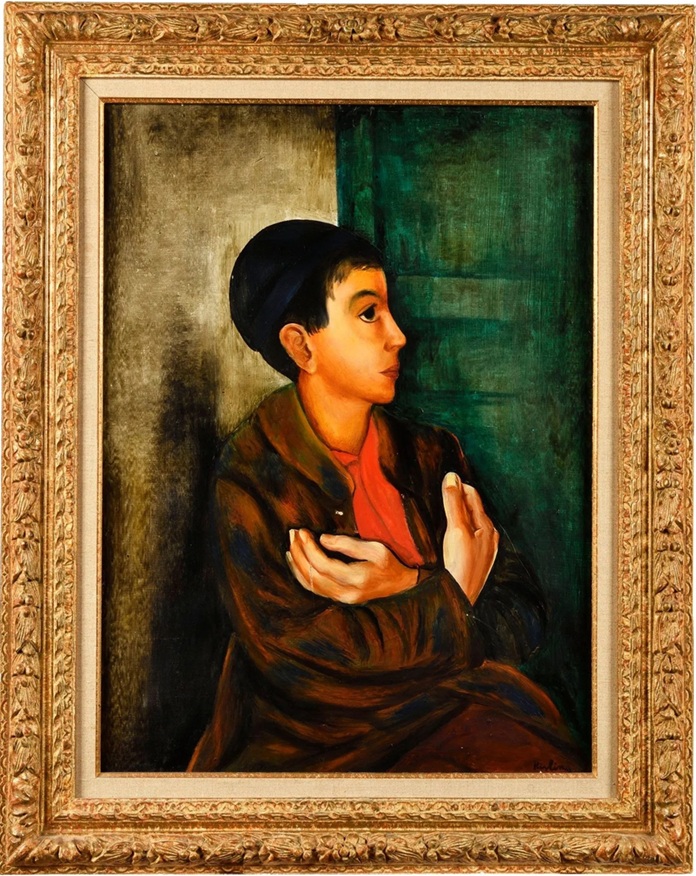
Lot 47. Moïse KISLING (Poland – France / 1891-1953) – Collection Jacques Thalheimer. Young boy with yarmulke, circa 1922 .Oil on canvas. Signed ‘Kisling’ (lower right). As is, missing. 73 x 54 cm; with frame 93 x 74 cm. Provenance: – Jacques Thalheimer (1890-1975), Paris, circa 1925 (acquired from the artist, in 1925, according to J. Thalheimer’s personal register, no. 31). – Then by descent to the present owner. This work will be included in “Volume IV et Additifs aux Tomes I, II et III” of the Catalogue Raisonné de l’OEuvre de Moïse Kisling currently being prepared by Marc Ottavi. Note: –
The circular ink stamp ‘BUNDESDENKMALAMT WIEN’ refers to a shipment of the work to Vienna, Austria in 1925-1926, probably as part of an exhibition or publication. Moïse Kisling himself wrote to Jacques Thalheimer on February 18, 1926 to inform him that the Polish publisher J. Mortkowiez in Mazowiecka Street 12 had borrowed 5 paintings and was to bring them back to Vienna himself. The paintings remained in Vienna with a friend of Kisling’s, Dr. Roff [?], director of the Wiener Kunstdruck-Gesellschaft Wien Parkgasse, and then returned to Paris via BUNDESDENKMALAMT control, hence the origin of the stamp on the frame of the work.
Themes related to Judaism are relatively rare in Moïse Kisling’s work. Rather, our work is part of a series of portraits inspired by the street models the artist encountered in the Montparnasse district, such as flower sellers and newspaper criers. As Jacques Guenne noted in L’Art Vivant in 1925, these portraits are a frequent feature of the artist’s work: “Kisling also focused on frail beings, the poor and children. Who doesn’t know these portraits of orphans, beggars, all those works that Kisling was able to recapture the tragedy of certain popular images. As Kisling himself says: “A poor, unfortunate child saddens me; I paint him with the feeling he inspires”. Estimate €30,000 – 50,000. Osenat. 03/29/26. Sold €27,000
Bardzo dobrze udokumentowana jest proweniecja tego obrazu Mojżesza Kislinga. Praca znajdzie się w IV tomie wszystkich prac tego artysty pod redakacją Marca Ottaviego. Mamy dodatkowy polski wątek (Mortkowicz)
 Polish Art Corner