Lot 209. Igor Mitoraj (Polish, 1944-2014). Untitled, 1993, pastel on paper board, signed Mitoraj and dated (right center), 22 1/2 x 21 1/2 inches. Framed: 36 x 34 1/2 inches. Estimate $2,000 – 4,000. Hindman. 06/27/23. Sold $4,250
Nie było logiki w tej sprzedaży bo rok temu obraz ten spadł przy ofercie z sali GBP 3,700,000 a obecnie sprzedano go za GBP 2,100,000. Ktoś tu mocno kręci w Sotheby’s i daje tym samym zły przykład polskim firmom.
Lot 113. Tamara de Lempicka 1898 – 1980. Femme à la robe jaune, signed TAMARA LEMPICKA and T. Lempicka and dated New York 1929 (on the verso), oil on canvas, 80 by 120 cm. 31 ½ by 47 ¼ in. Executed in New York in 1929.
This work has been requested for the exhibition Tamara de Lempicka to be held at the de Young Museum / Legion of Honor, San Francisco and The Museum of Fine Arts, Houston opening on 12 October 2024. Estimate 2,500,000 – 3,500,000. Sotheby’s. 06/27/23. Sold 2,100,000 GBP
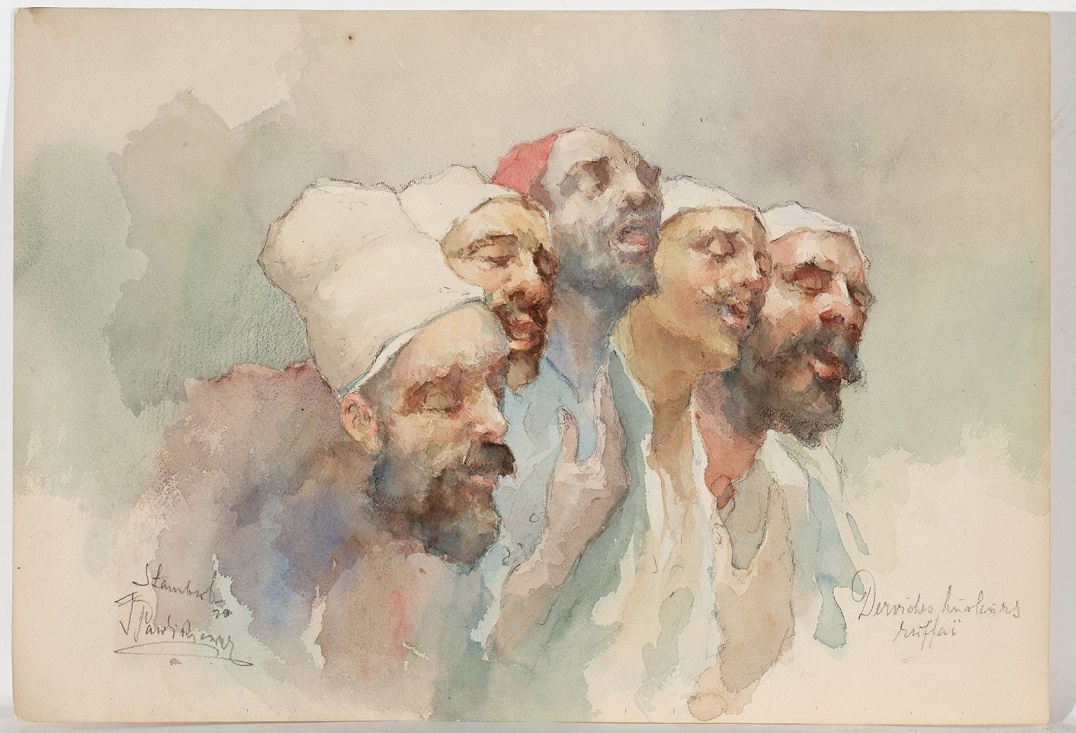
Lot 119. JÓZEF PAWLIKIEWICZ, PROBABLY ANNA MAY-RICHTER (1864-1955). Reunion of three drawings Man in front of Saint Sophia – The call to prayer in Turkey – Dervishes singing. Watercolor and graphite on paper/ Signed and two located ‘Stanbul (Istanbul)’ lower left and right (Traces of adhesive and some foxing). A set of three drawings, watercolor and graphite on paper, signed and located lower left and right 45 x 30,5 cm – 17 3/4 x 12 in. 45 x 29 cm – 17 3/4 x 11 3/8 in. 30 x 44 cm – 11 3/4 x 17 3/8 in. Provenance Private collection, France
Od jakiegoś czasu pojawia się sugestia, że Józef Pawlikiewicz to właściciwie Anna May (1865 – 1955), czyli partnerka Tadeusza Rychtera, byłego męża Bronisławy Rychter-Janowskiej. Większość prac Anny May rozgrywa się w Jerozolimie natomiast Józef Pawlikiewicz tworzył widoki Stambułu. Należy obserwować inne akawarele, które pojawią się w przyszłości bo może sie okazać, że to jest rzeczywiście ta sama osoba. Ciąg dalszy na pewno nastąpi.
Józef Pawlikiewicz. Man in front of Saint Sophia
Note Anna May-Rychter (Regensburg 1864-1955), probably active under the pseudonym Józef Pawlikiewicz, was an early 20th-century realist painter best known for her watercolors of the Holy Land. She studied at the Munich Academy of Fine Arts, where Nikolaos Gyzis was one of her teachers. She was the companion of Polish artist Tadeusz Rychter. They did not marry, as the Catholic Church did not recognize divorce, and Tadeusz had already married the Krakow artist Bronislawa Janowska. According to Haaretz, social disapproval of their unmarried relationship was the reason why the couple left Europe and settled in Jerusalem. In 1939, Tadeusz went to Poland on a professional mission and died in Warsaw during the Second World War. May-Rychter continued to live in the Arabic-speaking neighborhoods of East Jerusalem until his death in 1955, at the age of 90. In 2014, the Palestinian Heritage Foundation and the Jerusalem Fund sponsored an exhibition of May-Rychter’s watercolors.
Estimate 400 – 600 euro. Aguttes. 06/27/23. Sold 650 euro
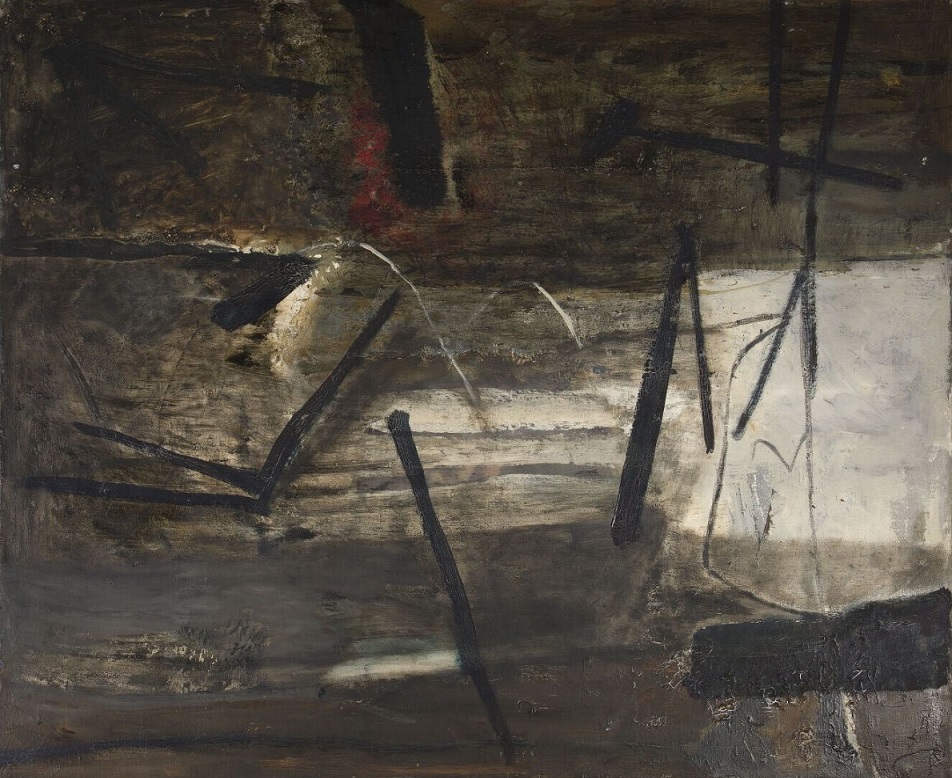
Teresa Pągowska. Pejzaz nadmorski III (Seascape III), 1959
Lot 38. Teresa PAGOWSKA (1926-2007). Pejzaz nadmorski III (Seascape III), 1959. Oil on canvas. Signed, titled and dated on the back. 73 x 92 cm. Teresa Pagowska participated in the 1959 “Biennale des Jeunes” at the Musée d’Art Moderne in Paris. Our painting is most probably one of the 4 or 5 that Pagowska brought to Paris for the Biennale, but which were not exhibited, as the selected artists were allowed to exhibit only two paintings (see: Biennale catalog). In 1961 Teresa Pagawska exhibited at the Galerie Lambert in Paris. In 1997, a major retrospective of her work was held at the Zacheta National Gallery of Contemporary Art in Warsaw, and in 2003 at the National Museum in Poznan (the artist’s hometown). Bibliography : – Catalog of the “Biennale des Jeunes”, Musée d’art Moderne, Paris, 1959 – Teresa Pagowska, Wydawnictwa Artystyczne i Filmowe, Warszawa, 2001 – Aleksander Wojciechwski, Mlode malarstwo polskie, 1944-1974, Ossolineum, Wroclaw, 1983 This work is presented jointly by the firm Brun-Perazzone and Mr. Piotr Kasznia. Estimate 10,000 – 15,000 euro. Nicolas Nouvelet Commissaire-priseur. 06/27/23. Sold 15,000 euro
Skopiowałem niemal z obowiązku ten informacyjny opis katalogowy. Znakomita proweniencja oraz relatywna rzadkość prac sferycznych tego artysty na rynku aukcyjnym zaowocowały dużym zainteresowaniem tą pracą i wysoką ceną sprzedaży.
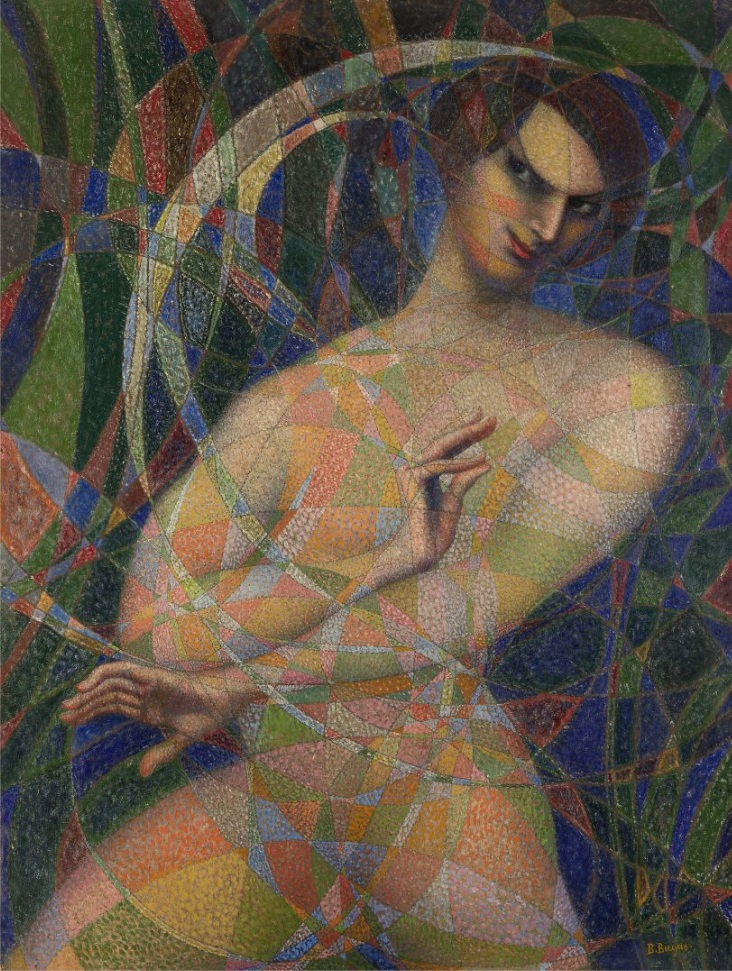
Lot 34. Boleslas BIEGAS (1877-1954). La danse du mépris, circa 1922-1925. Huile sur carton marouflé sur toile signée en bas à droite « B. Biegas ». Au dos sur une étiquette à l’encre : « 1937. APM/87 danse du mépris, 1937 ». 99 x 75 cm. Provenance : – Atelier de l’artiste légué à la Société Historique et Littéraire Polonaise de Paris (1954); – Galerie Jan Krugier, Genève, acquise auprès de la précédente au début des années 1970; – Galerie Valois, Paris, acquise auprès de la précédente au début des années 1980; – « Vente atelier Boleslas Biegas » Me Pierre Cornette de Saint Cyr, 30 juin 1987, Hôtel Drouot, n° 70, reproduit en couleurs. – Collection particulière. Un avis d’inclusion dans le catalogue raisonné du Comité Biegas avec le soutien de la Société Historique et Littéraire Polonaise (SHLP), signé par Monsieur Xavier Deryng et Madame Anna Czarnocka, sera remis à l’acquéreur. Estimate 25,000 – 30,000 euro. Nicolas Nouvelet Commissaire-priseur. 06/27/23. Sold 48,000 euro
Boleslas Biegas probably began painting his first spherical paintings in1912. Guillaume Apollinaire, on the occasion of his exhibition organized from the 21st of June to the 5th of July by the Amicale des Arts, in the Femina Theatre avenue des Champs Élysées, remarked on the circular elements in his paintings in L’Intrangiseant dated June 28th : “The firmament to which his fervor raises him is populated by beings in symbolic colors, in beautiful and simple shapes to which the artist imprints his melodious spherical movement. This elevated art, that should be linked with religious art, is worthy of attention”. Biegas will only start using the term “sphérisme” after WWI, during his participation at the Exposition des artistes Peintres et Sculpteurs Polonais, a fundraiser for the Polish soldiers wounded in France, open to the public on November 30th, 1918 in the Palace of the Count Nicolas Potocki, 27 avenue de Friedland, and to which Biegas had sent 49 paintings and 7 sculptures.
In the catalog of the exhibition, 6 pieces are preceded by the statement “Biegas’s invention of spherical paintings”. Biegas painted more than a hundred spherical paintings which he presented at the Salon d’Automne of 1919, at the Salon des Indépendants in 1920, 1921, 1922 and 1923, and especially at the Pavillon de Magny, located 55 avenue Victor Hugo. Unfortunately, no catalog of this exhibition entirely dedicated to spherism was ever published. However, several articles make it possible to establish that it took place from the 20th of March to the beginning of May 1919 and that it included about forty paintings. Spherism had a real impact on the Parisian artistic scene then, as shown by the articles from Pascal Forthuny, Michel Georges-Michel, Gustave Kahn, Louis Vauxcelles and Claude Chauvière. L’Éclair’s columnist entitled his article dated March 20th : “Art or mystification ? Cubism is dead ! We now know “spherism”…which would almost make us regret its predecessor!” In l’Heure dated May 19th, Claude Chauvière entitles his article “Round-Round” and defined Biegas as “the master of circles” : “Biegas sees everything round and he explains it logically : the Earth is round, the moon is round : humans have brain convolutions, blood circulation and the belt-railway make the circular motion uniform ; liquids’ concave or convex menisci ; the spheroidal embryo ; the sound that spreads through waves, sensibility which is projected and perceived through waves, etc…”
Until 1914, Biegas had not shown any kind of interest for the motion of the human body. After WWI, dance occupied a special place in spherism, as well as in the Mystique de l’Infini. The Danse du Mépris perfectly illustrates Biegas’ art’s new orientation, which gave rise to connections that had not yet been explored. In the early 20’s, Biegas was very close to the American dancer Paul Swan “ The Most Beautiful Man in the World”(1) who was very successful with Isadora Duncan and animated his parties in his studio on rue Bagneux. Biegas also knew Jan Reszke, who was approached by Vaclav Nijinsky in 1919 to get Polish citizenship. Starting in 1917, Nijinsky realized drawings based on circles that present, for some of them, astonishing kinship with Spherism. It is difficult to date the Danse du Mépris with precision because Biegas signed his paintings but never dated them, unlike his sculptures. We can assume that the Danse du Mépris was painted around 1922-1925 because after 1925, Biegas only exposed paintings from the Mystique de l’Infini. Xavier Deryng


 Polish Art Corner