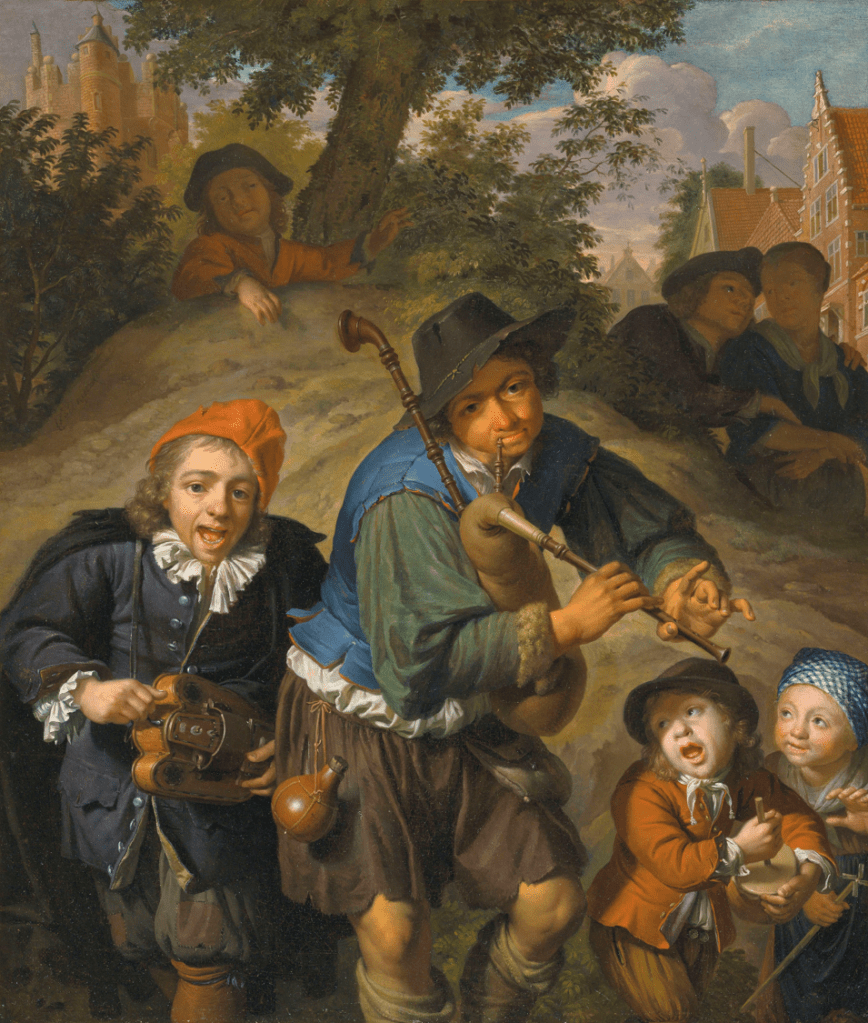
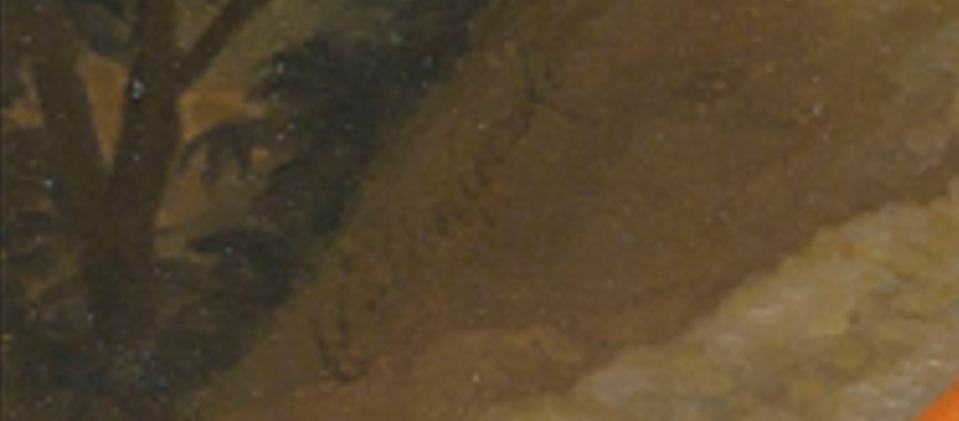
Lot 152. Christoffel Lubieniecki Szczecin 1659–1729 Amsterdam. A merry band of travelling musicians, or an allegory of sound, signed centre left on the rock below the bushes: CLubieniecki (CL in ligature), oil on canvas, unframed: 56.5 x 48.2 cm.; 22¼ x 19 in., framed: 80.7 x 72.7 cm.; 31¾ x 28⅝ in. Property from the Estate of Ambassador J. William Middendorf II, Rhode Island. Estimate GBP 50,000 – 70,000. Sotheby’s. 12/04/25. Sold GBP 38,000
Provenance: Sir Joseph Benjamin Robinson Bt (1840–1929), Dudley House, Park Lane, London, and subsequently in store; His sale, London, Christie’s, 6 July 1923, lot 72, for £294 to Hyde; Subsequently bought back by Sir Joseph Benjamin Robinson; Thence by descent to his daughter, Princess Ida Louise Robinson Labia (1871–1961), Wynberg, Cape Town, South Africa; By whose estate sold (‘The Property of the Late Princess Labia (Sold by Order of her Heirs)’), London, Sotheby’s, 27 November 1963, lot 17 for £400 to ‘Spiller’; Count Maurycy Klemens Zamoyski (1871–1939), Poland; Thence by inheritance to his daughter-in-law, Nicole Zamoyska; Thence by descent to a private collector; By whom anonymously sold, London, Christie’s, 7 December 2018, lot 165, for £125,000; Where acquired.
Exhibited: Cape Town, National Gallery of South Africa, The Joseph Robinson Collection, 1959, no. 47.
Literature: The Sir Joseph Robinson Collection, Lent by the Princess Labia, exh. cat., Capetown 1959, p. 13, no. 47; M. Stevenson, Old Masters and Aspirations: The Randlords, Art and South Africa, PhD thesis, University of Cape Town, Cape Town 1997, pp. 294 and 428.
Catalogue note: This work relates to a series of genre scenes by Lubieniecki of comparable dimensions depicting allegories of the five senses, for example: Taste (Muzeum Narodowe w Warszawie, Warsaw),1 Smell (Statens Museum for Kunst, Copenhage),2 Sight (Private collection),3 and Touch (Muzeum Narodowe w Warszawie, Warsaw).4
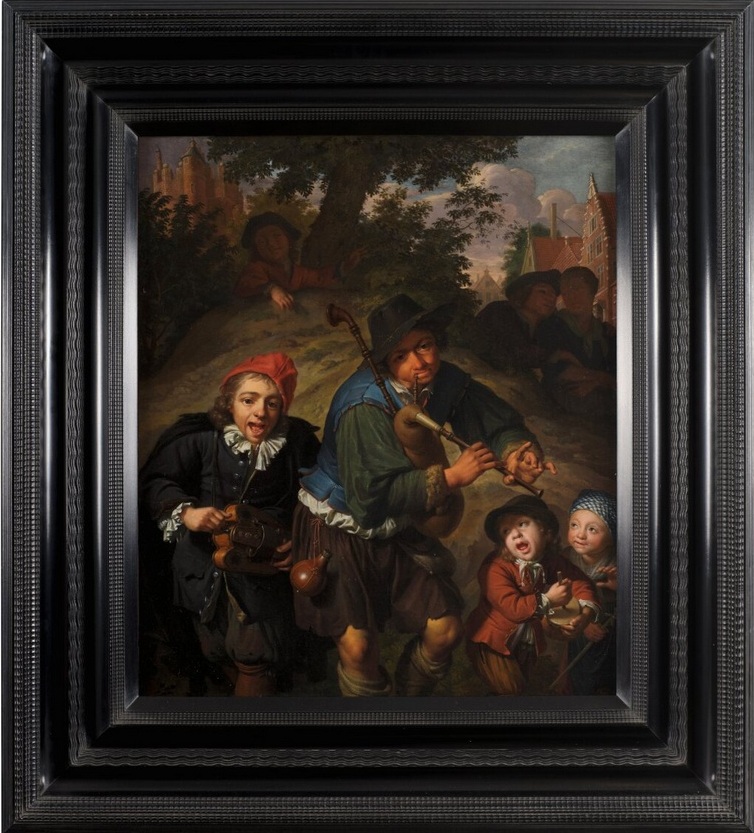
Trudno znaleźć lepsze nazwisko malarza pochodzącego z polskiej rodziny, zaliczanego do starych mistrzów, jak Krzysztof (Christoffel) Lubieniecki. Artysta pochodził z rodziny polskich arian, którzy wyemigrowali z Rzeczpospolitej pod koniec XVI wieku i osiedlili się na terenach obecnej Holandii. Historię rodziny Lubienieckich można prześledzić w książce Michała Walickiego “Lubienieccy” wydanej w latach 60-tych w Polsce. Bratem Krzysztofa był Teodor, również malarz, który pod koniec życia wrócił na tereny Rzeczpospolitej natomiast Krzysztof wtopił się w środowisko holenderskie i pozostał tam do śmierci. Obraz, który pojawił się obecnie na rynku był opisany na łamach PAC w 2018 roku. Ministerstwo Kultury i Dziedzictwa Narodowego ma pieniądze by wyrzucić je w błoto na dwie żeliwne wanny (GBP170,000) pokazywane obecnie w bunkrze Trzaskowskiego Muzeum Sztuki Nowoczenej na Placu Defilad w Warszawie (https://ewarszawa.pl/news-news-3340-wanny_w_muzeum_w_warszawie_za_ponad_800_tys_zl_moze_by_tak_trzaskowski_je_wstawil_do_tej_toalety_w_parku_skaryszewskim) Może by tak zakupić obraz Krzystofa Lubienieckiego i przekazać go do Muzeum Narodowego w Warszawie? Pamiętam, że ok 20 lat temu to muzeum ekponowało w specjalnej sali malarstwo braci Lubienieckich i prac obydwu malarzy było niewiele. Kilka lat temu MKIDZN odzyskało ‘Portret młodzieńca’ Krzysztofa Lubienieckiego, skradziony w czasie oststniej wojny. Obecnie jest możliwość zakupu do zbiorów znakomitego obrazu tego malarza a wycena jest bardzo atrakcyjna za tej klasy malarstwo. Pieniądze pewnie by się znalazły, gdyby p. Cienkowska mniej podróżowała do Australii a tak to trzeba je ‘zabezpieczyć’ na kolejne jej zwiedzanie świata.
Christoffel Lubieniecki was a Polish-born Baroque painter and engraver who spent most of his career in Amsterdam. Born in Szczecin, he apprenticed in Hamburg under Juriaan Stuhr before relocating with his brother Theodor to Amsterdam in 1675, where he was taught by Adriaen Backer. He became noted for his refined portraits, genre scenes, and moralizing compositions, often echoing the style of Dutch artists such as Adriaen van Ostade.
Note on provenance: The first recorded owner of this painting, the South African magnate Sir Joseph Robinson Bt (1840–1929) was born in the Eastern Cape. A self-made man, he made his fortune in diamond and gold-mining. A contemporary of another great Randlord collector, Alfred Beit, he had settled in London by the mid-1890s, taking out a lease in 1894 on Dudley House on Park Lane, with its magnificent eighty-foot long picture gallery. With the help of his advisors, the dealers Sir George Donaldson (1845–1925) and Charles Davis (1849–1914), he set about amassing a highly important collection of around 170 Old Master and British paintings, many purchased during the period 1894–99. These included superlative Italian works, notably the Tornabuoni–Albizzi spalliera panels of the Departure of the Argonauts and the Argonauts in Colchis bought from the Ashburnham Collection, and Giambattista Tiepolo’s superb Madonna of the Rosary. From the same source came his fine late Murillo of The Vision of Saint Francis Paola. Dutch and Flemish paintings formed the core of the collection and included Van Dyck’s Portrait of Elizabeth, Lady Herbert, and those of Jacob de Witte and his wife Maria; a fine Family group by Gonzales Cocques; outstanding genre scenes by Eglon Hendrick van der Neer and Jacob Ochtervelt; and a Portrait of a gentleman by Frans Hals. Major British paintings included works by Gainsborough, Constable’s oil sketch for The opening of Waterloo Bridge, now in Anglesey Abbey, and Turner’s Falls of the Clyde, now in the Lady Lever Art Gallery, Port Sunlight. After 1900 the pace of Robinson’s collecting slowed, but fine French eighteenth-century works were bought for the reception rooms at Dudley House. Created a Baronet in 1908, Robinson returned to South Africa in 1910, where he spent the duration of the First World War, while the contents of Dudley House were put into storage. From these a selection of 116 works was put up for sale at Christie’s in July 1923. However, Robinson, who was by then nearly eighty, was struck on the eve of the auction by an apparent attack of vendor’s remorse. Too late to be able to withdraw the pictures, he placed instead prohibitive reserves on the collection succeeding in retaining all but twelve works. In 1958, eighty-four works, including the present painting, were exhibited at the Royal Academy in London and the following year at the National Gallery of South Africa in Cape Town. It is not known, however, when and from what source the present Lubieniecki was acquired.
1 https://cyfrowe.mnw.art.pl/en/catalog/454519
2 https://open.smk.dk/artwork/image/KMSsp772?q=Lubieniecki&page=0
4 A period copy after a lost original by the artist, possibly executed in his workshop; https://cyfrowe.mnw.art.pl/en/catalog/454523
 Polish Art Corner