
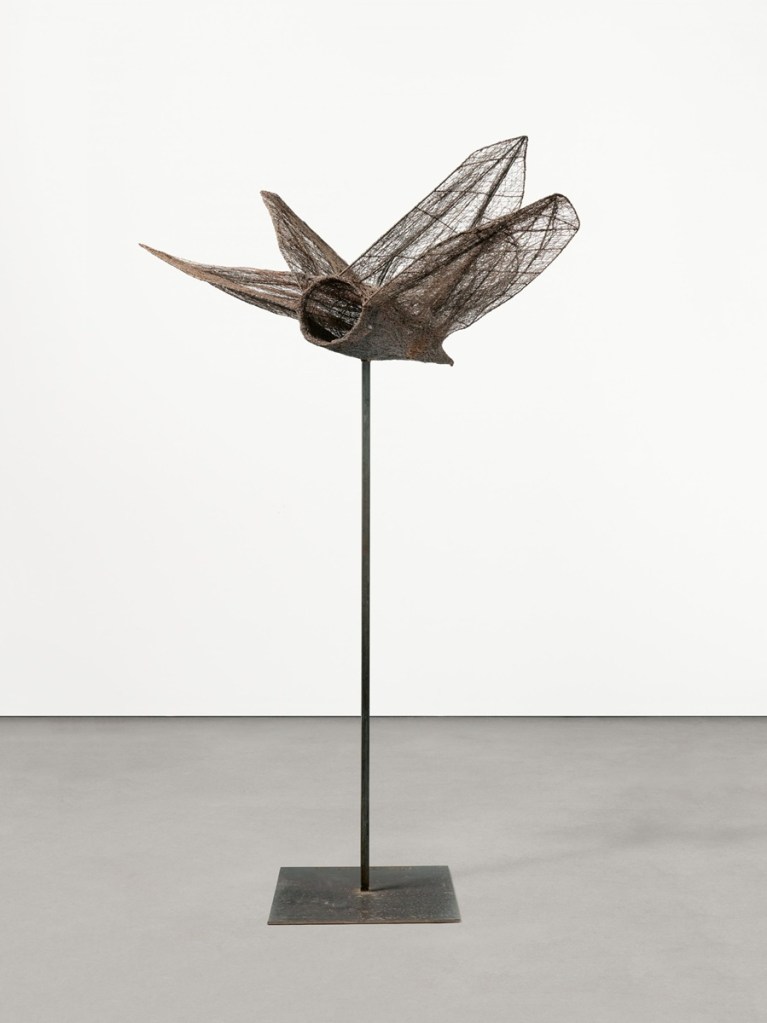
Lot 47. Abakanowicz Magdalena 1930 Falenty/Poland – 2017 Warsaw.”Ptak-Da” (Vogel), 1997. Iron and wire. 275 x 210 x 120cm. Titled, dated and with artist’s signet front on the plinth: PTAK-DA 1997 AM (ligated). Provenance: – West German Art Fair Cologne; – Private collection North Rhine-Westphalia (acquired from the previous owner in 2002). Estimate €70,000 – 100,000. Van Ham. 12/03/25. Sold €75,000
Monumentalny wymiarami Ptak-DA Magdaleny Abakanowicz na aukcji w niemieckiem Van Ham. Bardzo dobry tekst uzupełniający domu aukcyjnego.
The work ‘Ptak-Da’ (Bird), created in 1997, belongs to a phase of her work in which she increasingly uses metal and other hard materials. Iron and wire replace the mesh, but the structure of the weave is retained. With its dimensions of 275 x 210 x 120cm, the work automatically assumes a monumental presence in the room. The bird rises into the room, not as a lifelike representation, but as an abstract suggestion of a winged creature. A gesture of resistance also resonates in this exaggeration: Abakanowicz uses size, scale and material as a means of protest against limitation and standardisation.
The wire and iron construction lends the work an open, breathing structure. The viewer’s gaze penetrates and becomes entangled in the lines, which overlap and intertwine. The wire is reminiscent of the hatching of a drawing, of the process of designing and searching, as if the artist had translated the fleeting moment of a sketch into space and metal. This creates a paradoxical tension: the heaviness of the material meets the lightness of movement.
The four wings reinforce the impression of the extraordinary, the unreal. They turn the bird into an ambiguous, almost mystical creature. The motif of the headless, which runs through her entire figurative work, appears here in a particularly haunting form. The headlessness denies identity and individuality, opens the view to something general. It deprives the animal of unambiguity, making it a symbol of life, of movement, of the constant attempt to rise up.
Ptak-Da” shows the consistent development of a motif that has accompanied Abakanowicz for decades. Probably the best-known realisation of the bird is located on Kilbourn Avenue in Milwaukee, Wisconsin, USA. In ‘Birds of Knowledge of Good and Evil’ from 2001, six headless aluminium birds soar into the sky on poles four to six metres high, making a decisive contribution to the cityscape. (Fig. 1) Three decapitated birds also watch over the city on the banks of the Oder in Warsaw. Due to its positioning in public space, the headless bird has become one of Abakanowicz’s best-known motifs.
For Abakanowicz, art is always an experience; she describes her art as “like a diary of my life, with all its disappointments and longings. By working with it, I integrate myself into the entire cycle of existence. Creativity is not a profession, but a way of existing.” (Magdalena Abakanowicz quoted from Park, Betty: Magdalena Abakanowicz Speaks: The Renowned Polish Artist Discusses her Work and Life, in: Fiberarts, No. 9, March/April 1983, p. 11). Sophie Ballermann
 Polish Art Corner