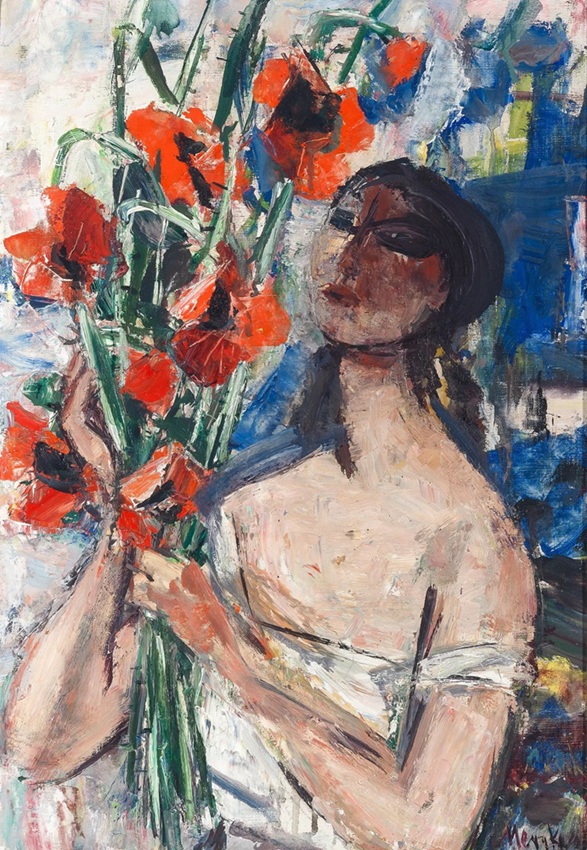
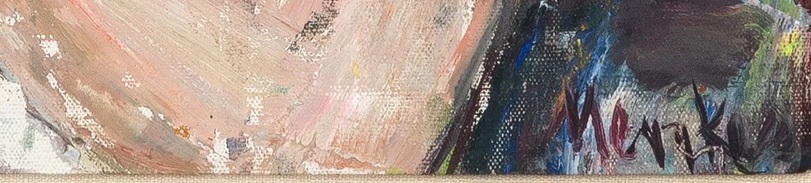
Lot 161. Sigmund (Zigmunt) Joseph Menkes Polish/American, 1896-1986. Woman with Flowers. Signed Menkes (lr). Oil on canvas partially laid to panel, 21 1/2 x 15 inches (54.6 x 38.1 cm). Estimate $7,000 – 10,000. Doyle. 11/20/25. Sold $10,000
Ładna lecz w sumie szablonowa i w dodatku mała wymiarami praca Zygmunta Menkesa. Wycena dość wysoka jak ten olej ale w USA jest spora grupa osób zainteresowanych pracami tego artysty. Przypuszczam, że olej ten pozostanie w USA.
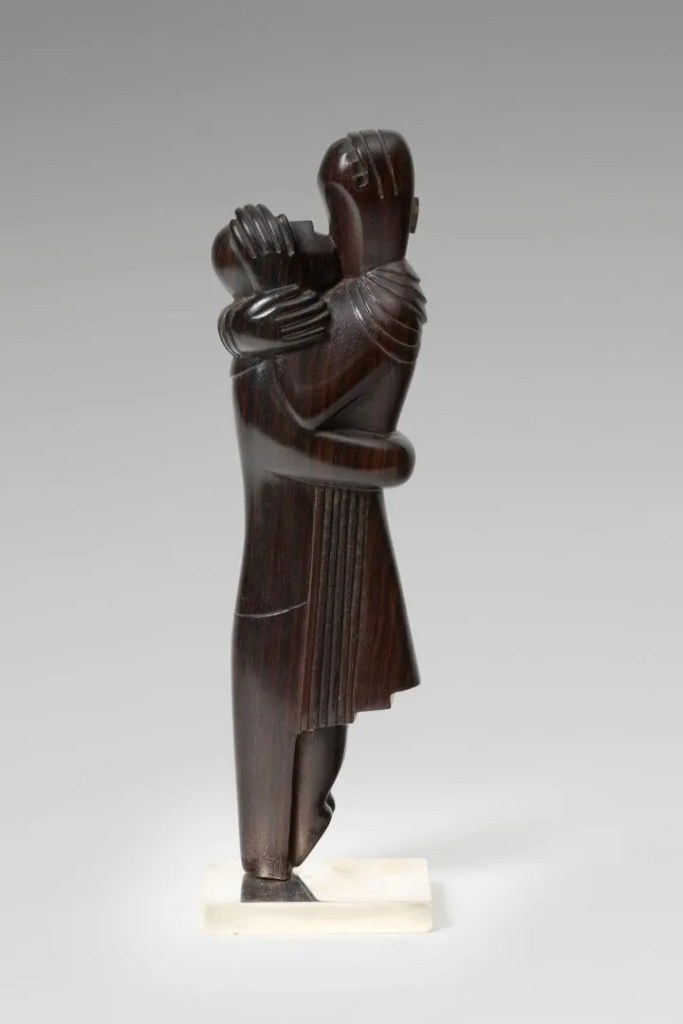
Lot 261. ean LAMBERT-RUCKI (1888-1967). “Couple“. Direct-cut ebony sculpture. Unique piece. Quadrangular base in silver-plated bronze. Unsigned. Height: 23 cm (subject alone) History: a certificate from Mrs. Mara Rucki dated November 19, 1981 will be given to the buyer. Provenance: Galerie Félix Marcilhac, Paris. Acquired from Galerie Félix Marcilhac on June 18, 1981, and has remained in the same family ever since. Bibliography: Sammlung Bröhan, Lambert Rucki, Berlin, sd, a variant in gilded bronze is reproduced on the back cover. Estimate €40,000 – 60,000. May et Associes. 11/29/25
Jean Lambert-Rucki. Couple
Oddam głos czytelnikowi, który napisał do mnie list w sprawie tej rzeźby:
Dzień Dobry, jeśli chodzi o twórczość Jean Lambert-Ruckiego, to prawdziwą sensacją kolekcjonerską jest zupełnie inna praca, czyli słynny Pocałunek (Paweł i Nina) z 1929 w mahoniu. nane są odlewy Valsuani w brązie (oraz ze złotą patyną), ale oryginał mahoniowy znany był do tej pory tylko ze zdjęcia, publikowanego np. w książce Artura Winiarskiego, “Jean Lambert Rucki”, wyd. Villa La Fleur, str. 109. Choć na czarno białym zdjęciu w tej publikacji podstawa wygląda na machoniową, a w katalogu jest opisana jako brąz posrebrzany, to fakt opisu przez certyfikowanego eksperta sztuki, panią Amelie Marcilhac (https://www.marcilhacexpert.com/cabinet.html), przemawia na korzyść autentyczności dzieła. Miejmy nadzieję, że rzeżba trafi do kolekcji Marka Roeflera, co dałoby nam możność oglądania jej w Konstancinie. Pozdrowienia, Kolekcjoner.
Wątpliwości innego czytelnika:
Dzień dobry. Sporo rzeczy mi nie pasuje w oferowanej pracy.
Certyfikat a materiał rzeźby. Na certyfikacie mowa jest o statuetce „z hebanu, odlanej z posrebrzanego brązu”, podczas gdy w opisie aukcyjnym obiekt określony jest jako rzeźba w oryginalnym hebanie. Budzi to wątpliwość, czy certyfikat na pewno dotyczy dokładnie tej oferowanej pracy. “Ja, niżej podpisana Mara Rucki, poświadczam, że ta statuetka (widoczna na fotografii) jest rzeczywiście dziełem mojego ojca, Lamberta Ruckiego. Jest z hebanu, odlana z posrebrzanego brązu. Sporządzono w Paryżu, dnia 19.11.81. Mara Rucki”
Publikacja Villa La Fleur, Comité Jean Lambert-Rucki, Galerie Michel Giraud. W książce poświęconej Jean Lambert-Rucki (Villa La Fleur) znalazłem reprodukcję tej pracy. Wspomniany jest tam Comité Jean Lambert-Rucki, a zdjęcie przypisane jest Galerie Michel Giraud. Instytucje te nie pojawiają się jednak w opisie proweniencji w katalogu aukcyjnym, co rodzi pytanie o pełne i dokładne powiązanie tej rzeźby z wymienionymi podmiotami.
Odkształcenie / „odstająca część” z tyłu głowy. Na zdjęciach aukcyjnych widoczny jest element „odstający” z tyłu głowy kobiety. Na fotografii w cytowanej książce taki element nie występuje.
Różnice w podstawie rzeźby. Na zdjęciu z książki podstawa wydaje się ciemniejsza, bardziej chropowata, jakby z innego materiału, i optycznie „zlicowana” z rzeźbą. W aktualnych zdjęciach aukcyjnych podstawa wygląda na jaśniejszą, gładszą i mniej zintegrowaną z figurą. Może to świadczyć o wymianie, modyfikacji lub restauracji podstawy.
Co Pan o tym sądzi? Pozdrawiam. M. (11/11/25)
Odpowiedź:
Dzień Dobry, bardzo dobrze, że inny czytelnik zwraca uwagę na odręczną notkę/certyfikat – uczuli to osoby zainteresowane, by wyjaśnić sobie ten punkt z domem aukcyjnym, który zazwyczaj w takich przypadkach dostarcza wystarczającą dokumentację z serią bardzo dokładnych zdjęć. I zawsze można dopytać telefonicznie, wiem z doświadczenia. Zwłaszcza jeśli daną ofertę przygotowuje “cabinet”, a nie jest to powszechna praktyka. W opisie użyto fraz: “piece unique”, “direct cut/carving” – co ma wymowę jednoznaczną w języku aukcyjnym. Na zdjęciu widać słoje (nie spotkałem się jeszcze z brązem malowanym w słoje). Ale oczywiście dociekań nigdy za mało, gdy w grę wchodzą pieniądze.
Od siebie mogę dodać, że gdyby okazało się, że to odlew z brązu to estymacja byłaby absurdalna. Brązy pocałunku osiągały ostatnio ceny netto 5tyś euro za brąz w Arcturial, czy 7 tyś. dla brązu patynowanego złotem u Remy le Fur, z tego co pamiętam. Estymacja 40-60K jest i tak bardzo wysoka jak na 23 centymetrowy oryginał z hebanu i nie ma pewności, że cena młotka dojdzie do jej dolnego poziomu. Jednak to wszystko rozważania, a fakty leżą na stole w domu aukcyjnym i ten kto się skontaktuje będzie miał jasność:).
Pozdrawiam Pana oraz autora komentarza, Kolekcjoner (11/12/25)
Lot 1180. 4328205. ANNA GÜNTNER (POLAND 1933-2013). “Dialog”. Oil on canvas, 100 x 65 cm, including frame 68 x 103 cm. Signed Anna Güntner on the reverse. Executed in 1965. PROVENANCE: Sveagalleriet, Stockholm, acquired in the late 1960s. Gunilla Laurell, Stockholm. Thence by descent. EXHIBITED: Biuro Wystaw Artystycznych, Krakow. Sveagalleriet, Stockholm, 20 April – 7 May 1967, listed under the title “Samtal”, owner Anna Güntner, cat. no. 5. Estimate 27 232 – 36 310 EUR. Stockholms Auttionsverk. 11/20/25. Sold SEK 900,000 (€81,887)
Two figures – a man and a woman – stand still in a quiet encounter, separated and yet connected by climbing vines that twist their way upward through the pictorial space. The man’s gaze is are directed toward the viewer but the woman seems immersed in an inner state – a kind of silent communication, where words appear to have given way to something deeper. In the background, a dreamlike yet structured landscape unfolds, populated by mute trees and rolling hills, painted in a restrained palette that enhances the work’s meditative tone.
Anna Güntner’s “Dialog” is a work that does not shout for attention – it whispers, and in that whisper lies the complexity of life itself. Güntner was part of a group of Polish artists who, during the 1960s, broke away from the dominant trends of abstraction in favor of a more symbolic, figurative, and simultaneously enigmatic visual language. Her works often reflect the clarity of Surrealism, yet with a distinctive, restrained sensitivity.
Born in Poznań in 1933, she was trained at the Academy of Fine Arts in Kraków, where she absorbed both classical techniques and modernist influences. During the 1960s and 70s, she exhibited frequently internationally, and in recent years, her art has enjoyed a well-deserved resurgence among collectors.
“Dialog” is a brilliant example of Güntner’s artistic vision, whose works exude a sense of timelessness – an aesthetic in which the dreamlike and the precise coexist. Here, two people meet, but perhaps it is also an image of an internal dialogue – between past and present, between stillness and movement, between outer life and the undercurrents beneath the surface. A work that lingers – not only as an image, but as a presence.
Dwa oleje Anny Güntner w odstępie jednego dnia. Prace artystki znajdują coraz większe zainteresowanie w Polsce a ich stosunkowo niewiele namalowała. Domom aukcyjnym bardzo podoba się to zainteresowanie.
Anna Güntner. Untitled (Couple Embracing), 1974
Lot 604. Anna Güntner 1933 – 2013. Untitled (Couple Embracing), signed Anna Güntner and dated 1974 (on the reverse), oil on canvas, 32 by 49 in. 81.3 by 124 cm. Executed in 1974. We are grateful to Janina Czarnecka and Dominika Czarnecka from Galeria Artemis for their help in researching and cataloguing this work. Provenance: DESA Foreign Trade Company, Warsaw Private Collection, Toronto (acquired from the above circa 1978). Acquired by descent from the above by the present owner. Exhibited: Cat., Kraków, Nowa Huta Cultural Centre and Galeria Artemis, Anna Güntner, Painting, 2022, p. 152, illustrated in color. Estimate $40,000 – 60,000. Sotheby’s. 11/21/25. Sold $140,000 ($177,800 bp)
In Untitled (Couple Embracing), Güntner draws upon the compositional order and fineness of detail of the Northern Renaissance, recalling in particular Hieronymus Bosch’s monumentally-scaled triptych on temptation, The Garden of Earthly Delights. Like Bosch’s vision of Adam and Eve before the Fall, Güntner’s pair inhabits a lush landscape charged with psychological undercurrents. Yet her approach is unmistakably modern: the dreamlike incongruities suggest an awareness of Surrealism, particularly the lucid enigmas of René Magritte. The man with his back turned is particularly redolent of one of Magritte’s most famous motifs of the anonymous suited man, exemplified in works such as The Son of Man. Thus, the present painting’s measured stillness and subtle estrangement places it within a lineage of European art united by themes of allegory, dream, and intellect.


 Polish Art Corner