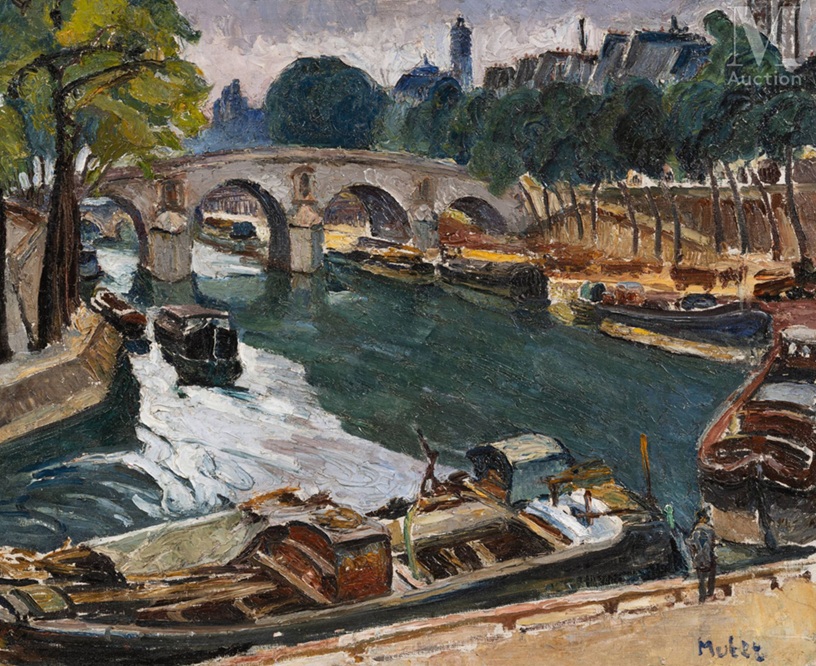
Lot 33. Mela MUTER (Warsaw 1876 – Paris 1967). Barge on the banks of the Seine. Circa 1930. Oil on canvas 60 x 73 cm. Signed lower right “Muter”. Estimate €40,000 – 60,000. Millon. 10/28/25. Sold €39,000

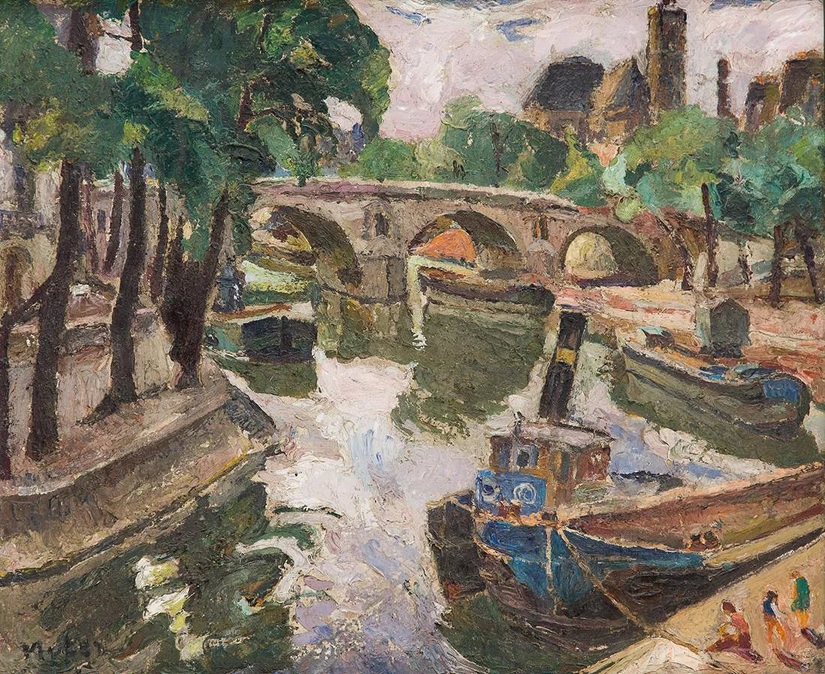
Millon i jego eksperci dołączyli do tego obrazu opis biograficzy Meli Muter napisany przez innych, który pominąłem. Takie przepisywanie opisów z książek niewiele dodają wartości do sprzedawanej pracy. Jestem przekonany, że osoba, która rozważa wydanie €40,000 – 60,000 zna biografię artystki i potrafi umiejscowić ten obraz w jej twórczości. Czego brakuje w opisie? Oczywiście informacji o proweniencji. Wygląda jakby obraz został właśnie po raz pierwszy odkryty na rynku. Tak oczywiście nie jest i Millon pominął fakt sprzedaży tej pracy 19 listopada 2021 roku pod tytułem “Paris, la Seine au Pont-Marie, ca. 1930″, czyli stosunkowo niedawno. Spora niedbałość domu aukcyjnego i niepotrzebnie firma ukrywa falt tej sprzedaży. Można było oczywiście dodać informację o bardzo podobnej pracy Meli Muter sprzedanej w 2020 roku przez Desę-Unicum (fot poniżej) i jakoś odnieść się do niej. W sumie odnoszę wrażenie dużej nonszalancji ekspertów Millon mogącej sprawiać wrażenie pogardy w stosunku do klientów od których firma oczekuje, że sami wykonają za nich pracę.
Dla kontrasu przedstawiam obraz Meli Muter z nadchodzącej aukcji w Bonhams pt. Le sculpteur François Pompon dans son atelier. Opis (praca chyba nie jest sygnowana) zawiera znakomity esej o przedmiocie obrazu przedstawiającego znanego rzeźbiarza zajętego pracą w swojej pracowni.
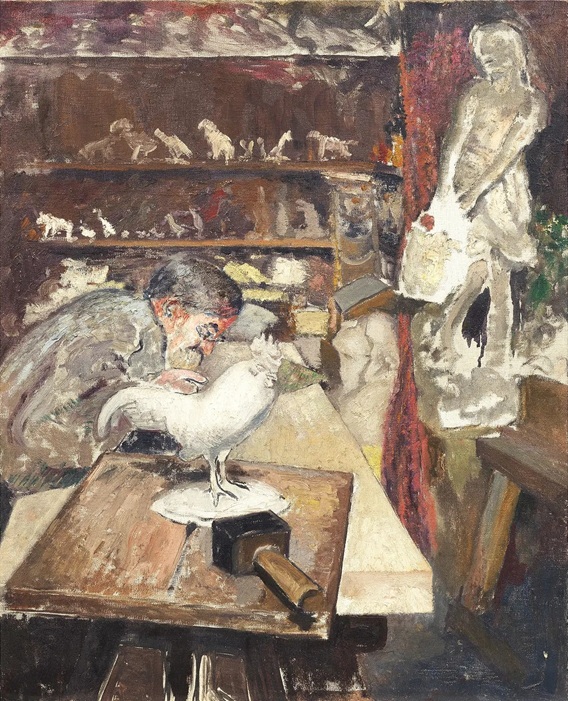
Lot 2. MELA MUTER (1876-1967). Le sculpteur François Pompon dans son atelier, oil on canvas, 81 x 64.8cm (31 7/8 x 25 1/2in). Painted circa 1925. The authenticity of this work has been confirmed by Urszula Lazowski. Provenance: Gérald Schurr Collection, Paris. Leicester Galleries (Peter Nahum), London. Private collection, UK. Private collection, UK (by descent from the above). Exhibited: Neuilly-sur-Seine, Centre Culturel Arturo Lopez, Portraits et autoportraits de la Collection Gérald Schurr, 16 April – 5 May 1986, no. 58. Literature: G. Schurr, Les petits maîtres de la peinture de valeur de demain, Vol. V, Paris, 1981 (illustrated p. 28).
Estimate £70,000 – £100,000. Bonhams. Passed
Le sculpteur François Pompon dans son atelier is a painting that masterfully blends visual realism and psychological depth. Painted from a viewpoint just inside the threshold of the sculptor’s studio, the composition evokes the sense of having quietly entered the space, catching the artist absorbed in his work. Pompon sits at a modest table, his posture hunched in concentration, his hands obscured by a tall stool placed between him and the viewer. Atop the stool rests a pristine white sculpture of a cockerel (Coq, 1914), one of Pompon’s signature animal forms. Rendered with remarkable fidelity, it mirrors the polished, essentialist aesthetic for which he became known – to show the animal in its truest and most undeniable essence. A hammer lies casually beside the sculpture, implying that the piece is still in progress, yet the artist’s focus has shifted, suggesting a moment of contemplation or perhaps a natural pause in the rhythm of his day.
The painting is saturated with tactile details that give it a documentary quality, yet Muter’s loose, confident brushwork imbues the scene with a painterly vitality. The use of an earthy palette, with ochres, browns, deep reds and soft whites, captures the warm, lived-in atmosphere of the atelier. In this painting, as in several of Muter’s works, the use of bold black contours defines forms with clarity and emotional intensity – a technique likely inspired by the noted polish painter Władysław Ślewiński. Lining the wall behind Pompon are semi-abstracted sculptures, their smooth, rounded forms hinting at animal figures. Though their features are indistinct, they echo the recurring themes in Pompon’s career: the distillation of the animal form into something rhythmically pure and timeless. These forms are not incidental. They represent decades of observation and refinement, whether from the farmyards of his native Normandy or from exotic creatures studied at the Jardin des Plantes in Paris, where he famously set up a portable studio to model animals from life.
To the right, two figurative sculptures subtly broaden the range of Pompon’s artistic practice. A large figure of a girl with a basket (Cosette, 1888) and a Neoclassical bust serve as reminders that Pompon had mastered the human form before gaining recognition for his animal sculptures. Trained under the animalier Pierre Louis Rouillard and having worked in the studio of Auguste Rodin, who once predicted Pompon would become ‘a great artist’, Pompon’s grounding in traditional sculpture was robust (P. Kjellberg, Les bronzes du XIXe siècle, Paris, 2005, p. 583). Yet, it was only after 1905 that he devoted himself exclusively to animals, reducing their forms, smoothing away detail, and searching for ‘the essential’, as he self-described his method.
The present work was formerly part of the collection of Gérald Schurr, a French art critic and passionate collector with a unique focus on portraits of painters and writers, whether self-portraits or depictions by fellow artists such as Maurice Vlaminck, Pablo Picasso, and Paul Cézanne. François Pompon is thereby placed within this pantheon, one that truly celebrates his talent and enduring art historical significance. Schurr’s collection grew to around 700 works, reflecting his unwavering dedication and profound fascination with the faces, emotions, and enigmatic presence of each artist. He firmly believed that these portraits served as a bridge between the artist and their work, revealing deeper truths about their identity. Schurr explores this idea in Portraits et Autoportraits, a text published to accompany an exhibition of the same name held at in Neuilly-sur-Seine in 1986, within which the present work formed a critical touchstone of his artistic philosophy. Alongside works such as Louis Valtat’s portrait of Pierre-Auguste Renoir (circa 1910), Maximilien Luce’s portrait of Georges Seurat (1888), and Jean Cocteau’s portrait of Pablo Picasso (1917), the present work shone in remarkable company, contributing to a vital dialogue between artists.
In Le sculpteur François Pompon dans son atelier, Mela Muter brings the hallmarks of her mature style to bear: psychological insight, expressive brushwork, and a profound sensitivity to her subject’s inner world. Just as she approached her portraits of political thinkers and anonymous exiles with unflinching emotional honesty, here she captures the quiet dignity of an artist whose life was devoted to form, restraint, and essence. This painting is not merely a depiction of a studio – it is a meditation on artistic integrity and solitude, rendered by an artist who herself navigated the complexities of identity, displacement, and belonging. The result is a rare double portrait: of the sculptor and of the very nature of artistic creation. This level of authenticity reveals not only Muter’s keen sensitivity as an observer, but also her embeddedness in the intellectual and artistic circles of the École de Paris. She was an artist who, despite her outsider status, saw and understood her subjects with remarkable clarity. In capturing Pompon within the sanctum of his creative life, Muter affirms her enduring ability to translate the invisible – concentration, humility, and genius – into powerful visual form.
Please note that this work has been requested for the landmark François Pompon retrospective at the Château de Frontenay in the summer of 2026, currently being prepared by Côme Remy and Liliane Colas from the Association François Pompon, authors of the François Pompon catalogue raisonné. This work will be reproduced in the exhibition catalogue and would be featured alongside Pompon’s seminal works in the exhibition, including Coq (1914), which appears in the foreground of this portrait.
 Polish Art Corner