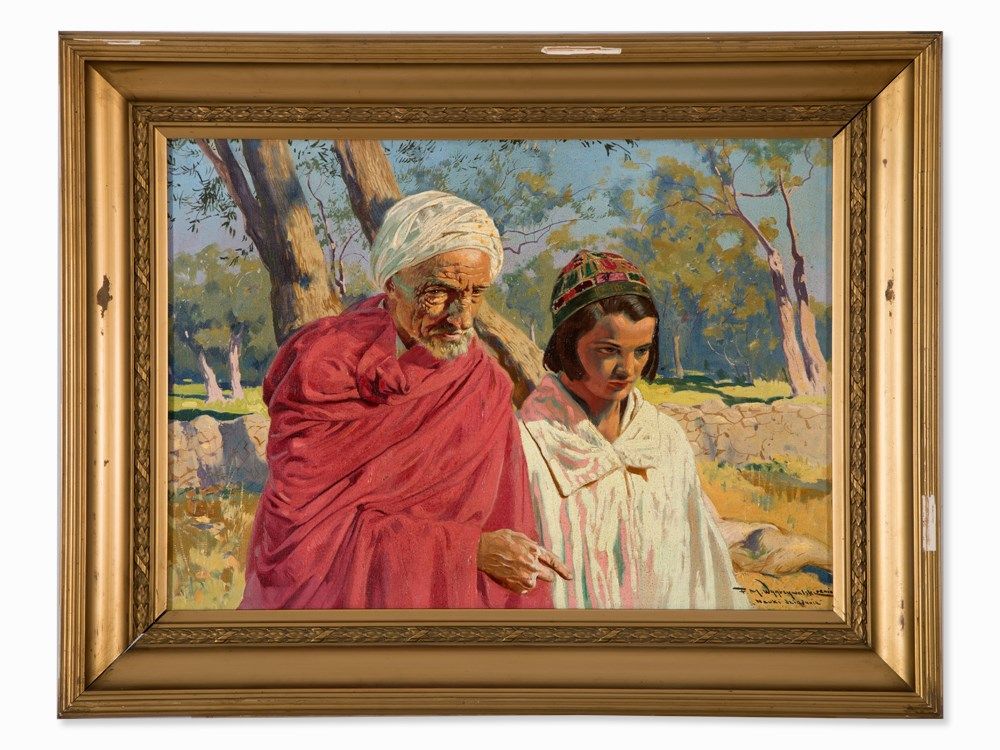
‘Nauki dziadunia’ lub można inaczej nazwać tę pracę. Wydaje mi sie, że zabranie się Wygrzywalskiego do oddania pędzlem bardziej klasycznego tematu, podejmowanego w różny sposób również przez innych artystów (Starość i młodość), wyszło na dobre artyście jeśli porównamy do tematyki klęczacych i modlących się Arabów. W tym przypadku pal licho te arabskie stroje ale ważna jest głębsza myśl o przemijaniu pokoleń. Uważam, że jest to udana praca Wygrzywalskiego, warta kupienia. Trzeba jednak potargować się by nie przepłacić.
===================================
Lot 151. Feliks M. Wygrzywalski, Painting, ‘Nauki Dziadunia’, 20th C. Oil on canvas Poland, early 20th century. Feliks Michal Wygrzywalski (1875-1944) – Polish painter Signed lower right ‘F. M. Wygrzywalski senior’ and titled ‘Nauki Dziadunia’. Dimensions: 54 x 75.5 cm. Good condition Provenance: Private collection, Berlin. Typical Oriental motif of the Polish painter, bathe in an atmospheric light; Wygrzywalski‘s paintings fetch up to €13,000 at international auctions. Estimate 6,400 – 8,000 €. Auctionata. 12/3/14.
This painting by Feliks Michal Wygrzywalski depicts an old man in a red gown next to a young boy in a sunlit landscape. Deep wrinkles crisscross the wise face of the grandfather, who is instructing his grandson. Wygrzywalski followed the academic manner painting of the early 20th century. Nevertheless, the present work shows slight impressionist touches, for example in the loosely painted background or the color of the shadows. From 1906 to 1908, the Polish artist lived in Egypt, where he created numerous oriental motifs of this kind.
The painting is signed lower right ‘F. M. Wygrzywalski senior’ and titled ‘Nauki Dziadunia’. It is in very good condition consistent with age. The frame shows some losses. The image measures 54 x 75.5 cm. The framed work measures 74 x 96 cm.
Feliks Michal Wygrzywalski studied at the Academy of Fine Arts in Munich and at the Académie Julian in Paris. From 1900 he lived in Rome where he copied the works of Italian masters such as Caravaggio, Raphael and Titian. In addition, he also created landscapes and nudes. In 1906 he moved to Egypt; here Wygrzywalski created paintings with oriental subject matter, mainly harem scenes. Two years later he moved to Lviv, where he worked as a set designer. After the First World War, the Polish artist enjoyed increasing success with numerous exhibitions.
 Polish Art Corner